Part VI, section 23

User authorisation

Features and outlook of regulation on Russian websites, apps and systems

  • 16 slides
  • 4 subsections
  • Edition of 25 October 2026

23.1

Regulation of authorisation

AVT-001

Regulation of authorisation

The duty to authorise Russian users by one of the permitted methods
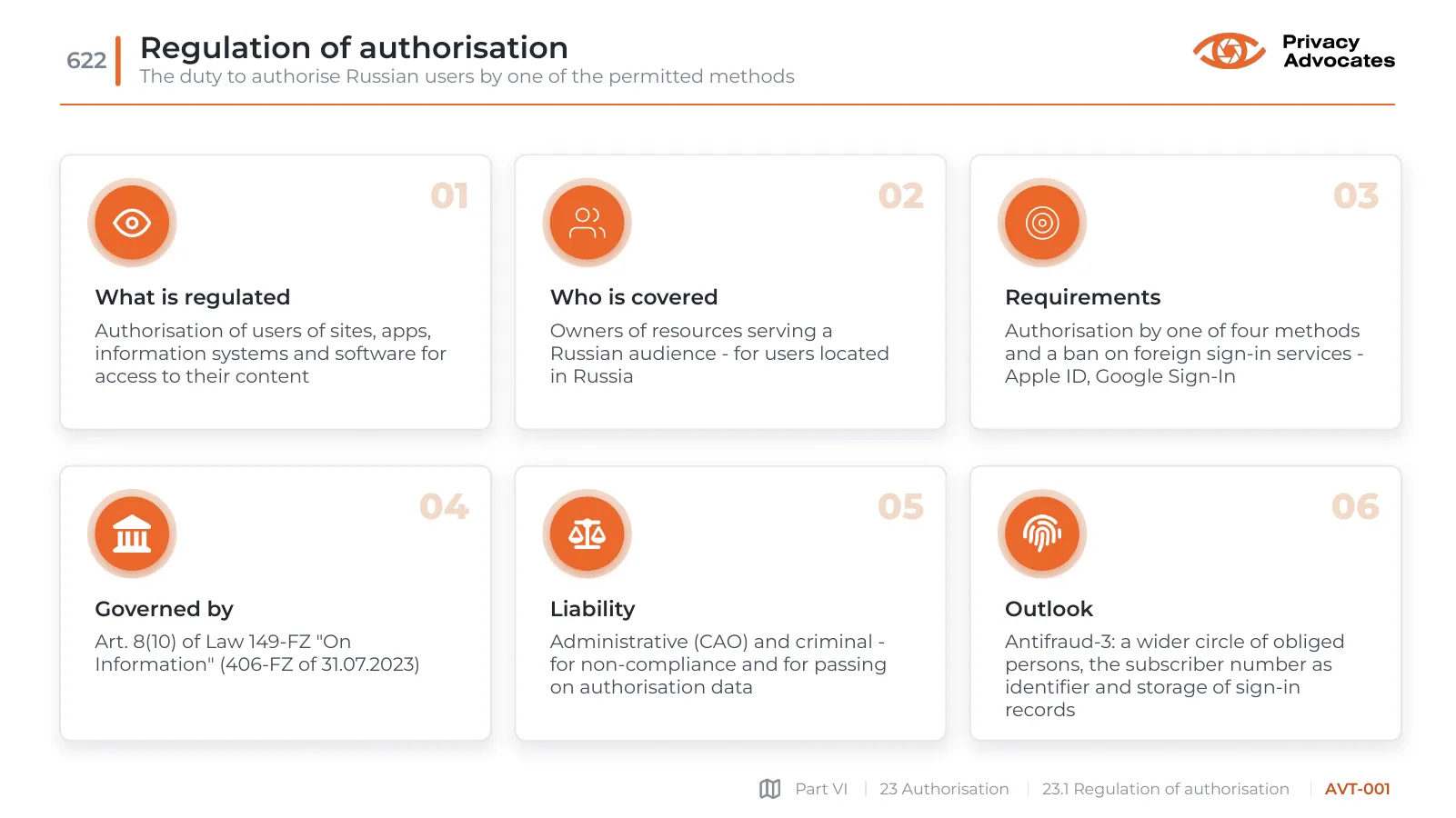
Slide AVT-001: Regulation of authorisation
Slide text

01

What is regulated

Authorisation of users of sites, apps, information systems and software for access to their content

02

Who is covered

Owners of resources serving a Russian audience - for users located in Russia

03

Requirements

Authorisation by one of four methods and a ban on foreign sign-in services - Apple ID, Google Sign-In

04

Governed by

Art. 8(10) of Law 149-FZ "On Information" (406-FZ of 31.07.2023)

05

Liability

Administrative (CAO) and criminal - for non-compliance and for passing on authorisation data

06

Outlook

Antifraud-3: a wider circle of obliged persons, the subscriber number as identifier and storage of sign-in records
AVT-002

Identification, authentication, authorisation

Standard technical concepts and the term's special meaning in Art. 8(10) of Law 149-FZ

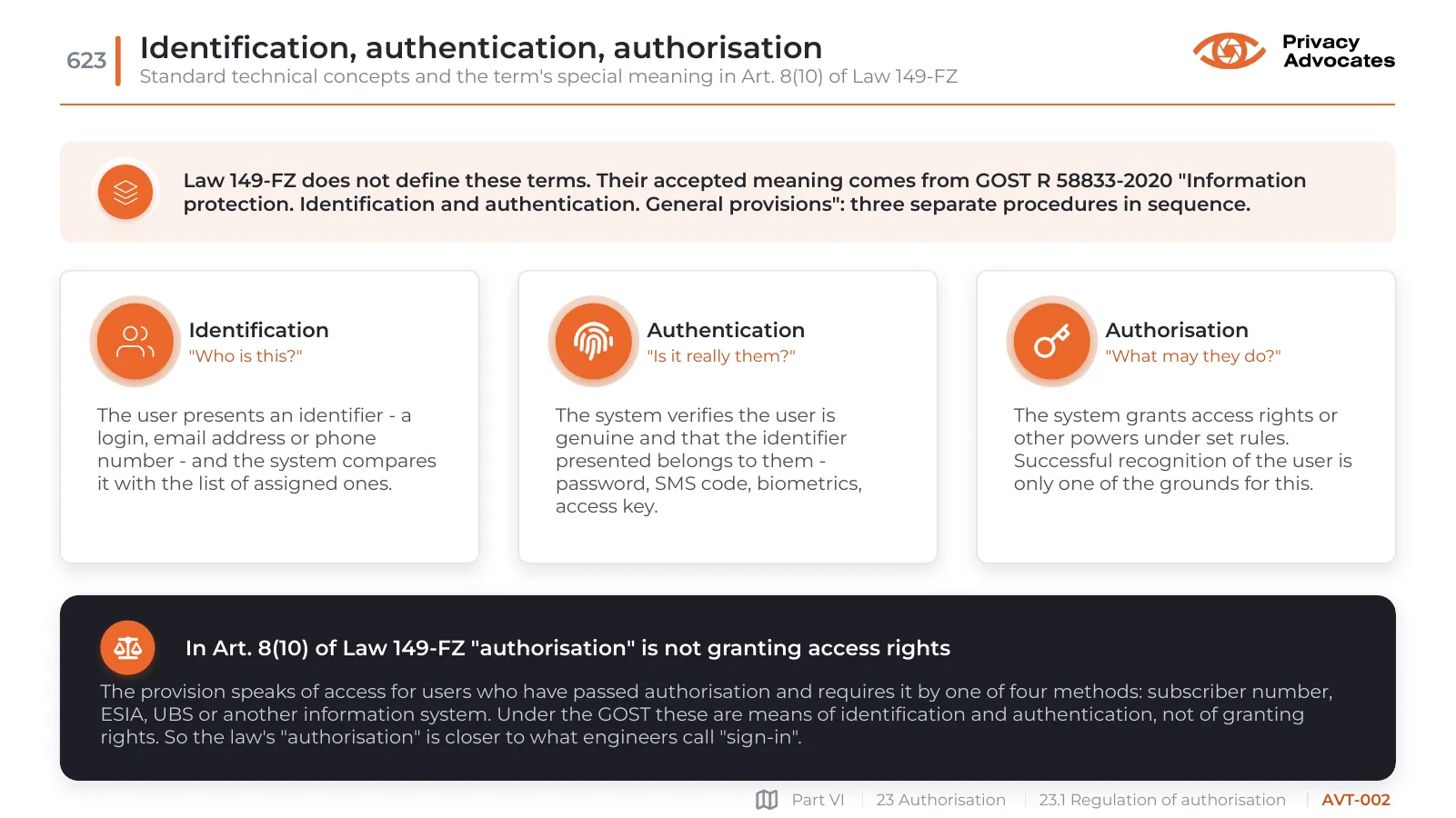
Slide AVT-002: Identification, authentication, authorisation
Slide text

Law 149-FZ does not define these terms. Their accepted meaning comes from GOST R 58833-2020 "Information protection. Identification and authentication. General provisions": three separate procedures in sequence.

Identification

"Who is this?"

The user presents an identifier - a login, email address or phone number - and the system compares it with the list of assigned ones.

Authentication

"Is it really them?"

The system verifies the user is genuine and that the identifier presented belongs to them - password, SMS code, biometrics, access key.

Authorisation

"What may they do?"

The system grants access rights or other powers under set rules. Successful recognition of the user is only one of the grounds for this.

In Art. 8(10) of Law 149-FZ "authorisation" is not granting access rights

The provision speaks of access for users who have passed authorisation and requires it by one of four methods: subscriber number, ESIA, UBS or another information system. Under the GOST these are means of identification and authentication, not of granting rights. So the law's "authorisation" is closer to what engineers call "sign-in".

AVT-003

What is regulated

Authorisation as a condition of access to site information

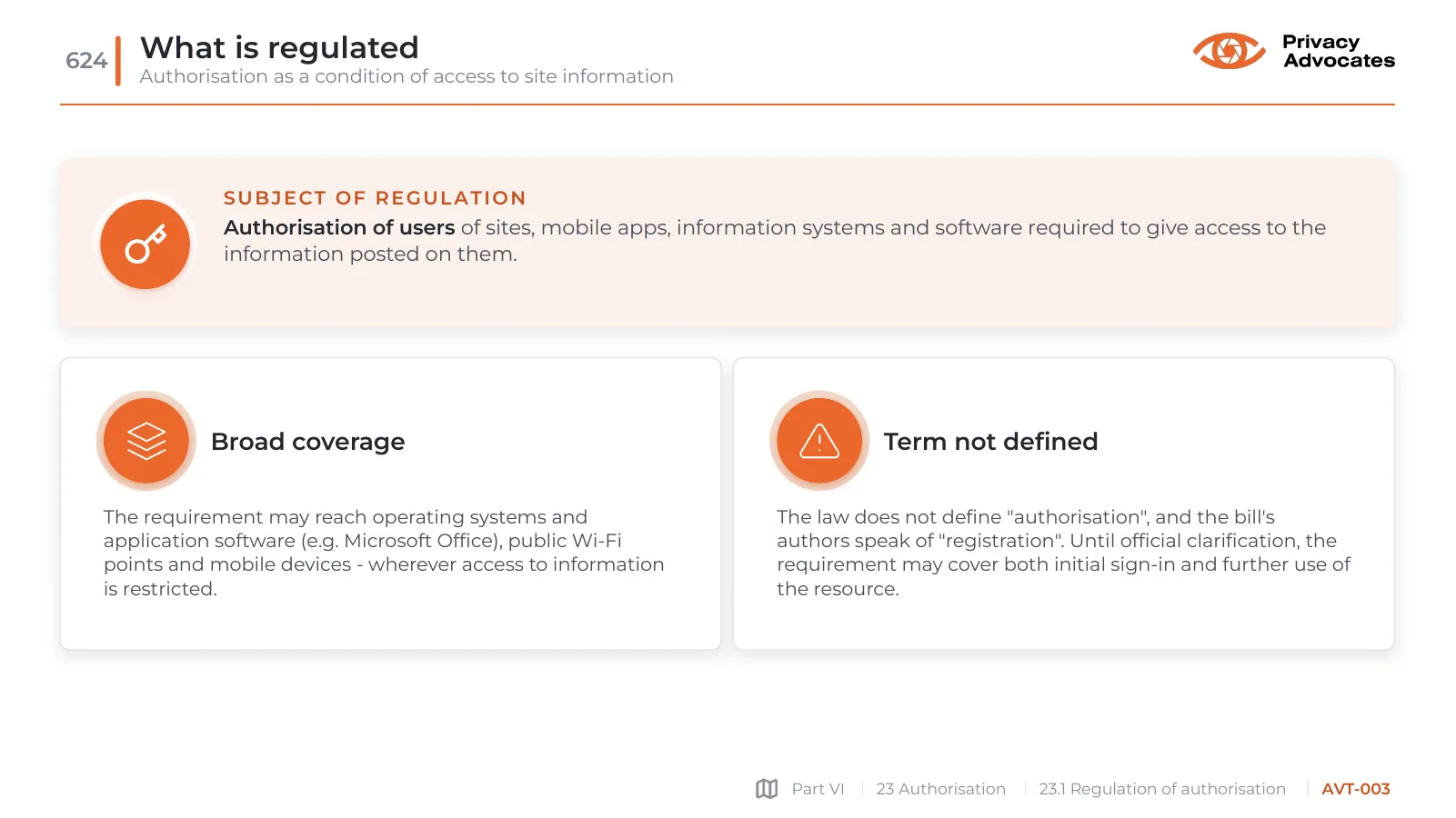
Slide AVT-003: What is regulated
Slide text

SUBJECT OF REGULATION

Authorisation of users of sites, mobile apps, information systems and software required to give access to the information posted on them.

Broad coverage

The requirement may reach operating systems and application software (e.g. Microsoft Office), public Wi-Fi points and mobile devices - wherever access to information is restricted.

Term not defined

The law does not define "authorisation", and the bill's authors speak of "registration". Until official clarification, the requirement may cover both initial sign-in and further use of the resource.

AVT-004

Legal basis and motive

What the requirement is and how its authors explain it

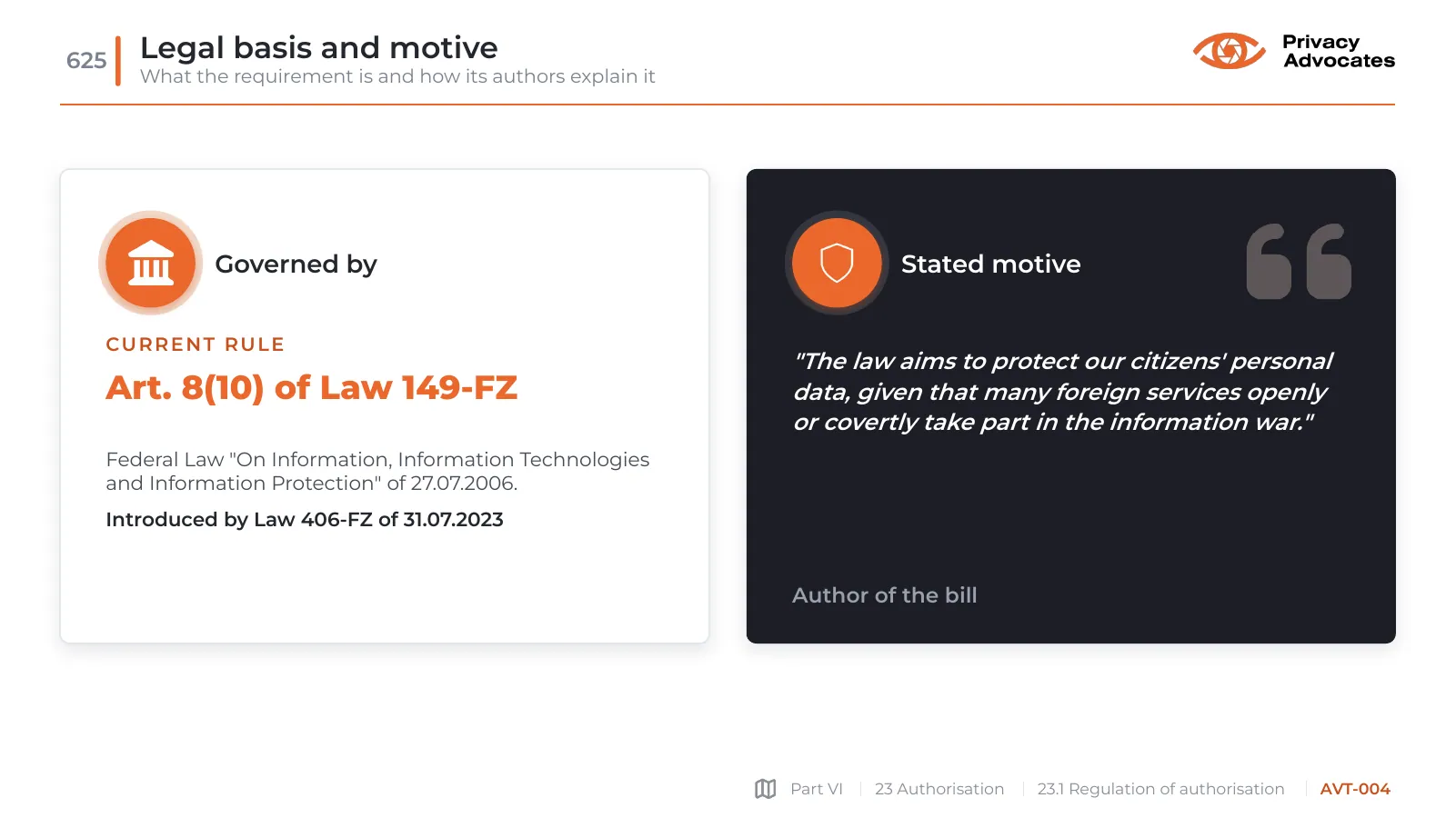
Slide AVT-004: Legal basis and motive
Slide text

Governed by

CURRENT RULE

Art. 8(10) of Law 149-FZ

Federal Law "On Information, Information Technologies and Information Protection" of 27.07.2006.

Introduced by Law 406-FZ of 31.07.2023

Stated motive

"The law aims to protect our citizens' personal data, given that many foreign services openly or covertly take part in the information war."

Author of the bill

AVT-005

Who is covered

Tied to the user's location, not citizenship

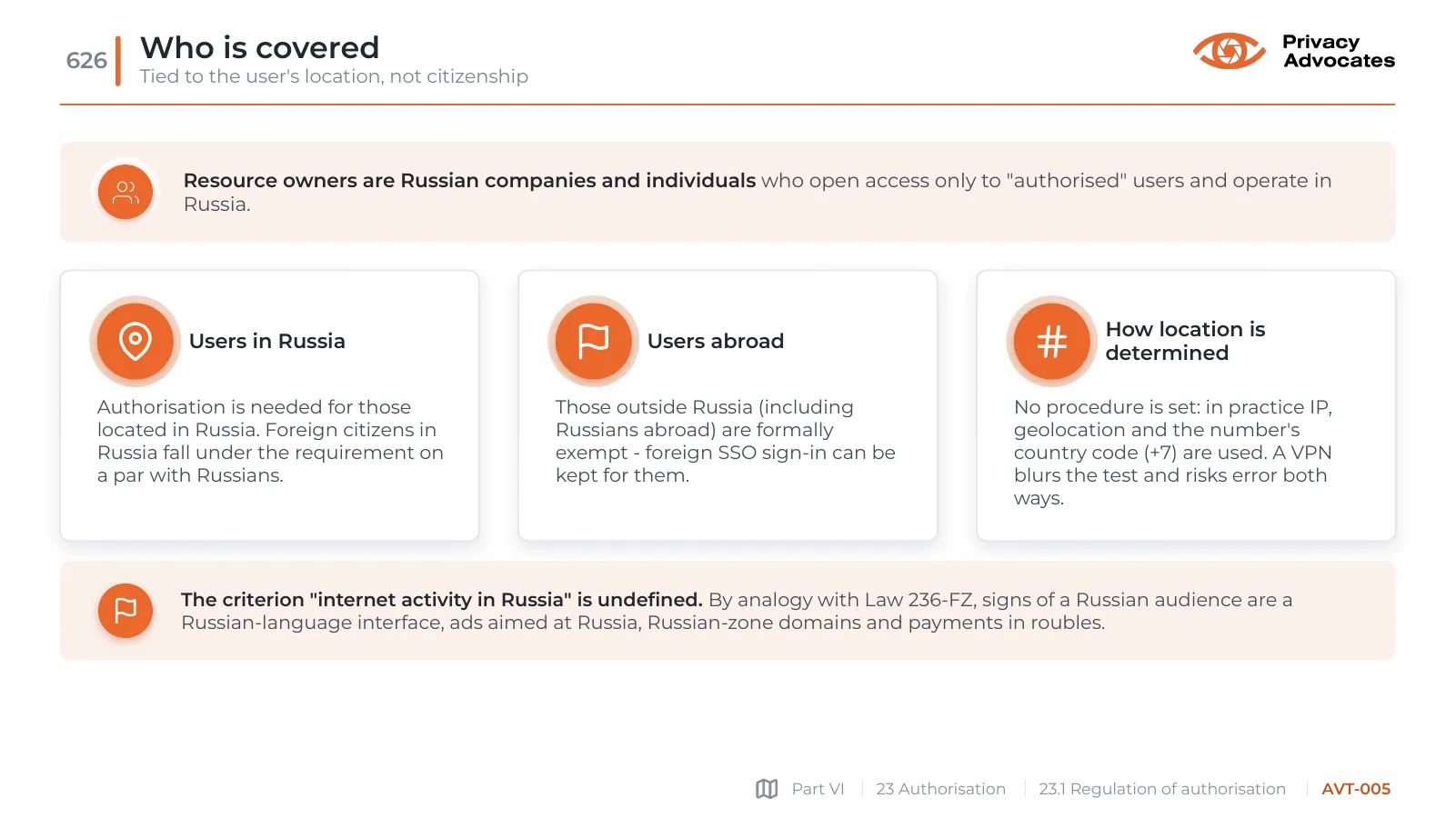
Slide AVT-005: Who is covered
Slide text

Resource owners are Russian companies and individuals who open access only to "authorised" users and operate in Russia.

Users in Russia

Authorisation is needed for those located in Russia. Foreign citizens in Russia fall under the requirement on a par with Russians.

Users abroad

Those outside Russia (including Russians abroad) are formally exempt - foreign SSO sign-in can be kept for them.

How location is determined

No procedure is set: in practice IP, geolocation and the number's country code (+7) are used. A VPN blurs the test and risks error both ways.

The criterion "internet activity in Russia" is undefined. By analogy with Law 236-FZ, signs of a Russian audience are a Russian-language interface, ads aimed at Russia, Russian-zone domains and payments in roubles.

AVT-006

Who is exempt

Exemptions from the requirement and no retroactivity

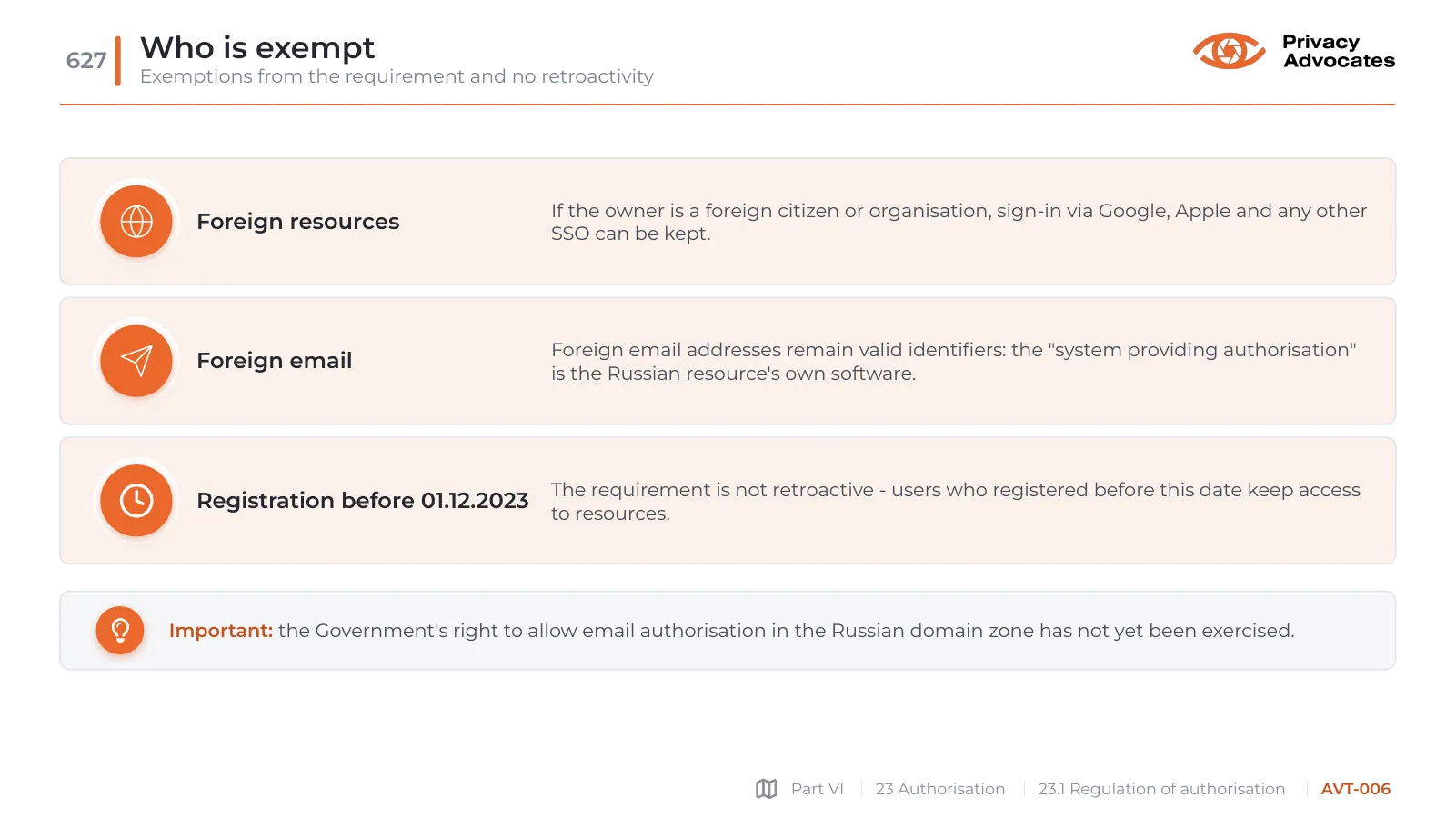
Slide AVT-006: Who is exempt
Slide text
  • Foreign resources
  • If the owner is a foreign citizen or organisation, sign-in via Google, Apple and any other SSO can be kept.
  • Foreign email
  • Foreign email addresses remain valid identifiers: the "system providing authorisation" is the Russian resource's own software.
  • Registration before 01.12.2023
  • The requirement is not retroactive - users who registered before this date keep access to resources.

Important: the Government's right to allow email authorisation in the Russian domain zone has not yet been exercised.

23.2

Requirements and liability

AVT-007

Requirements: authorisation methods

Russian users are authorised by one of four methods

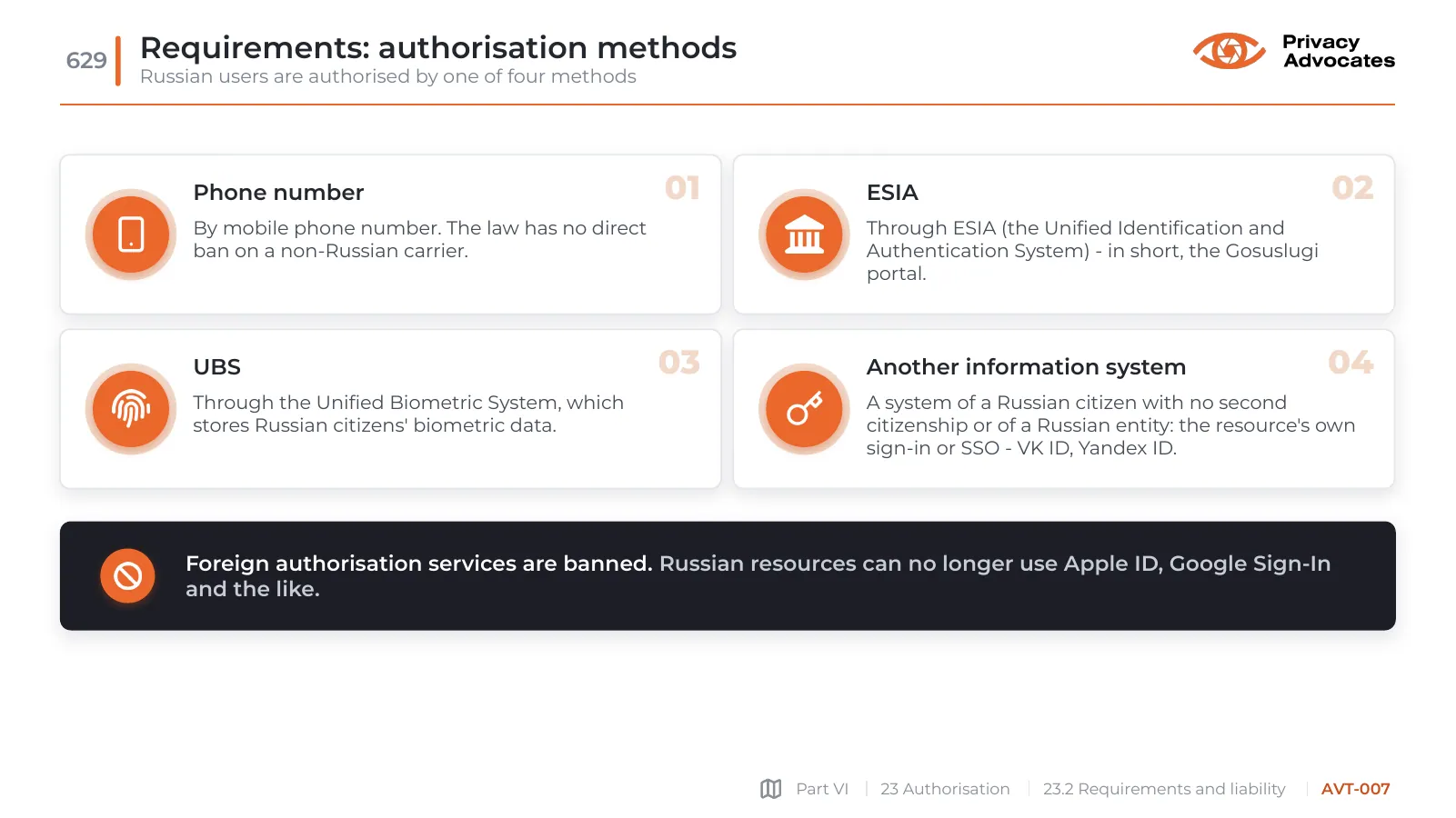
Slide AVT-007: Requirements: authorisation methods
Slide text
  • Phone number
  • 01

By mobile phone number. The law has no direct ban on a non-Russian carrier.

  • ESIA
  • 02

Through ESIA (the Unified Identification and Authentication System) - in short, the Gosuslugi portal.

  • UBS
  • 03

Through the Unified Biometric System, which stores Russian citizens' biometric data.

  • Another information system
  • 04

A system of a Russian citizen with no second citizenship or of a Russian entity: the resource's own sign-in or SSO - VK ID, Yandex ID.

Foreign authorisation services are banned. Russian resources can no longer use Apple ID, Google Sign-In and the like.

AVT-008

Liability

Administrative and criminal sanctions for violations

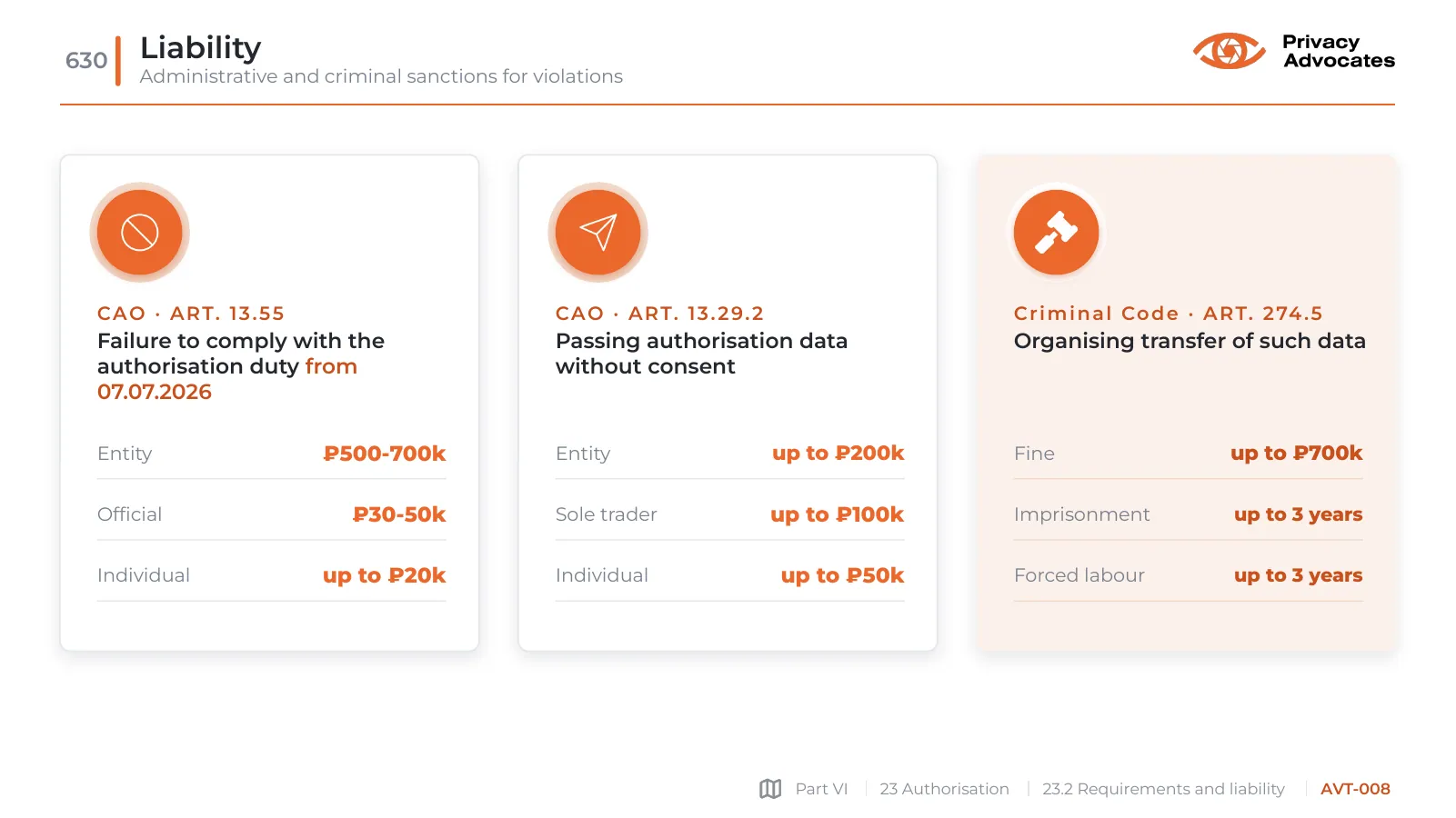
Slide AVT-008: Liability
Slide text

CAO, ART. 13.55

Failure to comply with the authorisation duty from 07.07.2026

  • Entity
  • ₽500-700k
  • Official
  • ₽30-50k

CAO, ART. 13.29.2

Passing authorisation data without consent

  • Entity
  • up to ₽200k
  • Sole trader
  • up to ₽100k
  • Individual
  • up to ₽50k

Criminal Code, ART. 274.5

Organising transfer of such data

  • Fine
  • up to ₽700k
  • Imprisonment
  • up to 3 years
  • Individual
  • up to ₽20k
  • Forced labour
  • up to 3 years

23.3

Practice and questions

AVT-009

Issues and market practice

Open application questions and services' first reaction

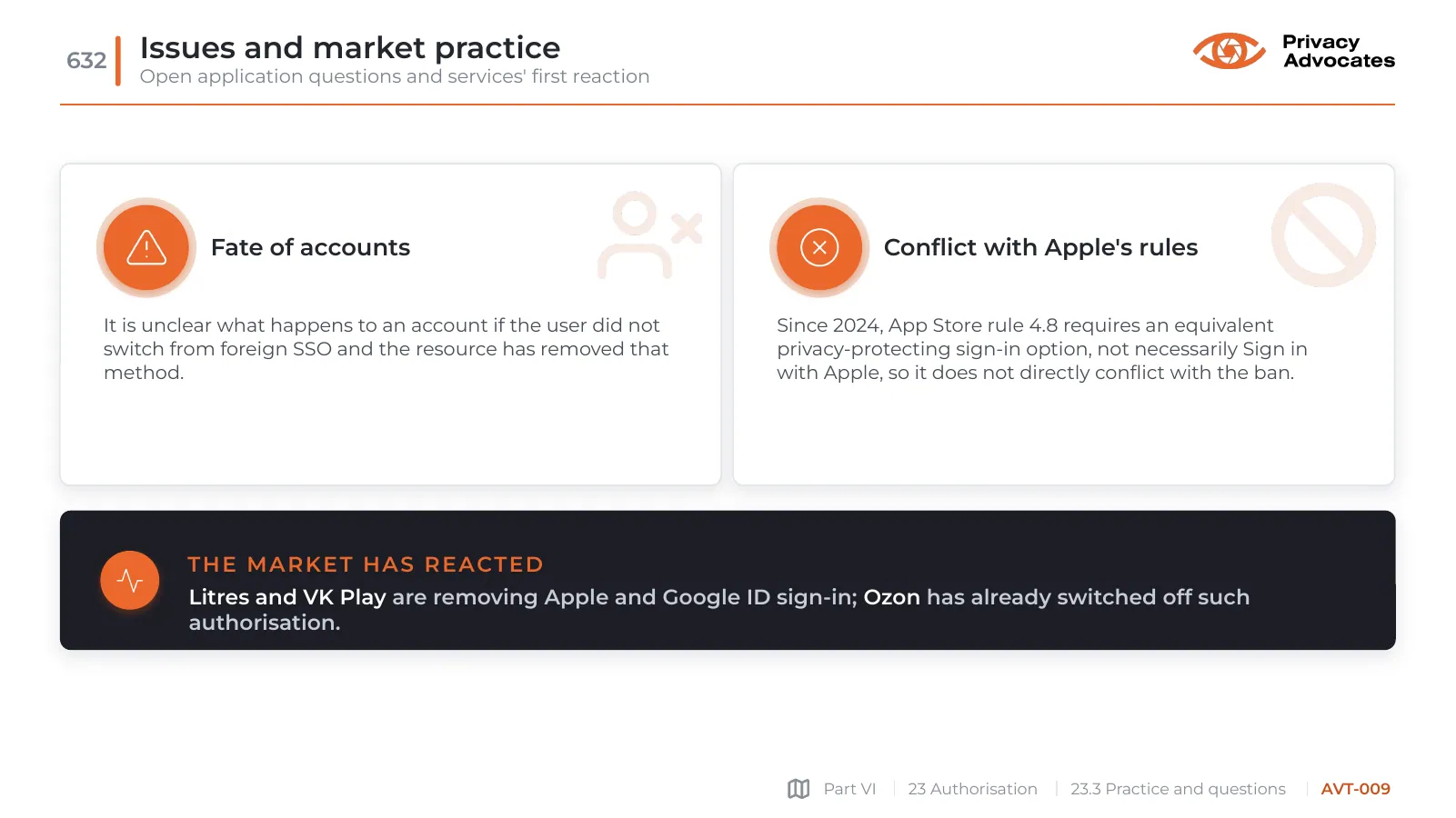
Slide AVT-009: Issues and market practice
Slide text

Fate of accounts

It is unclear what happens to an account if the user did not switch from foreign SSO and the resource has removed that method.

Conflict with Apple's rules

Since 2024, App Store rule 4.8 requires an equivalent privacy-protecting sign-in option, not necessarily Sign in with Apple, so it does not directly conflict with the ban.

THE MARKET HAS REACTED

Litres and VK Play are removing Apple and Google ID sign-in; Ozon has already switched off such authorisation.

AVT-010

Q&A: limits of the ban

What Art. 8(10) of Law 149-FZ covers and who is liable for a breach

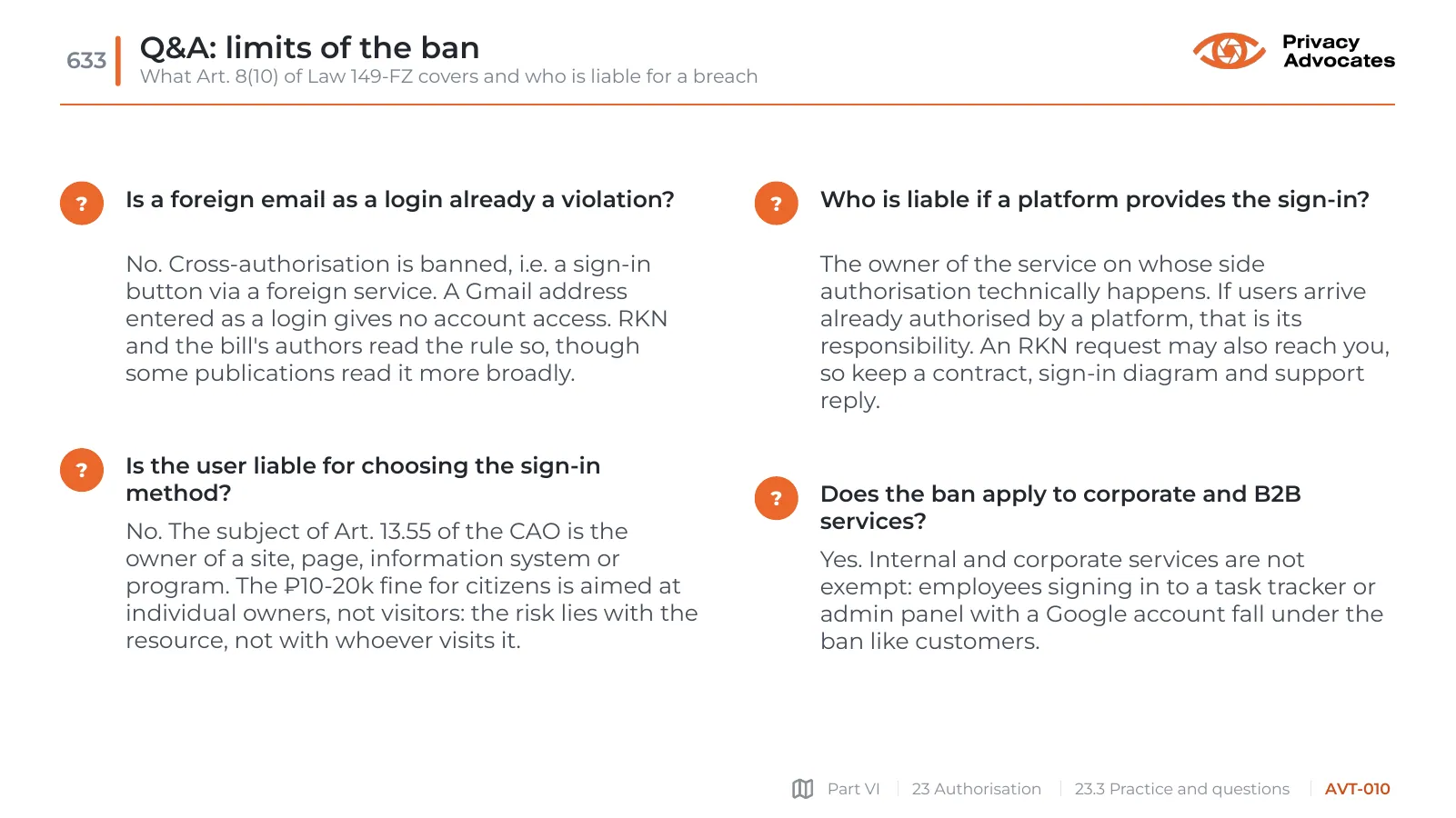
Slide AVT-010: Q&A: limits of the ban
Slide text
  • ?
  • Is a foreign email as a login already a violation?

No. Cross-authorisation is banned, i.e. a sign-in button via a foreign service. A Gmail address entered as a login gives no account access. RKN and the bill's authors read the rule so, though some publications read it more broadly.

  • ?
  • Is the user liable for choosing the sign-in method?

No. The subject of Art. 13.55 of the CAO is the owner of a site, page, information system or program. The ₽10-20k fine for citizens is aimed at individual owners, not visitors: the risk lies with the resource, not with whoever visits it.

  • ?
  • Who is liable if a platform provides the sign-in?

The owner of the service on whose side authorisation technically happens. If users arrive already authorised by a platform, that is its responsibility. An RKN request may also reach you, so keep a contract, sign-in diagram and support reply.

  • ?
  • Does the ban apply to corporate and B2B services?

Yes. Internal and corporate services are not exempt: employees signing in to a task tracker or admin panel with a Google account fall under the ban like customers.

AVT-011

Q&A: implementation

User location, code delivery and choice of sign-in system

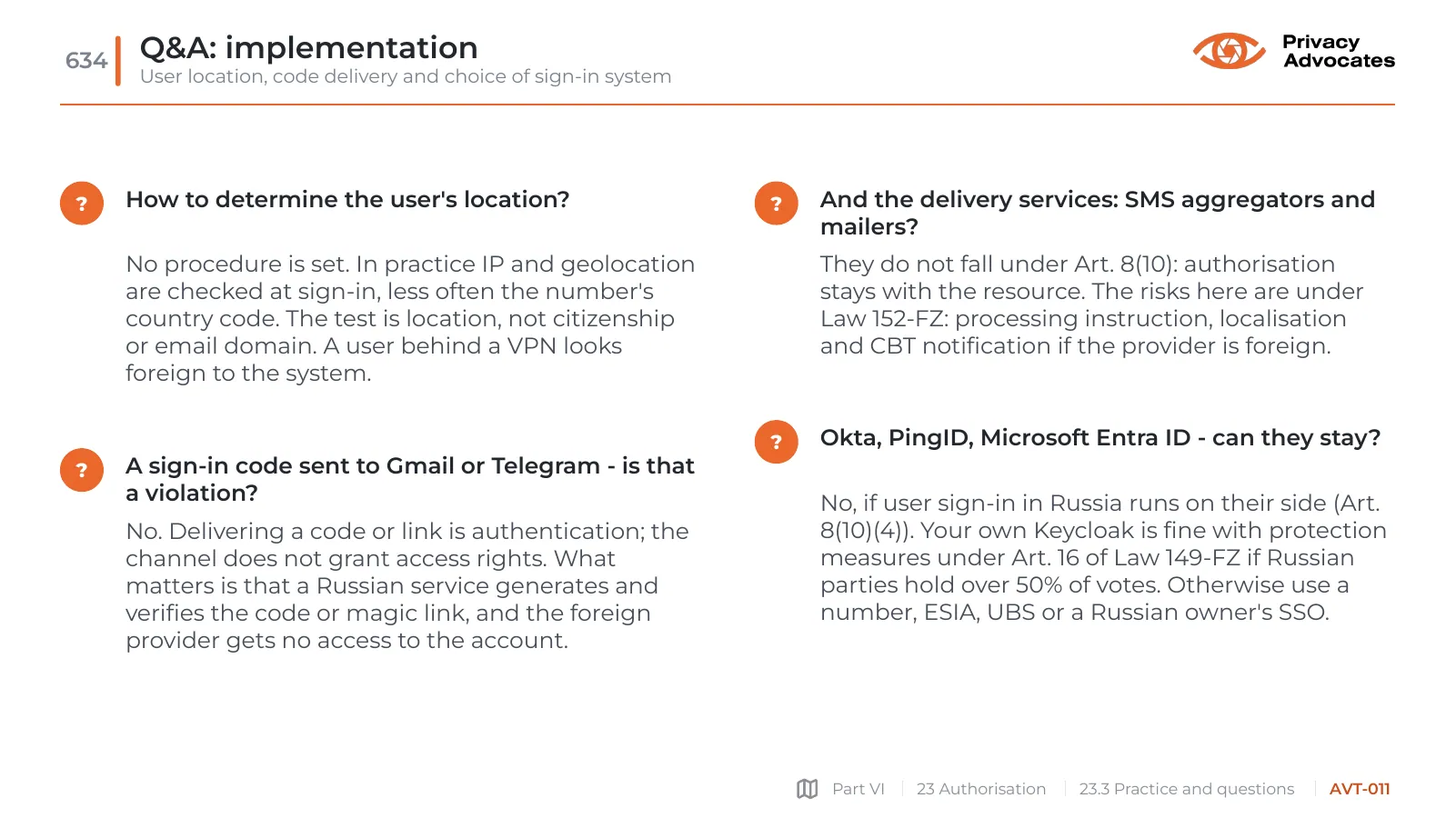
Slide AVT-011: Q&A: implementation
Slide text
  • ?
  • How to determine the user's location?

No procedure is set. In practice IP and geolocation are checked at sign-in, less often the number's country code. The test is location, not citizenship or email domain. A user behind a VPN looks foreign to the system.

  • ?
  • A sign-in code sent to Gmail or Telegram - is that a violation?

No. Delivering a code or link is authentication; the channel does not grant access rights. What matters is that a Russian service generates and verifies the code or magic link, and the foreign provider gets no access to the account.

  • ?
  • And the delivery services: SMS aggregators and mailers?

They do not fall under Art. 8(10): authorisation stays with the resource. The risks here are under Law 152-FZ: processing instruction, localisation and CBT notification if the provider is foreign.

  • ?
  • Okta, PingID, Microsoft Entra ID - can they stay?

No, if user sign-in in Russia runs on their side (Art. 8(10)(4)). Your own Keycloak is fine with protection measures under Art. 16 of Law 149-FZ if Russian parties hold over 50% of votes. Otherwise use a number, ESIA, UBS or a Russian owner's SSO.

AVT-012

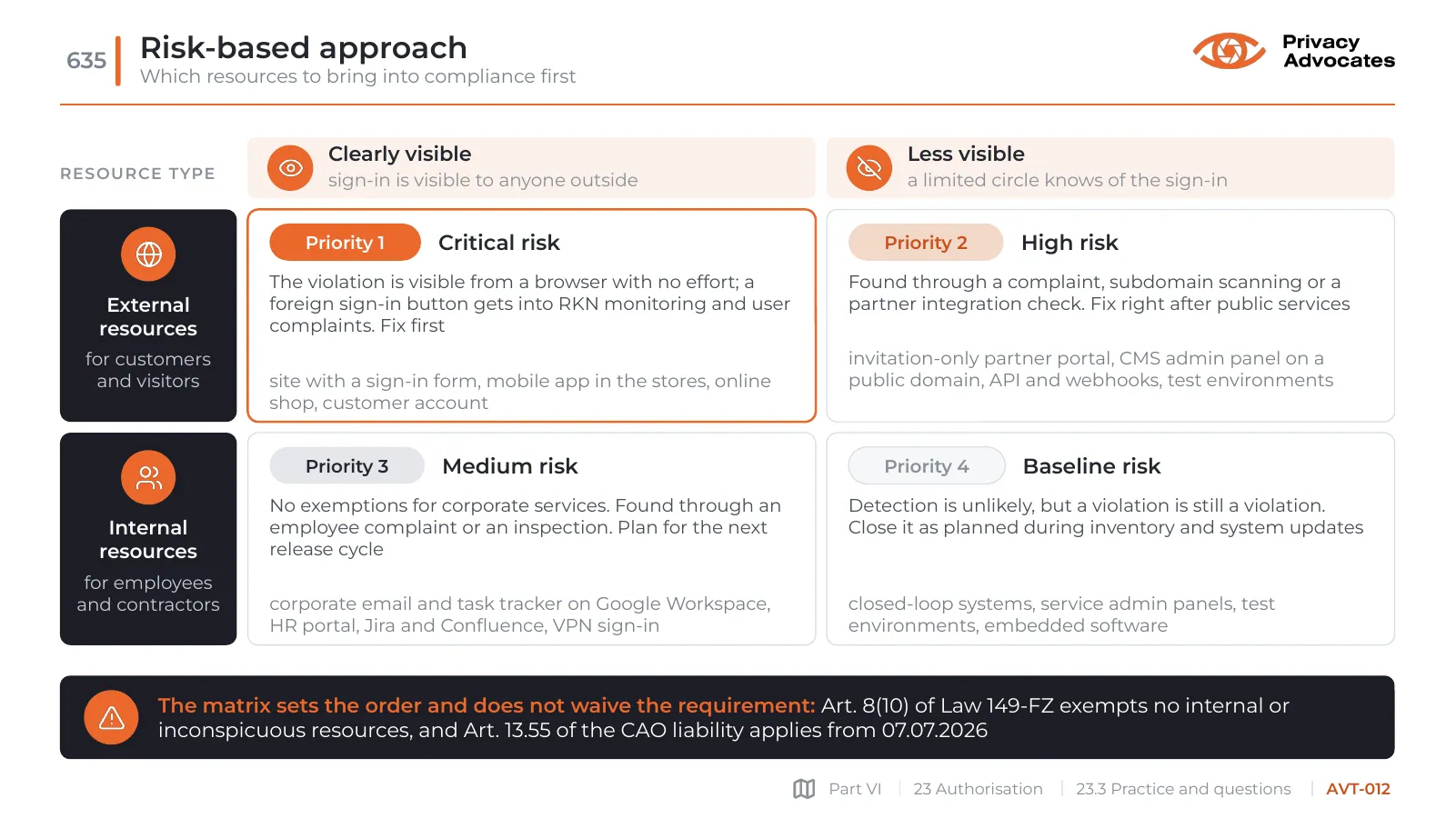
Risk-based approach

Which resources to bring into compliance first

Slide AVT-012: Risk-based approach
Slide text

Resource type

Clearly visible

sign-in is visible to anyone outside

Less visible

a limited circle knows of the sign-in

External resources

for customers and visitors

  • Priority 1
  • Critical risk

The violation is visible from a browser with no effort; a foreign sign-in button gets into RKN monitoring and user complaints. Fix first

site with a sign-in form, mobile app in the stores, online shop, customer account

  • Priority 2
  • High risk

Found through a complaint, subdomain scanning or a partner integration check. Fix right after public services

invitation-only partner portal, CMS admin panel on a public domain, API and webhooks, test environments

Internal resources

for employees and contractors

  • Priority 3
  • Medium risk

No exemptions for corporate services. Found through an employee complaint or an inspection. Plan for the next release cycle

corporate email and task tracker on Google Workspace, HR portal, Jira and Confluence, VPN sign-in

  • Priority 4
  • Baseline risk

Detection is unlikely, but a violation is still a violation. Close it as planned during inventory and system updates

closed-loop systems, service admin panels, test environments, embedded software

The matrix sets the order and does not waive the requirement: Art. 8(10) of Law 149-FZ exempts no internal or inconspicuous resources, and Art. 13.55 of the CAO liability applies from 07.07.2026

23.4

Antifraud-3

AVT-013

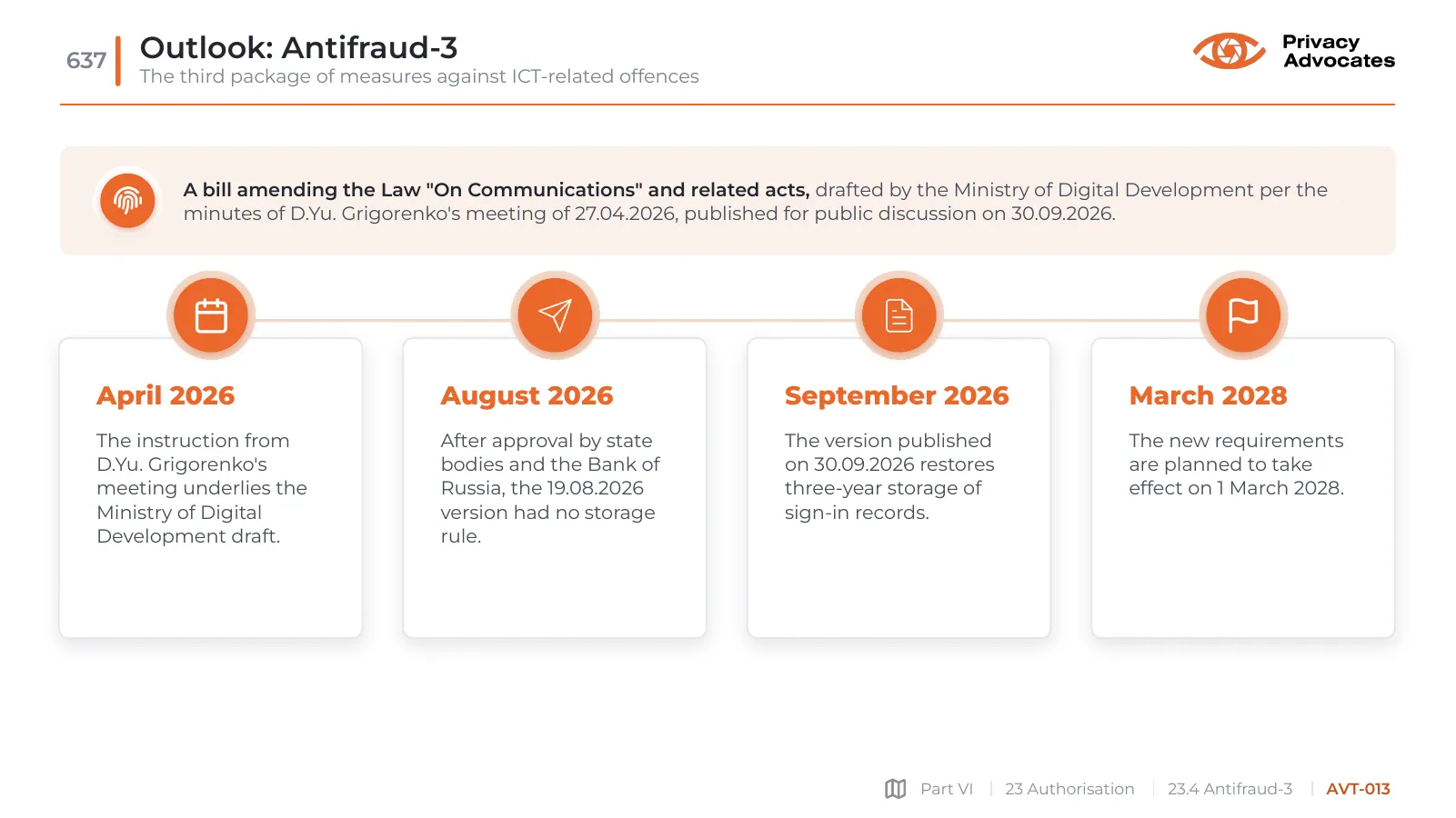
Outlook: Antifraud-3

The third package of measures against ICT-related offences

Slide AVT-013: Outlook: Antifraud-3
Slide text

A bill amending the Law "On Communications" and related acts, drafted by the Ministry of Digital Development per the minutes of D.Yu. Grigorenko's meeting of 27.04.2026, published for public discussion on 30.09.2026.

April 2026

The instruction from D.Yu. Grigorenko's meeting underlies the Ministry of Digital Development draft.

August 2026

After approval by state bodies and the Bank of Russia, the 19.08.2026 version had no storage rule.

September 2026

The version published on 30.09.2026 restores three-year storage of sign-in records.

March 2028

The new requirements are planned to take effect on 1 March 2028.

AVT-014

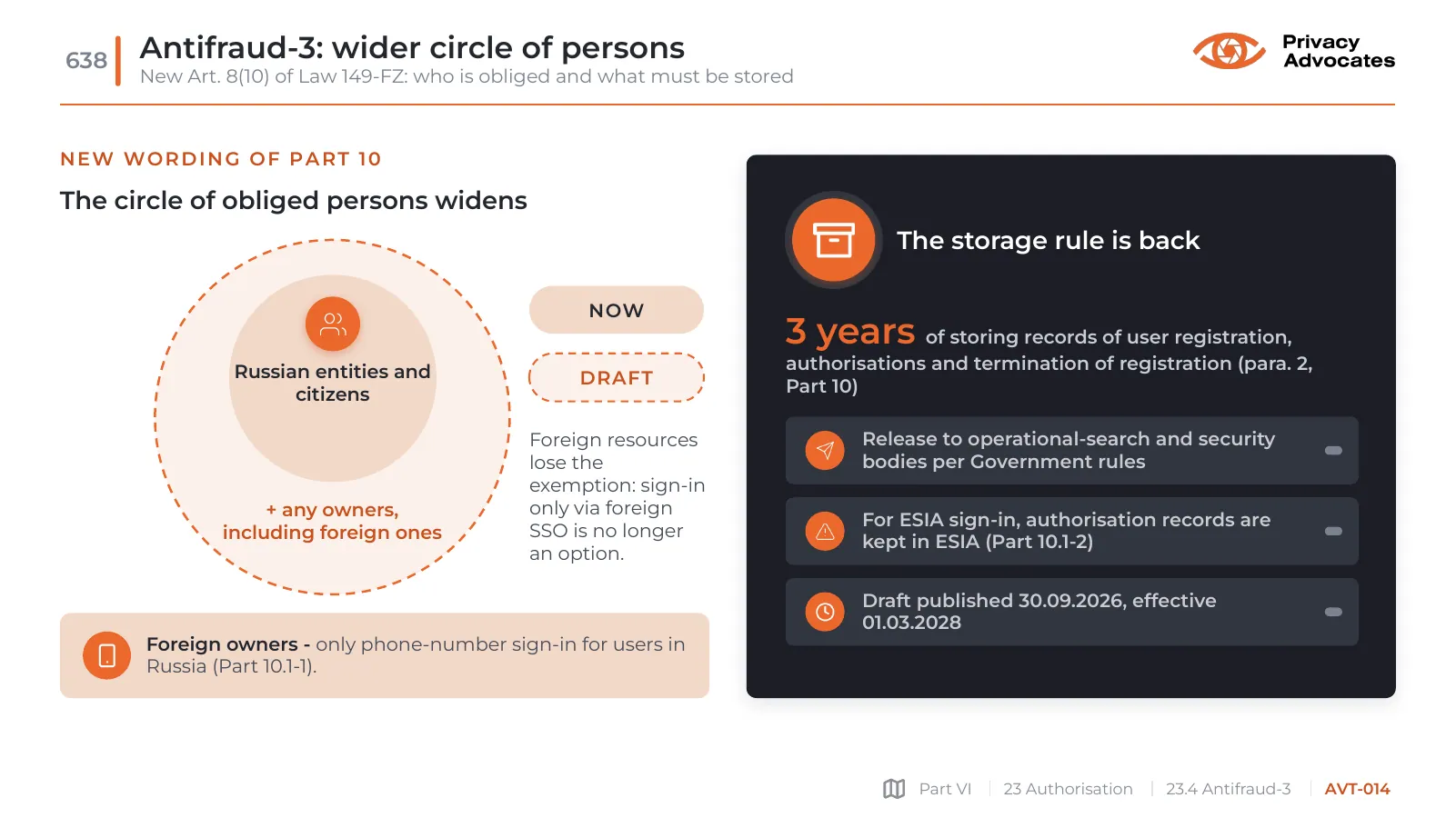
Antifraud-3: wider circle of persons

New Art. 8(10) of Law 149-FZ: who is obliged and what must be stored

Slide AVT-014: Antifraud-3: wider circle of persons
Slide text

NEW WORDING OF PART 10

The circle of obliged persons widens

Russian entities and citizens

+ any owners,

including foreign ones

NOW

DRAFT

Foreign resources lose the exemption: sign-in only via foreign SSO is no longer an option.

Foreign owners - only phone-number sign-in for users in Russia (Part 10.1-1).

The storage rule is back

3 years of storing records of user registration, authorisations and termination of registration (para. 2, Part 10)

Release to operational-search and security bodies per Government rules

For ESIA sign-in, authorisation records are kept in ESIA (Part 10.1-2)

Draft published 30.09.2026, effective 01.03.2028

AVT-015

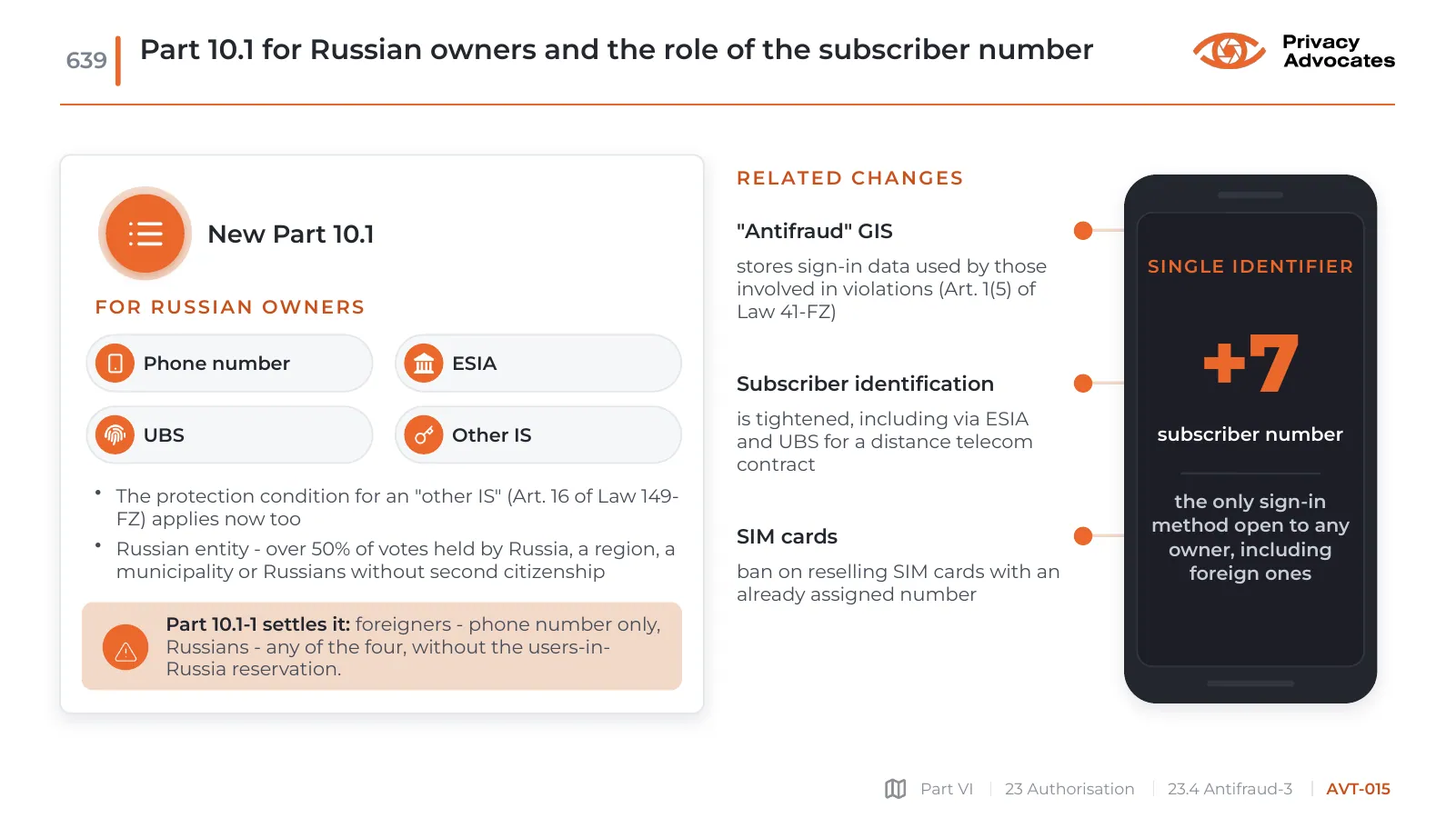
Part 10.1 for Russian owners and the role of the subscriber number

Slide AVT-015: Part 10.1 for Russian owners and the role of the subscriber number
Slide text

New Part 10.1

FOR RUSSIAN OWNERS

  • Phone number
  • ESIA
  • UBS
  • Other IS

The protection condition for an "other IS" (Art. 16 of Law 149-FZ) applies now too

Russian entity - over 50% of votes held by Russia, a region, a municipality or Russians without second citizenship

Part 10.1-1 settles it: foreigners - phone number only, Russians - any of the four, without the users-in-Russia reservation.

RELATED CHANGES

"Antifraud" GIS

stores sign-in data used by those involved in violations (Art. 1(5) of Law 41-FZ)

Subscriber identification

is tightened, including via ESIA and UBS for a distance telecom contract

SIM cards

ban on reselling SIM cards with an already assigned number

SINGLE IDENTIFIER

+7

subscriber number

the only sign-in method open to any owner, including foreign ones

AVT-016

Key takeaways

Slide AVT-016: Key takeaways
Slide text

Russian resources authorise users in Russia by one of four methods; foreign sign-in services - Apple ID, Google Sign-In - are banned.

The requirement is tied to the user's location, not citizenship. Violations fall under Art. 13.55 of the CAO; Art. 274.5 of the Criminal Code covers passing on authorisation data.

The Antifraud-3 draft (effective 01.03.2028) extends the requirement to foreign resources and restores three-year storage of registration and sign-in records, available to law enforcement.

t.me/prv_adv