
Part IX, section 34

PD in bankruptcy proceedings

Six permissibility criteria in bankruptcy proceedings

  • 7 slides
  • 2 subsections
  • Edition of 25 October 2026

34.1

Six criteria in bankruptcy proceedings

BNK-001

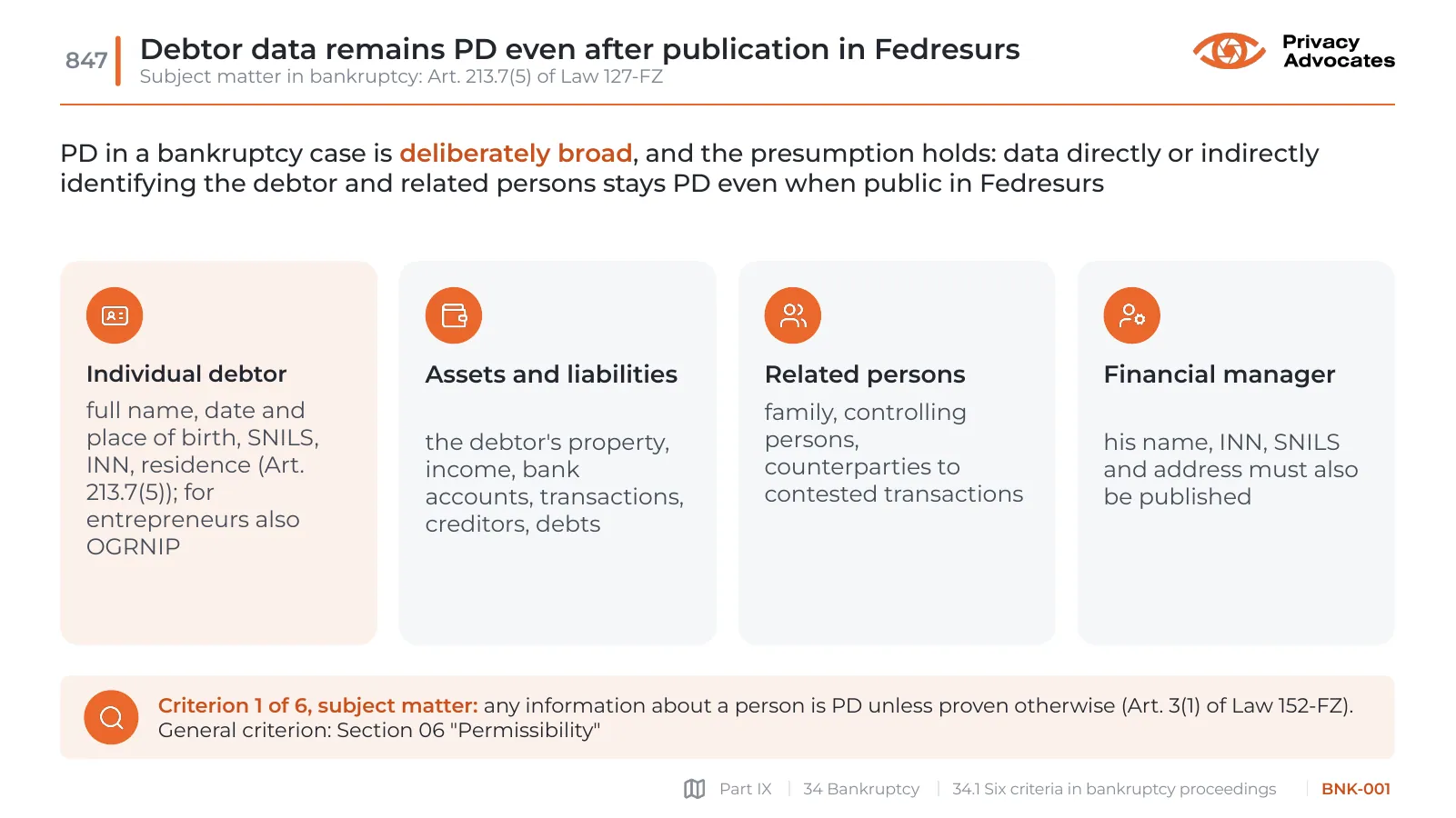
Debtor data remains PD even after publication in Fedresurs

Subject matter in bankruptcy: Art. 213.7(5) of Law 127-FZ
Slide BNK-001: Debtor data remains PD even after publication in Fedresurs
Slide text

PD in a bankruptcy case is deliberately broad, and the presumption holds: data directly or indirectly identifying the debtor and related persons stays PD even when public in Fedresurs

Individual debtor

full name, date and place of birth, SNILS, INN, residence (Art. 213.7(5)); for entrepreneurs also OGRNIP

Assets and liabilities

the debtor's property, income, bank accounts, transactions, creditors, debts

Related persons

family, controlling persons, counterparties to contested transactions

Financial manager

his name, INN, SNILS and address must also be published

Criterion 1 of 6, subject matter: any information about a person is PD unless proven otherwise (Art. 3(1) of Law 152-FZ). General criterion: Section 06 "Permissibility"
BNK-002

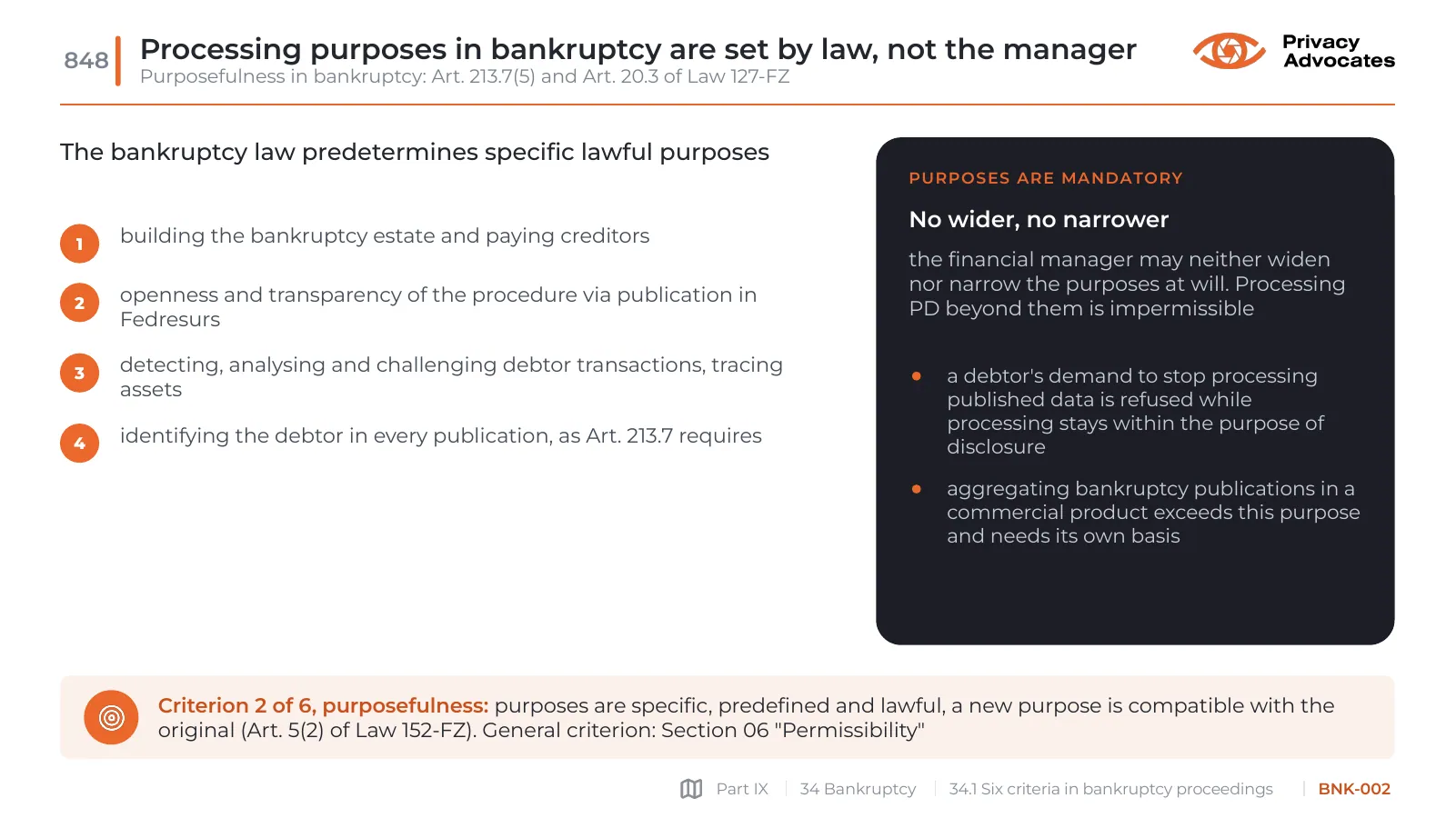
Processing purposes in bankruptcy are set by law, not the manager

Purposefulness in bankruptcy: Art. 213.7(5) and Art. 20.3 of Law 127-FZ

Slide BNK-002: Processing purposes in bankruptcy are set by law, not the manager
Slide text

The bankruptcy law predetermines specific lawful purposes

  • 1
  • building the bankruptcy estate and paying creditors
  • 2
  • openness and transparency of the procedure via publication in Fedresurs
  • 3
  • detecting, analysing and challenging debtor transactions, tracing assets
  • 4
  • identifying the debtor in every publication, as Art. 213.7 requires

Purposes are mandatory

No wider, no narrower

the financial manager may neither widen nor narrow the purposes at will. Processing PD beyond them is impermissible

a debtor's demand to stop processing published data is refused while processing stays within the purpose of disclosure

aggregating bankruptcy publications in a commercial product exceeds this purpose and needs its own basis

Criterion 2 of 6, purposefulness: purposes are specific, predefined and lawful, a new purpose is compatible with the original (Art. 5(2) of Law 152-FZ). General criterion: Section 06 "Permissibility"
BNK-003

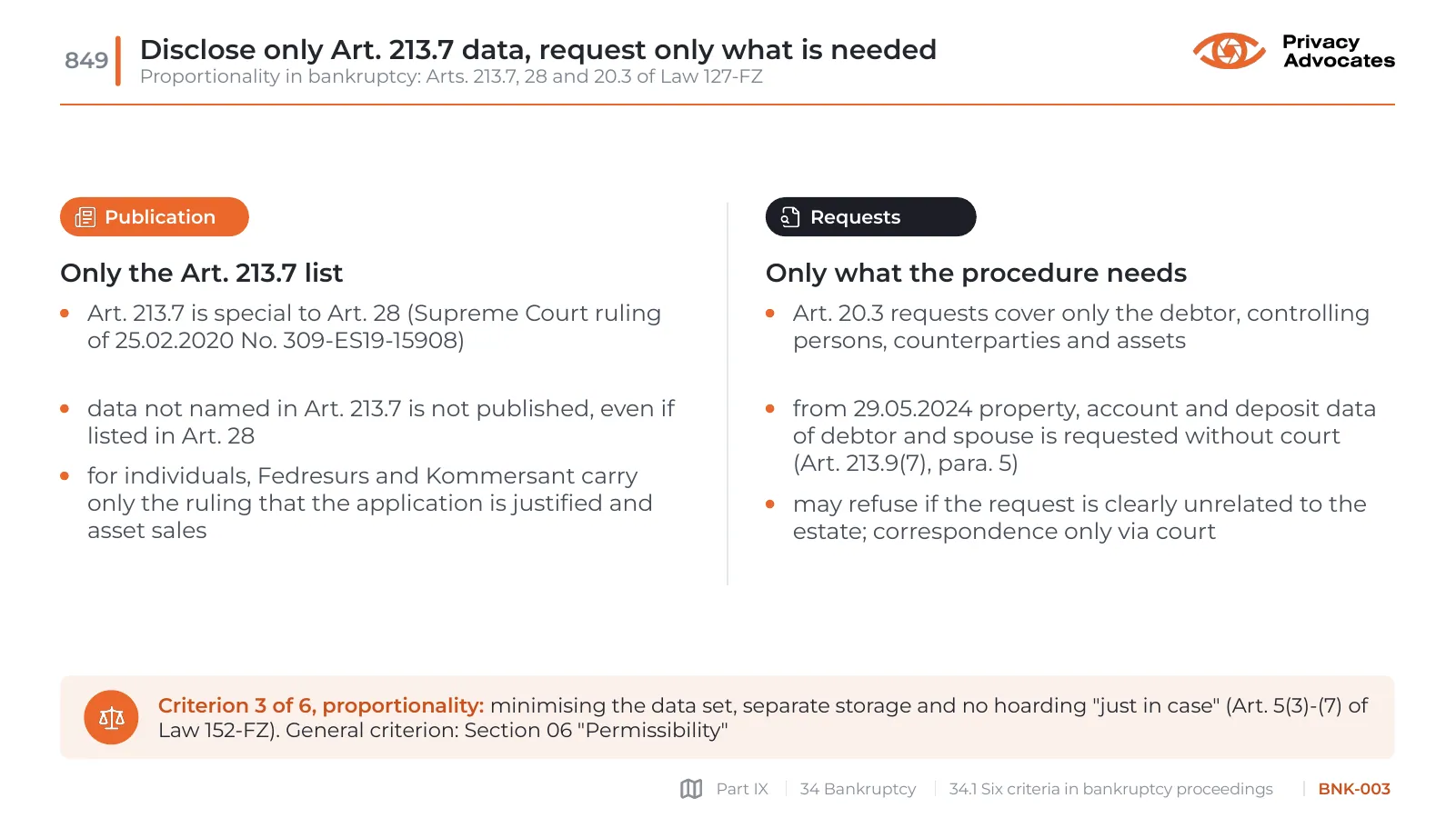
Disclose only Art. 213.7 data, request only what is needed

Proportionality in bankruptcy: Arts. 213.7, 28 and 20.3 of Law 127-FZ

Slide BNK-003: Disclose only Art. 213.7 data, request only what is needed
Slide text

Publication

Only the Art. 213.7 list

Art. 213.7 is special to Art. 28 (Supreme Court ruling of 25.02.2020 No. 309-ES19-15908)

data not named in Art. 213.7 is not published, even if listed in Art. 28

for individuals, Fedresurs and Kommersant carry only the ruling that the application is justified and asset sales

Requests

Only what the procedure needs

Art. 20.3 requests cover only the debtor, controlling persons, counterparties and assets

from 29.05.2024 property, account and deposit data of debtor and spouse is requested without court (Art. 213.9(7), para. 5)

may refuse if the request is clearly unrelated to the estate; correspondence only via court

Criterion 3 of 6, proportionality: minimising the data set, separate storage and no hoarding "just in case" (Art. 5(3)-(7) of Law 152-FZ). General criterion: Section 06 "Permissibility"
BNK-004

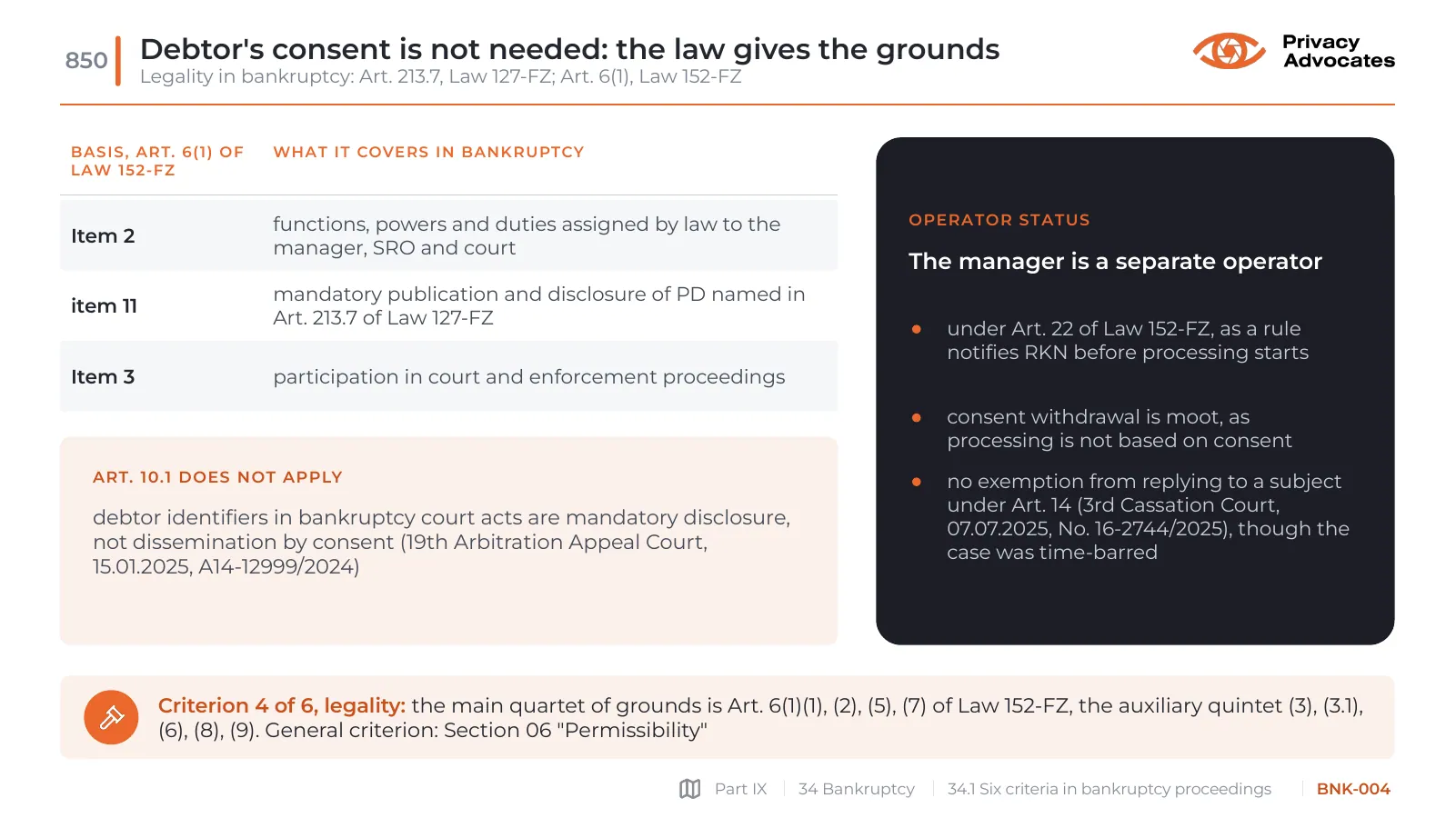
Debtor's consent is not needed: the law gives the grounds

Legality in bankruptcy: Art. 213.7, Law 127-FZ; Art. 6(1), Law 152-FZ

Slide BNK-004: Debtor's consent is not needed: the law gives the grounds
Slide text
  • Basis, Art. 6(1) of Law 152-FZ
  • What it covers in bankruptcy
  • Item 2
  • functions, powers and duties assigned by law to the manager, SRO and court
  • item 11
  • mandatory publication and disclosure of PD named in Art. 213.7 of Law 127-FZ
  • Item 3
  • participation in court and enforcement proceedings

Art. 10.1 does not apply

debtor identifiers in bankruptcy court acts are mandatory disclosure, not dissemination by consent (19th Arbitration Appeal Court, 15.01.2025, A14-12999/2024)

Operator status

The manager is a separate operator

under Art. 22 of Law 152-FZ, as a rule notifies RKN before processing starts

consent withdrawal is moot, as processing is not based on consent

no exemption from replying to a subject under Art. 14 (3rd Cassation Court, 07.07.2025, No. 16-2744/2025), though the case was time-barred

Criterion 4 of 6, legality: the main quartet of grounds is Art. 6(1)(1), (2), (5), (7) of Law 152-FZ, the auxiliary quintet (3), (3.1), (6), (8), (9). General criterion: Section 06 "Permissibility"
BNK-005

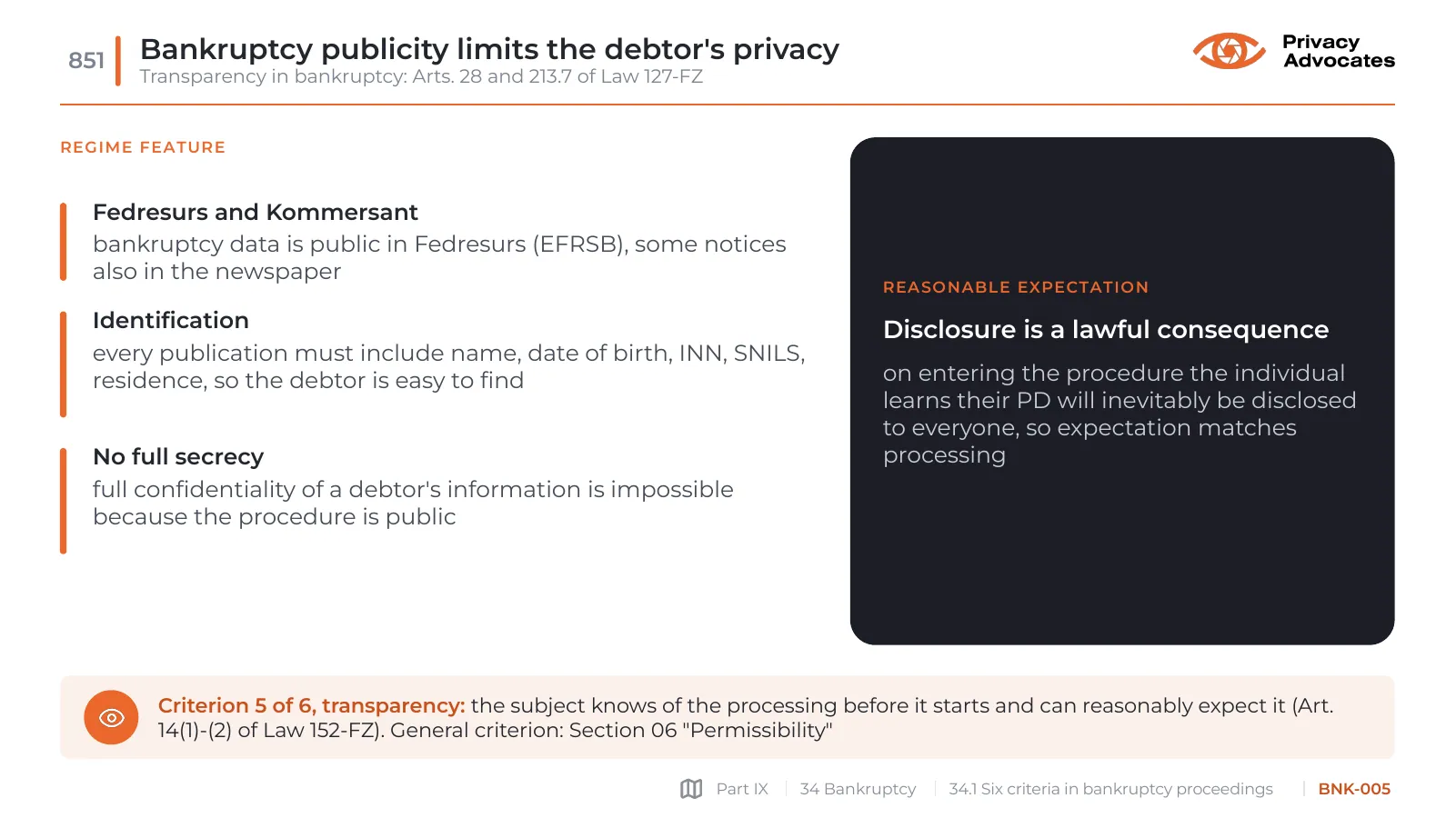
Bankruptcy publicity limits the debtor's privacy

Transparency in bankruptcy: Arts. 28 and 213.7 of Law 127-FZ

Slide BNK-005: Bankruptcy publicity limits the debtor's privacy
Slide text

Regime feature

Fedresurs and Kommersant

bankruptcy data is public in Fedresurs (EFRSB), some notices also in the newspaper

Identification

every publication must include name, date of birth, INN, SNILS, residence, so the debtor is easy to find

No full secrecy

full confidentiality of a debtor's information is impossible because the procedure is public

Reasonable expectation

Disclosure is a lawful consequence

on entering the procedure the individual learns their PD will inevitably be disclosed to everyone, so expectation matches processing

Criterion 5 of 6, transparency: the subject knows of the processing before it starts and can reasonably expect it (Art. 14(1)-(2) of Law 152-FZ). General criterion: Section 06 "Permissibility"
BNK-006

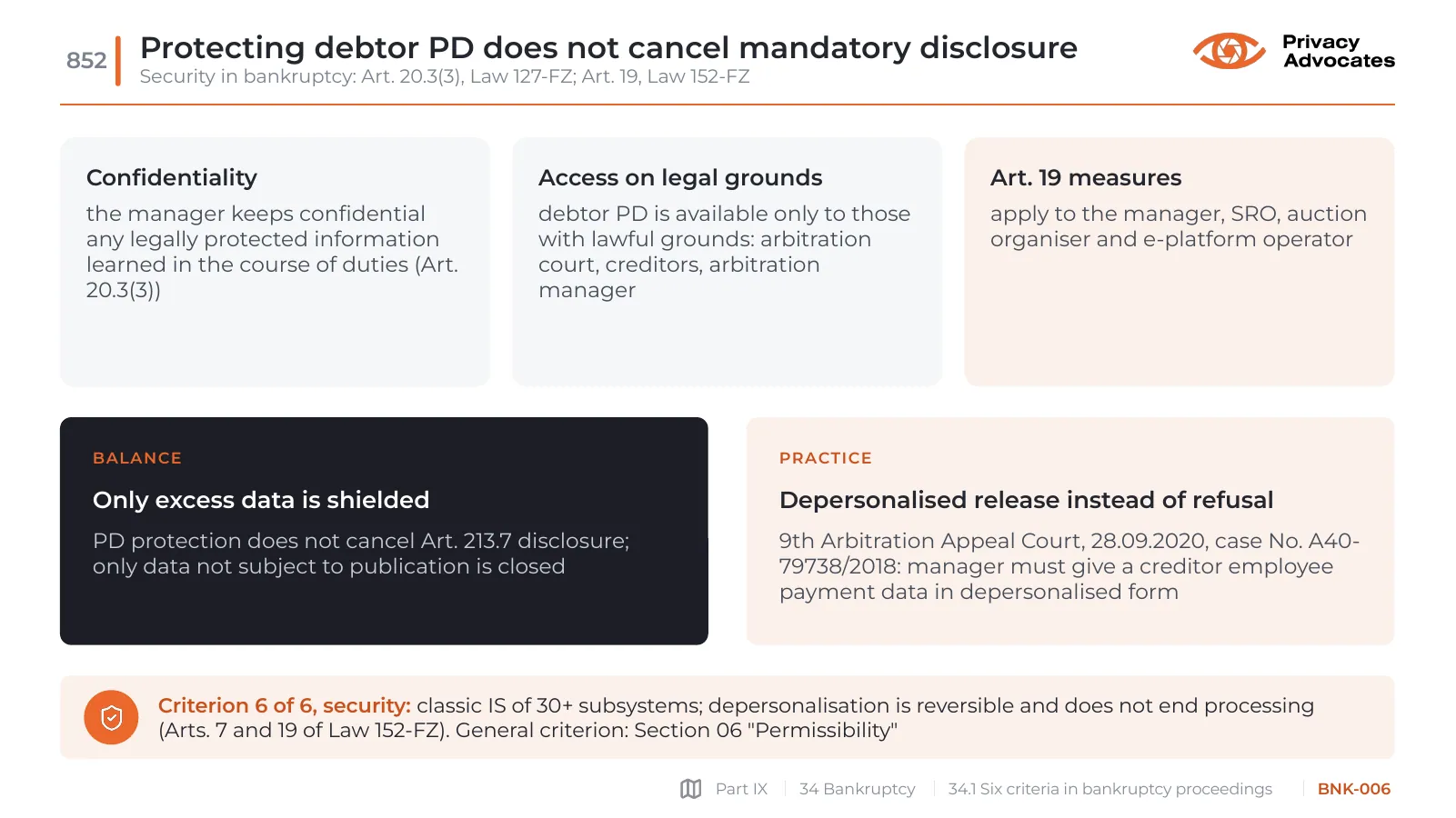
Protecting debtor PD does not cancel mandatory disclosure

Security in bankruptcy: Art. 20.3(3), Law 127-FZ; Art. 19, Law 152-FZ

Slide BNK-006: Protecting debtor PD does not cancel mandatory disclosure
Slide text

Confidentiality

the manager keeps confidential any legally protected information learned in the course of duties (Art. 20.3(3))

Access on legal grounds

debtor PD is available only to those with lawful grounds: arbitration court, creditors, arbitration manager

Art. 19 measures

apply to the manager, SRO, auction organiser and e-platform operator

Balance

Only excess data is shielded

PD protection does not cancel Art. 213.7 disclosure; only data not subject to publication is closed

Practice

Depersonalised release instead of refusal

9th Arbitration Appeal Court, 28.09.2020, case No. A40-79738/2018: manager must give a creditor employee payment data in depersonalised form

Criterion 6 of 6, security: classic IS of 30+ subsystems; depersonalisation is reversible and does not end processing (Arts. 7 and 19 of Law 152-FZ). General criterion: Section 06 "Permissibility"

34.2

Features of the regime and risks

BNK-007

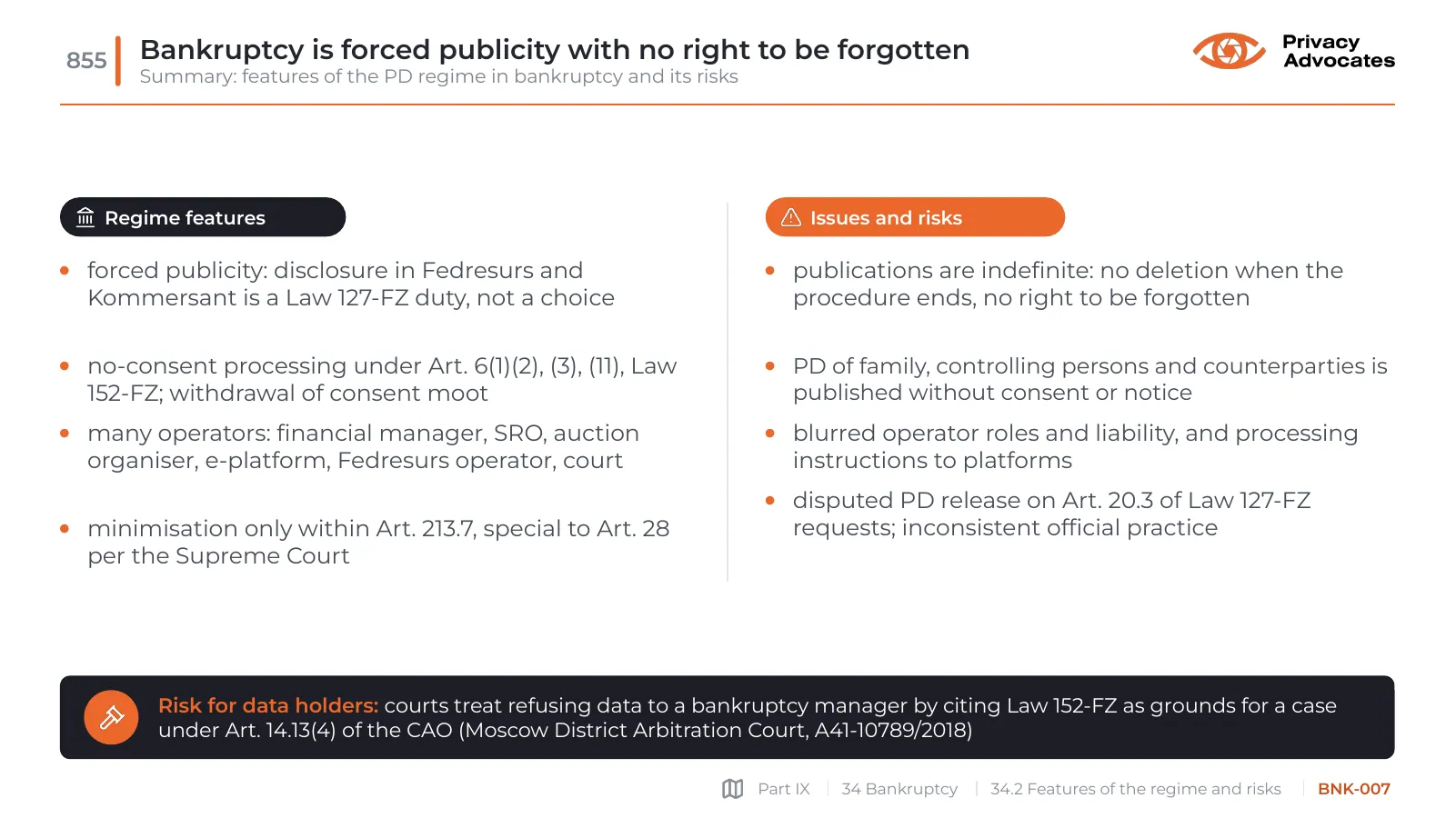
Bankruptcy is forced publicity with no right to be forgotten

Summary: features of the PD regime in bankruptcy and its risks

Slide BNK-007: Bankruptcy is forced publicity with no right to be forgotten
Slide text

Regime features

forced publicity: disclosure in Fedresurs and Kommersant is a Law 127-FZ duty, not a choice

no-consent processing under Art. 6(1)(2), (3), (11), Law 152-FZ; withdrawal of consent moot

many operators: financial manager, SRO, auction organiser, e-platform, Fedresurs operator, court

minimisation only within Art. 213.7, special to Art. 28 per the Supreme Court

Issues and risks

publications are indefinite: no deletion when the procedure ends, no right to be forgotten

PD of family, controlling persons and counterparties is published without consent or notice

blurred operator roles and liability, and processing instructions to platforms

disputed PD release on Art. 20.3 of Law 127-FZ requests; inconsistent official practice

Risk for data holders: courts treat refusing data to a bankruptcy manager by citing Law 152-FZ as grounds for a case under Art. 14.13(4) of the CAO (Moscow District Arbitration Court, A41-10789/2018)