
PD legislation trends in Russia
Processing, liability, onshoring, privacy, internet, CBT, consumers
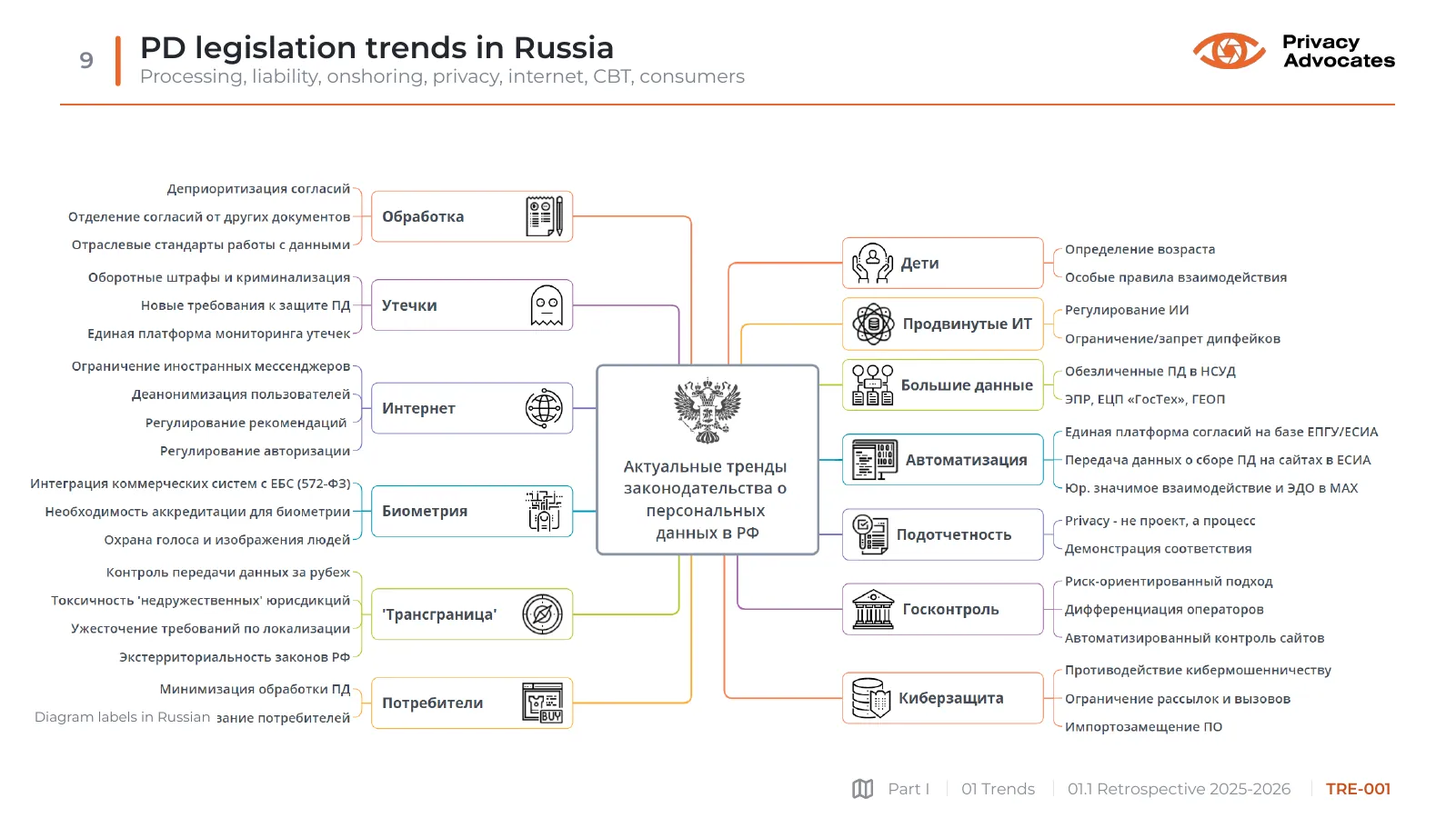
Slide text
Diagram labels in Russian
Part I, section 01
Retrospective 2025 and outlook 2026-2028: what a PD operator needs to know
01.1
What has become law, how oversight has changed and what case law has taught
Processing, liability, onshoring, privacy, internet, CBT, consumers
Diagram labels in Russian
Four lines of reform on one map
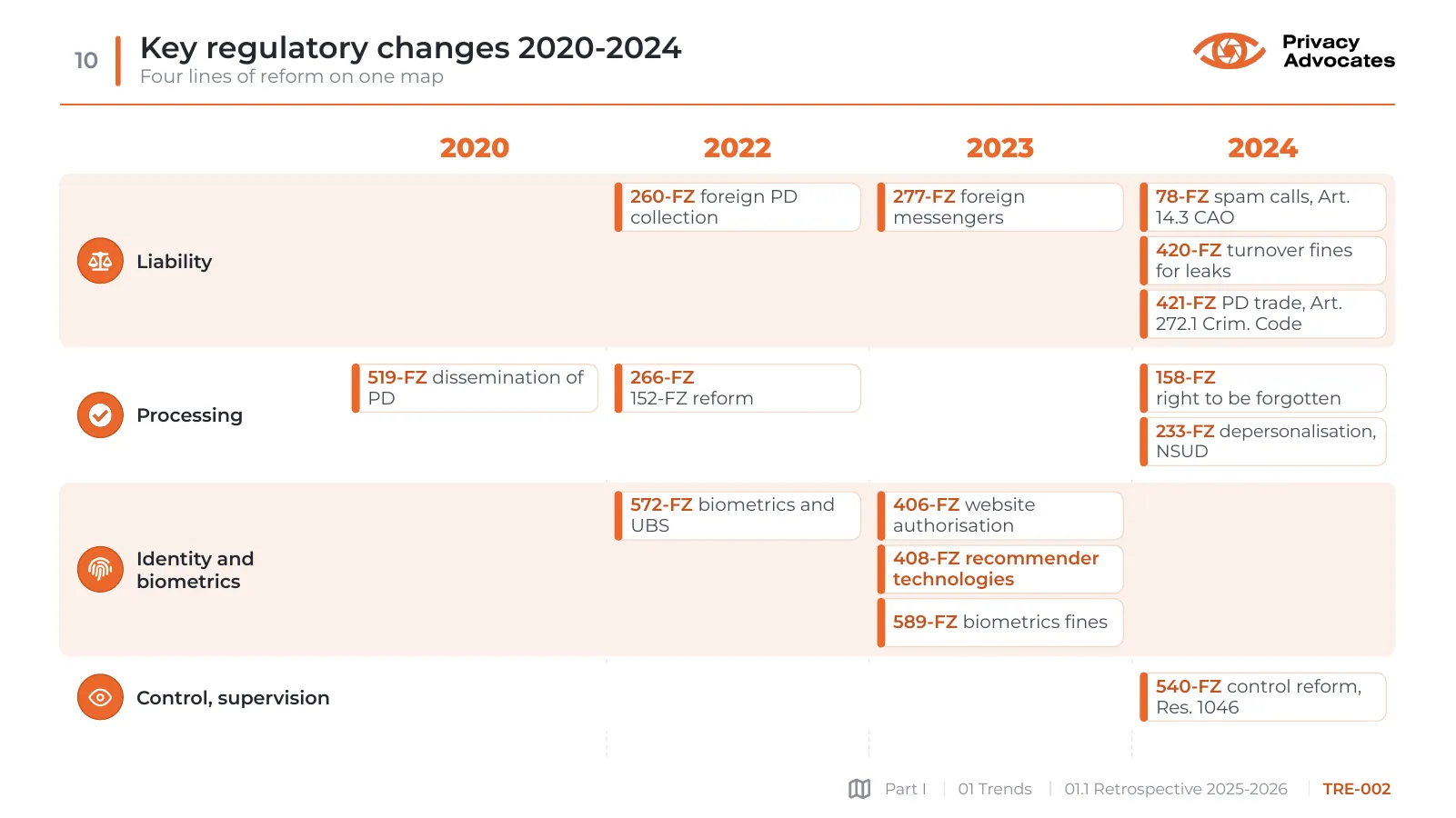
Liability
420-FZ turnover fines for leaks
421-FZ PD trade, Art. 272.1 Crim. Code
266-FZ
152-FZ reform
158-FZ
right to be forgotten
233-FZ depersonalisation, NSUD
Identity and biometrics
408-FZ recommender technologies
589-FZ biometrics fines
Era of antifraud, onshoring and AI
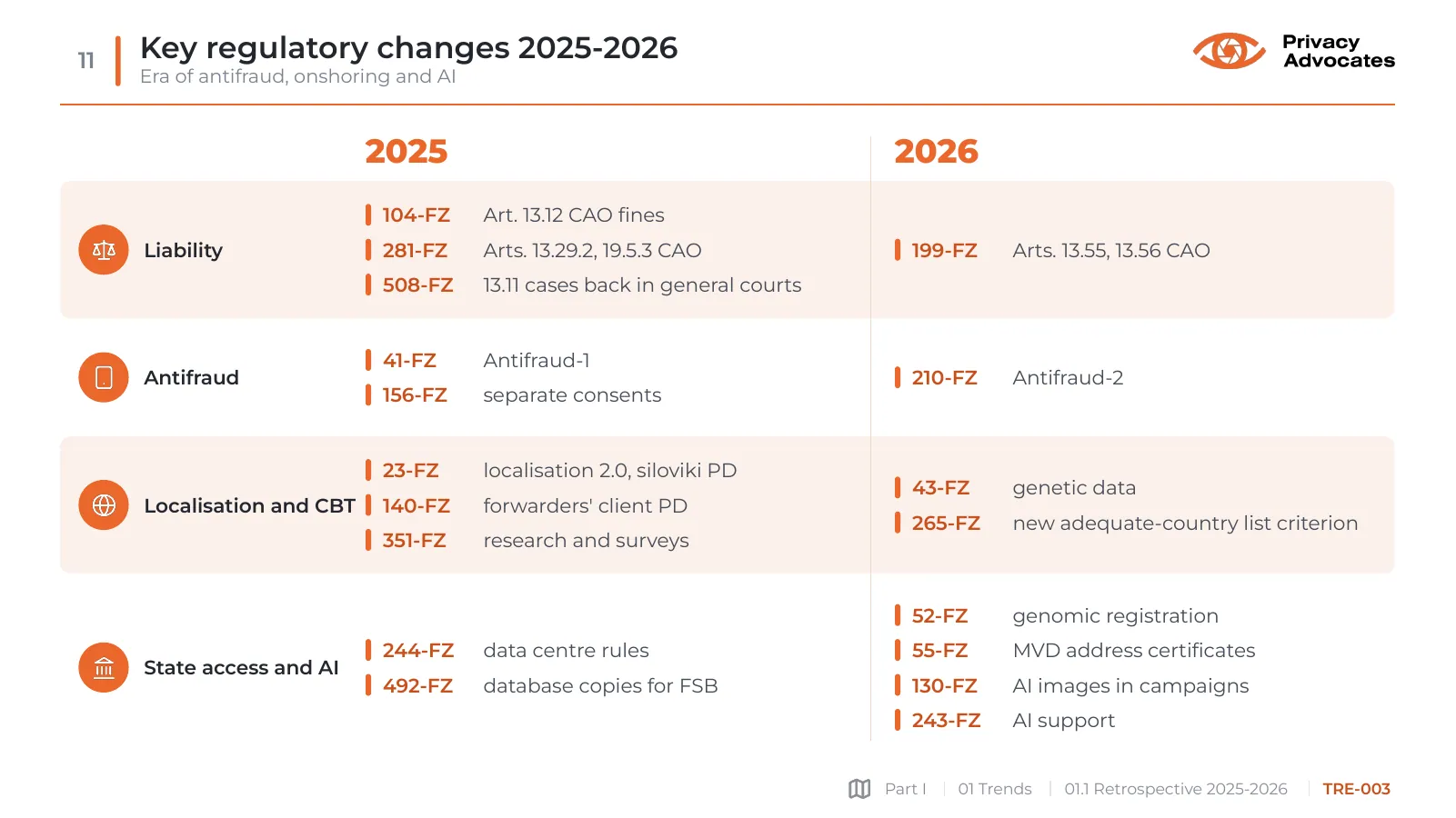
State access and AI
2024-2025 law package and first results
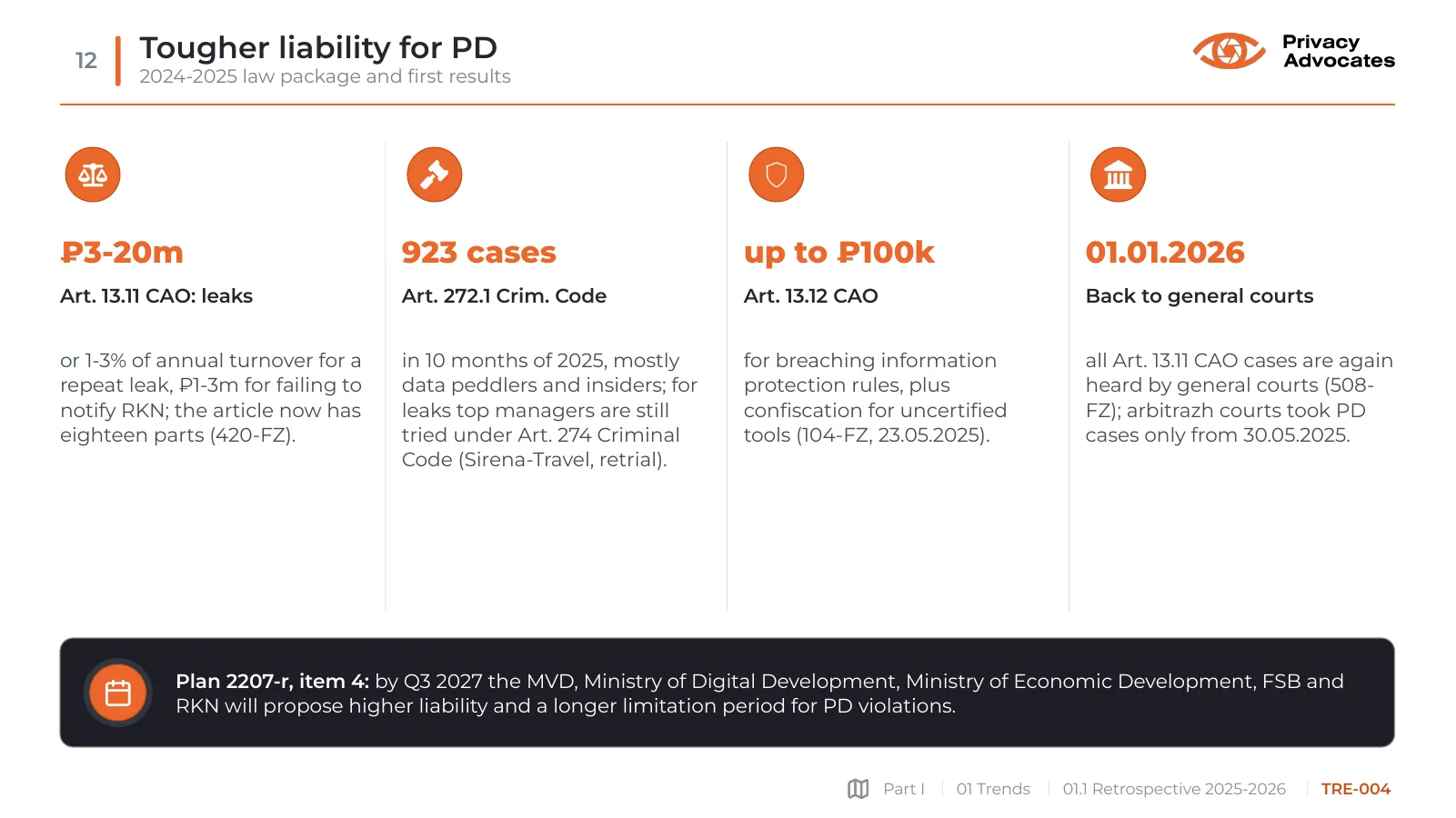
₽3-20m
Art. 13.11 CAO: leaks
or 1-3% of annual turnover for a repeat leak, ₽1-3m for failing to notify RKN; the article now has eighteen parts (420-FZ).
923 cases
Art. 272.1 Crim. Code
in 10 months of 2025, mostly data peddlers and insiders; for leaks top managers are still tried under Art. 274 Criminal Code (Sirena-Travel, retrial).
up to ₽100k
Art. 13.12 CAO
for breaching information protection rules, plus confiscation for uncertified tools (104-FZ, 23.05.2025).
01.01.2026
Back to general courts
all Art. 13.11 CAO cases are again heard by general courts (508-FZ); arbitrazh courts took PD cases only from 30.05.2025.
Plan 2207-r, item 4: by Q3 2027 the MVD, Ministry of Digital Development, Ministry of Economic Development, FSB and RKN will propose higher liability and a longer limitation period for PD violations.
Clarified 23-FZ rules and the 2026 wave of fines
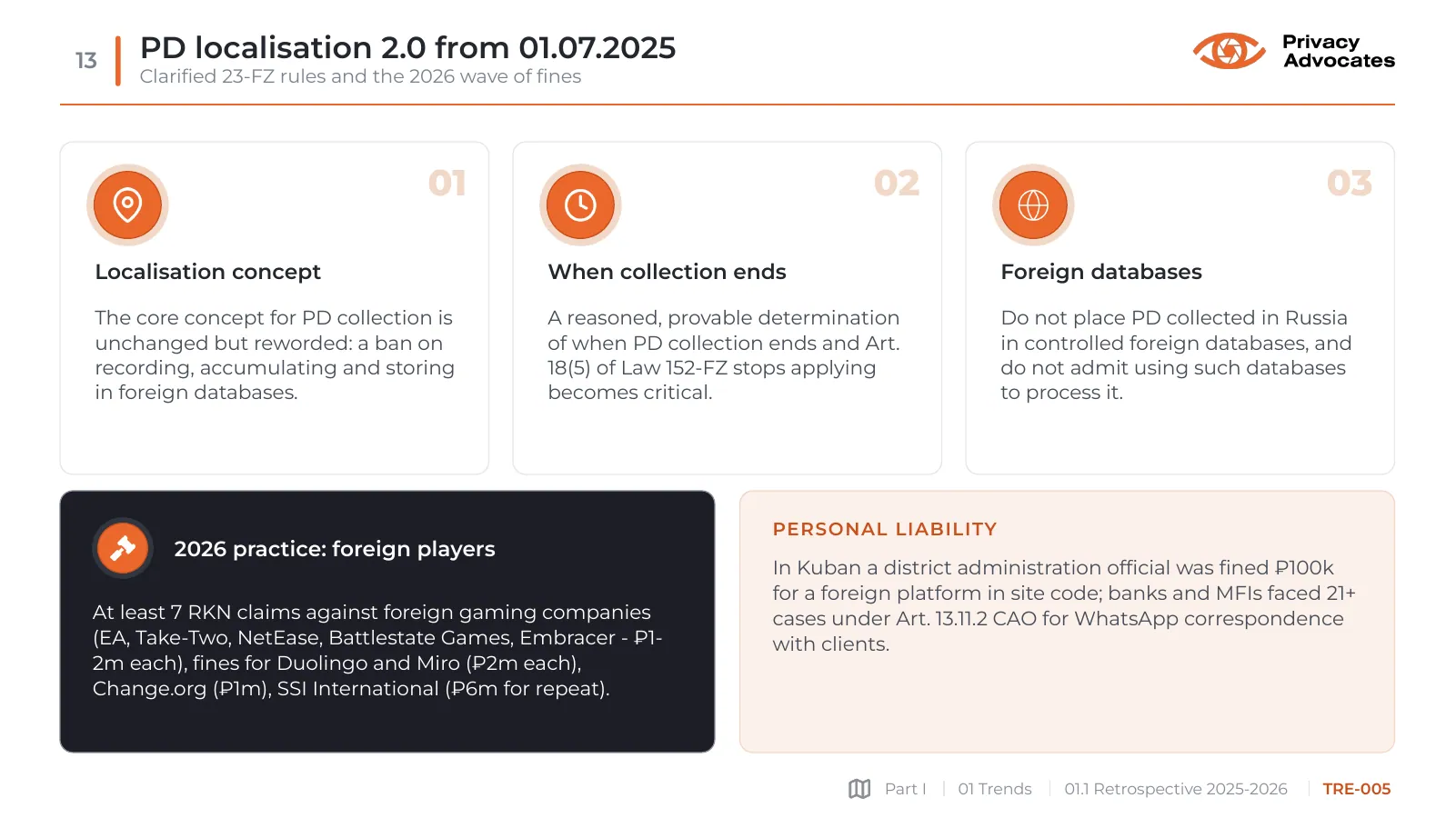
01
Localisation concept
The core concept for PD collection is unchanged but reworded: a ban on recording, accumulating and storing in foreign databases.
02
When collection ends
A reasoned, provable determination of when PD collection ends and Art. 18(5) of Law 152-FZ stops applying becomes critical.
03
Foreign databases
Do not place PD collected in Russia in controlled foreign databases, and do not admit using such databases to process it.
2026 practice: foreign players
At least 7 RKN claims against foreign gaming companies (EA, Take-Two, NetEase, Battlestate Games, Embracer - ₽1-2m each), fines for Duolingo and Miro (₽2m each), Change.org (₽1m), SSI International (₽6m for repeat).
PERSONAL LIABILITY
In Kuban a district administration official was fined ₽100k for a foreign platform in site code; banks and MFIs faced 21+ cases under Art. 13.11.2 CAO for WhatsApp correspondence with clients.
Depersonalised PD stays PD, and the Ministry's NSUD transfer demands are in force
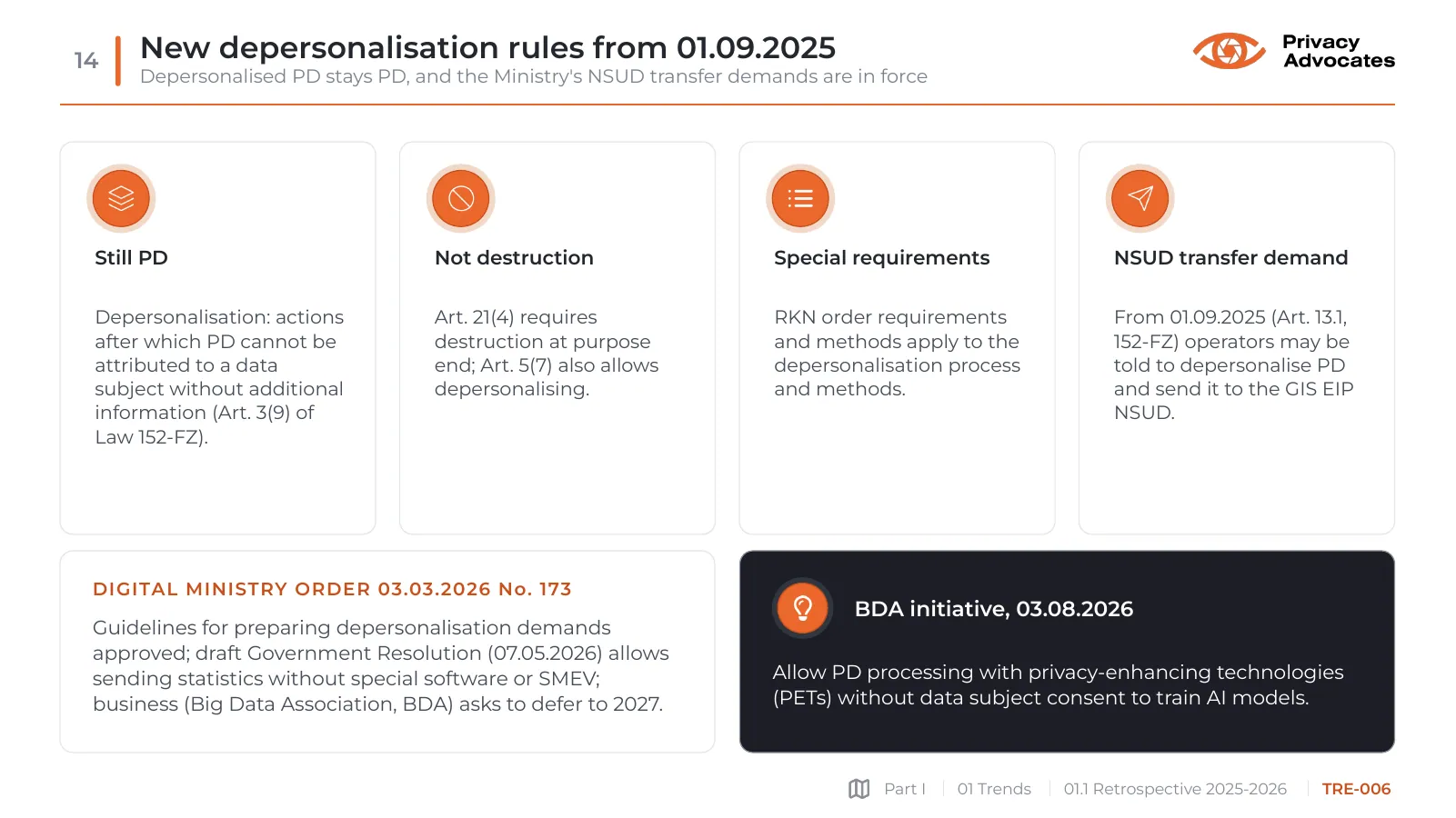
Still PD
Depersonalisation: actions after which PD cannot be attributed to a data subject without additional information (Art. 3(9) of Law 152-FZ).
Not destruction
Art. 21(4) requires destruction at purpose end; Art. 5(7) also allows depersonalising.
Special requirements
RKN order requirements and methods apply to the depersonalisation process and methods.
NSUD transfer demand
From 01.09.2025 (Art. 13.1, 152-FZ) operators may be told to depersonalise PD and send it to the GIS EIP NSUD.
DIGITAL MINISTRY ORDER 03.03.2026 No. 173
Guidelines for preparing depersonalisation demands approved; draft Government Resolution (07.05.2026) allows sending statistics without special software or SMEV; business (Big Data Association, BDA) asks to defer to 2027.
BDA initiative, 03.08.2026
Allow PD processing with privacy-enhancing technologies (PETs) without data subject consent to train AI models.
Art. 9(1), 152-FZ: consent is separate from other information and documents - how to read this?
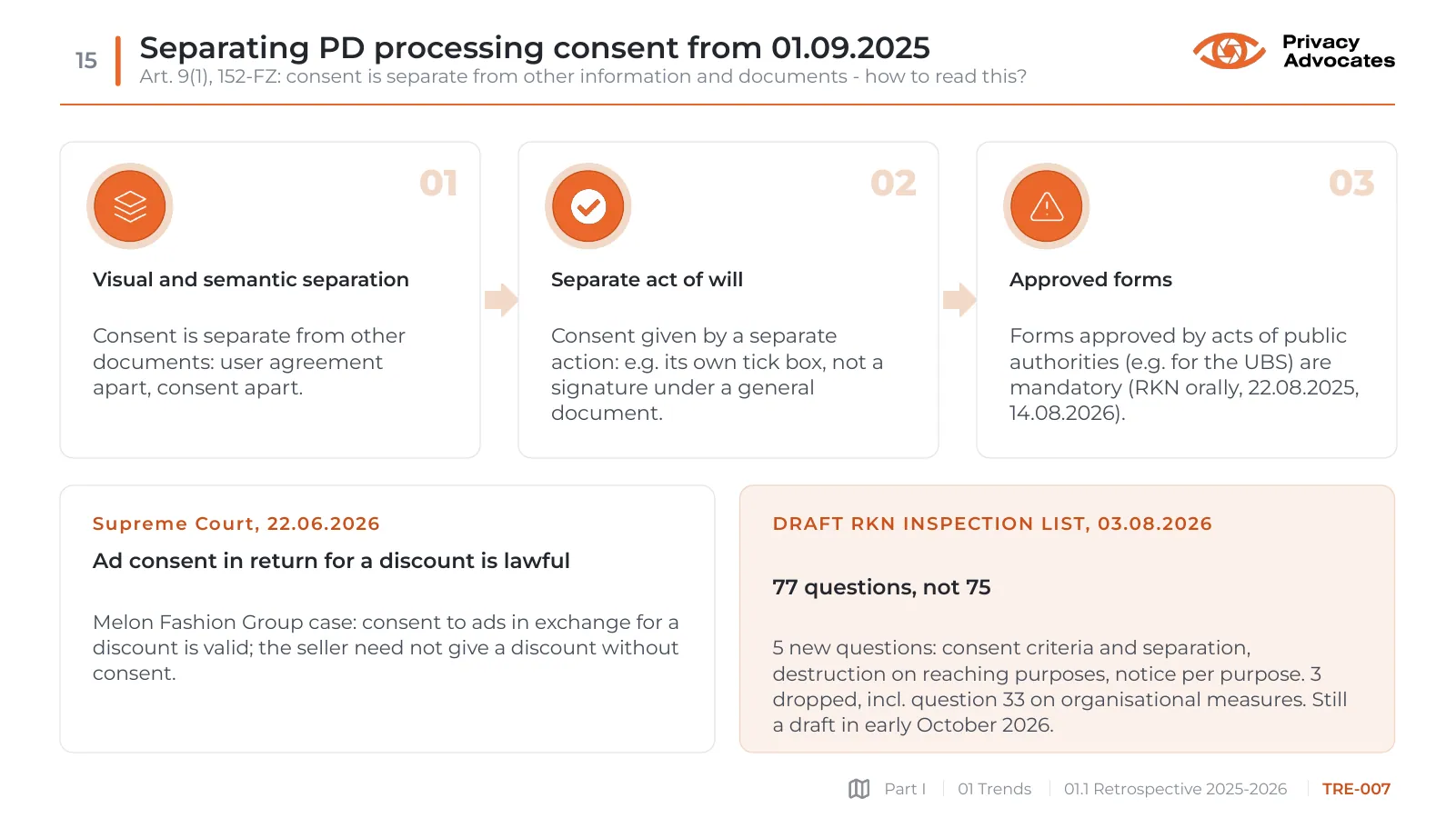
01
Visual and semantic separation
Consent is separate from other documents: user agreement apart, consent apart.
02
Separate act of will
Consent given by a separate action: e.g. its own tick box, not a signature under a general document.
03
Approved forms
Forms approved by acts of public authorities (e.g. for the UBS) are mandatory (RKN orally, 22.08.2025, 14.08.2026).
Supreme Court, 22.06.2026
Ad consent in return for a discount is lawful
Melon Fashion Group case: consent to ads in exchange for a discount is valid; the seller need not give a discount without consent.
DRAFT RKN INSPECTION LIST, 03.08.2026
77 questions, not 75
5 new questions: consent criteria and separation, destruction on reaching purposes, notice per purpose. 3 dropped, incl. question 33 on organisational measures. Still a draft in early October 2026.
Revised Res. No. 1046 (from 02.09.2025)
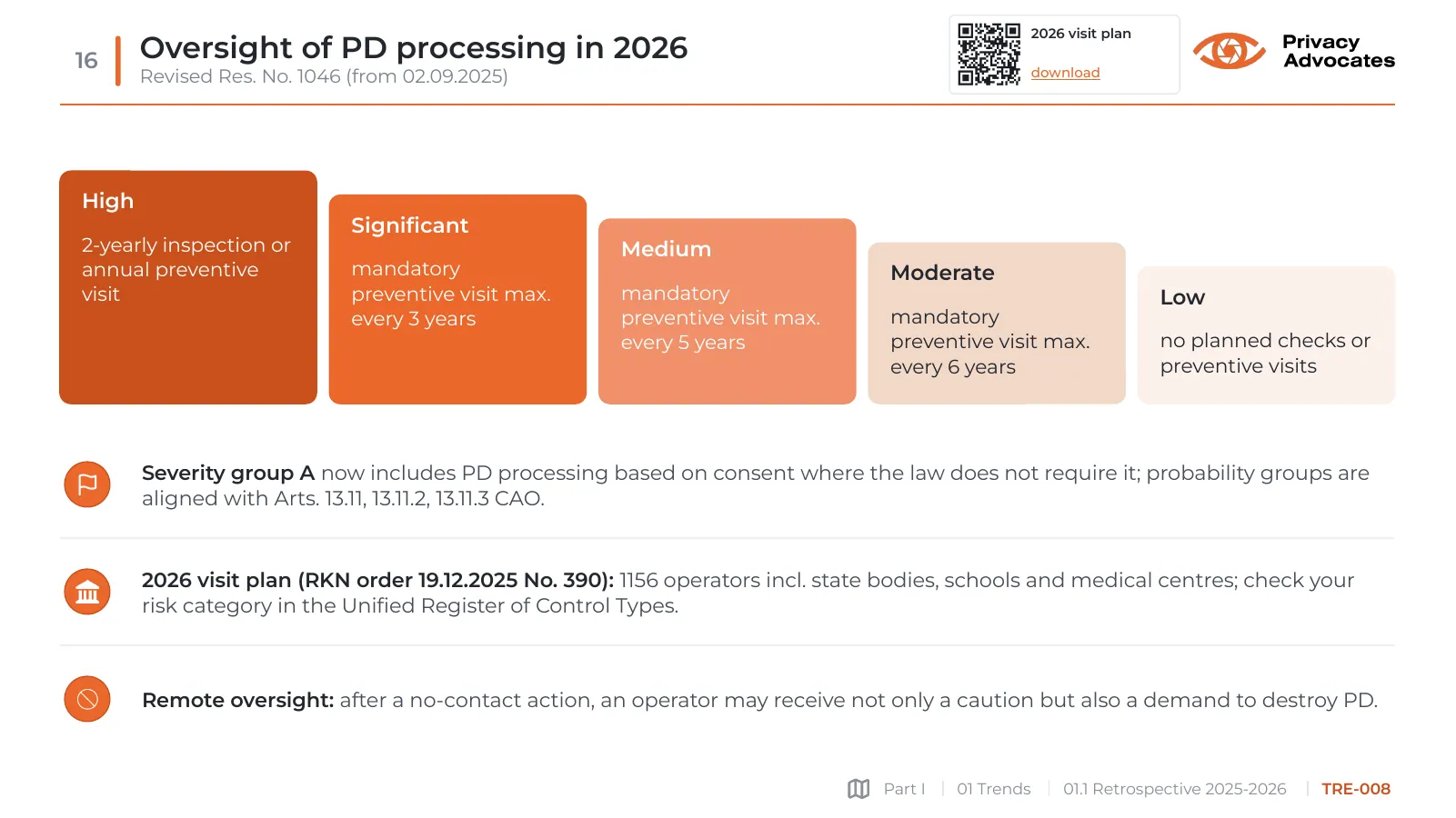
High
2-yearly inspection or annual preventive visit
Significant
mandatory preventive visit max. every 3 years
Medium
mandatory preventive visit max. every 5 years
Moderate
no planned checks or preventive visits
Severity group A now includes PD processing based on consent where the law does not require it; probability groups are aligned with Arts. 13.11, 13.11.2, 13.11.3 CAO.
2026 visit plan (RKN order 19.12.2025 No. 390): 1156 operators incl. state bodies, schools and medical centres; check your risk category in the Unified Register of Control Types.
Remote oversight: after a no-contact action, an operator may receive not only a caution but also a demand to destroy PD.
AS MPD: how site monitoring works and what it finds
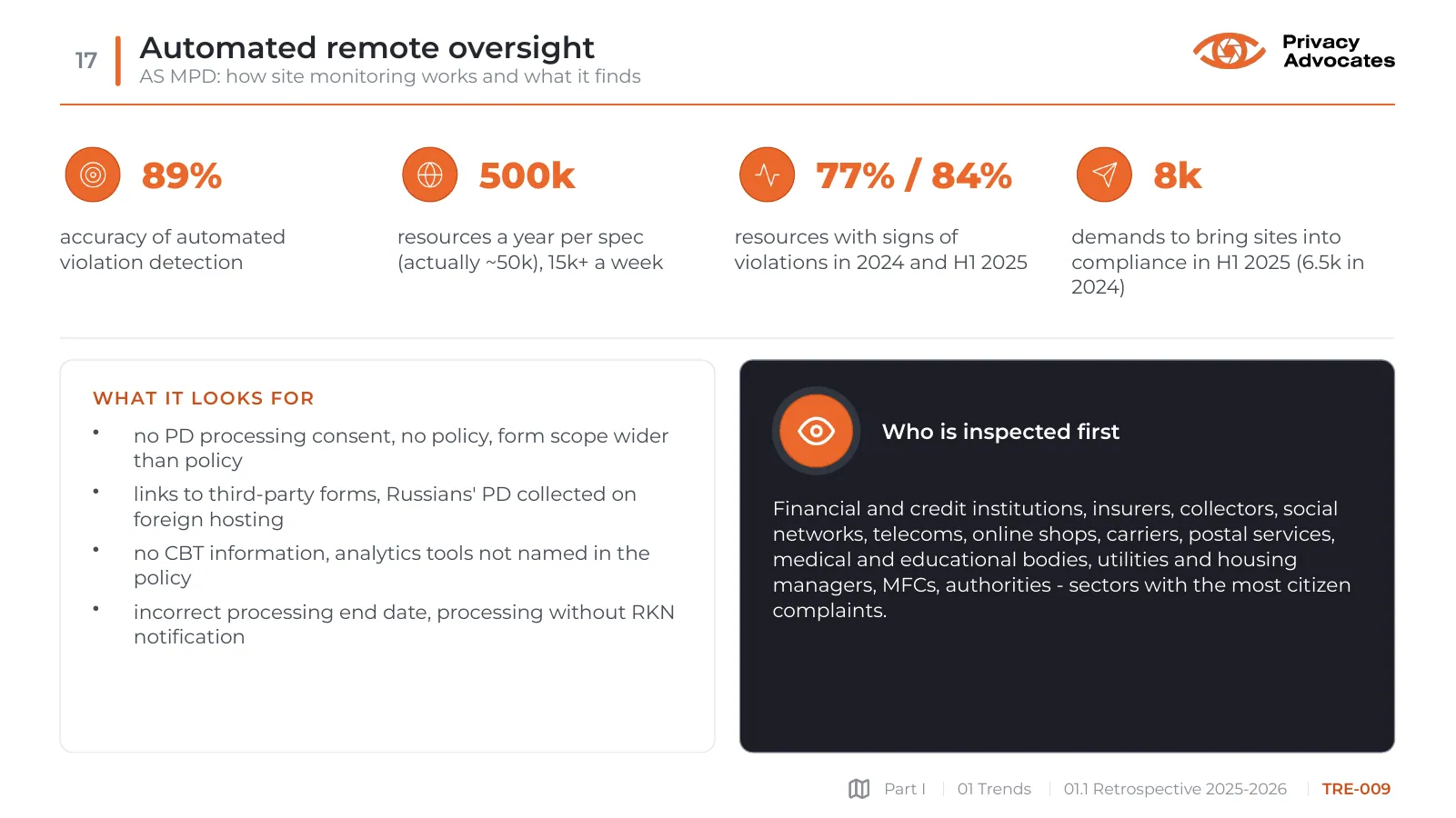
89%
accuracy of automated violation detection
500k
resources a year per spec (actually ~50k), 15k+ a week
77% / 84%
resources with signs of violations in 2024 and H1 2025
8k
demands to bring sites into compliance in H1 2025 (6.5k in 2024)
WHAT IT LOOKS FOR
no PD processing consent, no policy, form scope wider than policy
links to third-party forms, Russians' PD collected on foreign hosting
no CBT information, analytics tools not named in the policy
incorrect processing end date, processing without RKN notification
Who is inspected first
Financial and credit institutions, insurers, collectors, social networks, telecoms, online shops, carriers, postal services, medical and educational bodies, utilities and housing managers, MFCs, authorities - sectors with the most citizen complaints.
Practice mix: general courts (to 30.05), arbitrazh (from 30.05)
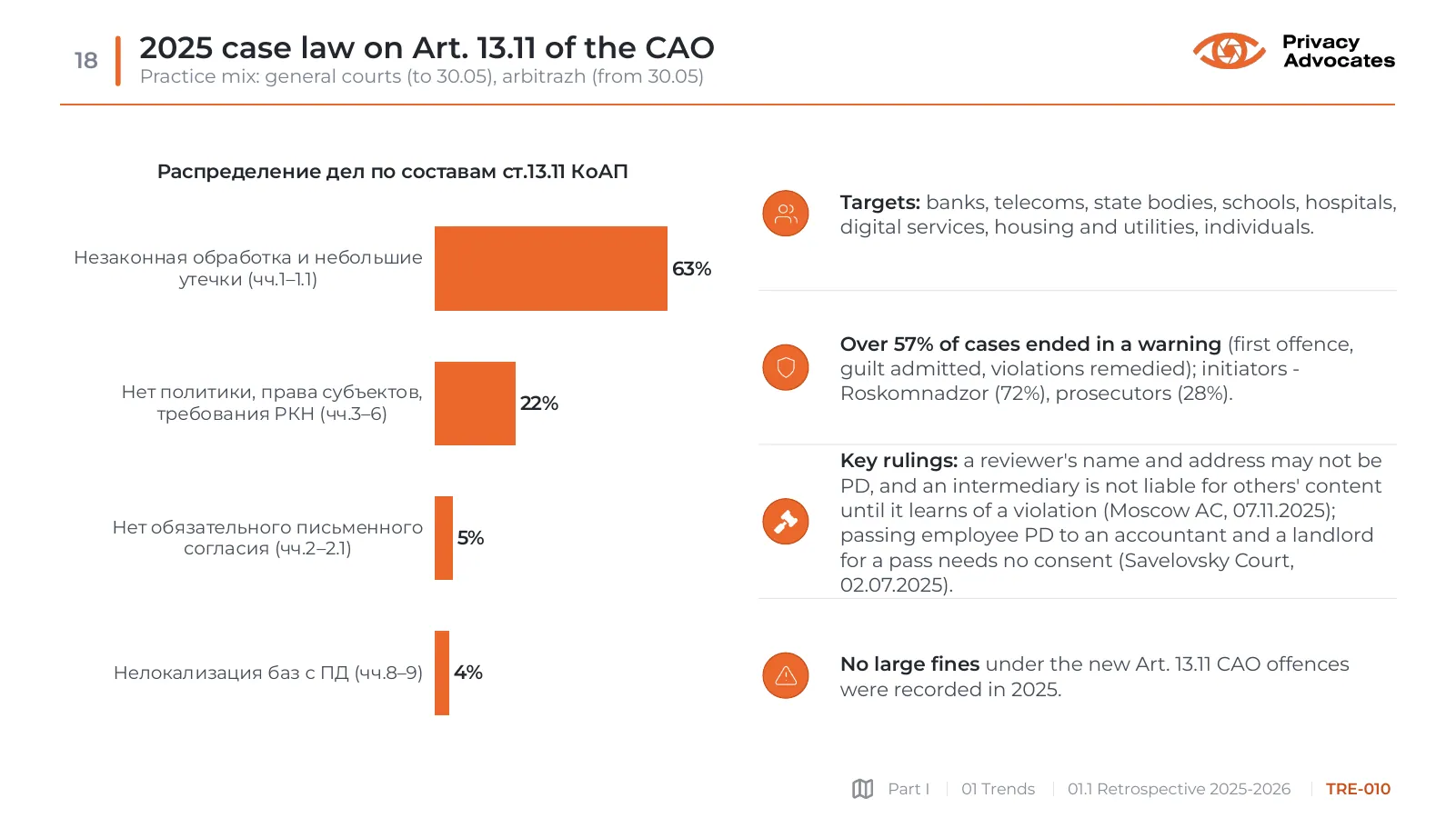
Targets: banks, telecoms, state bodies, schools, hospitals, digital services, housing and utilities, individuals.
Over 57% of cases ended in a warning (first offence, guilt admitted, violations remedied); initiators - Roskomnadzor (72%), prosecutors (28%).
Key rulings: a reviewer's name and address may not be PD, and an intermediary is not liable for others' content until it learns of a violation (Moscow AC, 07.11.2025); passing employee PD to an accountant and a landlord for a pass needs no consent (Savelovsky Court, 02.07.2025).
No large fines under the new Art. 13.11 CAO offences were recorded in 2025.
2026 rulings as of 14.10.2026
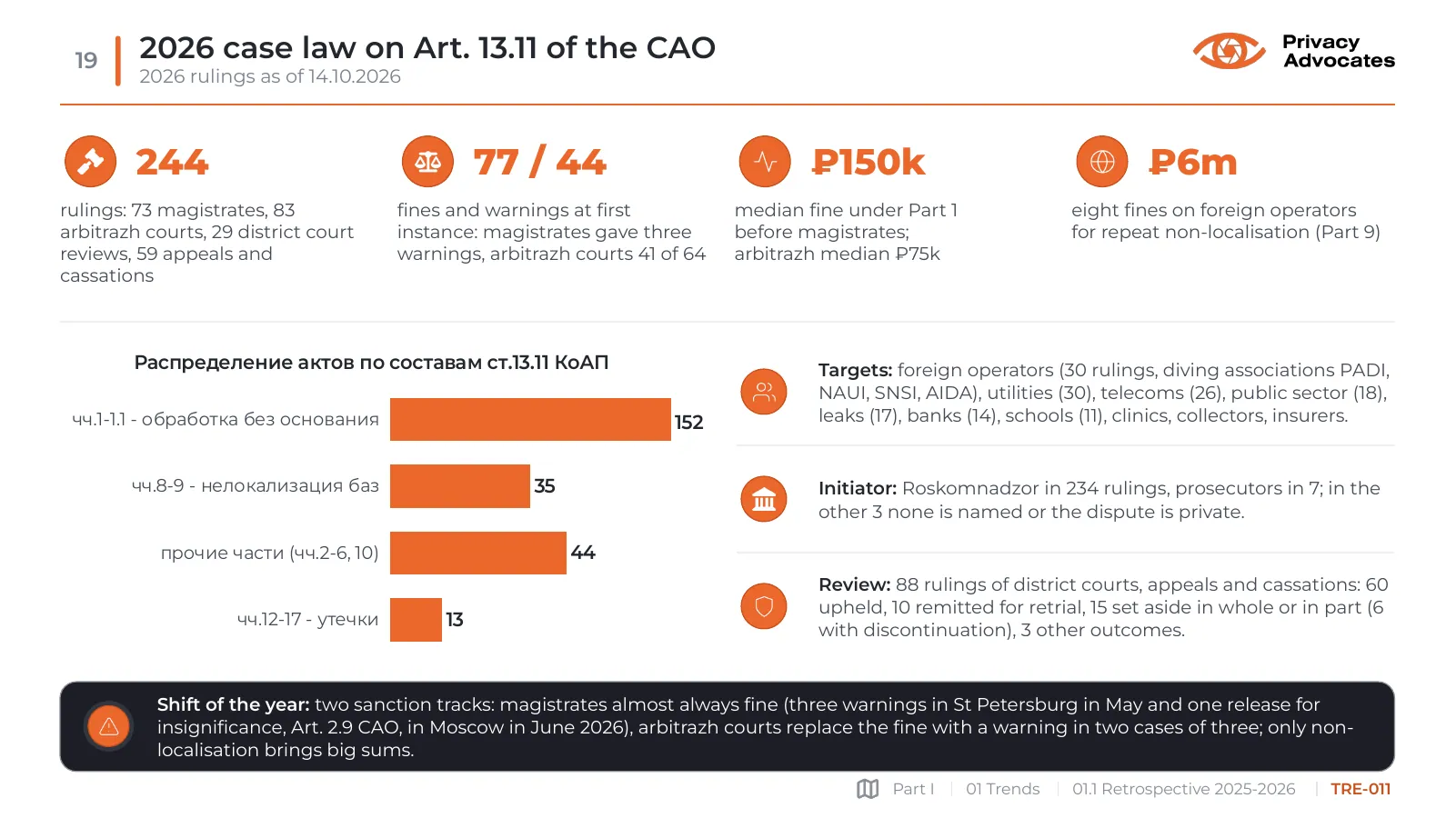
244
rulings: 73 magistrates, 83 arbitrazh courts, 29 district court reviews, 59 appeals and cassations
77 / 44
fines and warnings at first instance: magistrates gave three warnings, arbitrazh courts 41 of 64
₽150k
median fine under Part 1 before magistrates; arbitrazh median ₽75k
₽6m
eight fines on foreign operators for repeat non-localisation (Part 9)
Targets: foreign operators (30 rulings, diving associations PADI, NAUI, SNSI, AIDA), utilities (30), telecoms (26), public sector (18), leaks (17), banks (14), schools (11), clinics, collectors, insurers.
Initiator: Roskomnadzor in 234 rulings, prosecutors in 7; in the other 3 none is named or the dispute is private.
Review: 88 rulings of district courts, appeals and cassations: 60 upheld, 10 remitted for retrial, 15 set aside in whole or in part (6 with discontinuation), 3 other outcomes.
Shift of the year: two sanction tracks: magistrates almost always fine (three warnings in St Petersburg in May and one release for insignificance, Art. 2.9 CAO, in Moscow in June 2026), arbitrazh courts replace the fine with a warning in two cases of three; only non-localisation brings big sums.
Strict liability retreats, but contractors and silence do not help
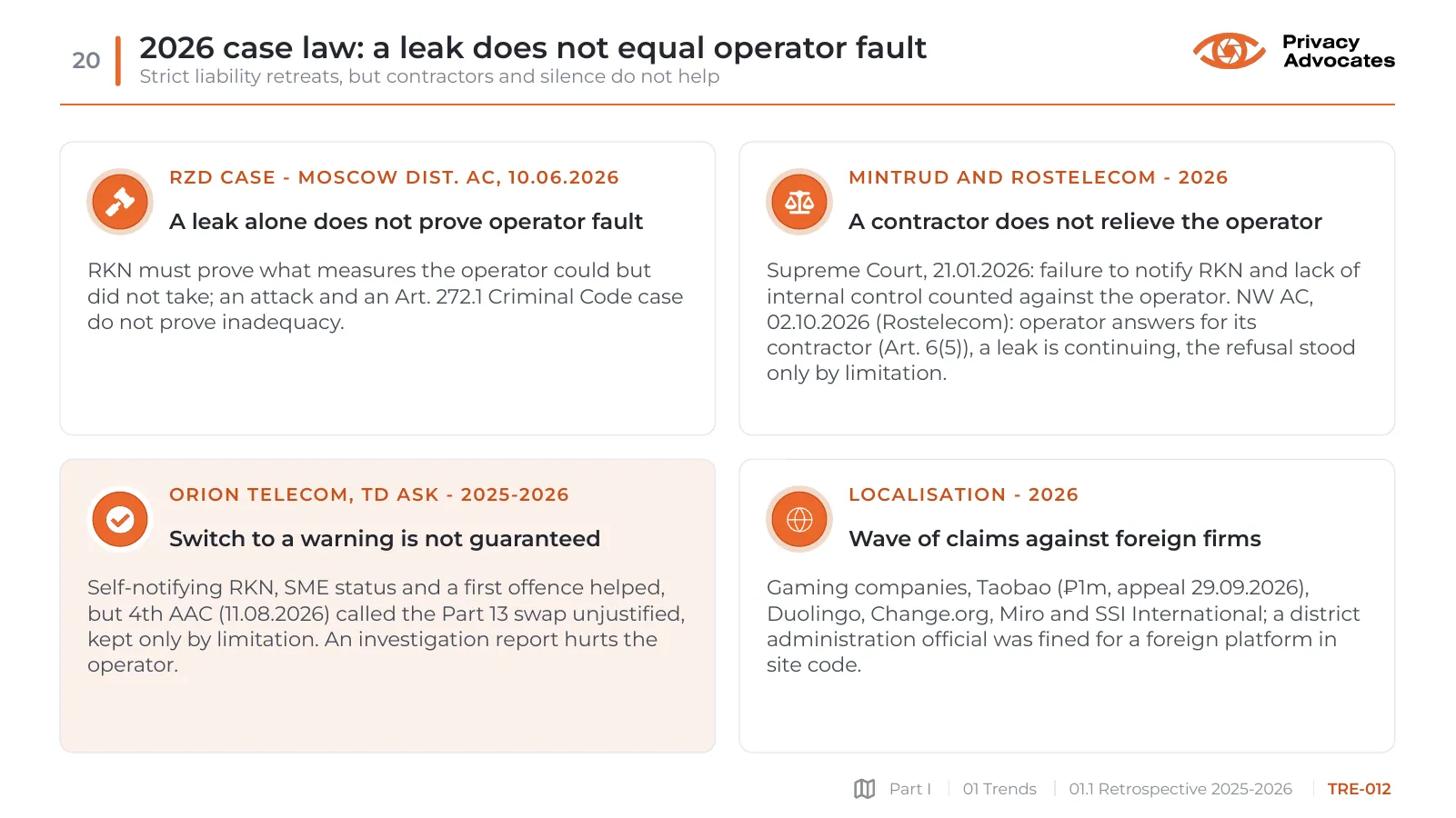
RZD CASE - MOSCOW DIST. AC, 10.06.2026
A leak alone does not prove operator fault
RKN must prove what measures the operator could but did not take; an attack and an Art. 272.1 Criminal Code case do not prove inadequacy.
MINTRUD AND ROSTELECOM - 2026
A contractor does not relieve the operator
Supreme Court, 21.01.2026: failure to notify RKN and lack of internal control counted against the operator. NW AC, 02.10.2026 (Rostelecom): operator answers for its contractor (Art. 6(5)), a leak is continuing, the refusal stood only by limitation.
ORION TELECOM, TD ASK - 2025-2026
Switch to a warning is not guaranteed
Self-notifying RKN, SME status and a first offence helped, but 4th AAC (11.08.2026) called the Part 13 swap unjustified, kept only by limitation. An investigation report hurts the operator.
LOCALISATION - 2026
Wave of claims against foreign firms
Gaming companies, Taobao (₽1m, appeal 29.09.2026), Duolingo, Change.org, Miro and SSI International; a district administration official was fined for a foreign platform in site code.
01.2
Consent leaves the throne, standards and onshoring take over, data moves from weak hands to strong
Each reform added a new mandatory property to consent
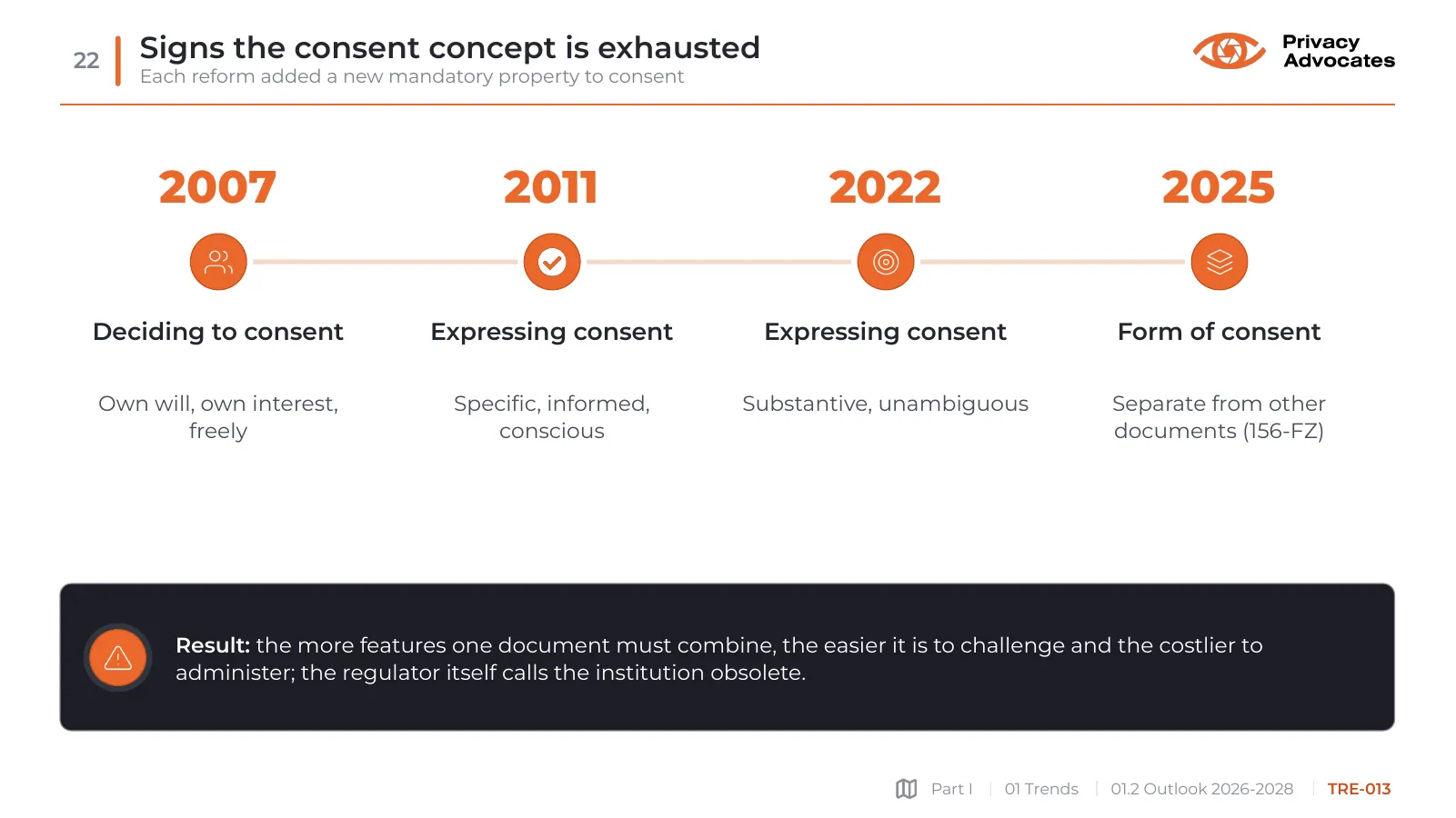
2007
Deciding to consent
Own will, own interest, freely
2011
Expressing consent
Specific, informed, conscious
2022
Expressing consent
Substantive, unambiguous
2025
Form of consent
Separate from other documents (156-FZ)
Result: the more features one document must combine, the easier it is to challenge and the costlier to administer; the regulator itself calls the institution obsolete.
Roskomnadzor's position: consent is obsolete, industry standards are needed
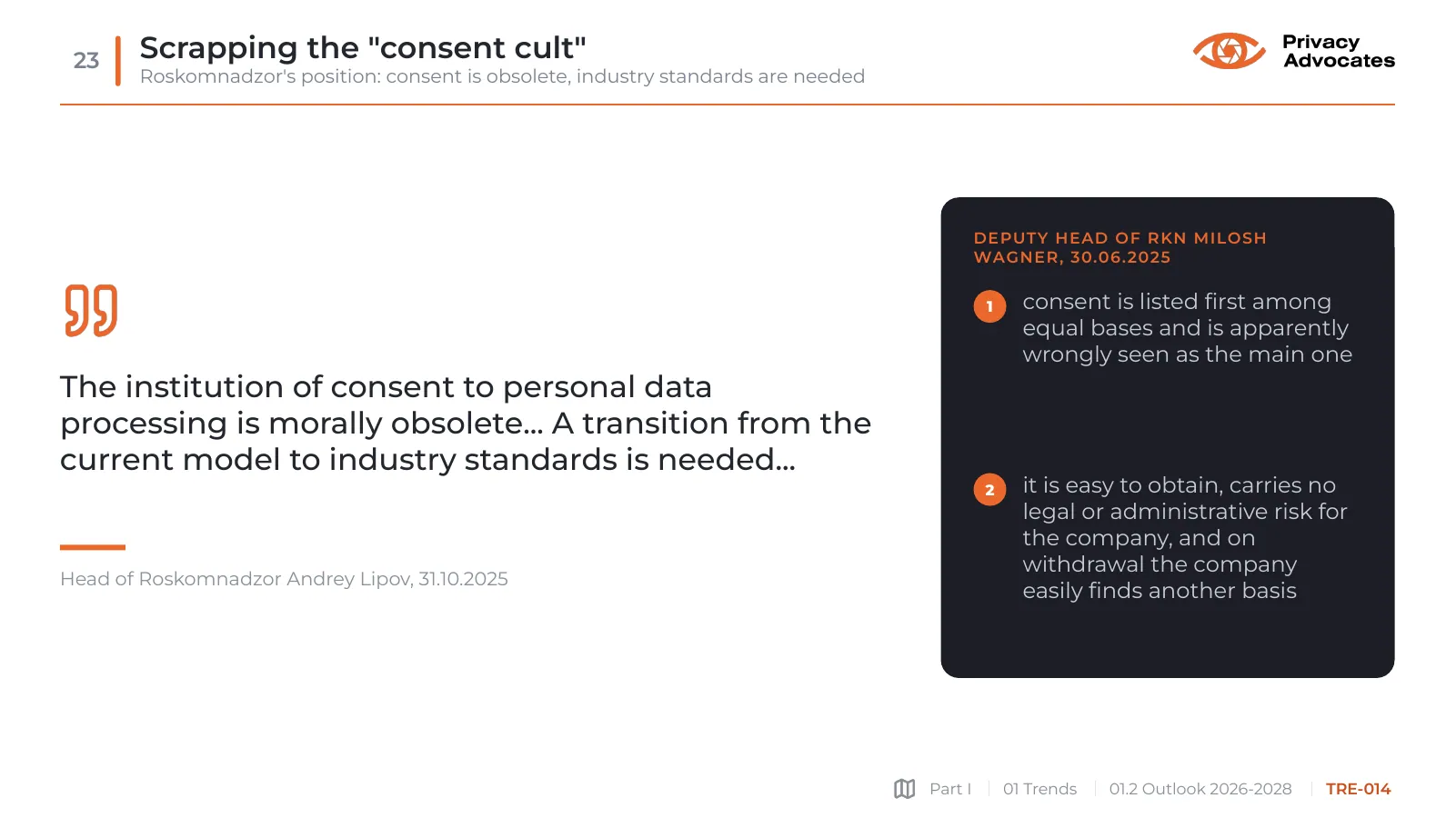
The institution of consent to personal data processing is morally obsolete... A transition from the current model to industry standards is needed...
Head of Roskomnadzor Andrey Lipov, 31.10.2025
Deputy Head of RKN Milosh Wagner, 30.06.2025
1
consent is listed first among equal bases and is apparently wrongly seen as the main one
2
it is easy to obtain, carries no legal or administrative risk for the company, and on withdrawal the company easily finds another basis
ESIA consent platform: from antifraud packages to the Doctrine
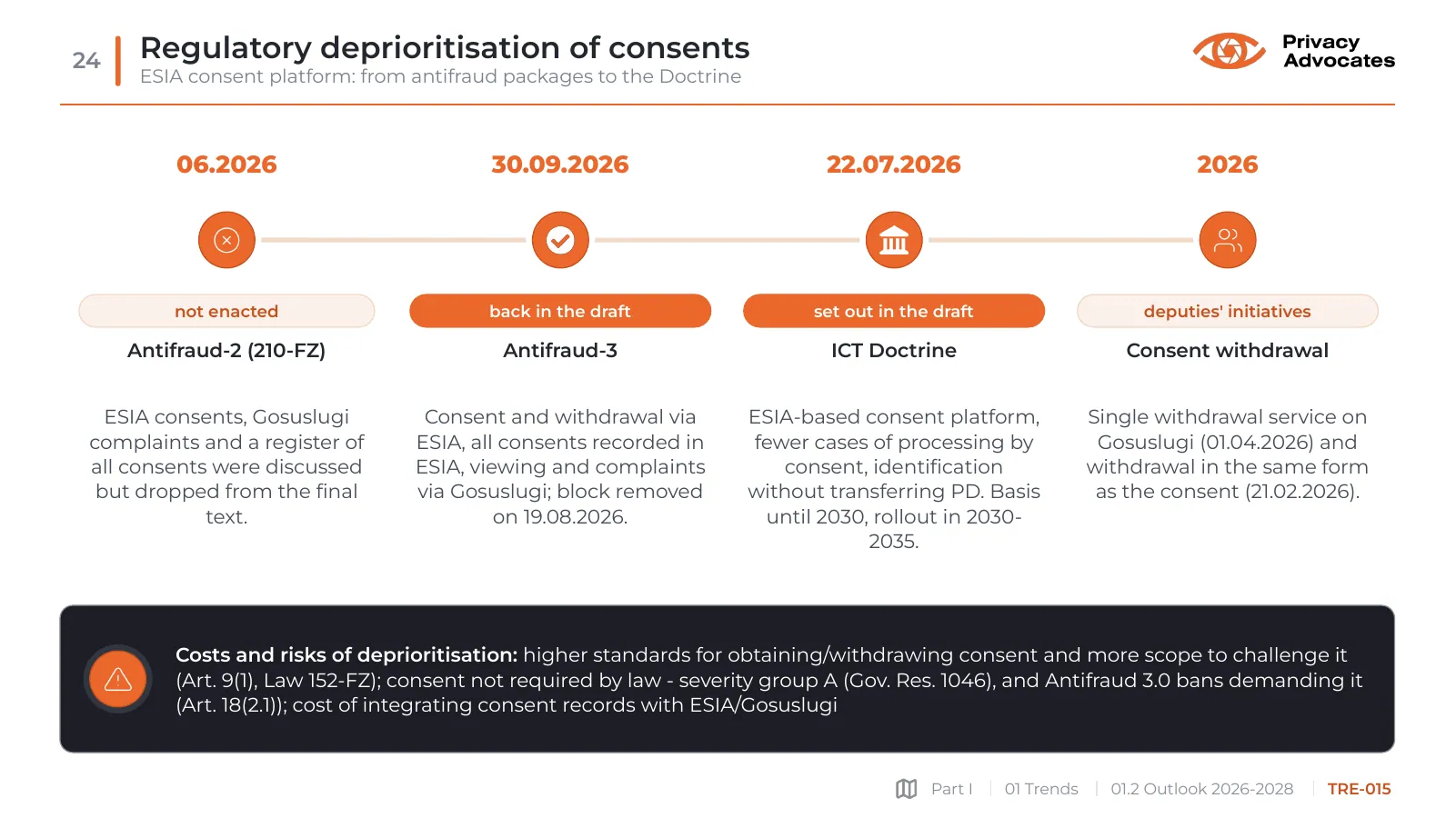
06.2026
not enacted
Antifraud-2 (210-FZ)
ESIA consents, Gosuslugi complaints and a register of all consents were discussed but dropped from the final text.
30.09.2026
back in the draft
Antifraud-3
Consent and withdrawal via ESIA, all consents recorded in ESIA, viewing and complaints via Gosuslugi; block removed on 19.08.2026.
22.07.2026
set out in the draft
ICT Doctrine
ESIA-based consent platform, fewer cases of processing by consent, identification without transferring PD. Basis until 2030, rollout in 2030-2035.
2026
deputies' initiatives
Consent withdrawal
Single withdrawal service on Gosuslugi (01.04.2026) and withdrawal in the same form as the consent (21.02.2026).
Costs and risks of deprioritisation: higher standards for obtaining/withdrawing consent and more scope to challenge it (Art. 9(1), Law 152-FZ); consent not required by law - severity group A (Gov. Res. 1046), and Antifraud 3.0 bans demanding it (Art. 18(2.1)); cost of integrating consent records with ESIA/Gosuslugi
Draft of 30.09.2026: consents, withdrawals, complaints go via ESIA and Gosuslugi
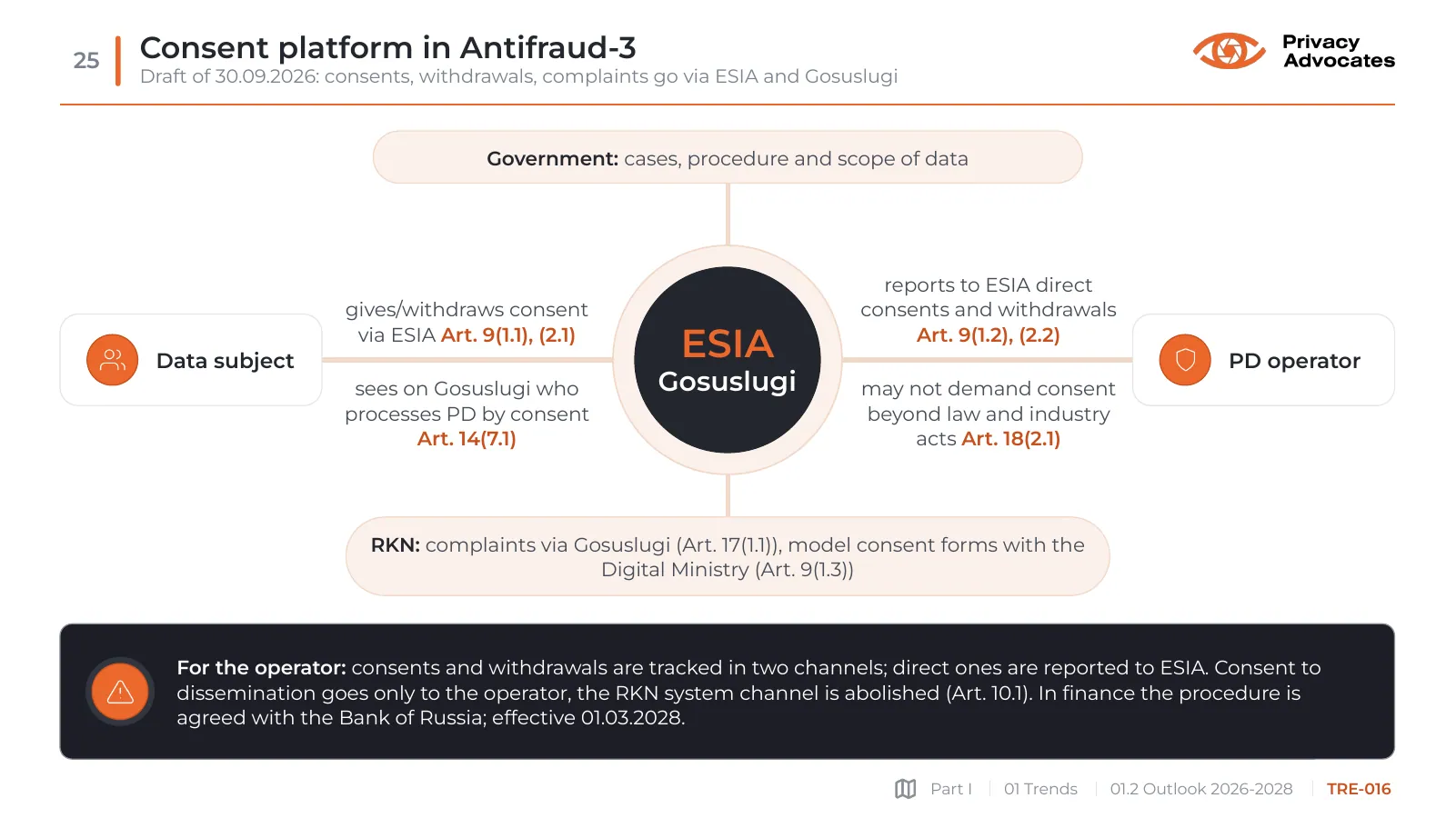
Government: cases, procedure and scope of data
ESIA
Gosuslugi
gives/withdraws consent via ESIA Art. 9(1.1), (2.1)
sees on Gosuslugi who processes PD by consent Art. 14(7.1)
reports to ESIA direct consents and withdrawals Art. 9(1.2), (2.2)
may not demand consent beyond law and industry acts Art. 18(2.1)
RKN: complaints via Gosuslugi (Art. 17(1.1)), model consent forms with the Digital Ministry (Art. 9(1.3))
For the operator: consents and withdrawals are tracked in two channels; direct ones are reported to ESIA. Consent to dissemination goes only to the operator, the RKN system channel is abolished (Art. 10.1). In finance the procedure is agreed with the Bank of Russia; effective 01.03.2028.
2025: one consent to rule them all. 2026-2028: four equal legal bases
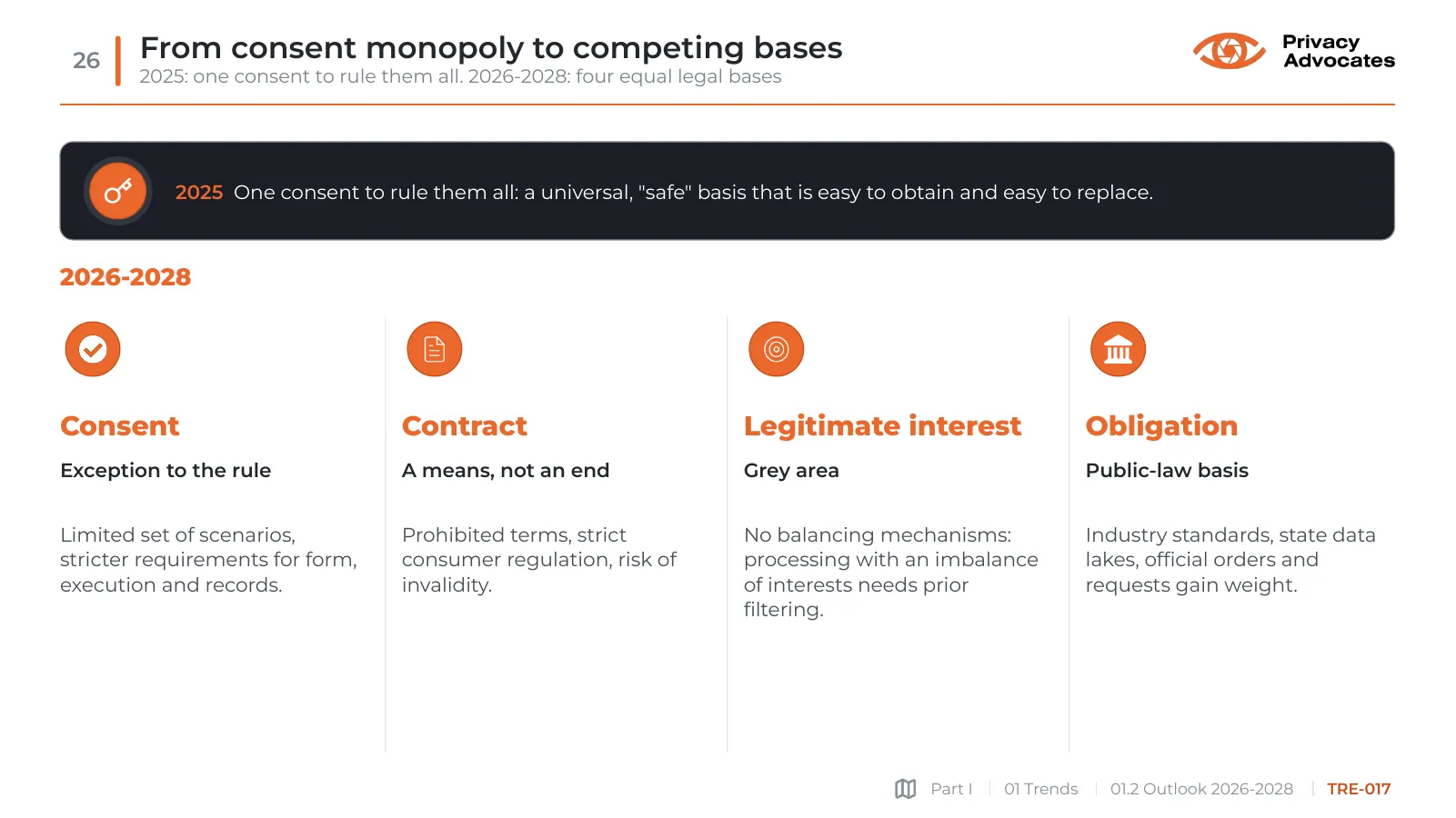
2025 One consent to rule them all: a universal, "safe" basis that is easy to obtain and easy to replace.
2026-2028
Consent
Exception to the rule
Limited set of scenarios, stricter requirements for form, execution and records.
Contract
A means, not an end
Prohibited terms, strict consumer regulation, risk of invalidity.
Legitimate interest
Grey area
No balancing mechanisms: processing with an imbalance of interests needs prior filtering.
Obligation
Public-law basis
Industry standards, state data lakes, official orders and requests gain weight.
Consent is preferable in a limited set of scenarios
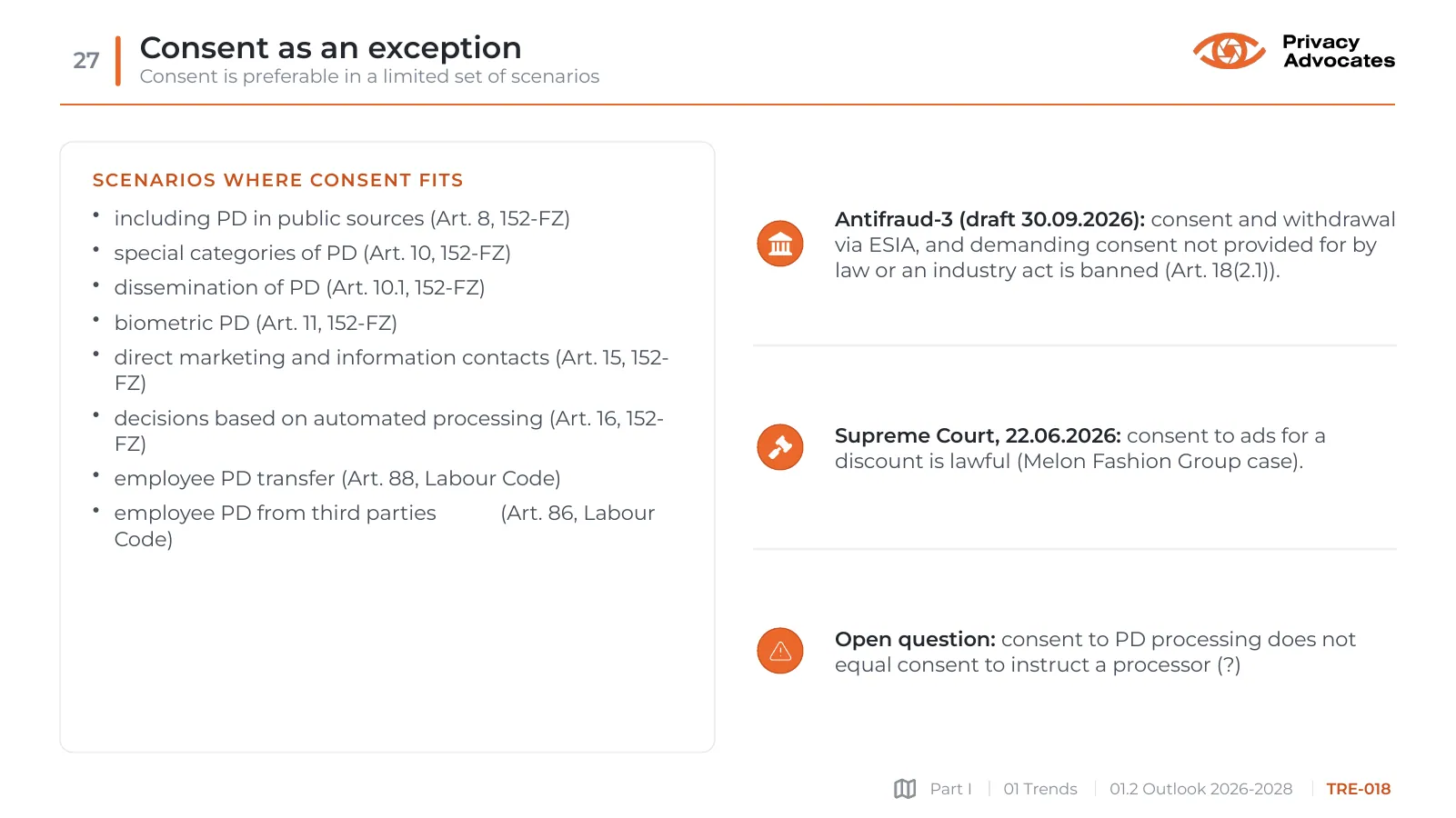
SCENARIOS WHERE CONSENT FITS
including PD in public sources (Art. 8, 152-FZ)
special categories of PD (Art. 10, 152-FZ)
dissemination of PD (Art. 10.1, 152-FZ)
biometric PD (Art. 11, 152-FZ)
direct marketing and information contacts (Art. 15, 152-FZ)
decisions based on automated processing (Art. 16, 152-FZ)
employee PD transfer (Art. 88, Labour Code)
employee PD from third parties (Art. 86, Labour Code)
Antifraud-3 (draft 30.09.2026): consent and withdrawal via ESIA, and demanding consent not provided for by law or an industry act is banned (Art. 18(2.1)).
Supreme Court, 22.06.2026: consent to ads for a discount is lawful (Melon Fashion Group case).
Open question: consent to PD processing does not equal consent to instruct a processor (?)
Contractual basis under pressure from consumer regulation
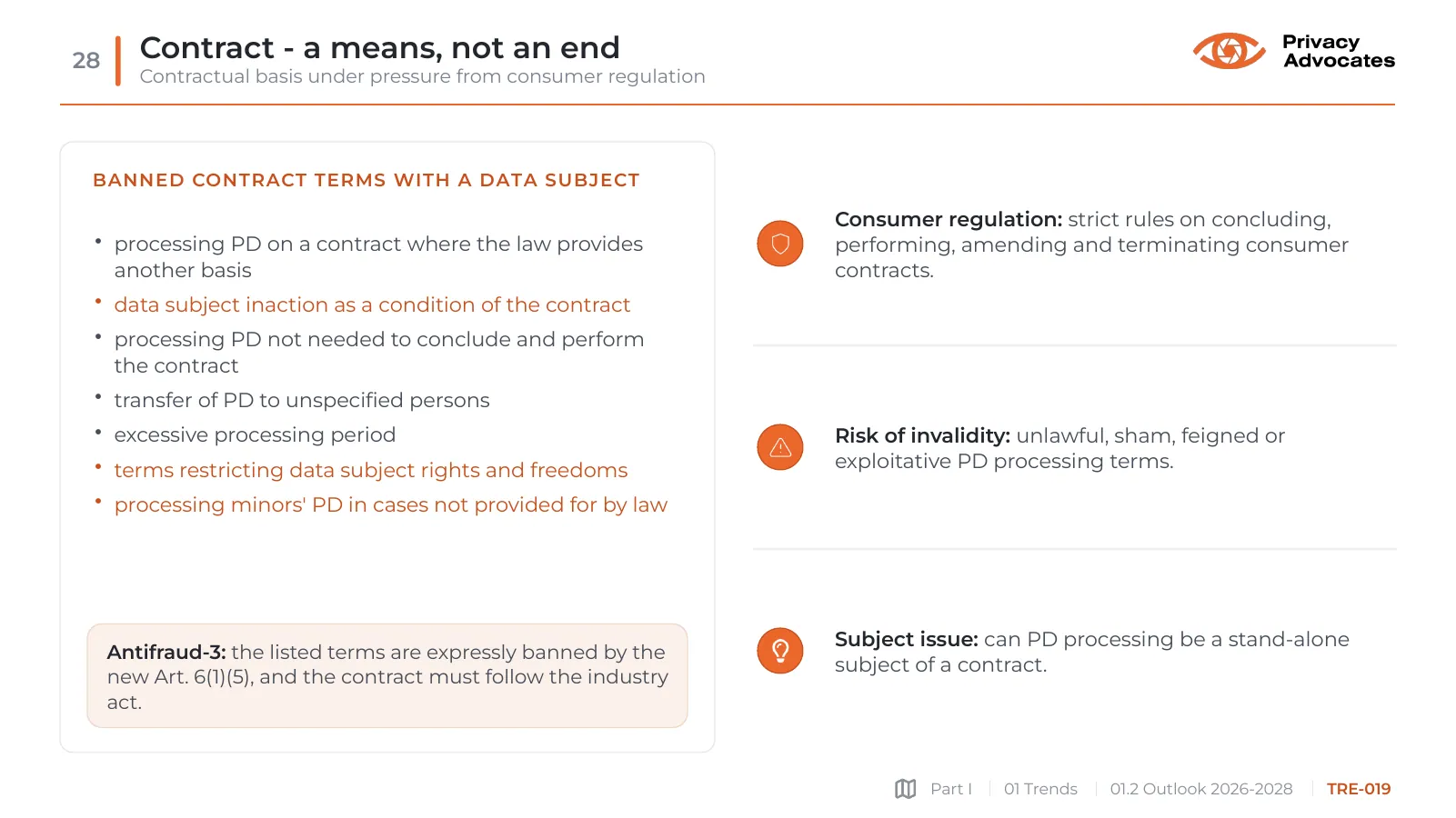
BANNED CONTRACT TERMS WITH A DATA SUBJECT
processing PD on a contract where the law provides another basis
data subject inaction as a condition of the contract
processing PD not needed to conclude and perform the contract
transfer of PD to unspecified persons
excessive processing period
terms restricting data subject rights and freedoms
processing minors' PD in cases not provided for by law
Consumer regulation: strict rules on concluding, performing, amending and terminating consumer contracts.
Risk of invalidity: unlawful, sham, feigned or exploitative PD processing terms.
Subject issue: can PD processing be a stand-alone subject of a contract.
Antifraud-3: the listed terms are expressly banned by the new Art. 6(1)(5), and the contract must follow the industry act.
Basis exists, no assessment or balancing mechanism
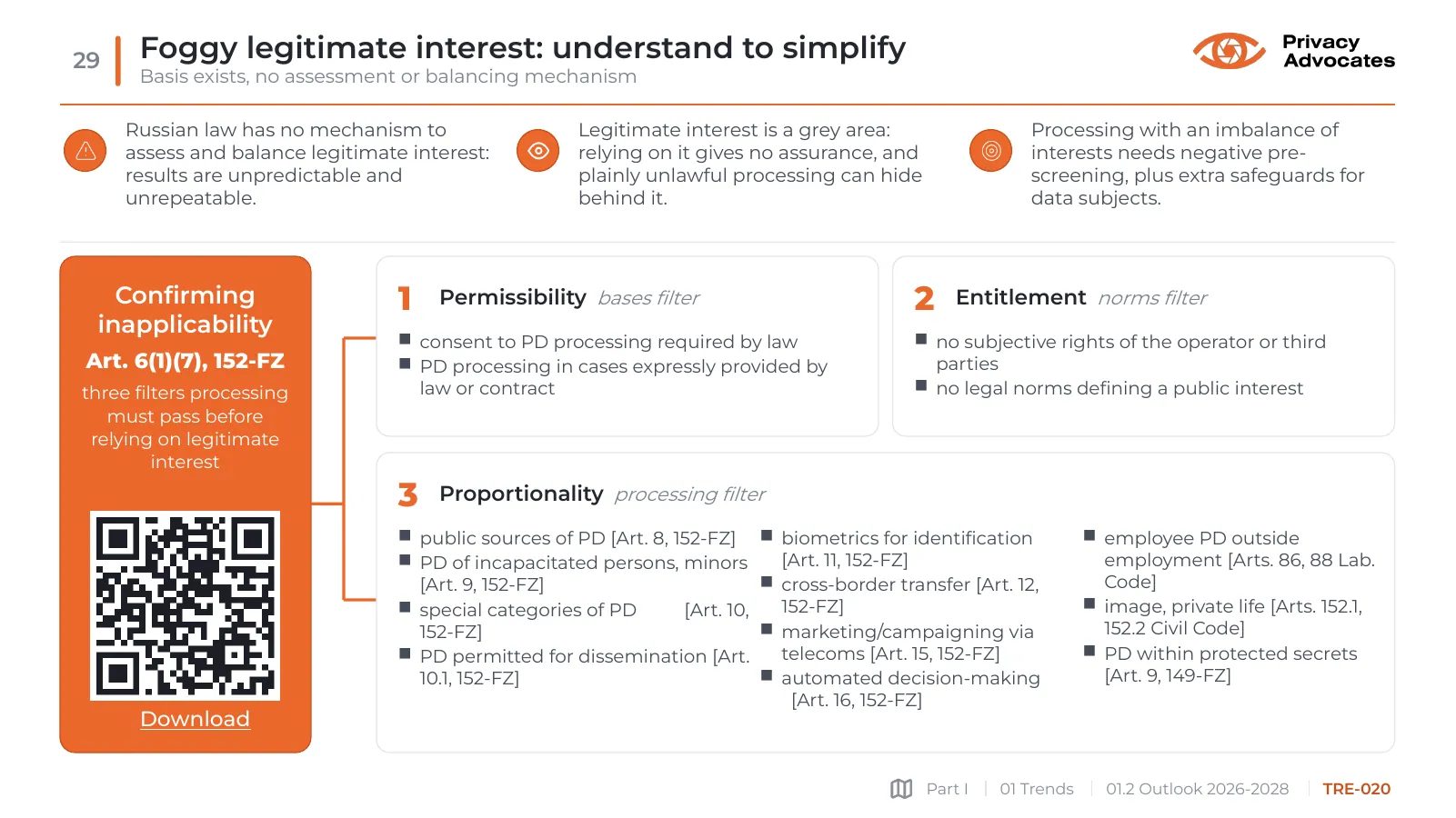
Confirming inapplicability
Art. 6(1)(7), 152-FZ
three filters processing must pass before relying on legitimate interest
consent to PD processing required by law
PD processing in cases expressly provided by law or contract
no subjective rights of the operator or third parties
no legal norms defining a public interest
public sources of PD [Art. 8, 152-FZ]
PD of incapacitated persons, minors [Art. 9, 152-FZ]
special categories of PD [Art. 10, 152-FZ]
PD permitted for dissemination [Art. 10.1, 152-FZ]
biometrics for identification [Art. 11, 152-FZ]
cross-border transfer [Art. 12, 152-FZ]
marketing/campaigning via telecoms [Art. 15, 152-FZ]
automated decision-making [Art. 16, 152-FZ]
employee PD outside employment [Arts. 86, 88 Lab. Code]
image, private life [Arts. 152.1, 152.2 Civil Code]
PD within protected secrets [Art. 9, 149-FZ]
Minimisation via standards instead of consents
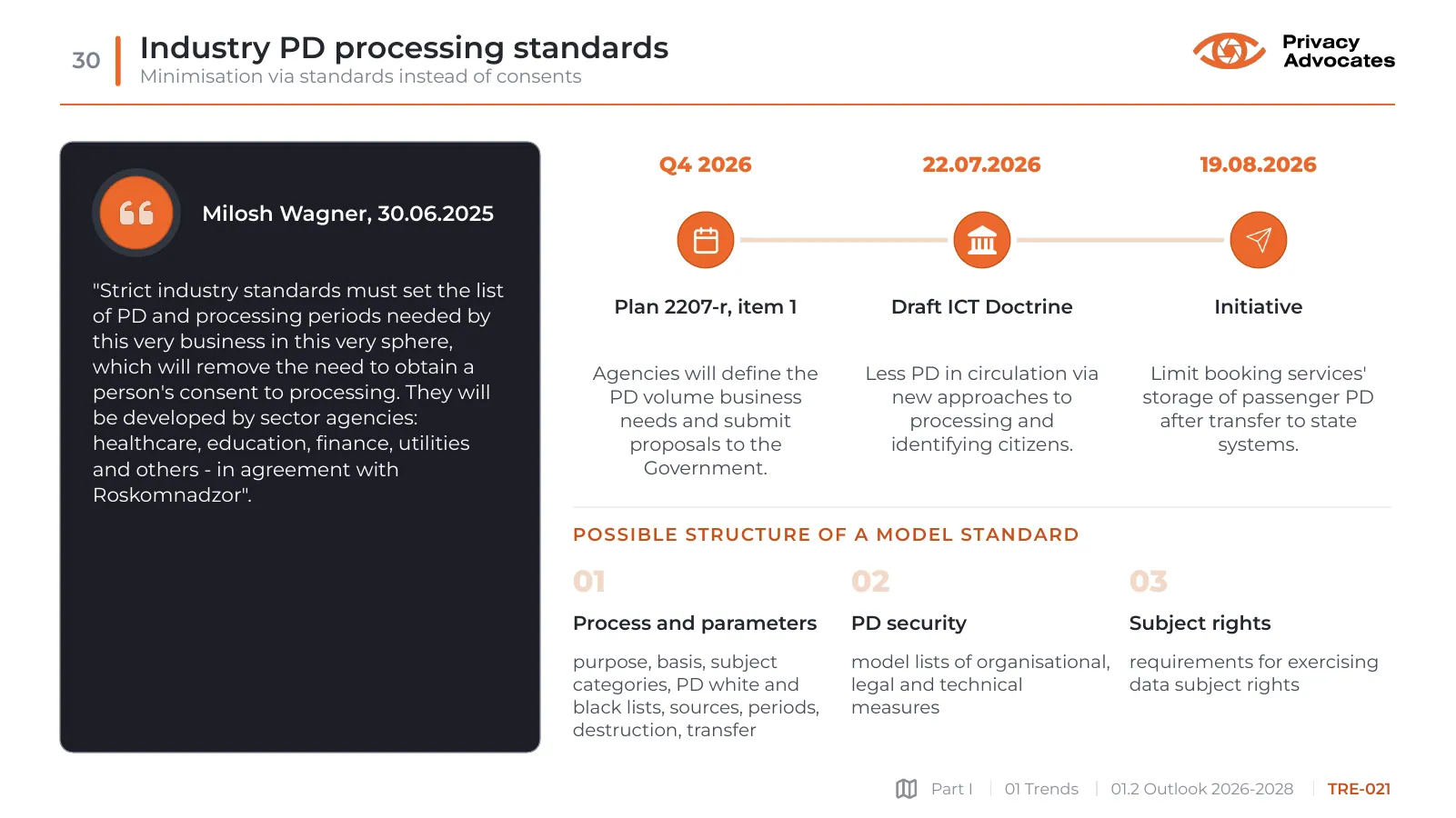
Milosh Wagner, 30.06.2025
"Strict industry standards must set the list of PD and processing periods needed by this very business in this very sphere, which will remove the need to obtain a person's consent to processing. They will be developed by sector agencies: healthcare, education, finance, utilities and others - in agreement with Roskomnadzor".
Q4 2026
Plan 2207-r, item 1
Agencies will define the PD volume business needs and submit proposals to the Government.
22.07.2026
Draft ICT Doctrine
Less PD in circulation via new approaches to processing and identifying citizens.
19.08.2026
Initiative
Limit booking services' storage of passenger PD after transfer to state systems.
POSSIBLE STRUCTURE OF A MODEL STANDARD
01
Process and parameters
purpose, basis, subject categories, PD white and black lists, sources, periods, destruction, transfer
02
PD security
model lists of organisational, legal and technical measures
03
Subject rights
requirements for exercising data subject rights
Antifraud-3 puts industry standards into Arts. 4 and 6, Law 152-FZ
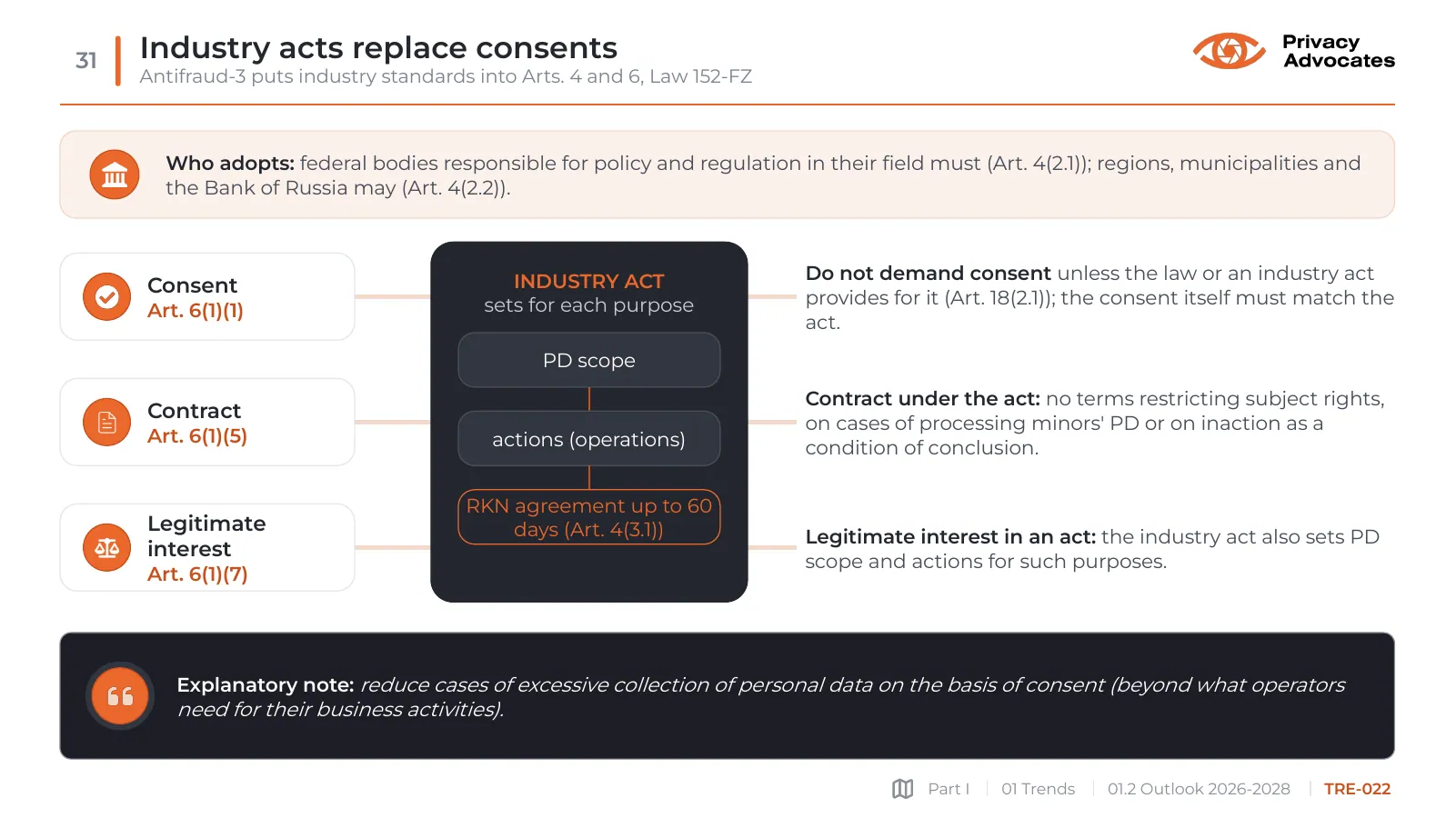
Who adopts: federal bodies responsible for policy and regulation in their field must (Art. 4(2.1)); regions, municipalities and the Bank of Russia may (Art. 4(2.2)).
Consent
Art. 6(1)(1)
Contract
Art. 6(1)(5)
Legitimate interest
Art. 6(1)(7)
INDUSTRY ACT
sets for each purpose
PD scope
actions (operations)
RKN agreement up to 60 days (Art. 4(3.1))
Do not demand consent unless the law or an industry act provides for it (Art. 18(2.1)); the consent itself must match the act.
Contract under the act: no terms restricting subject rights, on cases of processing minors' PD or on inaction as a condition of conclusion.
Legitimate interest in an act: the industry act also sets PD scope and actions for such purposes.
Explanatory note: reduce cases of excessive collection of personal data on the basis of consent (beyond what operators need for their business activities).
Special operators delayed, not dropped
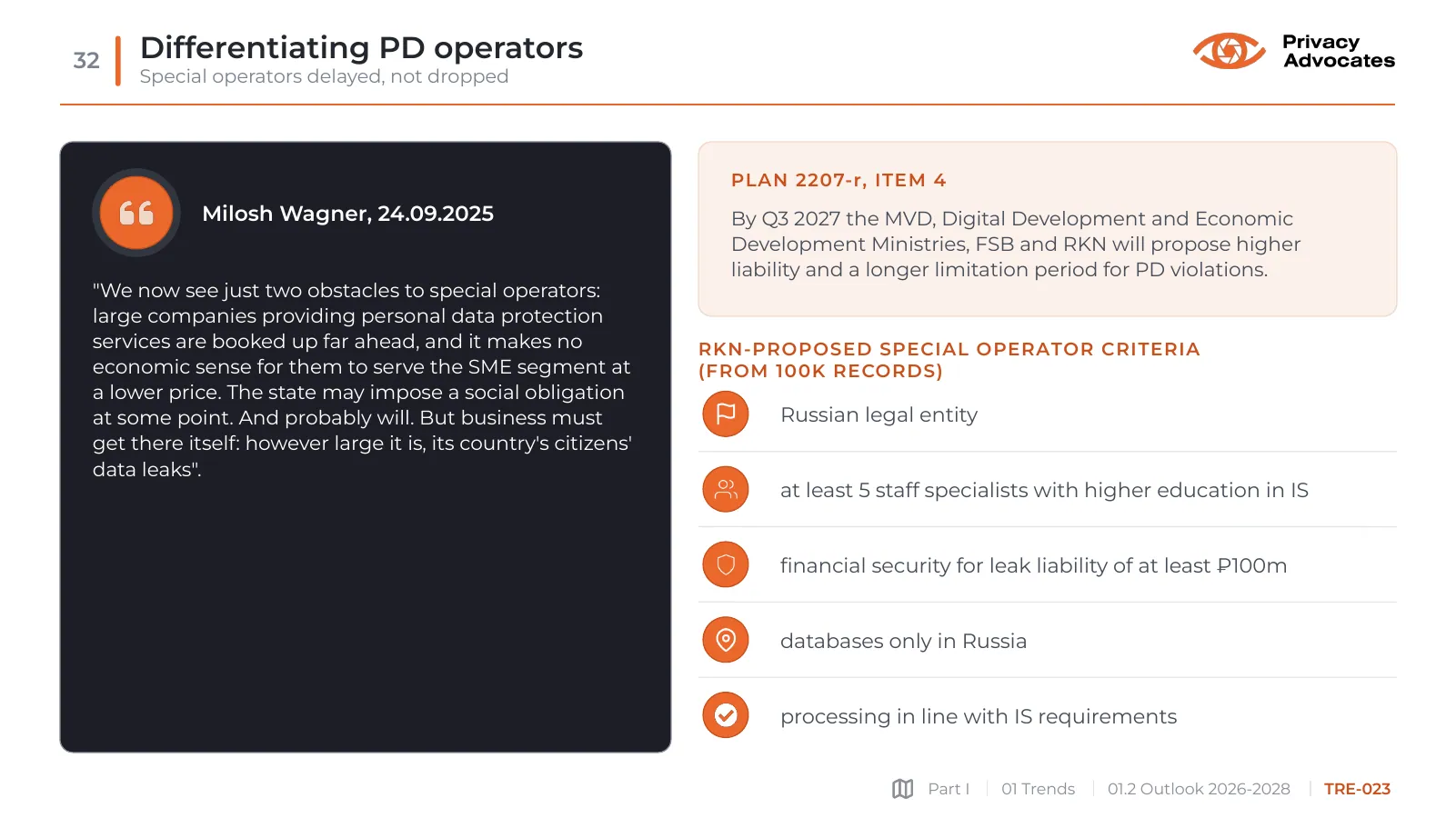
Milosh Wagner, 24.09.2025
"We now see just two obstacles to special operators: large companies providing personal data protection services are booked up far ahead, and it makes no economic sense for them to serve the SME segment at a lower price. The state may impose a social obligation at some point. And probably will. But business must get there itself: however large it is, its country's citizens' data leaks".
PLAN 2207-r, ITEM 4
By Q3 2027 the MVD, Digital Development and Economic Development Ministries, FSB and RKN will propose higher liability and a longer limitation period for PD violations.
RKN-PROPOSED SPECIAL OPERATOR CRITERIA
(FROM 100K RECORDS)
Russian legal entity
at least 5 staff specialists with higher education in IS
financial security for leak liability of at least ₽100m
databases only in Russia
processing in line with IS requirements
Order 117 applies, the methodology frames measures, the No. 21 replacement is a draft
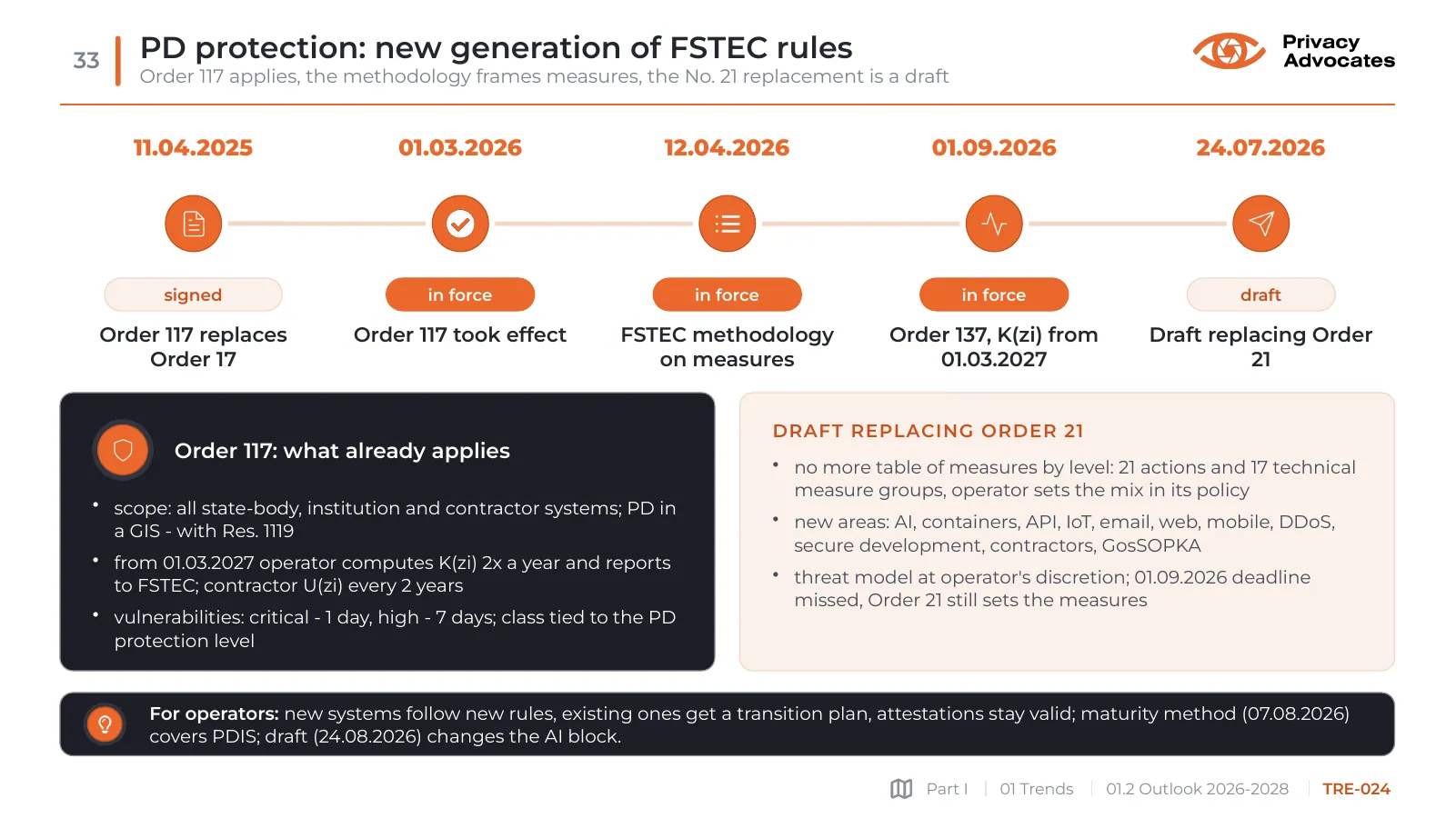
11.04.2025
signed
Order 117 replaces Order 17
01.03.2026
in force
Order 117 took effect
12.04.2026
in force
FSTEC methodology on measures
01.09.2026
in force
Order 137, K(zi) from 01.03.2027
24.07.2026
draft
Draft replacing Order 21
Order 117: what already applies
scope: all state-body, institution and contractor systems; PD in a GIS - with Res. 1119
from 01.03.2027 operator computes K(zi) 2x a year and reports to FSTEC; contractor U(zi) every 2 years
vulnerabilities: critical - 1 day, high - 7 days; class tied to the PD protection level
DRAFT REPLACING ORDER 21
no more table of measures by level: 21 actions and 17 technical measure groups, operator sets the mix in its policy
new areas: AI, containers, API, IoT, email, web, mobile, DDoS, secure development, contractors, GosSOPKA
threat model at operator's discretion; 01.09.2026 deadline missed, Order 21 still sets the measures
For operators: new systems follow new rules, existing ones get a transition plan, attestations stay valid; maturity method (07.08.2026) covers PDIS; draft (24.08.2026) changes the AI block.
Russian software, data centres and AI models, plus Russian control of channels
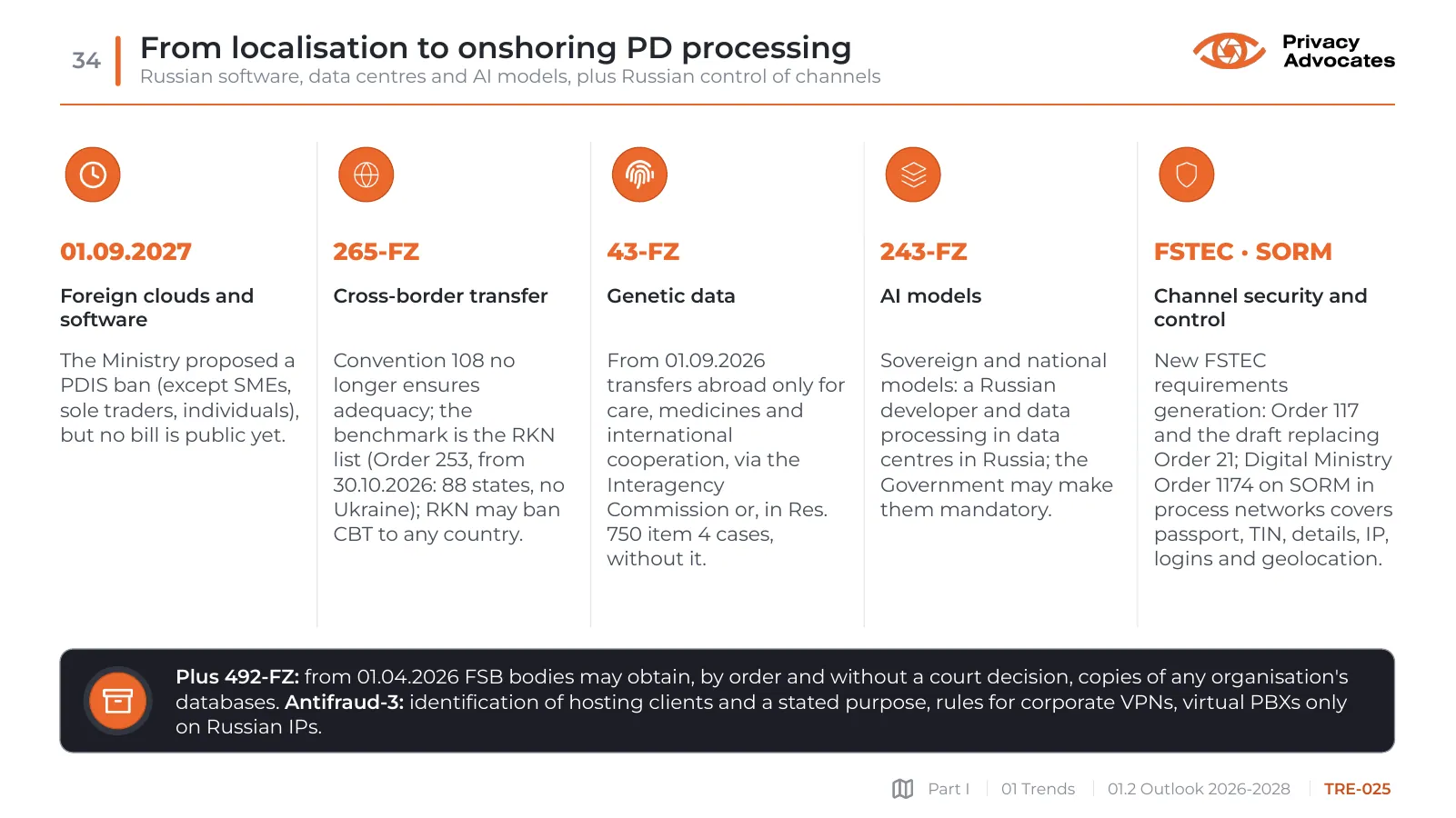
01.09.2027
Foreign clouds and software
The Ministry proposed a PDIS ban (except SMEs, sole traders, individuals), but no bill is public yet.
265-FZ
Cross-border transfer
Convention 108 no longer ensures adequacy; the benchmark is the RKN list (Order 253, from 30.10.2026: 88 states, no Ukraine); RKN may ban CBT to any country.
43-FZ
Genetic data
From 01.09.2026 transfers abroad only for care, medicines and international cooperation, via the Interagency Commission or, in Res. 750 item 4 cases, without it.
243-FZ
AI models
Sovereign and national models: a Russian developer and data processing in data centres in Russia; the Government may make them mandatory.
FSTEC, SORM
Channel security and control
New FSTEC requirements generation: Order 117 and the draft replacing Order 21; Digital Ministry Order 1174 on SORM in process networks covers passport, TIN, details, IP, logins and geolocation.
Plus 492-FZ: from 01.04.2026 FSB bodies may obtain, by order and without a court decision, copies of any organisation's databases. Antifraud-3: identification of hosting clients and a stated purpose, rules for corporate VPNs, virtual PBXs only on Russian IPs.
Subscriber ID, children's SIM cards and new CAO offences
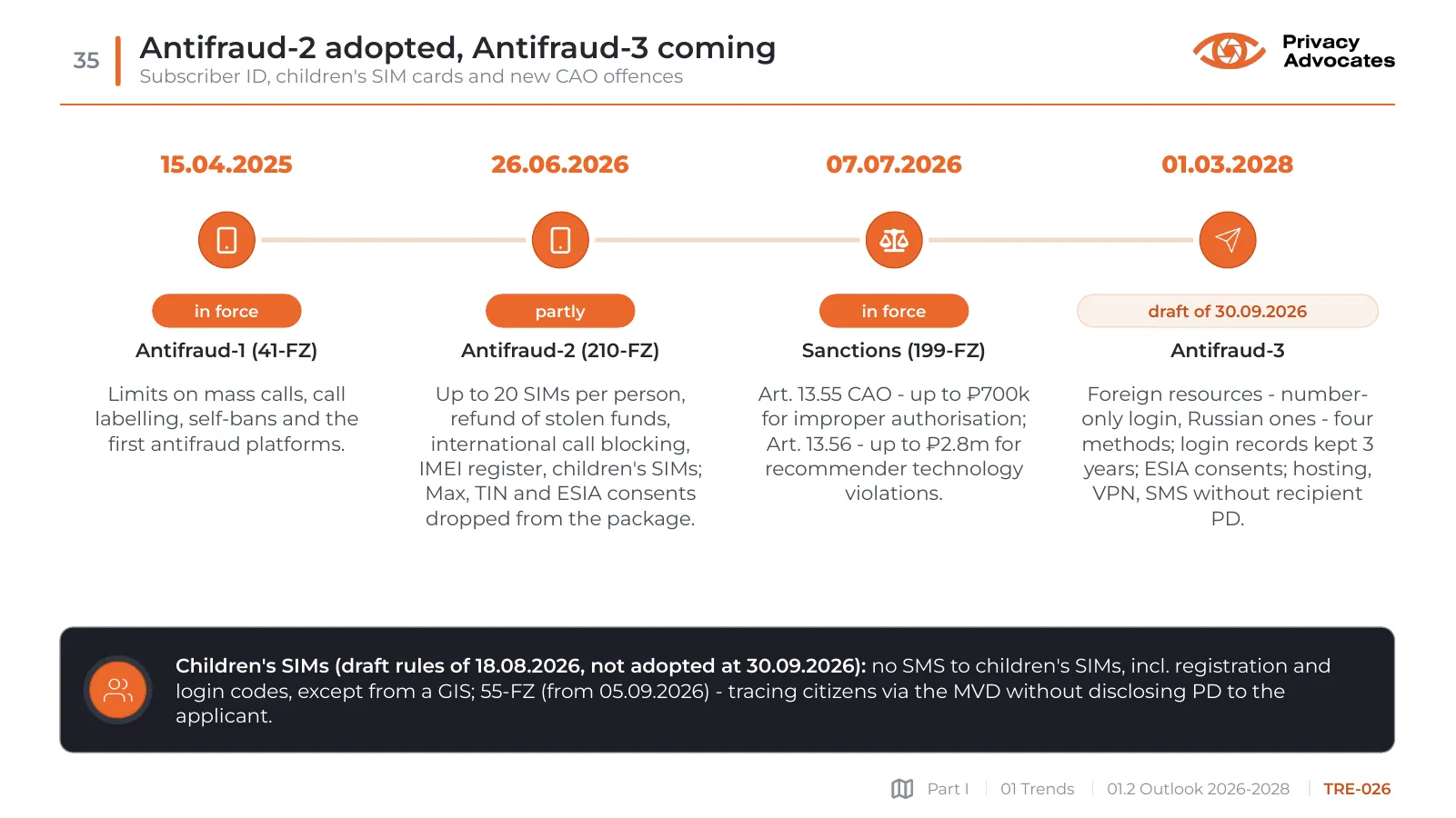
15.04.2025
in force
Antifraud-1 (41-FZ)
Limits on mass calls, call labelling, self-bans and the first antifraud platforms.
26.06.2026
partly
Antifraud-2 (210-FZ)
Up to 20 SIMs per person, refund of stolen funds, international call blocking, IMEI register, children's SIMs; Max, TIN and ESIA consents dropped from the package.
07.07.2026
in force
Sanctions (199-FZ)
Art. 13.55 CAO - up to ₽700k for improper authorisation; Art. 13.56 - up to ₽2.8m for recommender technology violations.
01.03.2028
draft of 30.09.2026
Antifraud-3
Foreign resources - number-only login, Russian ones - four methods; login records kept 3 years; ESIA consents; hosting, VPN, SMS without recipient PD.
Children's SIMs (draft rules of 18.08.2026, not adopted at 30.09.2026): no SMS to children's SIMs, incl. registration and login codes, except from a GIS; 55-FZ (from 05.09.2026) - tracing citizens via the MVD without disclosing PD to the applicant.
Nearest dates as of October 2026, draft deadlines tentative
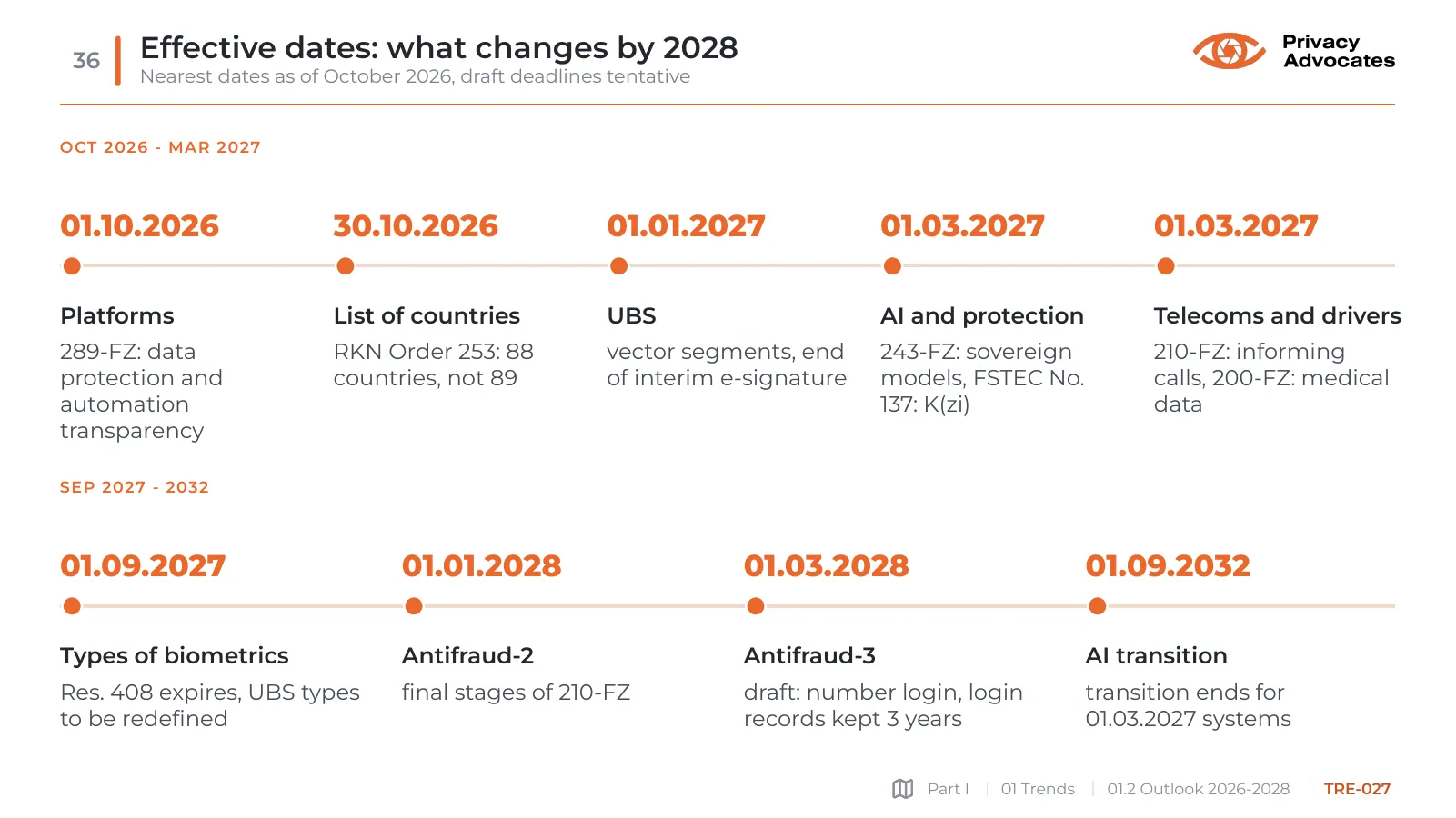
Oct 2026 - Mar 2027
01.10.2026
Platforms
289-FZ: data protection and automation transparency
30.10.2026
List of countries
RKN Order 253: 88 countries, not 89
01.01.2027
UBS
vector segments, end of interim e-signature
01.03.2027
AI and protection
243-FZ: sovereign models, FSTEC No. 137: K(zi)
01.03.2027
Telecoms and drivers
210-FZ: informing calls, 200-FZ: medical data
Sep 2027 - 2032
01.09.2027
Types of biometrics
Res. 408 expires, UBS types to be redefined
01.01.2028
Antifraud-2
final stages of 210-FZ
01.03.2028
Antifraud-3
draft: number login, login records kept 3 years
01.09.2032
AI transition
transition ends for 01.03.2027 systems
Art. 8(10), 149-FZ, fines from 07.07.2026, Antifraud-3 changes
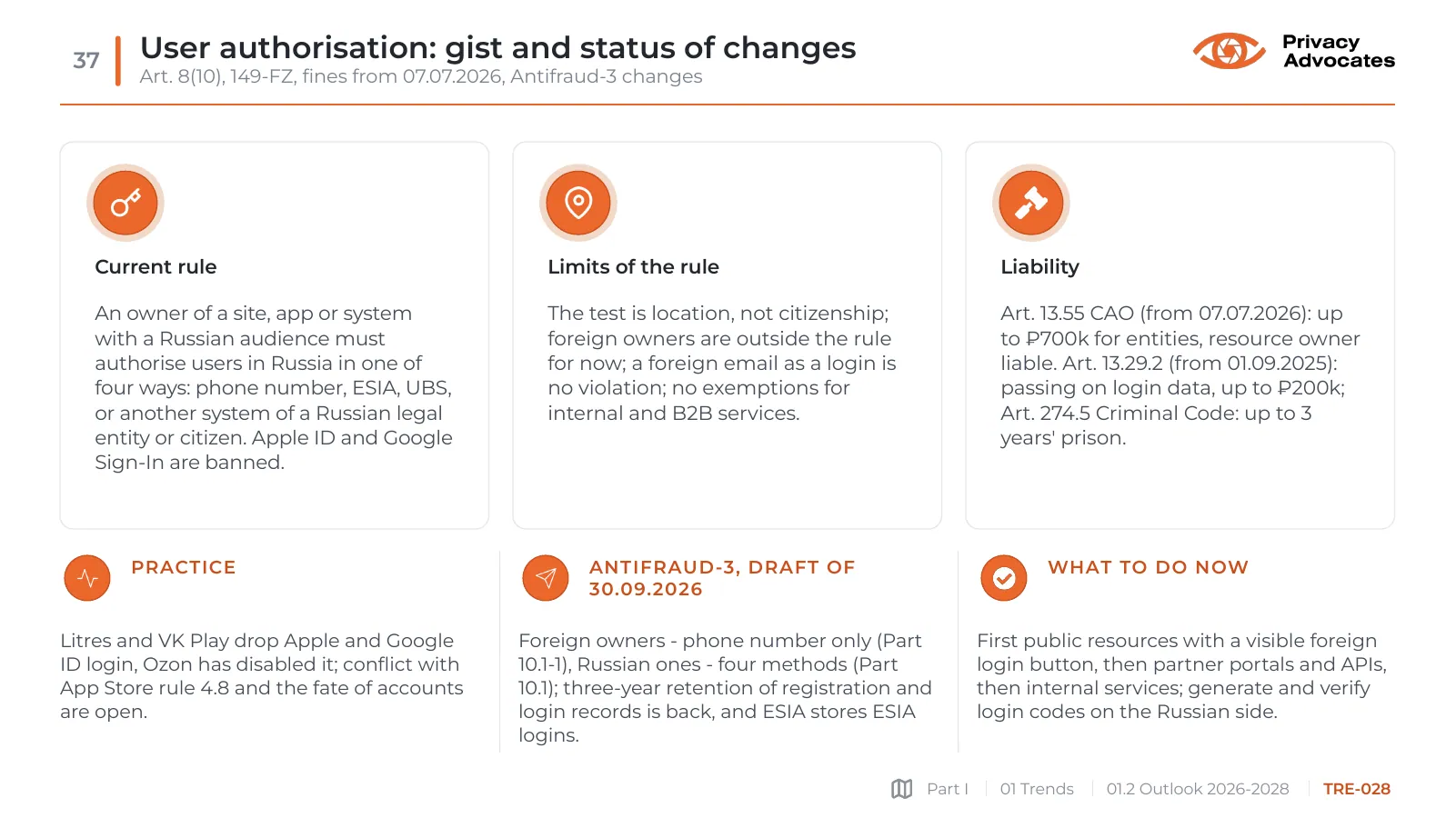
Current rule
An owner of a site, app or system with a Russian audience must authorise users in Russia in one of four ways: phone number, ESIA, UBS, or another system of a Russian legal entity or citizen. Apple ID and Google Sign-In are banned.
Limits of the rule
The test is location, not citizenship; foreign owners are outside the rule for now; a foreign email as a login is no violation; no exemptions for internal and B2B services.
Liability
Art. 13.55 CAO (from 07.07.2026): up to ₽700k for entities, resource owner liable. Art. 13.29.2 (from 01.09.2025): passing on login data, up to ₽200k; Art. 274.5 Criminal Code: up to 3 years' prison.
PRACTICE
Litres and VK Play drop Apple and Google ID login, Ozon has disabled it; conflict with App Store rule 4.8 and the fate of accounts are open.
ANTIFRAUD-3, DRAFT OF 30.09.2026
Foreign owners - phone number only (Part 10.1-1), Russian ones - four methods (Part 10.1); three-year retention of registration and login records is back, and ESIA stores ESIA logins.
WHAT TO DO NOW
First public resources with a visible foreign login button, then partner portals and APIs, then internal services; generate and verify login codes on the Russian side.
Digital tribute in Antifraud-3: logs, addresses, identifiers
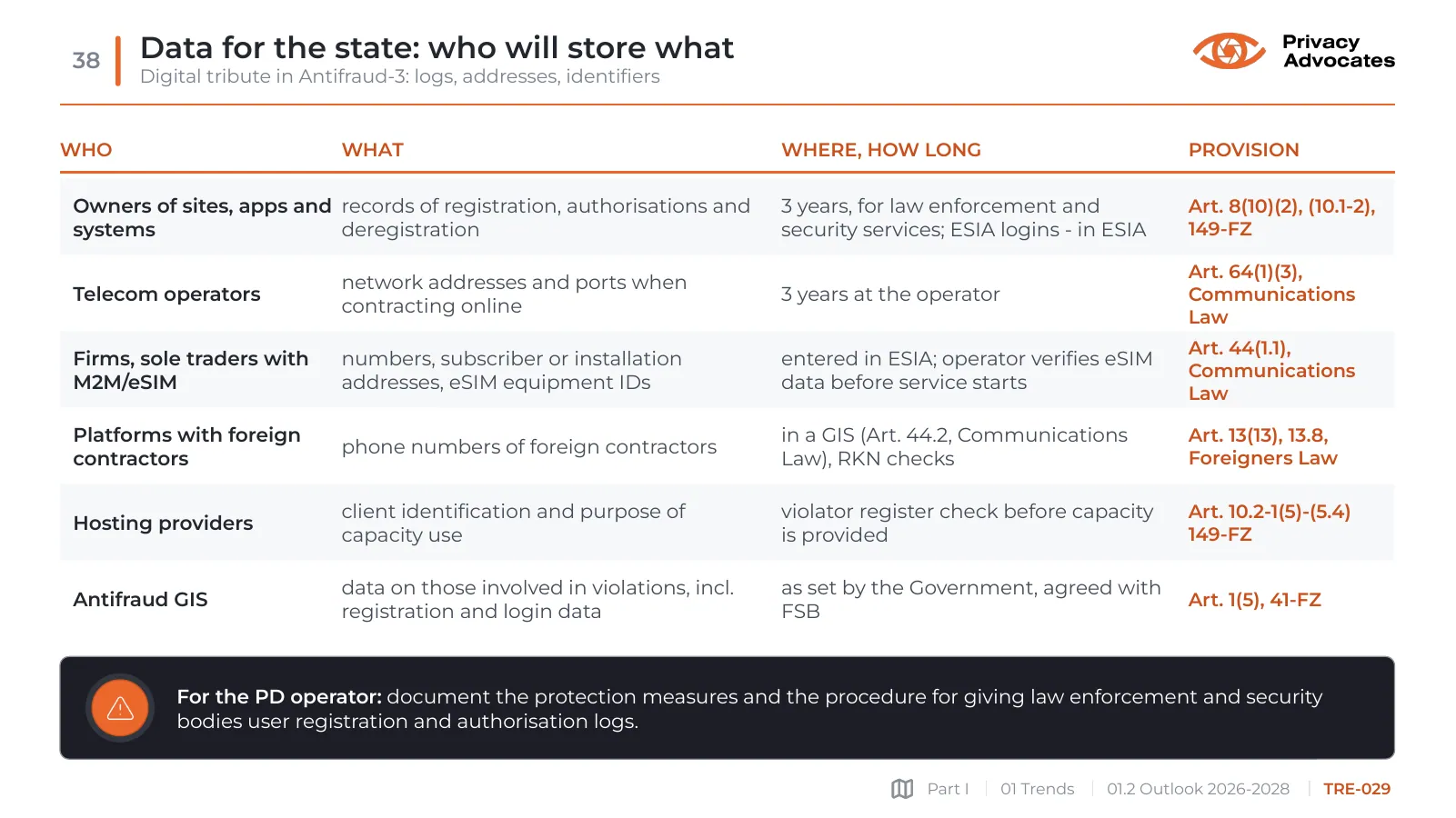
Art. 44(1.1),
Communications Law
Art. 10.2-1(5)-(5.4)
149-FZ
For the PD operator: document the protection measures and the procedure for giving law enforcement and security bodies user registration and authorisation logs.
243-FZ, institutions, standards, first practice
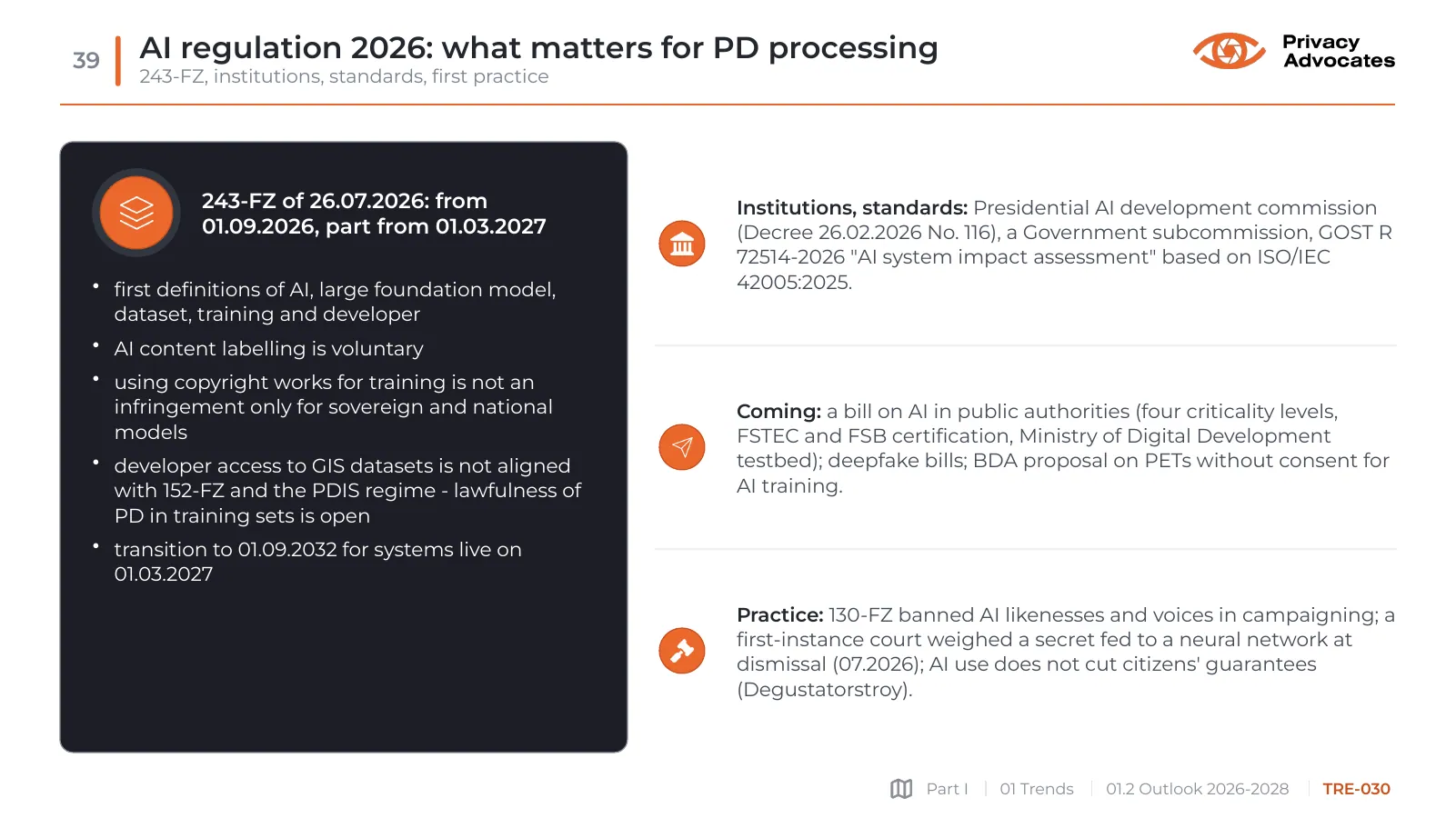
243-FZ of 26.07.2026: from 01.09.2026, part from 01.03.2027
first definitions of AI, large foundation model, dataset, training and developer
AI content labelling is voluntary
using copyright works for training is not an infringement only for sovereign and national models
developer access to GIS datasets is not aligned with 152-FZ and the PDIS regime - lawfulness of PD in training sets is open
transition to 01.09.2032 for systems live on 01.03.2027
Institutions, standards: Presidential AI development commission (Decree 26.02.2026 No. 116), a Government subcommission, GOST R 72514-2026 "AI system impact assessment" based on ISO/IEC 42005:2025.
Coming: a bill on AI in public authorities (four criticality levels, FSTEC and FSB certification, Ministry of Digital Development testbed); deepfake bills; BDA proposal on PETs without consent for AI training.
Practice: 130-FZ banned AI likenesses and voices in campaigning; a first-instance court weighed a secret fed to a neural network at dismissal (07.2026); AI use does not cut citizens' guarantees (Degustatorstroy).
Six trends and their status in autumn 2026
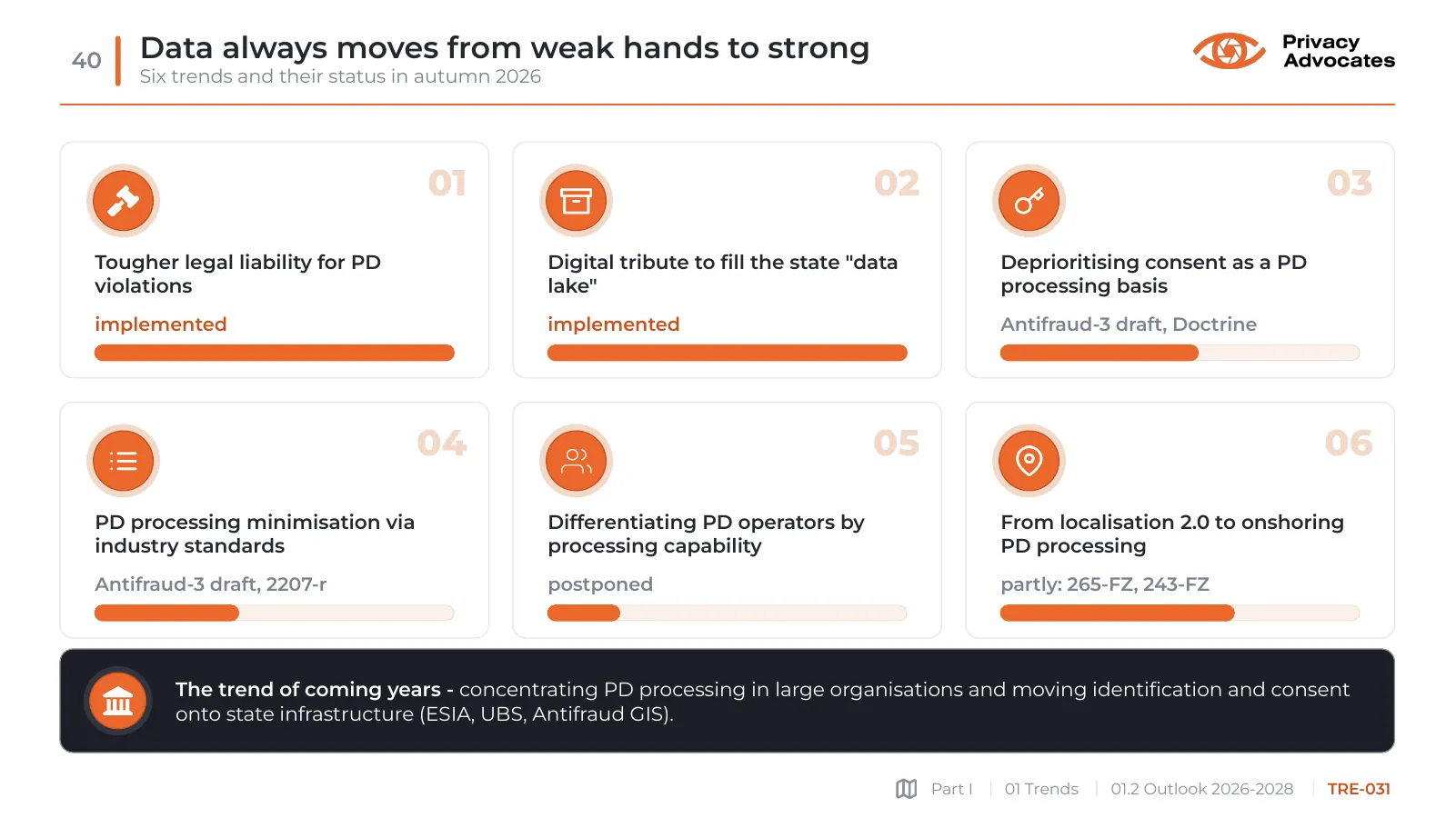
01
Tougher legal liability for PD violations
02
Digital tribute to fill the state "data lake"
03
Deprioritising consent as a PD processing basis
04
PD processing minimisation via industry standards
05
Differentiating PD operators by processing capability
06
From localisation 2.0 to onshoring PD processing
The trend of coming years - concentrating PD processing in large organisations and moving identification and consent onto state infrastructure (ESIA, UBS, Antifraud GIS).
01.3
Third package of measures against ICT-enabled offences: what it holds for PD
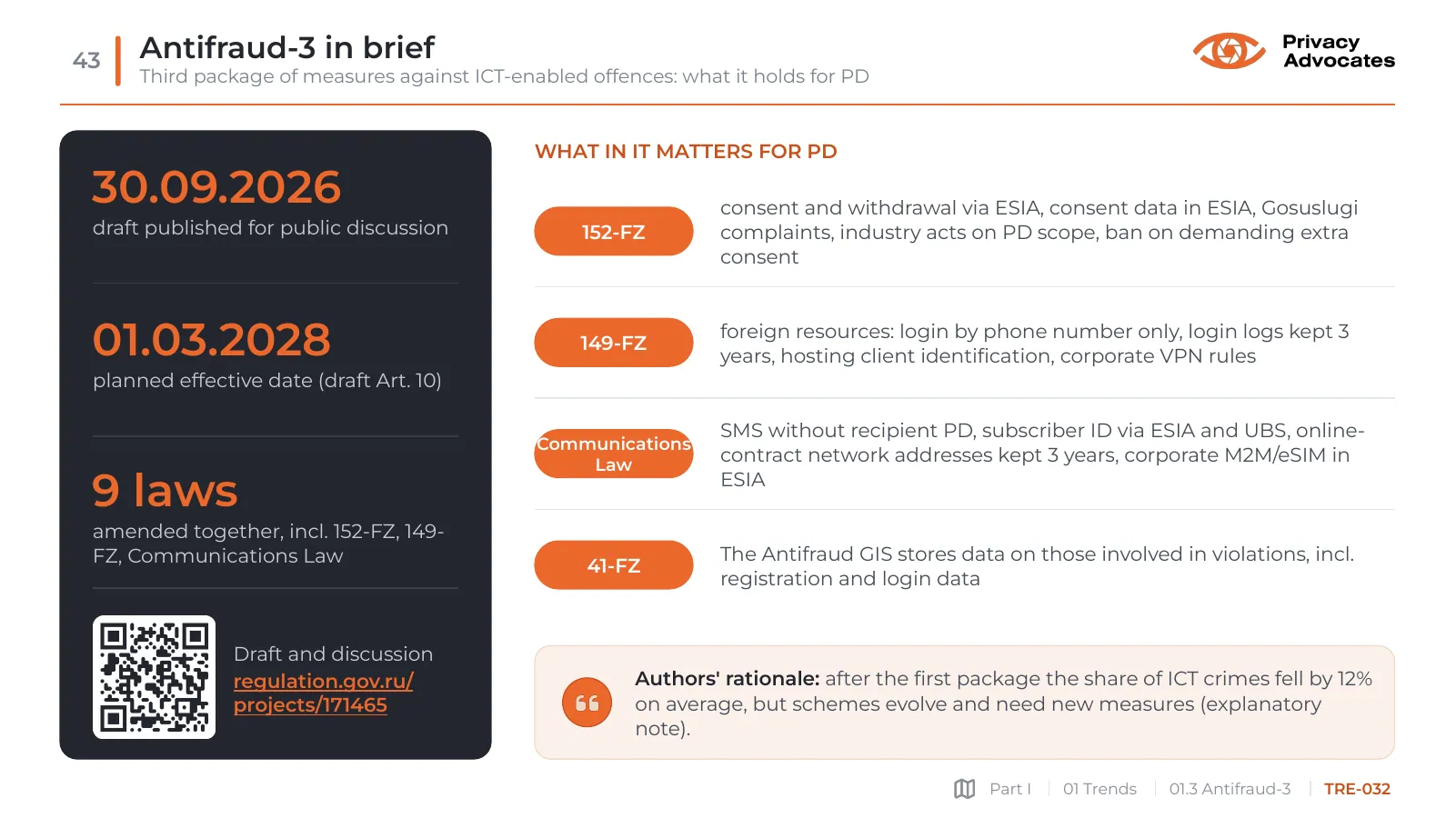
30.09.2026
draft published for public discussion
01.03.2028
planned effective date (draft Art. 10)
9 laws
amended together, incl. 152-FZ, 149-FZ, Communications Law
WHAT IN IT MATTERS FOR PD
Authors' rationale: after the first package the share of ICT crimes fell by 12% on average, but schemes evolve and need new measures (explanatory note).
Draft and discussion
New Art. 8(10)-(10.1-2), 149-FZ in the Antifraud-3 draft
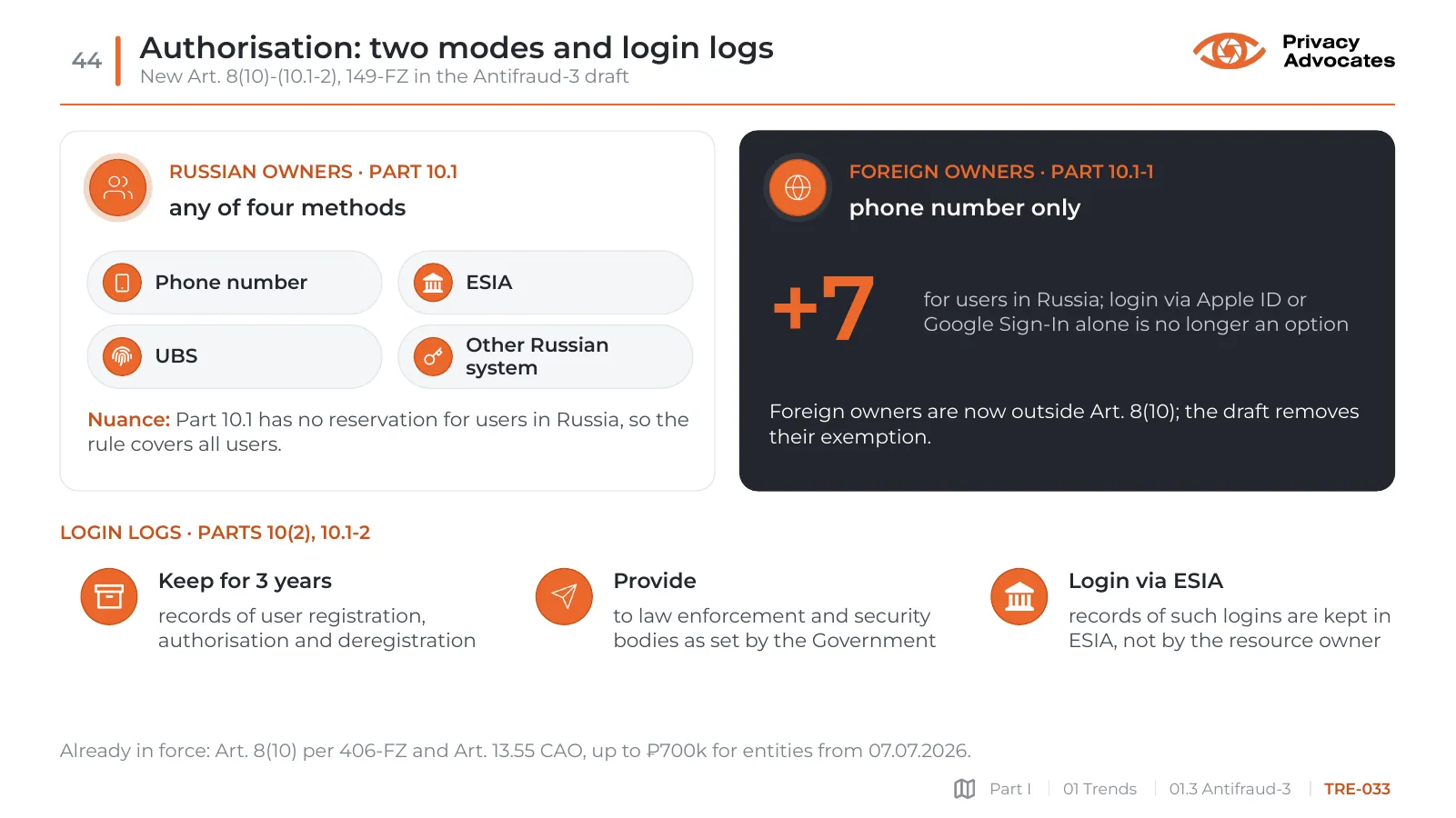
RUSSIAN OWNERS, PART 10.1
any of four methods
Nuance: Part 10.1 has no reservation for users in Russia, so the rule covers all users.
FOREIGN OWNERS, PART 10.1-1
phone number only
Foreign owners are now outside Art. 8(10); the draft removes their exemption.
LOGIN LOGS, PARTS 10(2), 10.1-2
Keep for 3 years
records of user registration, authorisation and deregistration
Provide
to law enforcement and security bodies as set by the Government
Login via ESIA
records of such logins are kept in ESIA, not by the resource owner
Already in force: Art. 8(10) per 406-FZ and Art. 13.55 CAO, up to ₽700k for entities from 07.07.2026.
Onshoring in Antifraud-3: hosting, VPN, telephony, mailings
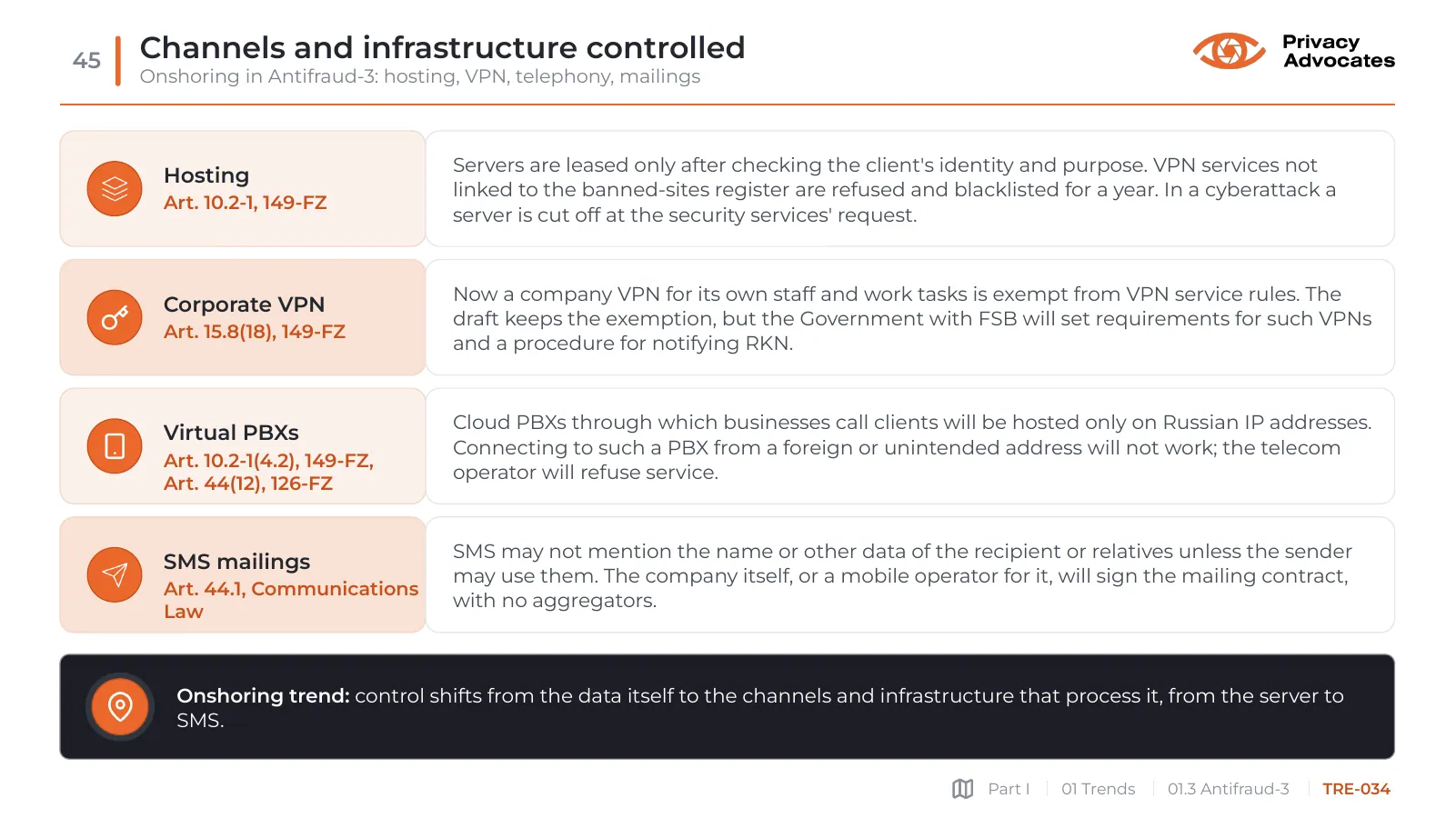
Hosting
Corporate VPN
Virtual PBXs
Art. 10.2-1(4.2), 149-FZ,
Art. 44(12), 126-FZ
Cloud PBXs through which businesses call clients will be hosted only on Russian IP addresses. Connecting to such a PBX from a foreign or unintended address will not work; the telecom operator will refuse service.
SMS mailings
Onshoring trend: control shifts from the data itself to the channels and infrastructure that process it, from the server to SMS.
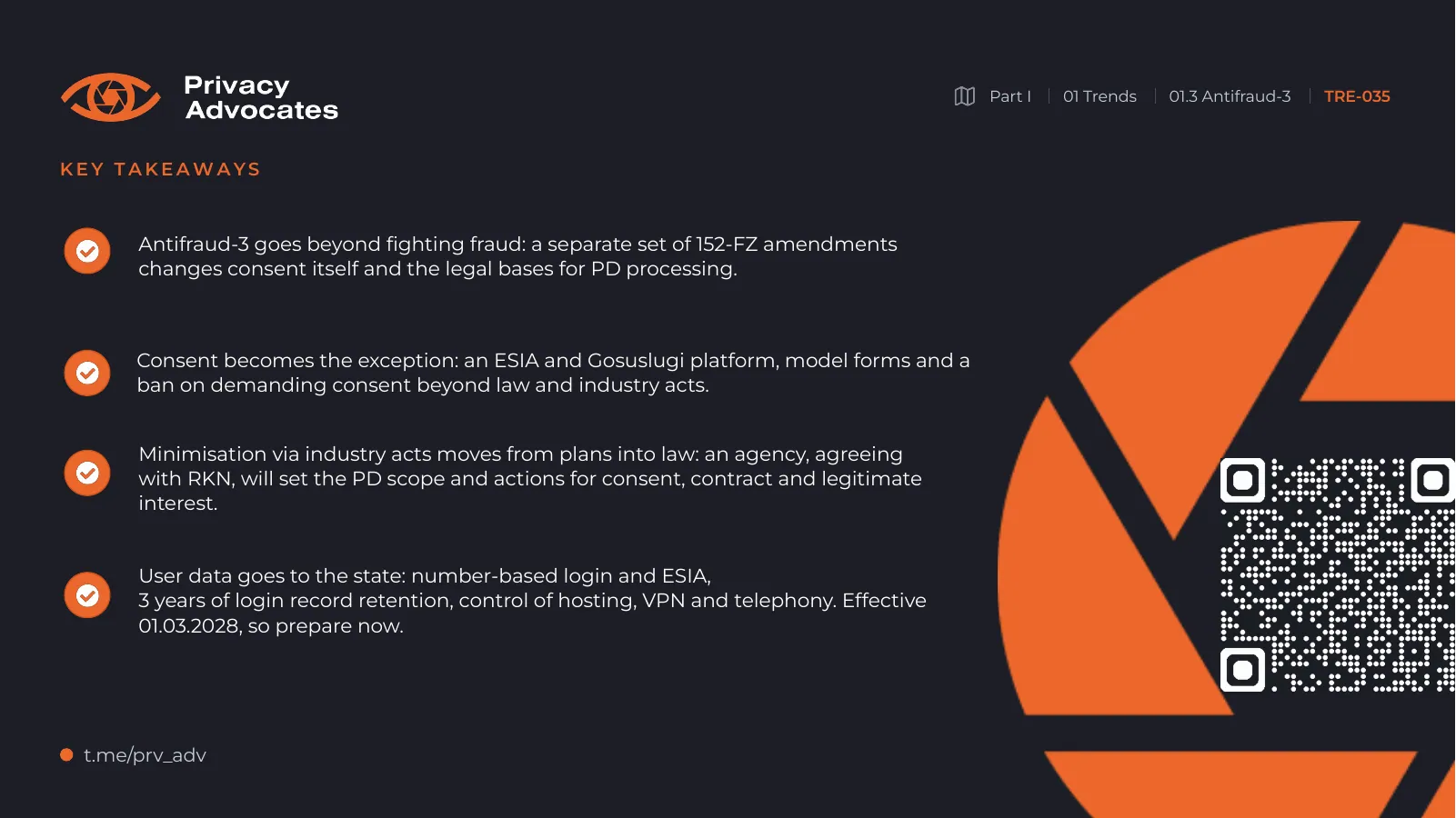
Antifraud-3 goes beyond fighting fraud: a separate set of 152-FZ amendments changes consent itself and the legal bases for PD processing.
Consent becomes the exception: an ESIA and Gosuslugi platform, model forms and a ban on demanding consent beyond law and industry acts.
Minimisation via industry acts moves from plans into law: an agency, agreeing with RKN, will set the PD scope and actions for consent, contract and legitimate interest.
User data goes to the state: number-based login and ESIA,
3 years of login record retention, control of hosting, VPN and telephony. Effective 01.03.2028, so prepare now.
t.me/prv_adv
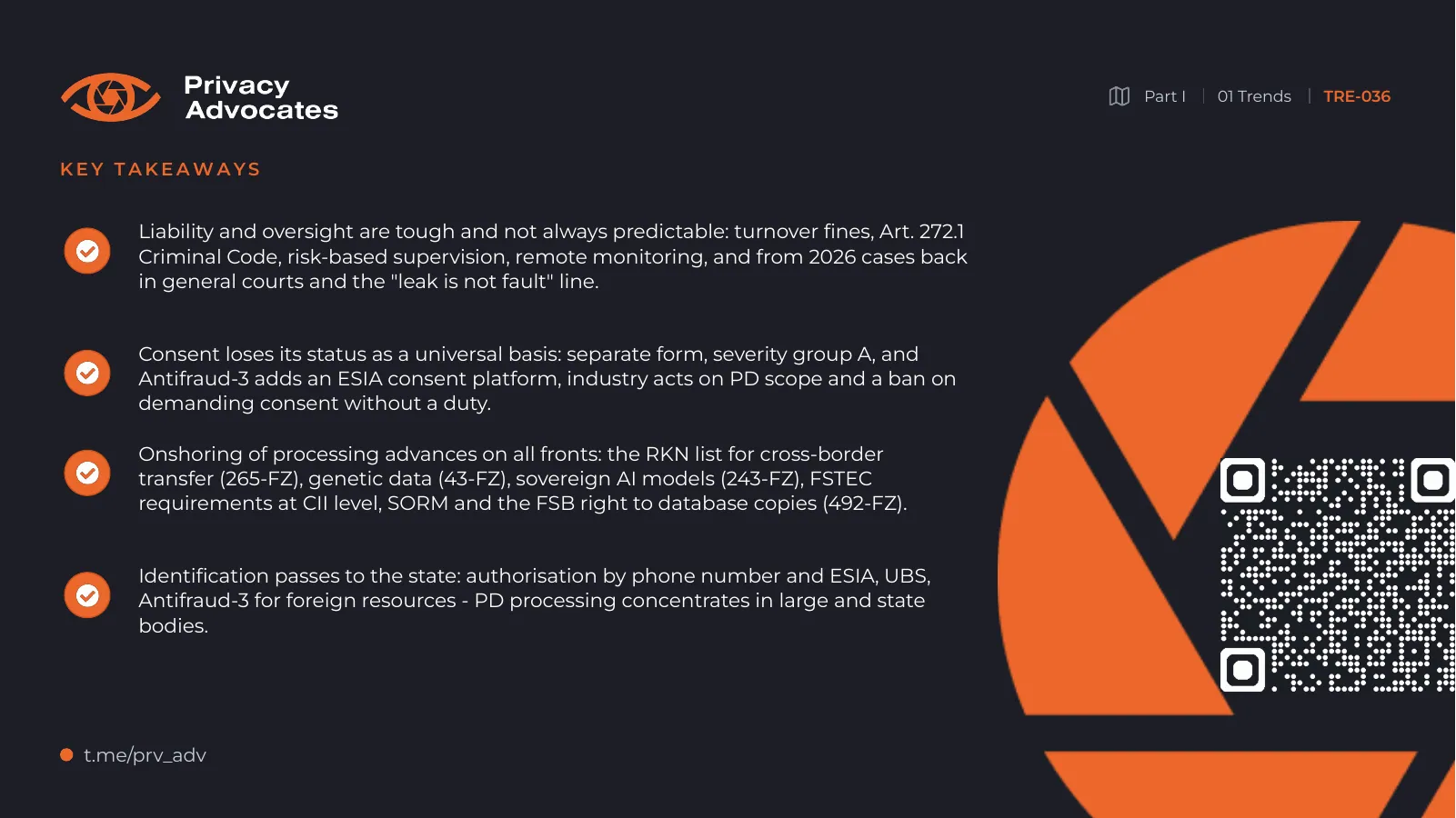
Liability and oversight are tough and not always predictable: turnover fines, Art. 272.1 Criminal Code, risk-based supervision, remote monitoring, and from 2026 cases back in general courts and the "leak is not fault" line.
Consent loses its status as a universal basis: separate form, severity group A, and Antifraud-3 adds an ESIA consent platform, industry acts on PD scope and a ban on demanding consent without a duty.
Onshoring of processing advances on all fronts: the RKN list for cross-border transfer (265-FZ), genetic data (43-FZ), sovereign AI models (243-FZ), FSTEC requirements at CII level, SORM and the FSB right to database copies (492-FZ).
Identification passes to the state: authorisation by phone number and ESIA, UBS, Antifraud-3 for foreign resources - PD processing concentrates in large and state bodies.
t.me/prv_adv
Section materials