Part III, section 09

Automation for DPOs

How to choose, test and not overpay for promises

  • 11 slides
  • 3 subsections
  • Edition of 25 October 2026

09.1

Where automation pays off

ATM-001

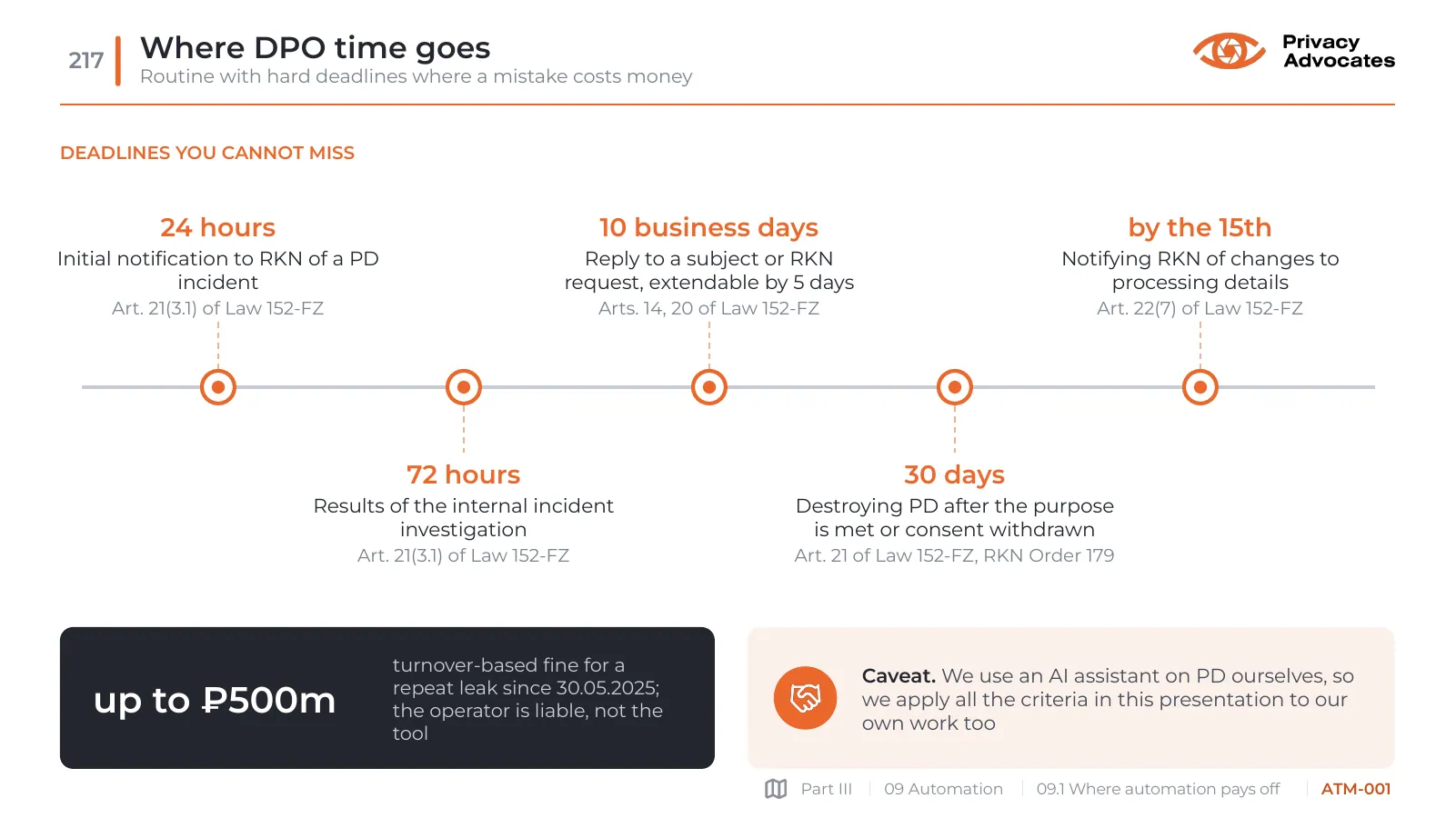
Where DPO time goes

Routine with hard deadlines where a mistake costs money
Slide ATM-001: Where DPO time goes
Slide text

DEADLINES YOU CANNOT MISS

24 hours

Initial notification to RKN of a PD incident

Art. 21(3.1) of Law 152-FZ

72 hours

Results of the internal incident investigation

Art. 21(3.1) of Law 152-FZ

10 business days

Reply to a subject or RKN request, extendable by 5 days

Arts. 14, 20 of Law 152-FZ

30 days

Destroying PD after the purpose is met or consent withdrawn

Art. 21 of Law 152-FZ, RKN Order 179

by the 15th

Notifying RKN of changes to processing details

Art. 22(7) of Law 152-FZ

  • up to ₽500m
  • turnover-based fine for a repeat leak since 30.05.2025; the operator is liable, not the tool
  • Caveat. We use an AI assistant on PD ourselves, so we apply all the criteria in this presentation to our own work too
ATM-002

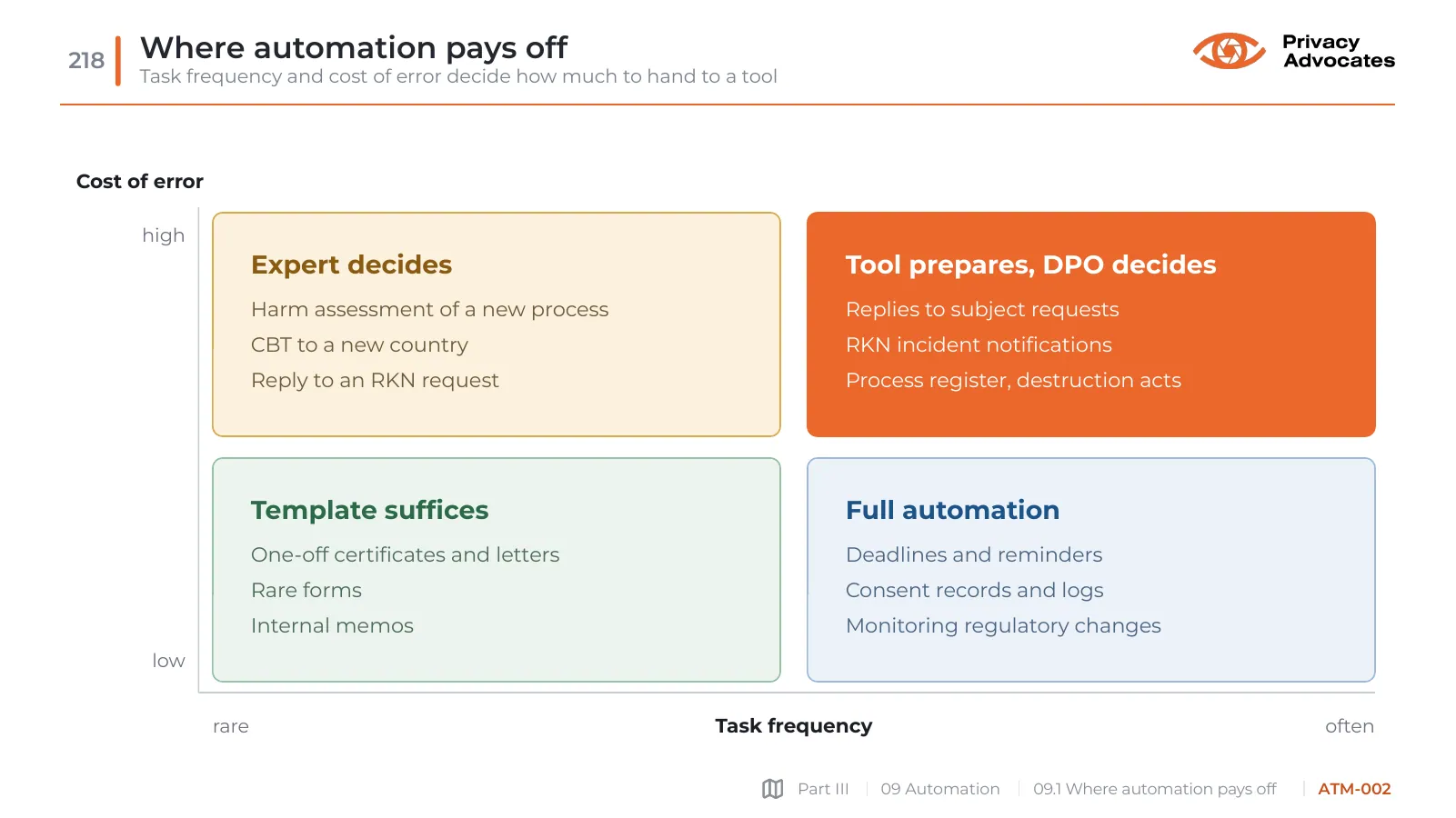
Where automation pays off

Task frequency and cost of error decide how much to hand to a tool

Slide ATM-002: Where automation pays off
Slide text

Cost of error

high

low

  • rare
  • Task frequency
  • often

Expert decides

Harm assessment of a new process

CBT to a new country

Reply to an RKN request

Tool prepares, DPO decides

Replies to subject requests

RKN incident notifications

Process register, destruction acts

Template suffices

One-off certificates and letters

Rare forms

Internal memos

Full automation

Deadlines and reminders

Consent records and logs

Monitoring regulatory changes

ATM-003

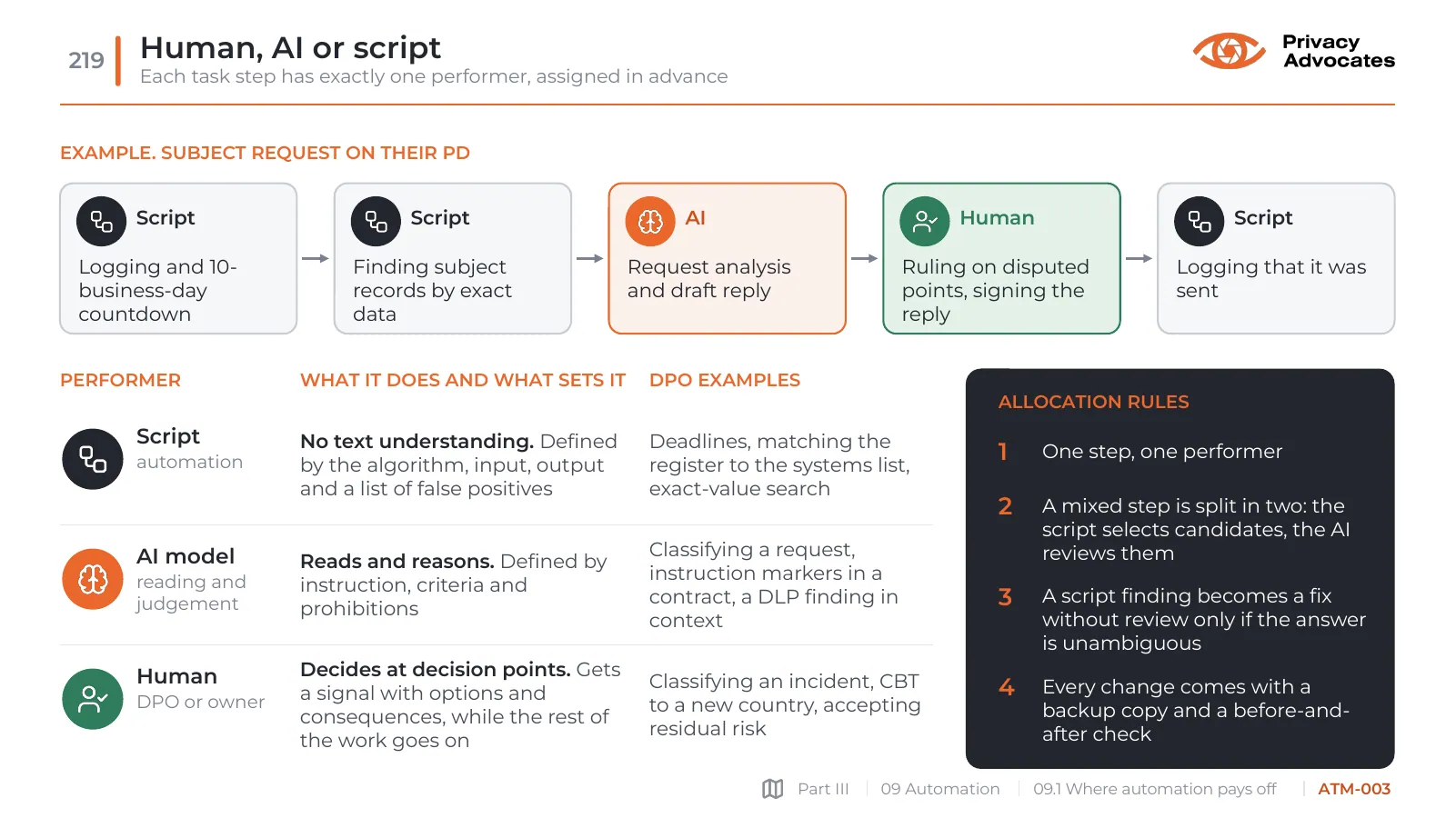
Human, AI or script

Each task step has exactly one performer, assigned in advance

Slide ATM-003: Human, AI or script
Slide text

EXAMPLE. SUBJECT REQUEST ON THEIR PD

Script

Logging and 10-business-day countdown

Script

Finding subject records by exact data

AI

Request analysis and draft reply

Human

Ruling on disputed points, signing the reply

Script

Logging that it was sent

  • PERFORMER
  • WHAT IT DOES AND WHAT SETS IT
  • DPO EXAMPLES

Script

automation

  • No text understanding. Defined by the algorithm, input, output and a list of false positives
  • Deadlines, matching the register to the systems list, exact-value search

AI model

reading and judgement

  • Reads and reasons. Defined by instruction, criteria and prohibitions
  • Classifying a request, instruction markers in a contract, a DLP finding in context

Human

DPO or owner

  • Decides at decision points. Gets a signal with options and consequences, while the rest of the work goes on
  • Classifying an incident, CBT to a new country, accepting residual risk

ALLOCATION RULES

  • 1
  • One step, one performer
  • 2
  • A mixed step is split in two: the script selects candidates, the AI reviews them
  • 3
  • A script finding becomes a fix without review only if the answer is unambiguous
  • 4
  • Every change comes with a backup copy and a before-and-after check
ATM-004

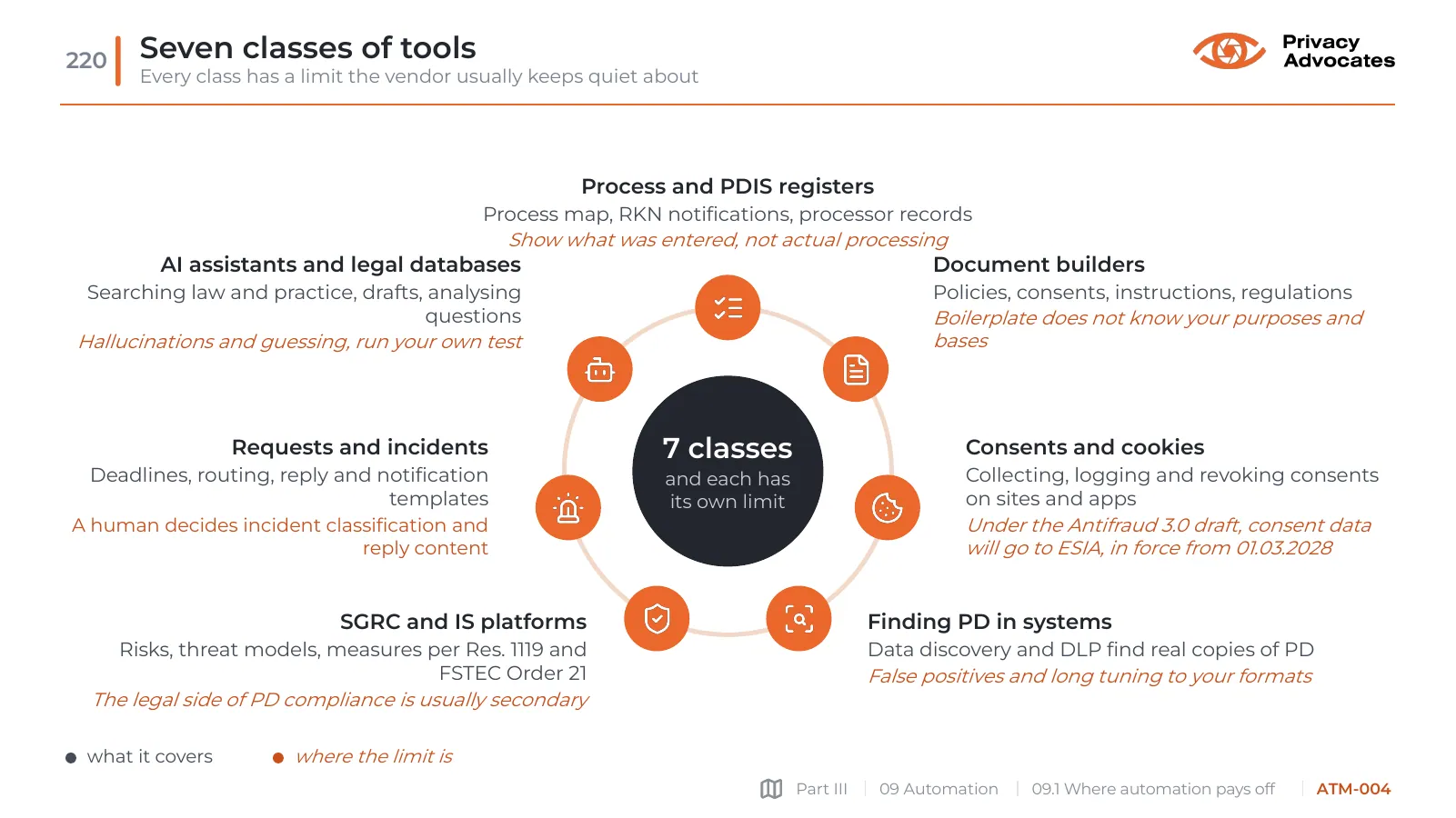
Seven classes of tools

Every class has a limit the vendor usually keeps quiet about

Slide ATM-004: Seven classes of tools
Slide text

7 classes

and each has

its own limit

Process and PDIS registers

Process map, RKN notifications, processor records

Show what was entered, not actual processing

Document builders

Policies, consents, instructions, regulations

Boilerplate does not know your purposes and bases

Consents and cookies

Collecting, logging and revoking consents on sites and apps

Under the Antifraud 3.0 draft, consent data will go to ESIA, in force from 01.03.2028

Finding PD in systems

Data discovery and DLP find real copies of PD

False positives and long tuning to your formats

SGRC and IS platforms

Risks, threat models, measures per Res. 1119 and FSTEC Order 21

The legal side of PD compliance is usually secondary

Requests and incidents

Deadlines, routing, reply and notification templates

A human decides incident classification and reply content

AI assistants and legal databases

Searching law and practice, drafts, analysing questions

Hallucinations and guessing, run your own test

  • what it covers
  • where the limit is

09.2

How to choose and test a tool

ATM-005

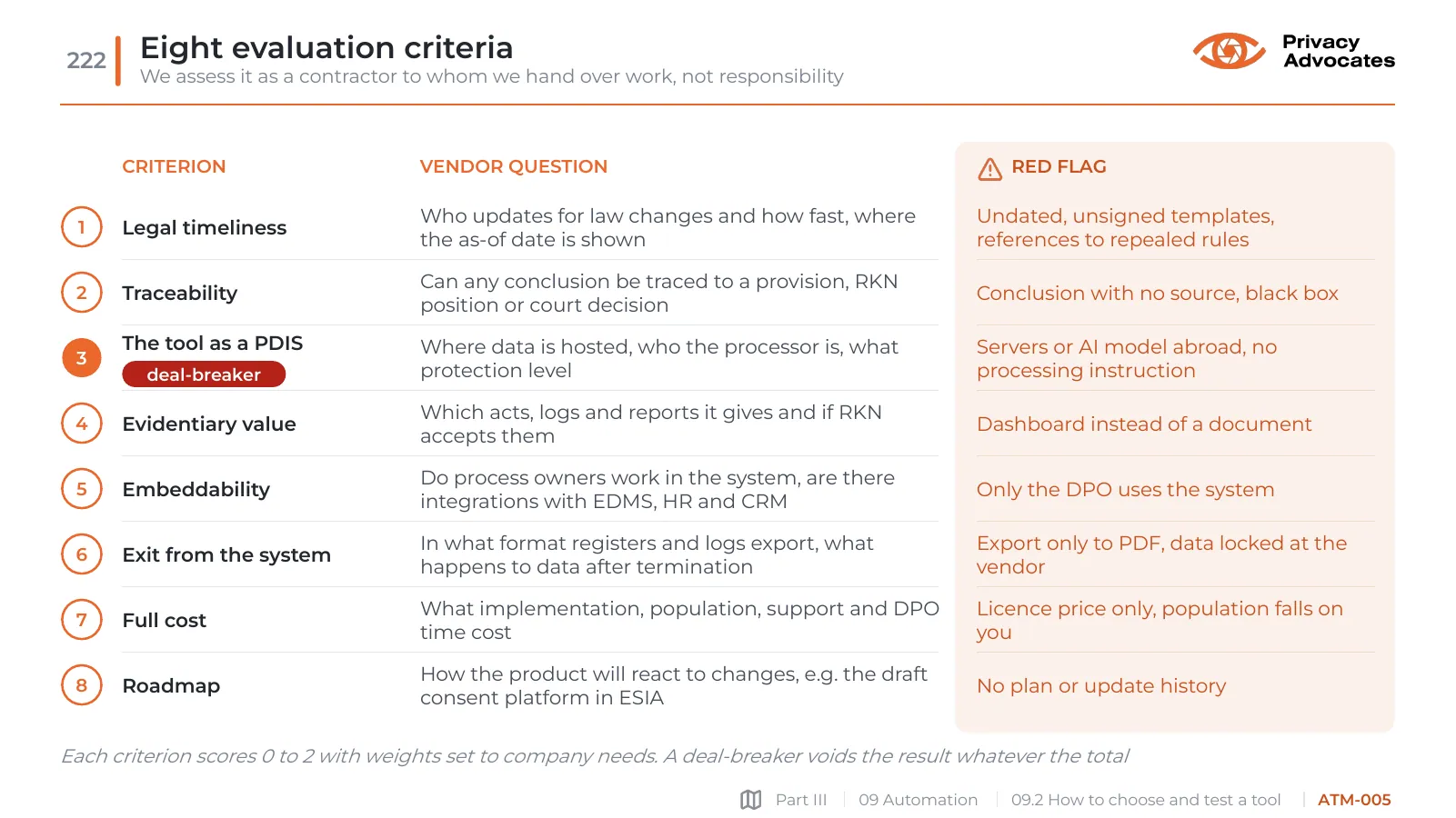
Eight evaluation criteria

We assess it as a contractor to whom we hand over work, not responsibility

Slide ATM-005: Eight evaluation criteria
Slide text
  • CRITERION
  • VENDOR QUESTION
  • RED FLAG
  • 1
  • Legal timeliness
  • Who updates for law changes and how fast, where the as-of date is shown
  • Undated, unsigned templates, references to repealed rules
  • 2
  • Traceability
  • Can any conclusion be traced to a provision, RKN position or court decision
  • Conclusion with no source, black box
  • 3
  • The tool as a PDIS
  • deal-breaker
  • Where data is hosted, who the processor is, what protection level
  • Servers or AI model abroad, no processing instruction
  • 4
  • Evidentiary value
  • Which acts, logs and reports it gives and if RKN accepts them
  • Dashboard instead of a document
  • 5
  • Embeddability
  • Do process owners work in the system, are there integrations with EDMS, HR and CRM
  • Only the DPO uses the system
  • 6
  • Exit from the system
  • In what format registers and logs export, what happens to data after termination
  • Export only to PDF, data locked at the vendor
  • 7
  • Full cost
  • What implementation, population, support and DPO time cost
  • Licence price only, population falls on you
  • 8
  • Roadmap
  • How the product will react to changes, e.g. the draft consent platform in ESIA
  • No plan or update history

Each criterion scores 0 to 2 with weights set to company needs. A deal-breaker voids the result whatever the total

ATM-006

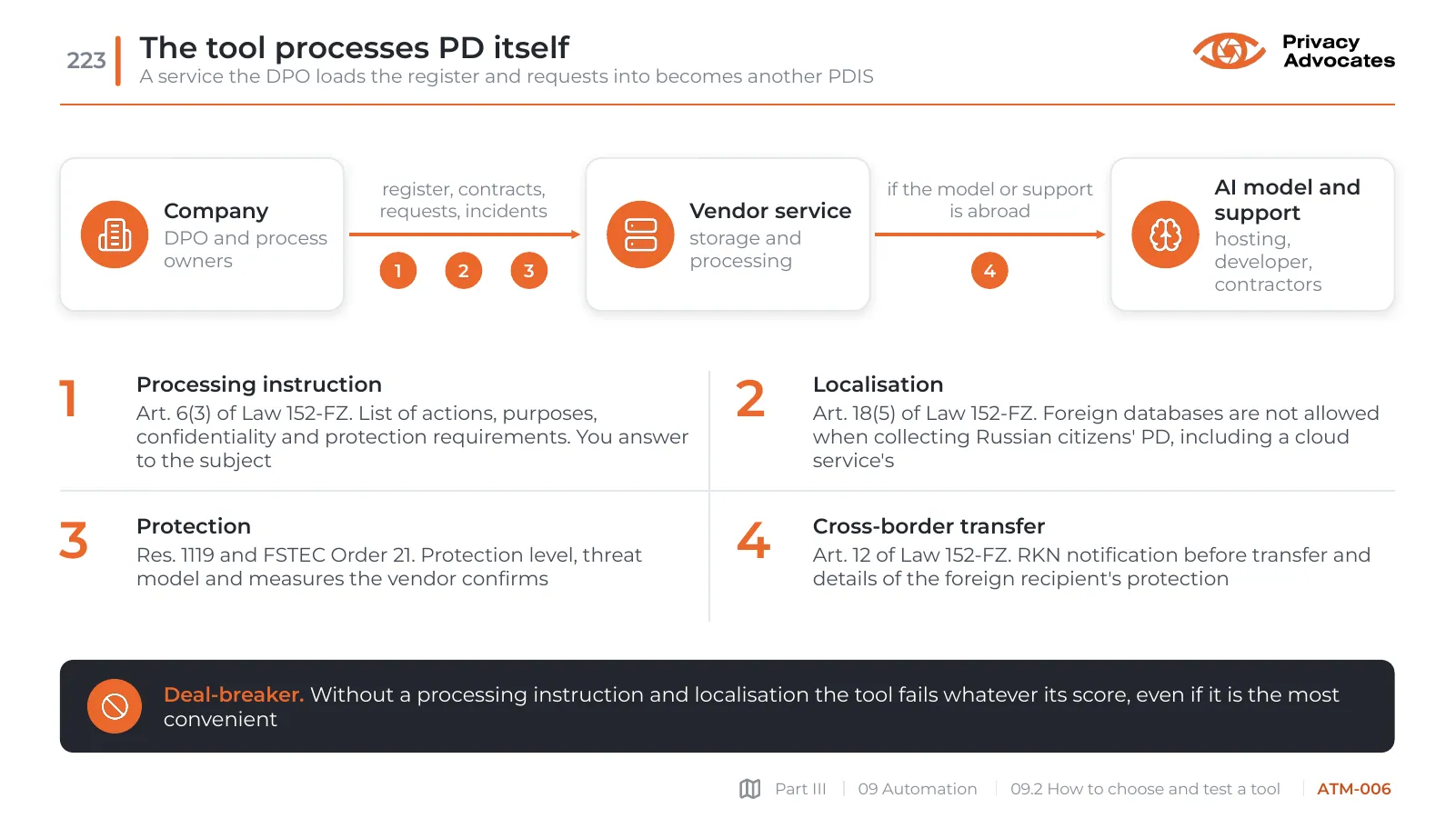
The tool processes PD itself

A service the DPO loads the register and requests into becomes another PDIS

Slide ATM-006: The tool processes PD itself
Slide text

Company

DPO and process owners

Vendor service

storage and processing

AI model and support

hosting, developer, contractors

register, contracts, requests, incidents

  • 1
  • 2
  • 3
  • 4

if the model or support is abroad

1

Processing instruction

Art. 6(3) of Law 152-FZ. List of actions, purposes, confidentiality and protection requirements. You answer to the subject

2

Localisation

Art. 18(5) of Law 152-FZ. Foreign databases are not allowed when collecting Russian citizens' PD, including a cloud service's

3

Protection

Res. 1119 and FSTEC Order 21. Protection level, threat model and measures the vendor confirms

4

Cross-border transfer

Art. 12 of Law 152-FZ. RKN notification before transfer and details of the foreign recipient's protection

Deal-breaker. Without a processing instruction and localisation the tool fails whatever its score, even if it is the most convenient

ATM-007

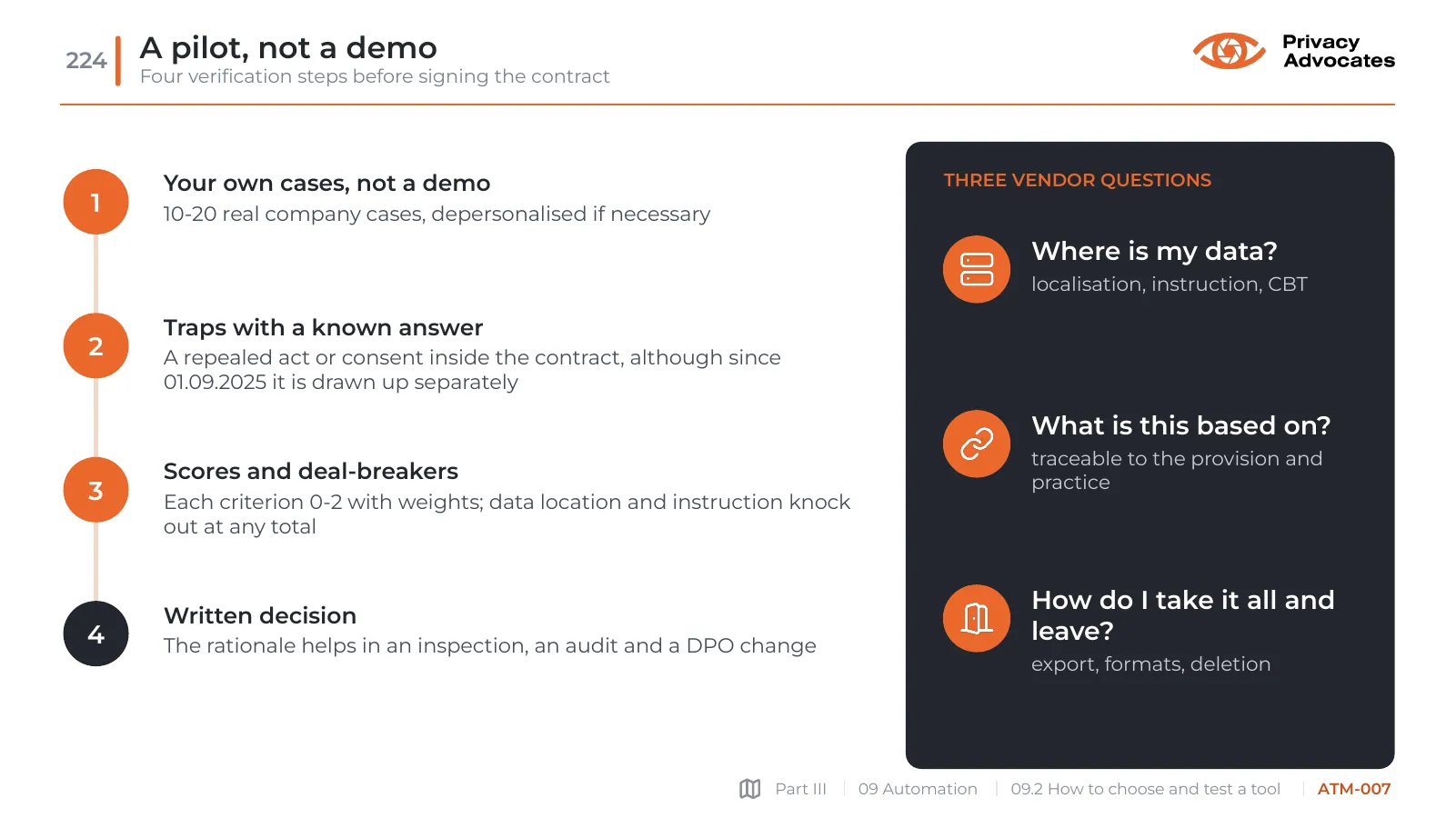
A pilot, not a demo

Four verification steps before signing the contract

Slide ATM-007: A pilot, not a demo
Slide text

1

Your own cases, not a demo

10-20 real company cases, depersonalised if necessary

2

Traps with a known answer

A repealed act or consent inside the contract, although since 01.09.2025 it is drawn up separately

3

Scores and deal-breakers

Each criterion 0-2 with weights; data location and instruction knock out at any total

4

Written decision

The rationale helps in an inspection, an audit and a DPO change

THREE VENDOR QUESTIONS

Where is my data?

localisation, instruction, CBT

What is this based on?

traceable to the provision and practice

How do I take it all and leave?

export, formats, deletion

ATM-008

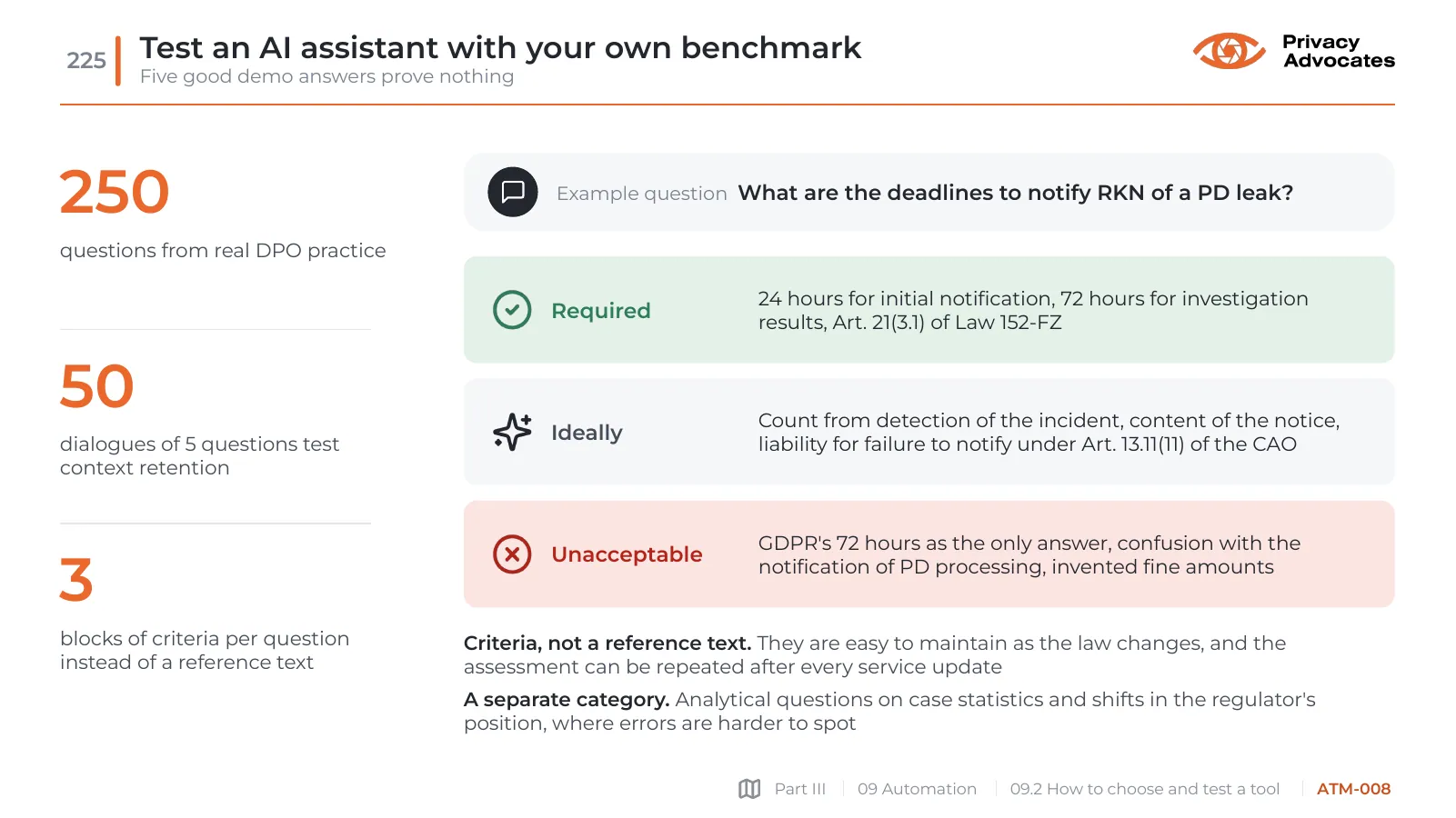
Test an AI assistant with your own benchmark

Five good demo answers prove nothing

Slide ATM-008: Test an AI assistant with your own benchmark
Slide text

250

questions from real DPO practice

50

dialogues of 5 questions test context retention

3

blocks of criteria per question instead of a reference text

Example question What are the deadlines to notify RKN of a PD leak?

  • Required
  • 24 hours for initial notification, 72 hours for investigation results, Art. 21(3.1) of Law 152-FZ
  • Ideally
  • Count from detection of the incident, content of the notice, liability for failure to notify under Art. 13.11(11) of the CAO
  • Unacceptable
  • GDPR's 72 hours as the only answer, confusion with the notification of PD processing, invented fine amounts

Criteria, not a reference text. They are easy to maintain as the law changes, and the assessment can be repeated after every service update

A separate category. Analytical questions on case statistics and shifts in the regulator's position, where errors are harder to spot

ATM-009

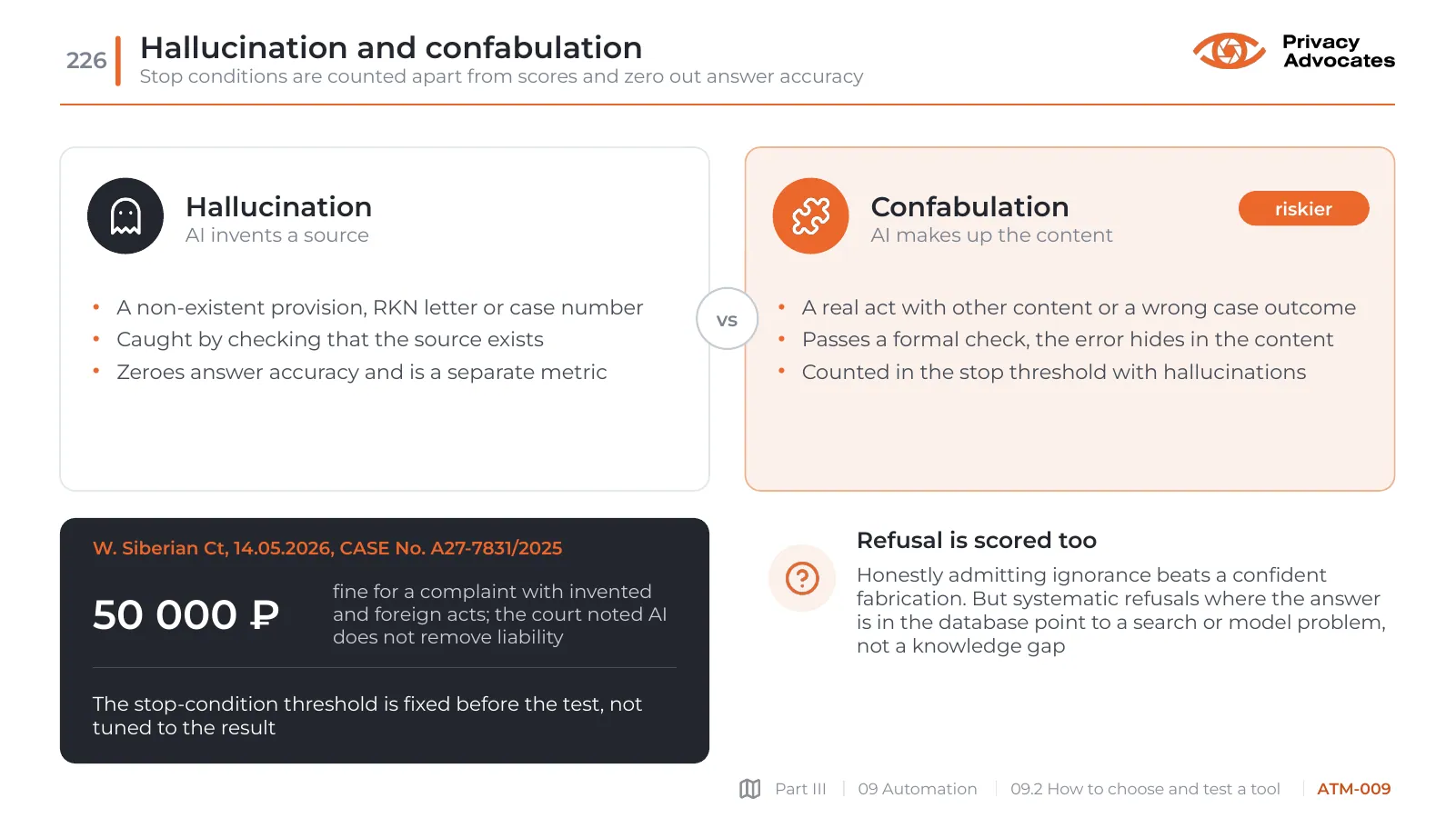
Hallucination and confabulation

Stop conditions are counted apart from scores and zero out answer accuracy

Slide ATM-009: Hallucination and confabulation
Slide text

Hallucination

AI invents a source

Confabulation

AI makes up the content

riskier

A non-existent provision, RKN letter or case number

Caught by checking that the source exists

Zeroes answer accuracy and is a separate metric

A real act with other content or a wrong case outcome

Passes a formal check, the error hides in the content

Counted in the stop threshold with hallucinations

vs

W. Siberian Ct, 14.05.2026, CASE No. A27-7831/2025

  • 50 000 ₽
  • fine for a complaint with invented and foreign acts; the court noted AI does not remove liability

The stop-condition threshold is fixed before the test, not tuned to the result

Refusal is scored too

Honestly admitting ignorance beats a confident fabrication. But systematic refusals where the answer is in the database point to a search or model problem, not a knowledge gap

09.3

What breaks after deployment

ATM-010

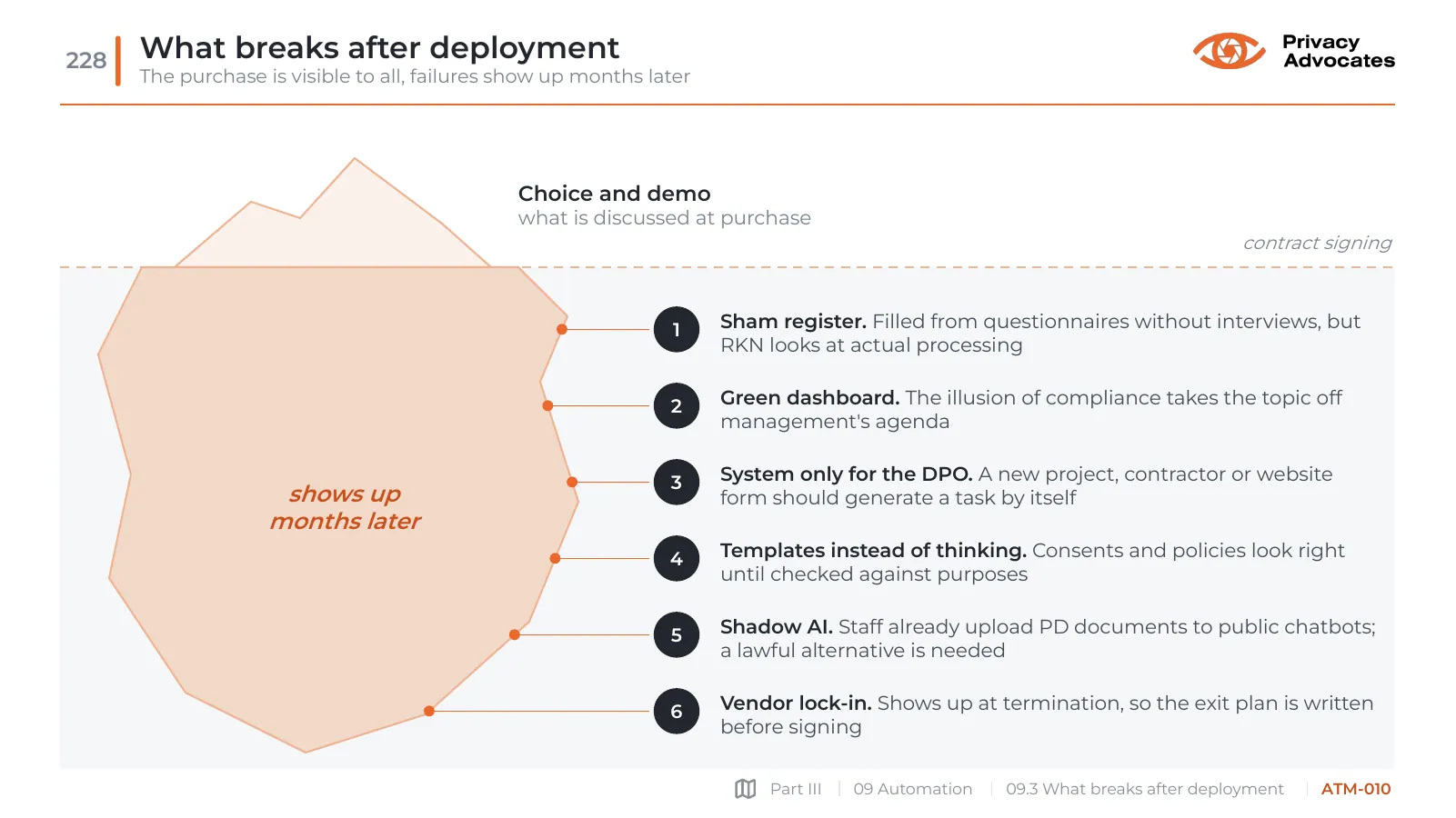
What breaks after deployment

The purchase is visible to all, failures show up months later

Slide ATM-010: What breaks after deployment
Slide text

contract signing

shows up

months later

Choice and demo

what is discussed at purchase

  • 1
  • Sham register. Filled from questionnaires without interviews, but RKN looks at actual processing
  • 2
  • Green dashboard. The illusion of compliance takes the topic off management's agenda
  • 3
  • System only for the DPO. A new project, contractor or website form should generate a task by itself
  • 4
  • Templates instead of thinking. Consents and policies look right until checked against purposes
  • 5
  • Shadow AI. Staff already upload PD documents to public chatbots; a lawful alternative is needed
  • 6
  • Vendor lock-in. Shows up at termination, so the exit plan is written before signing
ATM-011

Five steps for monday

Slide ATM-011: Five steps for monday
Slide text

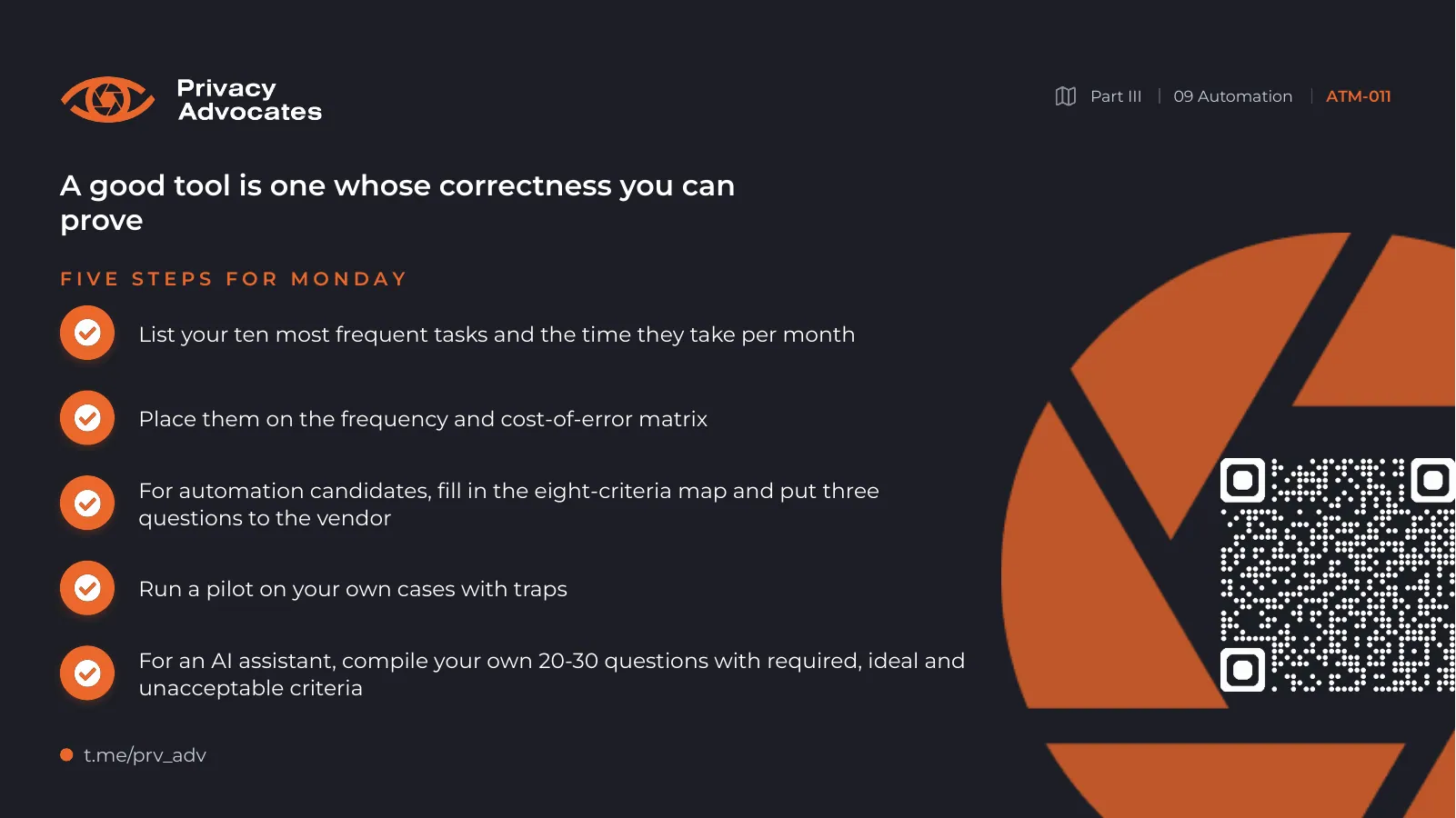
List your ten most frequent tasks and the time they take per month

Place them on the frequency and cost-of-error matrix

For automation candidates, fill in the eight-criteria map and put three questions to the vendor

Run a pilot on your own cases with traps

For an AI assistant, compile your own 20-30 questions with required, ideal and unacceptable criteria

t.me/prv_adv

A good tool is one whose correctness you can prove