Part III, section 08

The privacy profession

Functions, tracks, skills and tools of a privacy professional

  • 13 slides
  • 3 subsections
  • Edition of 25 October 2026

08.1

Profession and functions

PRF-001

PD compliance is a fortress with the DPO in the tower

Compliance system metaphor: regulatory moat, island of lean processing, tower and bridge
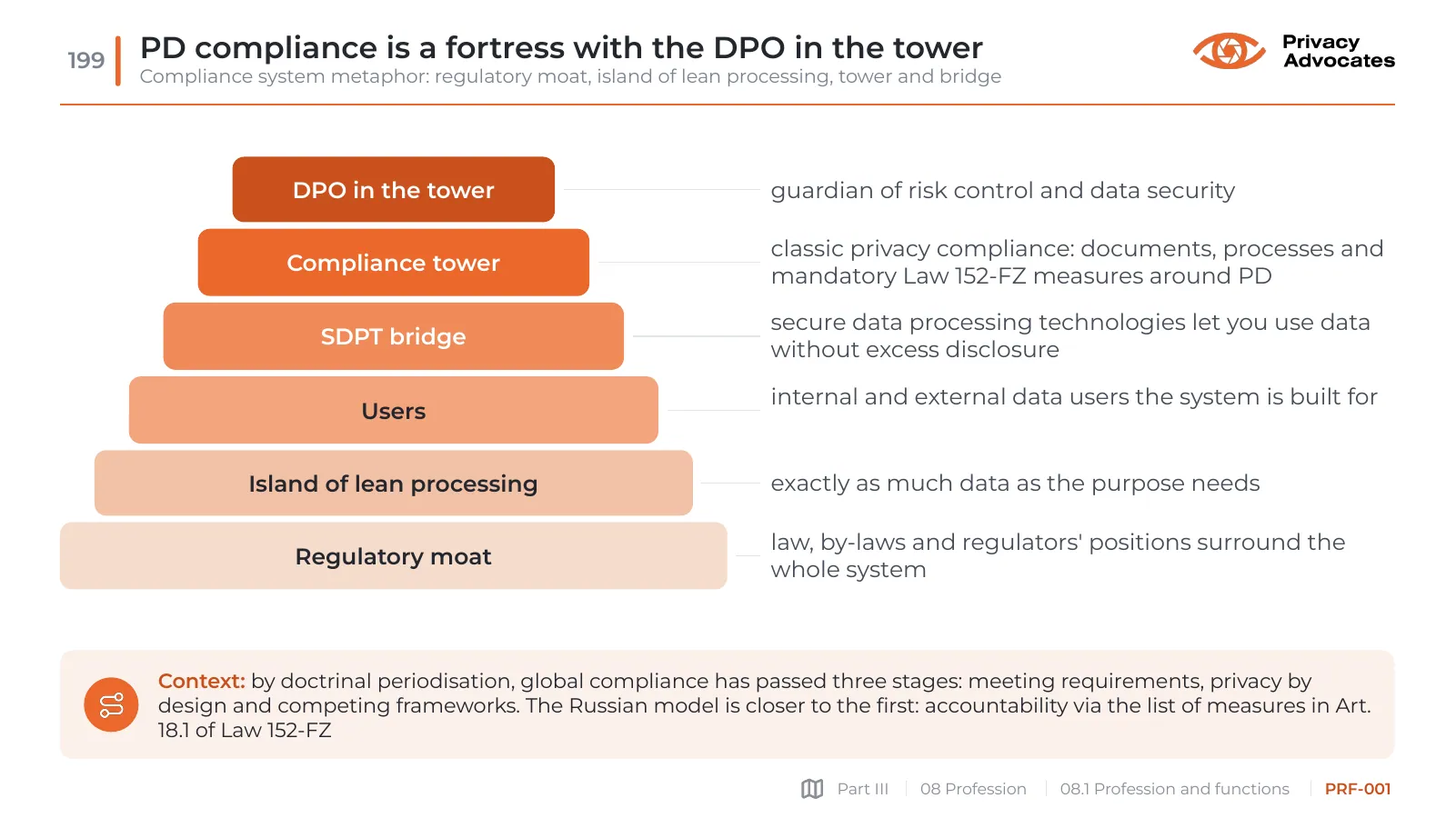
Slide PRF-001: PD compliance is a fortress with the DPO in the tower
Slide text
  • DPO in the tower
  • guardian of risk control and data security
  • Compliance tower
  • classic privacy compliance: documents, processes and mandatory Law 152-FZ measures around PD
  • SDPT bridge
  • secure data processing technologies let you use data without excess disclosure
  • Users
  • internal and external data users the system is built for
  • Island of lean processing
  • exactly as much data as the purpose needs
  • Regulatory moat
  • law, by-laws and regulators' positions surround the whole system

Context: by doctrinal periodisation, global compliance has passed three stages: meeting requirements, privacy by design and competing frameworks. The Russian model is closer to the first: accountability via the list of measures in Art. 18.1 of Law 152-FZ
PRF-002

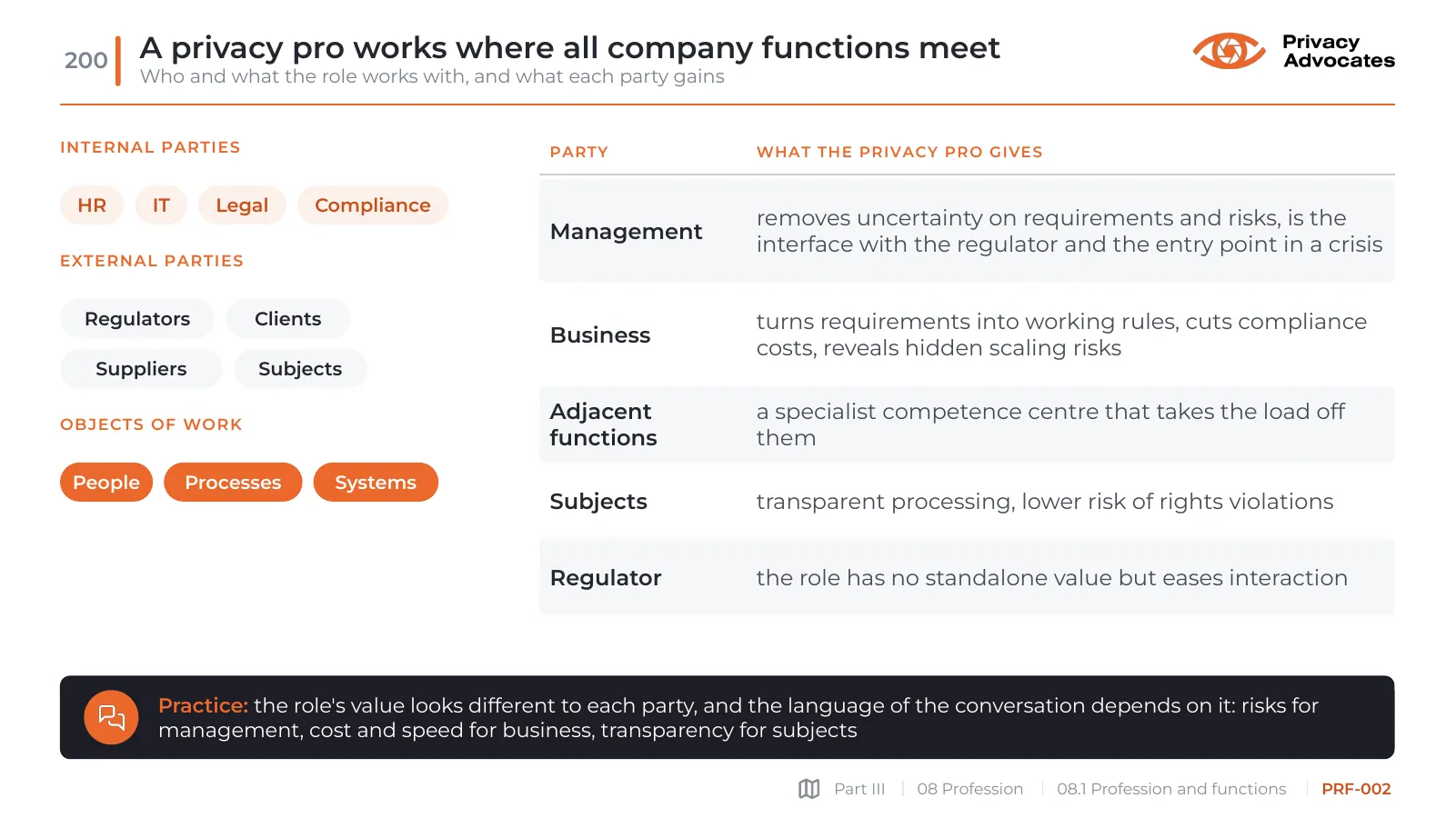
A privacy pro works where all company functions meet

Who and what the role works with, and what each party gains

Slide PRF-002: A privacy pro works where all company functions meet
Slide text

Internal parties

  • HR
  • IT
  • Legal
  • Compliance

External parties

  • Regulators
  • Clients
  • Suppliers
  • Subjects

Objects of work

  • People
  • Processes
  • Systems
  • Party
  • What the privacy pro gives
  • Management
  • removes uncertainty on requirements and risks, is the interface with the regulator and the entry point in a crisis
  • Business
  • turns requirements into working rules, cuts compliance costs, reveals hidden scaling risks
  • Adjacent functions
  • a specialist competence centre that takes the load off them
  • Subjects
  • transparent processing, lower risk of rights violations
  • Regulator
  • the role has no standalone value but eases interaction

Practice: the role's value looks different to each party, and the language of the conversation depends on it: risks for management, cost and speed for business, transparency for subjects

PRF-003

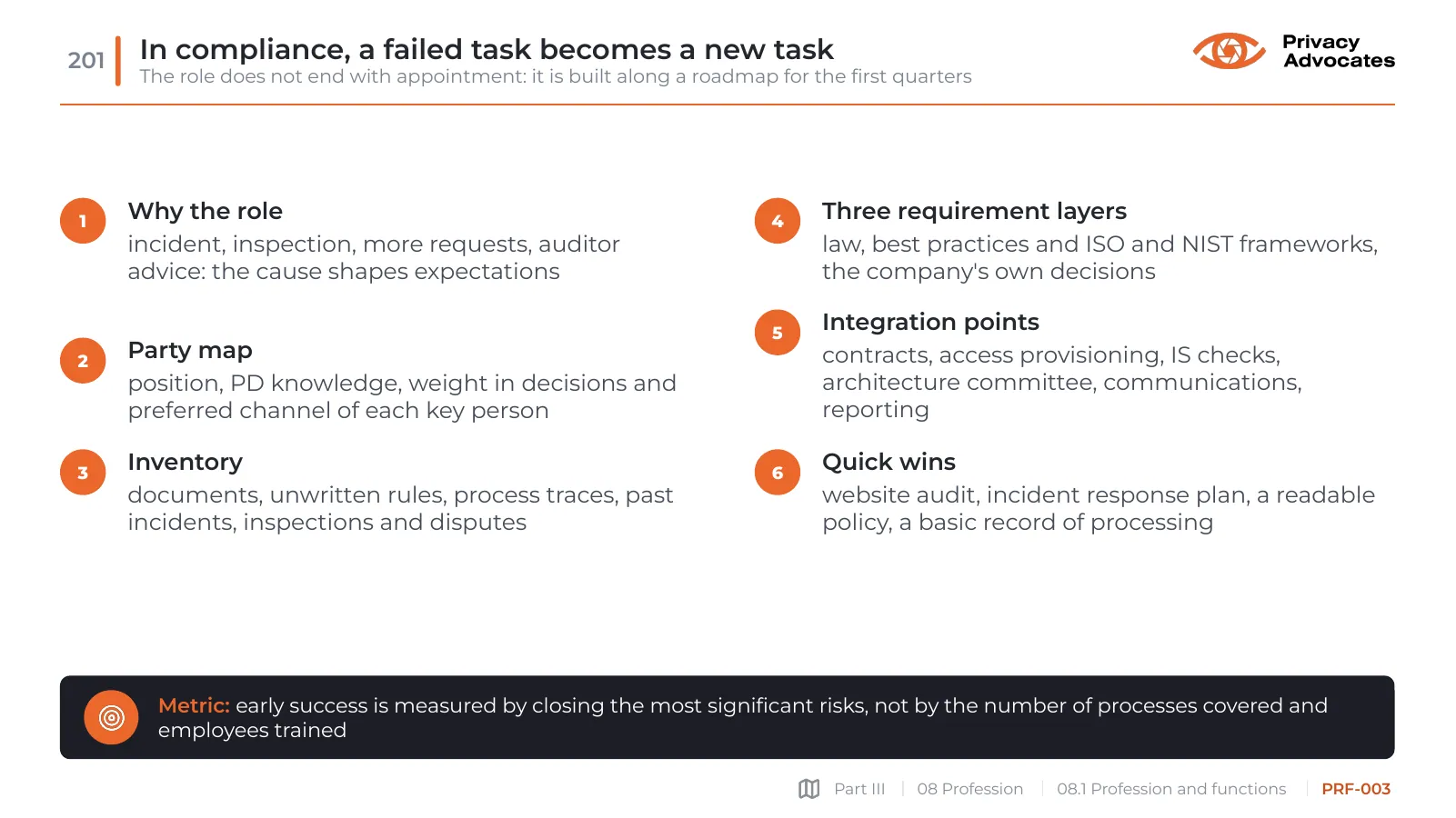
In compliance, a failed task becomes a new task

The role does not end with appointment: it is built along a roadmap for the first quarters

Slide PRF-003: In compliance, a failed task becomes a new task
Slide text
  • 1
  • Why the role

incident, inspection, more requests, auditor advice: the cause shapes expectations

  • 2
  • Party map

position, PD knowledge, weight in decisions and preferred channel of each key person

  • 3
  • Inventory

documents, unwritten rules, process traces, past incidents, inspections and disputes

  • 4
  • Three requirement layers

law, best practices and ISO and NIST frameworks, the company's own decisions

  • 5
  • Integration points

contracts, access provisioning, IS checks, architecture committee, communications, reporting

  • 6
  • Quick wins

website audit, incident response plan, a readable policy, a basic record of processing

Metric: early success is measured by closing the most significant risks, not by the number of processes covered and employees trained

PRF-004

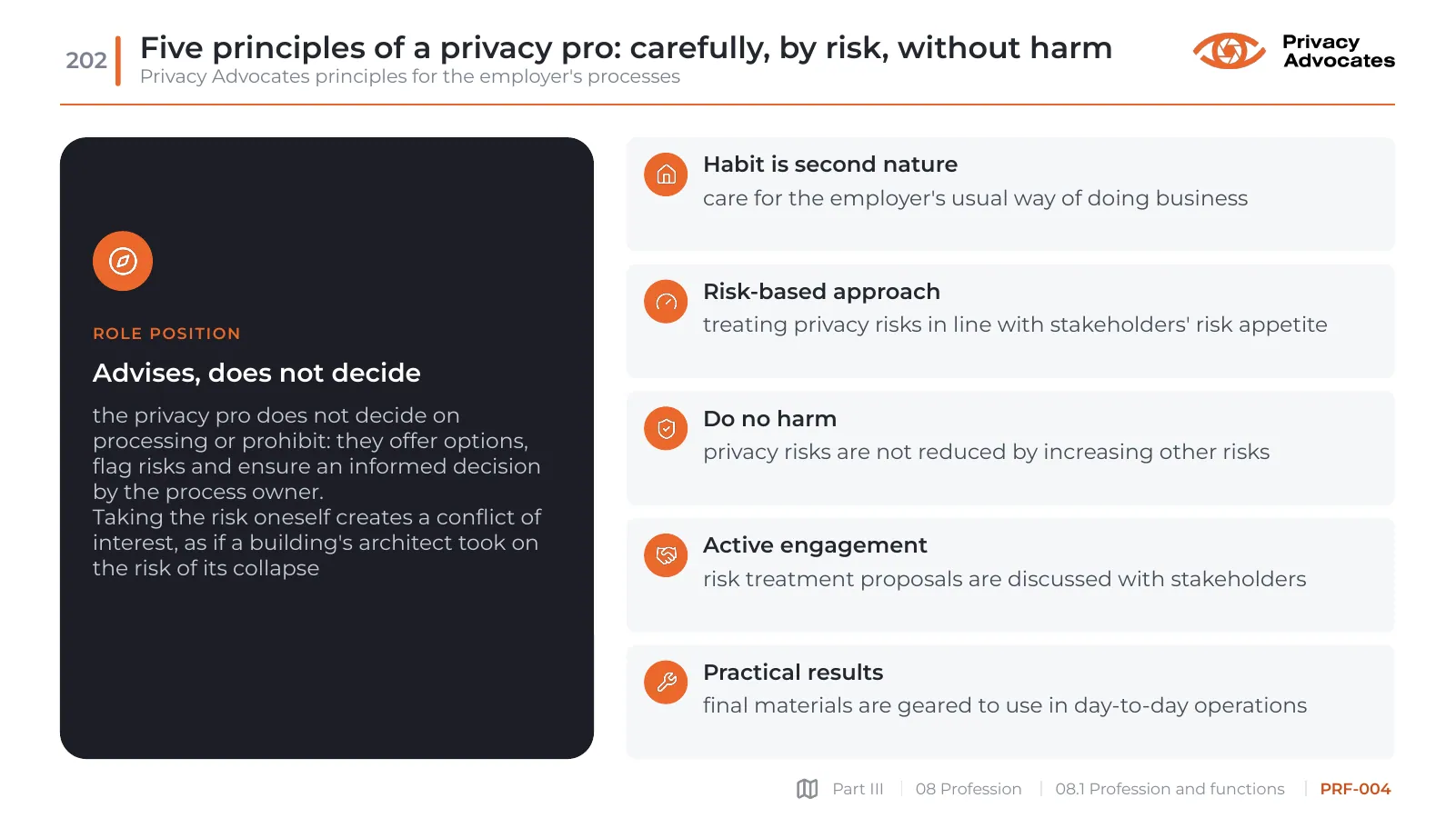
Five principles of a privacy pro: carefully, by risk, without harm

Privacy Advocates principles for the employer's processes

Slide PRF-004: Five principles of a privacy pro: carefully, by risk, without harm
Slide text

Role position

Advises, does not decide

the privacy pro does not decide on processing or prohibit: they offer options, flag risks and ensure an informed decision by the process owner.

Taking the risk oneself creates a conflict of interest, as if a building's architect took on the risk of its collapse

Habit is second nature

care for the employer's usual way of doing business

Risk-based approach

treating privacy risks in line with stakeholders' risk appetite

Do no harm

privacy risks are not reduced by increasing other risks

Active engagement

risk treatment proposals are discussed with stakeholders

Practical results

final materials are geared to use in day-to-day operations

PRF-005

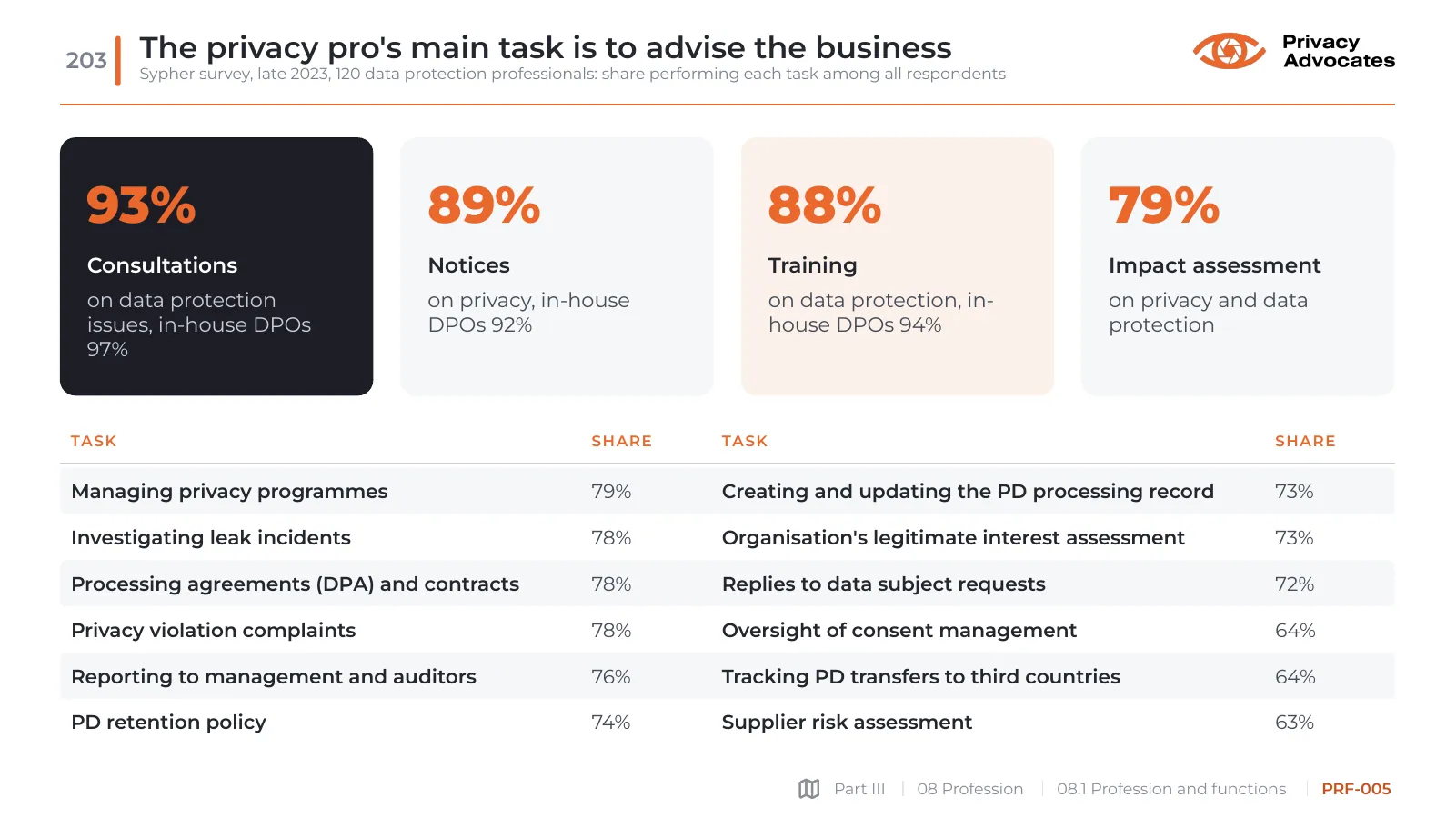
The privacy pro's main task is to advise the business

Sypher survey, late 2023, 120 data protection professionals: share performing each task among all respondents

Slide PRF-005: The privacy pro's main task is to advise the business
Slide text

93%

Consultations

on data protection issues, in-house DPOs 97%

89%

Notices

on privacy, in-house DPOs 92%

88%

Training

on data protection, in-house DPOs 94%

79%

Impact assessment

on privacy and data protection

  • Task
  • Share
  • Task
  • Share
  • Managing privacy programmes
  • 79%
  • Creating and updating the PD processing record
  • 73%
  • Investigating leak incidents
  • 78%
  • Organisation's legitimate interest assessment
  • 73%
  • Processing agreements (DPA) and contracts
  • 78%
  • Replies to data subject requests
  • 72%
  • Privacy violation complaints
  • 78%
  • Oversight of consent management
  • 64%
  • Reporting to management and auditors
  • 76%
  • Tracking PD transfers to third countries
  • 64%
  • PD retention policy
  • 74%
  • Supplier risk assessment
  • 63%
PRF-006

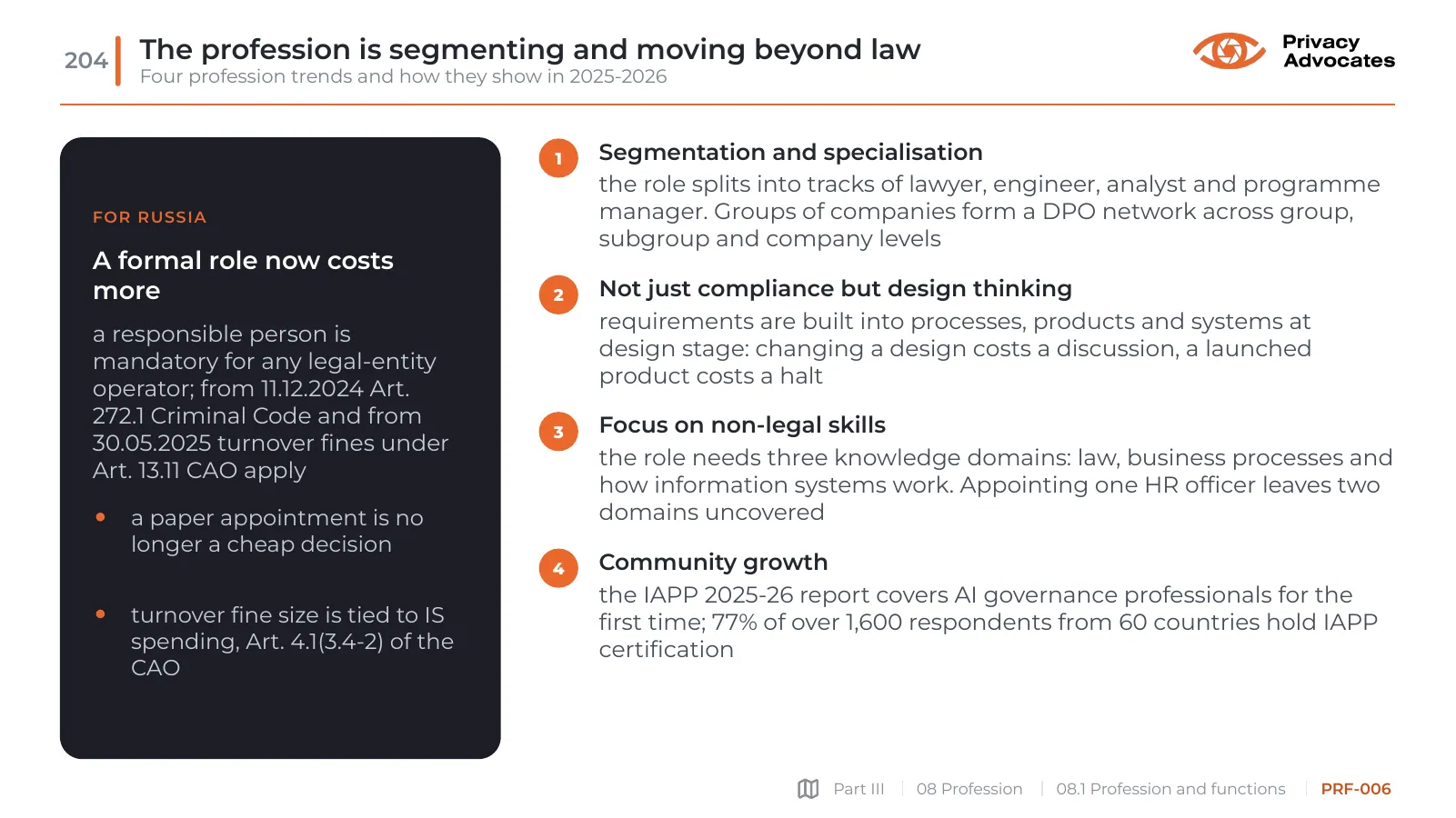
The profession is segmenting and moving beyond law

Four profession trends and how they show in 2025-2026

Slide PRF-006: The profession is segmenting and moving beyond law
Slide text

For Russia

A formal role now costs more

a responsible person is mandatory for any legal-entity operator; from 11.12.2024 Art. 272.1 Criminal Code and from 30.05.2025 turnover fines under Art. 13.11 CAO apply

a paper appointment is no longer a cheap decision

turnover fine size is tied to IS spending, Art. 4.1(3.4-2) of the CAO

  • 1
  • Segmentation and specialisation

the role splits into tracks of lawyer, engineer, analyst and programme manager. Groups of companies form a DPO network across group, subgroup and company levels

  • 2
  • Not just compliance but design thinking

requirements are built into processes, products and systems at design stage: changing a design costs a discussion, a launched product costs a halt

  • 3
  • Focus on non-legal skills

the role needs three knowledge domains: law, business processes and how information systems work. Appointing one HR officer leaves two domains uncovered

  • 4
  • Community growth

the IAPP 2025-26 report covers AI governance professionals for the first time; 77% of over 1,600 respondents from 60 countries hold IAPP certification

08.2

Tracks, skills and roles

PRF-007

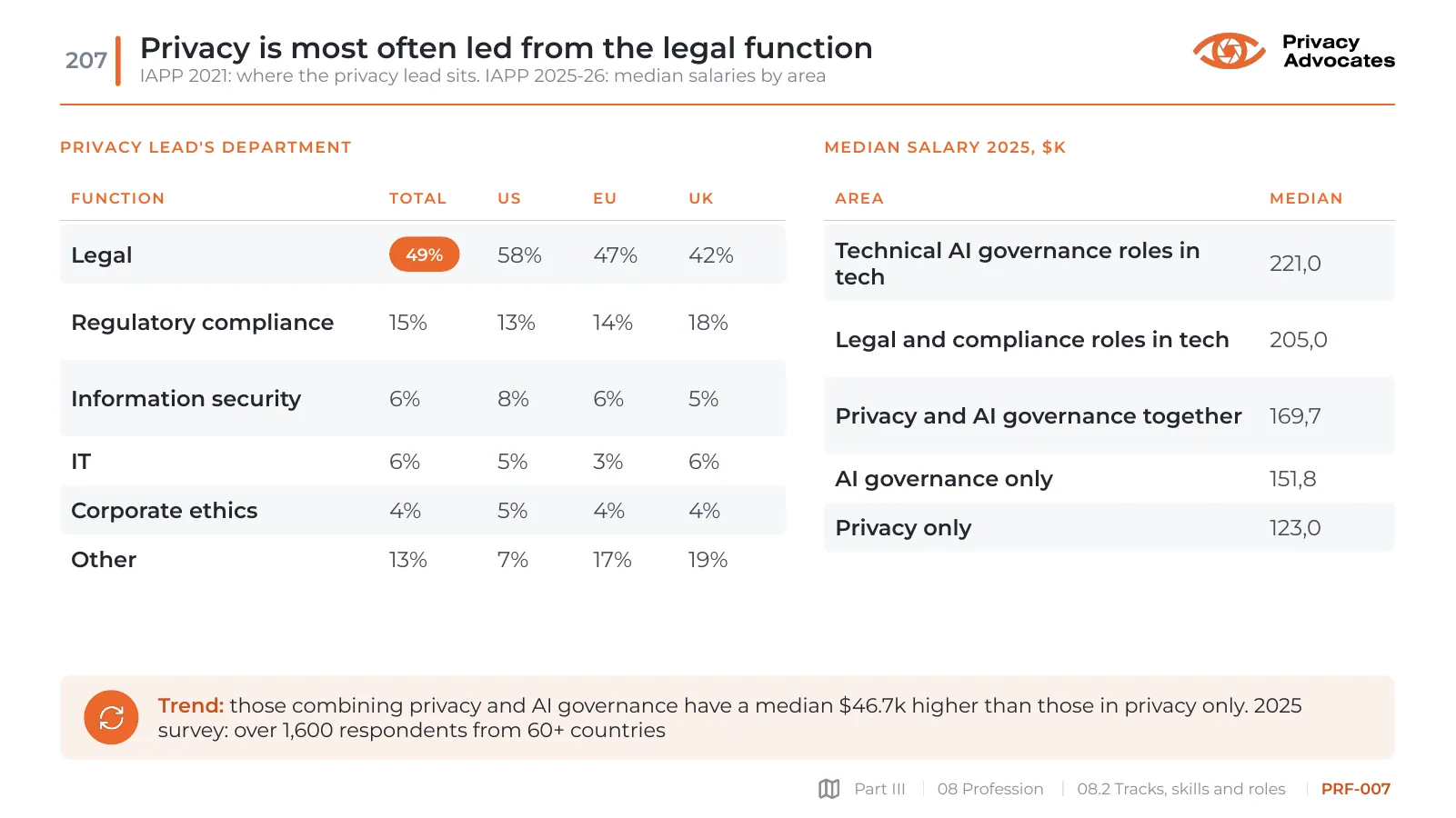
Privacy is most often led from the legal function

IAPP 2021: where the privacy lead sits. IAPP 2025-26: median salaries by area

Slide PRF-007: Privacy is most often led from the legal function
Slide text

Privacy lead's department

  • Function
  • Total
  • US
  • EU
  • UK
  • Legal
  • 49%
  • 58%
  • 47%
  • 42%
  • Regulatory compliance
  • 15%
  • 13%
  • 14%
  • 18%
  • Information security
  • 6%
  • 8%
  • 6%
  • 5%
  • IT
  • 6%
  • 5%
  • 3%
  • 6%
  • Corporate ethics
  • 4%
  • 5%
  • 4%
  • 4%
  • Other
  • 13%
  • 7%
  • 17%
  • 19%

Median salary 2025, $k

  • Area
  • Median
  • Technical AI governance roles in tech
  • 221,0
  • Legal and compliance roles in tech
  • 205,0
  • Privacy and AI governance together
  • 169,7
  • AI governance only
  • 151,8
  • Privacy only
  • 123,0

Trend: those combining privacy and AI governance have a median $46.7k higher than those in privacy only. 2025 survey: over 1,600 respondents from 60+ countries

PRF-008

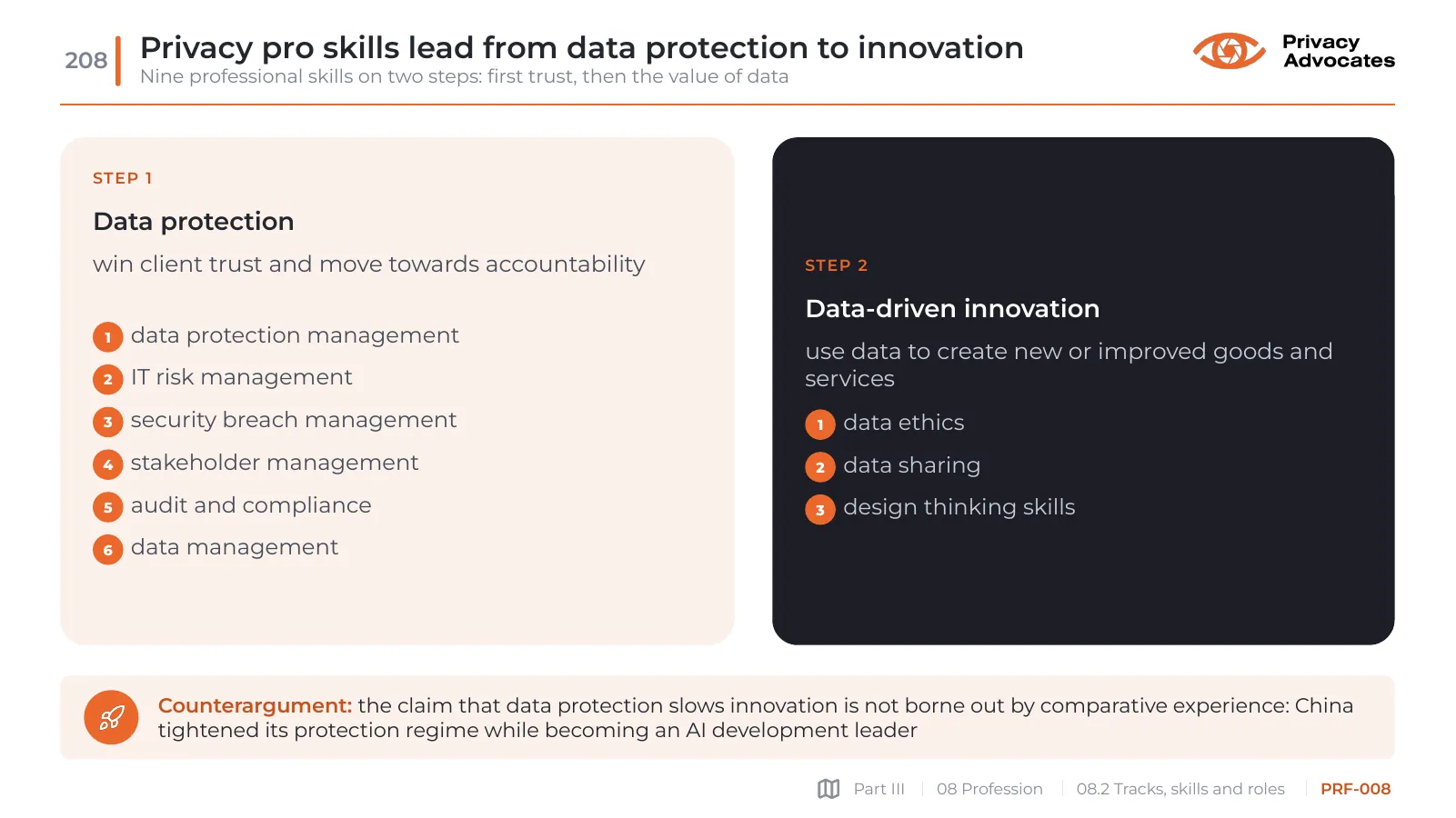
Privacy pro skills lead from data protection to innovation

Nine professional skills on two steps: first trust, then the value of data

Slide PRF-008: Privacy pro skills lead from data protection to innovation
Slide text

Step 1

Data protection

win client trust and move towards accountability

  • 1
  • data protection management
  • 2
  • IT risk management
  • 3
  • security breach management
  • 4
  • stakeholder management
  • 5
  • audit and compliance
  • 6
  • data management

Step 2

Data-driven innovation

use data to create new or improved goods and services

  • 1
  • data ethics
  • 2
  • data sharing
  • 3
  • design thinking skills

Counterargument: the claim that data protection slows innovation is not borne out by comparative experience: China tightened its protection regime while becoming an AI development leader

PRF-009

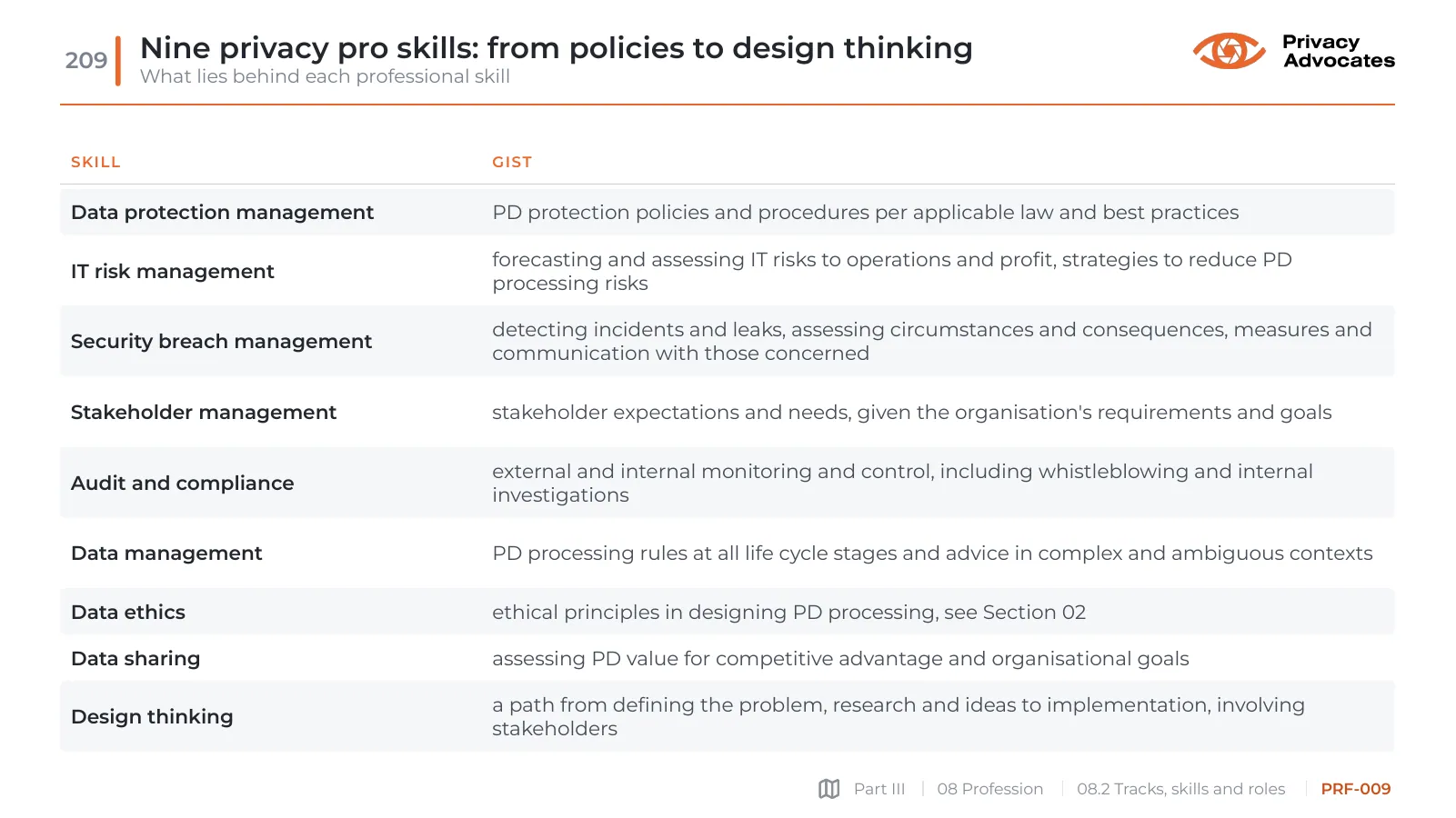
Nine privacy pro skills: from policies to design thinking

What lies behind each professional skill

Slide PRF-009: Nine privacy pro skills: from policies to design thinking
Slide text
  • Skill
  • Gist
  • Data protection management
  • PD protection policies and procedures per applicable law and best practices
  • IT risk management
  • forecasting and assessing IT risks to operations and profit, strategies to reduce PD processing risks
  • Security breach management
  • detecting incidents and leaks, assessing circumstances and consequences, measures and communication with those concerned
  • Stakeholder management
  • stakeholder expectations and needs, given the organisation's requirements and goals
  • Audit and compliance
  • external and internal monitoring and control, including whistleblowing and internal investigations
  • Data management
  • PD processing rules at all life cycle stages and advice in complex and ambiguous contexts
  • Data ethics
  • ethical principles in designing PD processing, see Section 02
  • Data sharing
  • assessing PD value for competitive advantage and organisational goals
  • Design thinking
  • a path from defining the problem, research and ideas to implementation, involving stakeholders
PRF-010

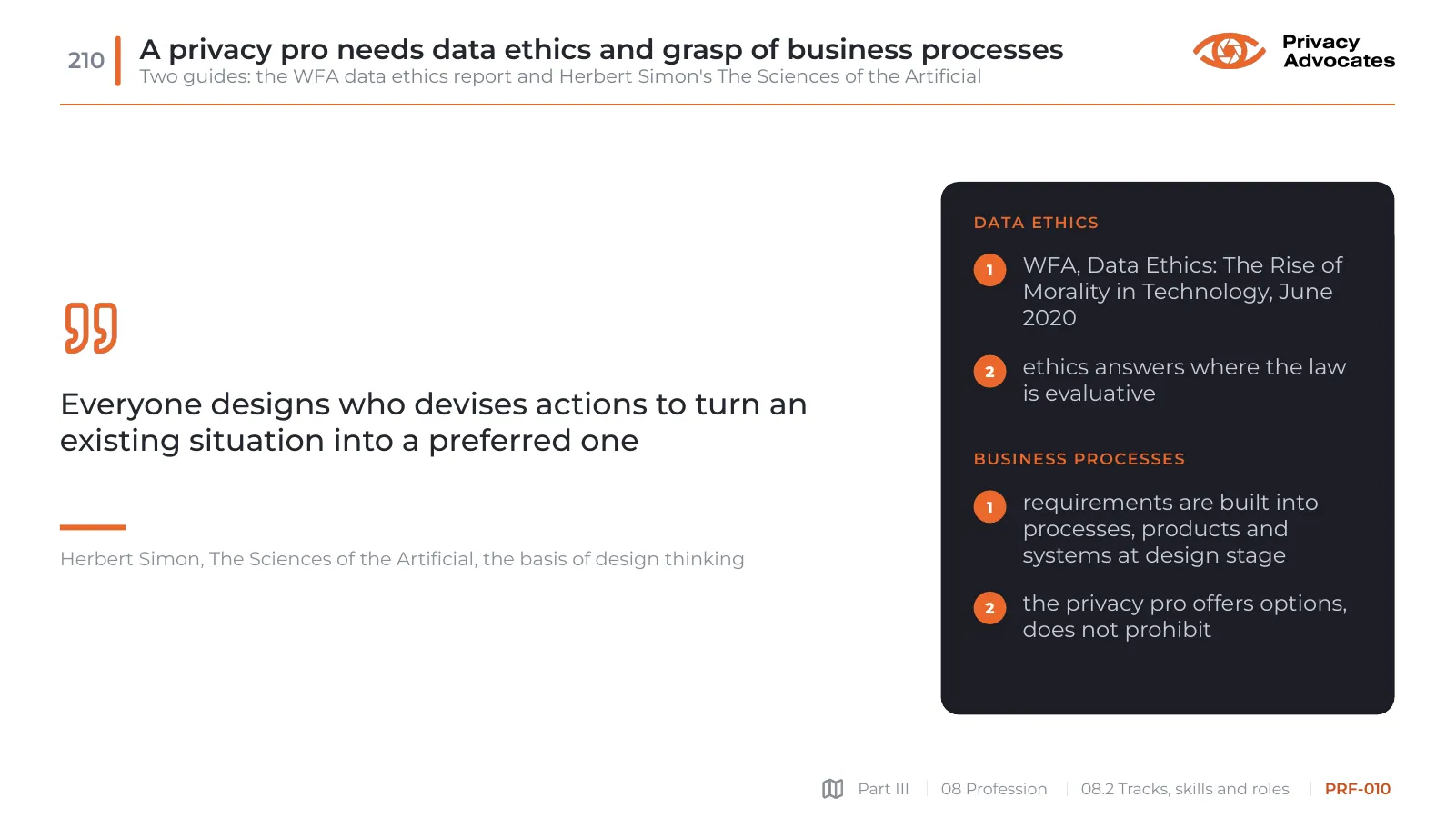
A privacy pro needs data ethics and grasp of business processes

Two guides: the WFA data ethics report and Herbert Simon's The Sciences of the Artificial

Slide PRF-010: A privacy pro needs data ethics and grasp of business processes
Slide text

Everyone designs who devises actions to turn an existing situation into a preferred one

Herbert Simon, The Sciences of the Artificial, the basis of design thinking

Data ethics

  • 1
  • WFA, Data Ethics: The Rise of Morality in Technology, June 2020
  • 2
  • ethics answers where the law is evaluative

Business processes

  • 1
  • requirements are built into processes, products and systems at design stage
  • 2
  • the privacy pro offers options, does not prohibit
PRF-011

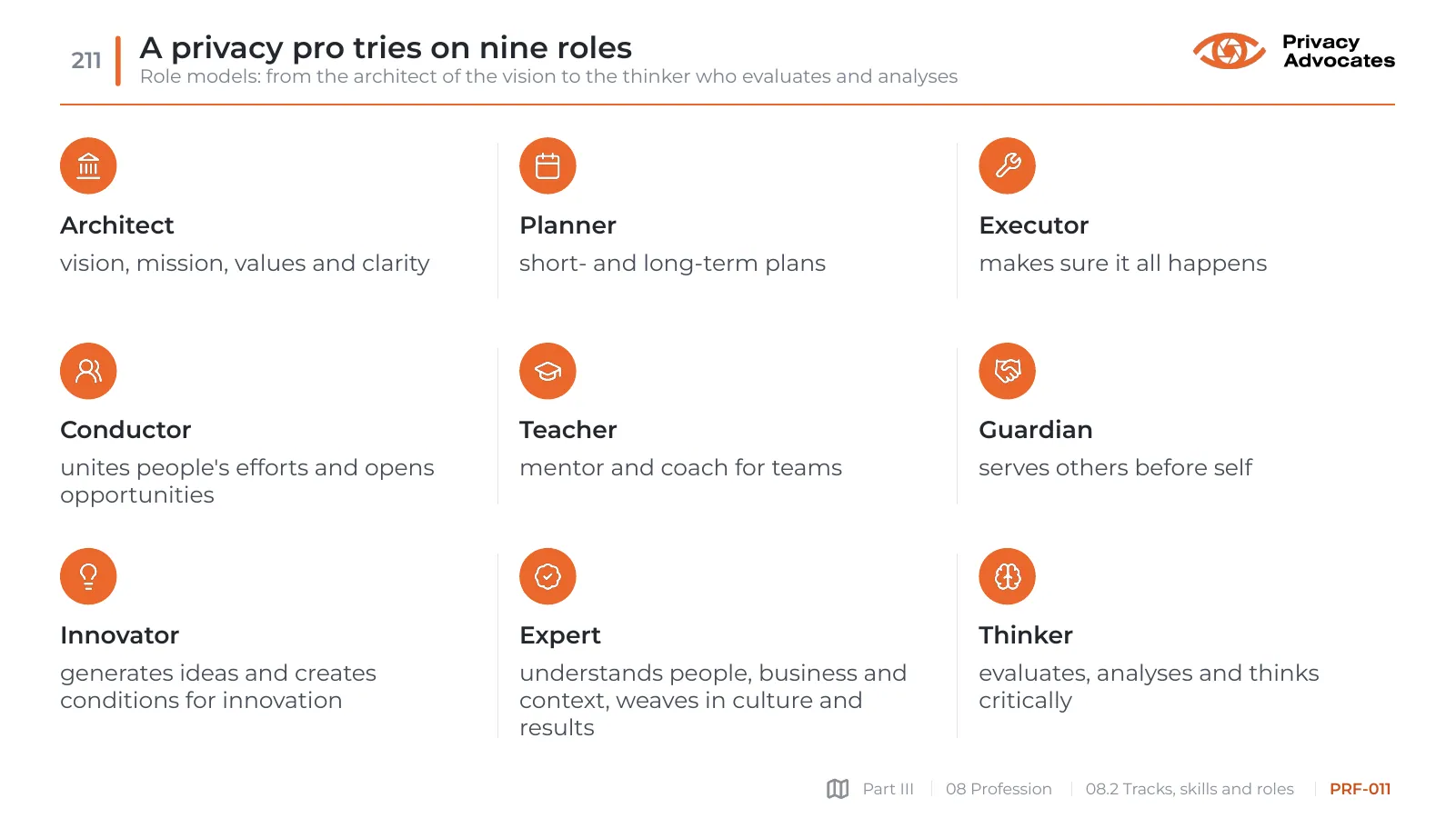
A privacy pro tries on nine roles

Role models: from the architect of the vision to the thinker who evaluates and analyses

Slide PRF-011: A privacy pro tries on nine roles
Slide text

Architect

vision, mission, values and clarity

Planner

short- and long-term plans

Executor

makes sure it all happens

Conductor

unites people's efforts and opens opportunities

Teacher

mentor and coach for teams

Guardian

serves others before self

Innovator

generates ideas and creates conditions for innovation

Expert

understands people, business and context, weaves in culture and results

Thinker

evaluates, analyses and thinks critically

08.3

Privacy Tech

PRF-012

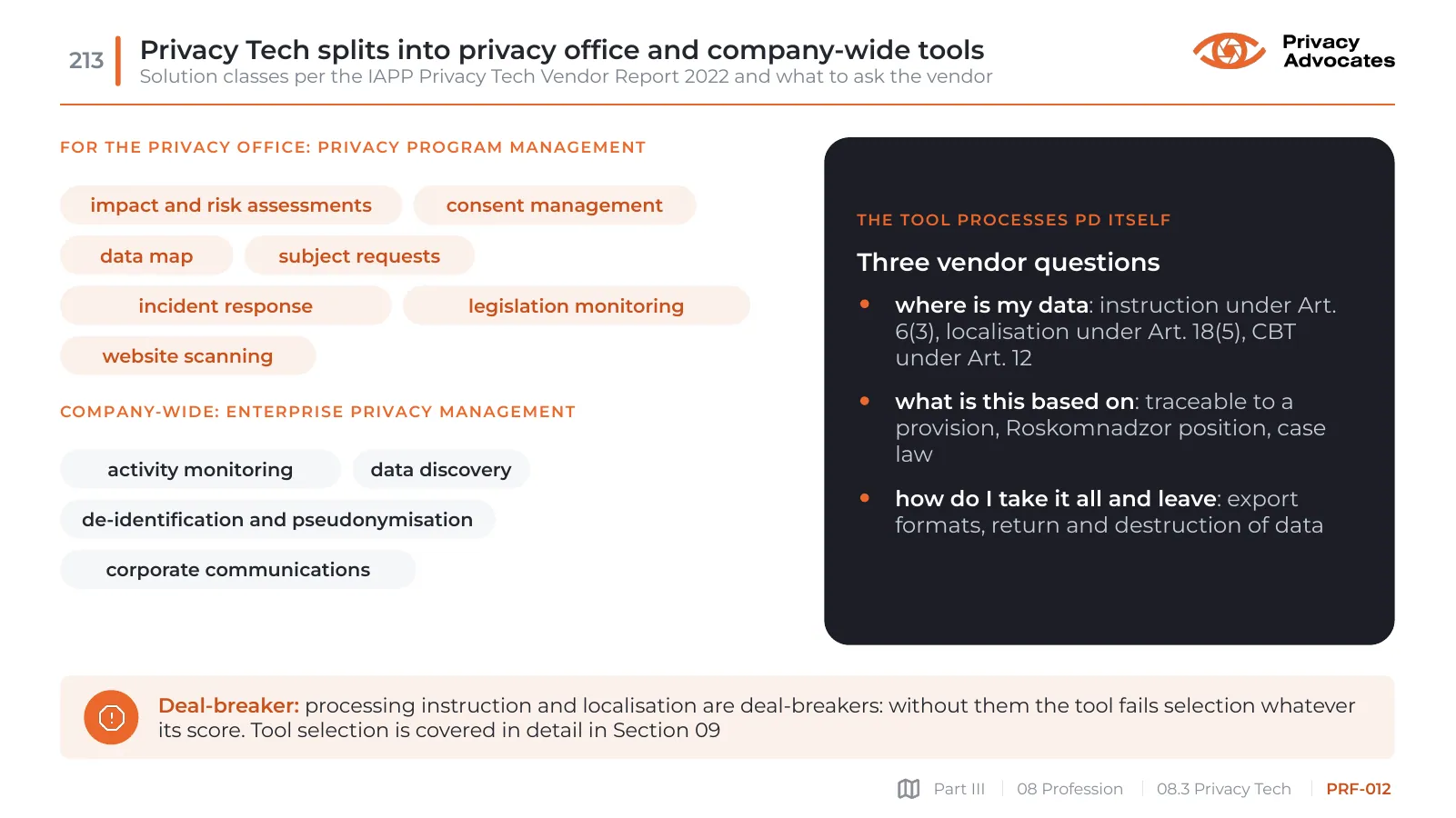
Privacy Tech splits into privacy office and company-wide tools

Solution classes per the IAPP Privacy Tech Vendor Report 2022 and what to ask the vendor

Slide PRF-012: Privacy Tech splits into privacy office and company-wide tools
Slide text

For the privacy office: Privacy Program Management

  • impact and risk assessments
  • consent management
  • data map
  • subject requests
  • incident response
  • legislation monitoring

website scanning

Company-wide: Enterprise Privacy Management

  • activity monitoring
  • data discovery

de-identification and pseudonymisation

corporate communications

The tool processes PD itself

Three vendor questions

where is my data: instruction under Art. 6(3), localisation under Art. 18(5), CBT under Art. 12

what is this based on: traceable to a provision, Roskomnadzor position, case law

how do I take it all and leave: export formats, return and destruction of data

Deal-breaker: processing instruction and localisation are deal-breakers: without them the tool fails selection whatever its score. Tool selection is covered in detail in Section 09

PRF-013

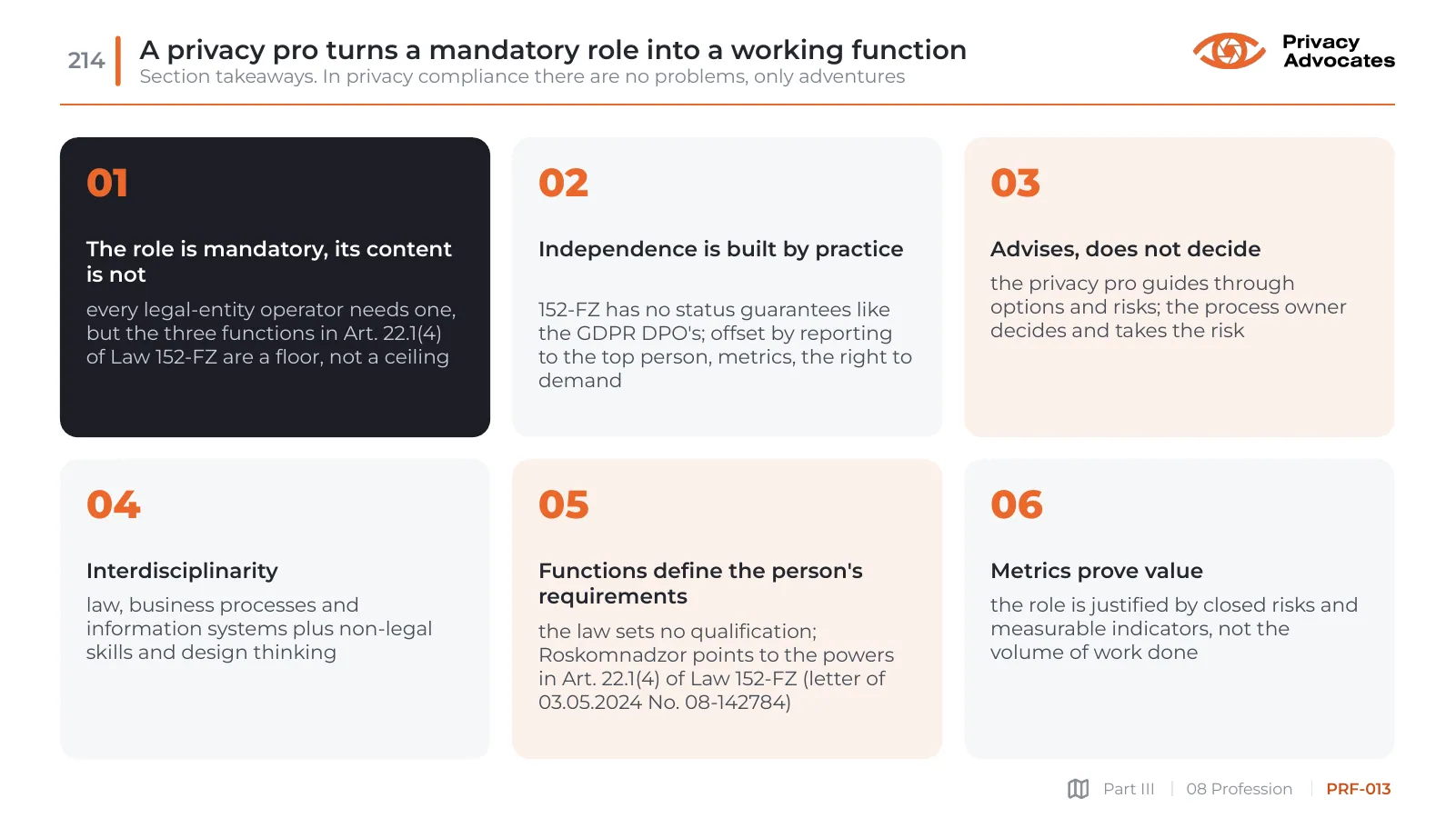
A privacy pro turns a mandatory role into a working function

Section takeaways. In privacy compliance there are no problems, only adventures

Slide PRF-013: A privacy pro turns a mandatory role into a working function
Slide text

01

The role is mandatory, its content is not

every legal-entity operator needs one, but the three functions in Art. 22.1(4) of Law 152-FZ are a floor, not a ceiling

02

Independence is built by practice

152-FZ has no status guarantees like the GDPR DPO's; offset by reporting to the top person, metrics, the right to demand

03

Advises, does not decide

the privacy pro guides through options and risks; the process owner decides and takes the risk

04

Interdisciplinarity

law, business processes and information systems plus non-legal skills and design thinking

05

Functions define the person's requirements

the law sets no qualification; Roskomnadzor points to the powers in Art. 22.1(4) of Law 152-FZ (letter of 03.05.2024 No. 08-142784)

06

Metrics prove value

the role is justified by closed risks and measurable indicators, not the volume of work done