Part VI, section 25

Deepfakes

The legal status of deepfakes in Russia and worldwide

  • 9 slides
  • 2 subsections
  • Edition of 25 October 2026

25.1

The threat and synthetic identities

DIP-001

Deepfake fraud grows and the eye can no longer spot a fake

Scale of the threat: rising attacks, vulnerable state systems and a shift in the detection paradigm
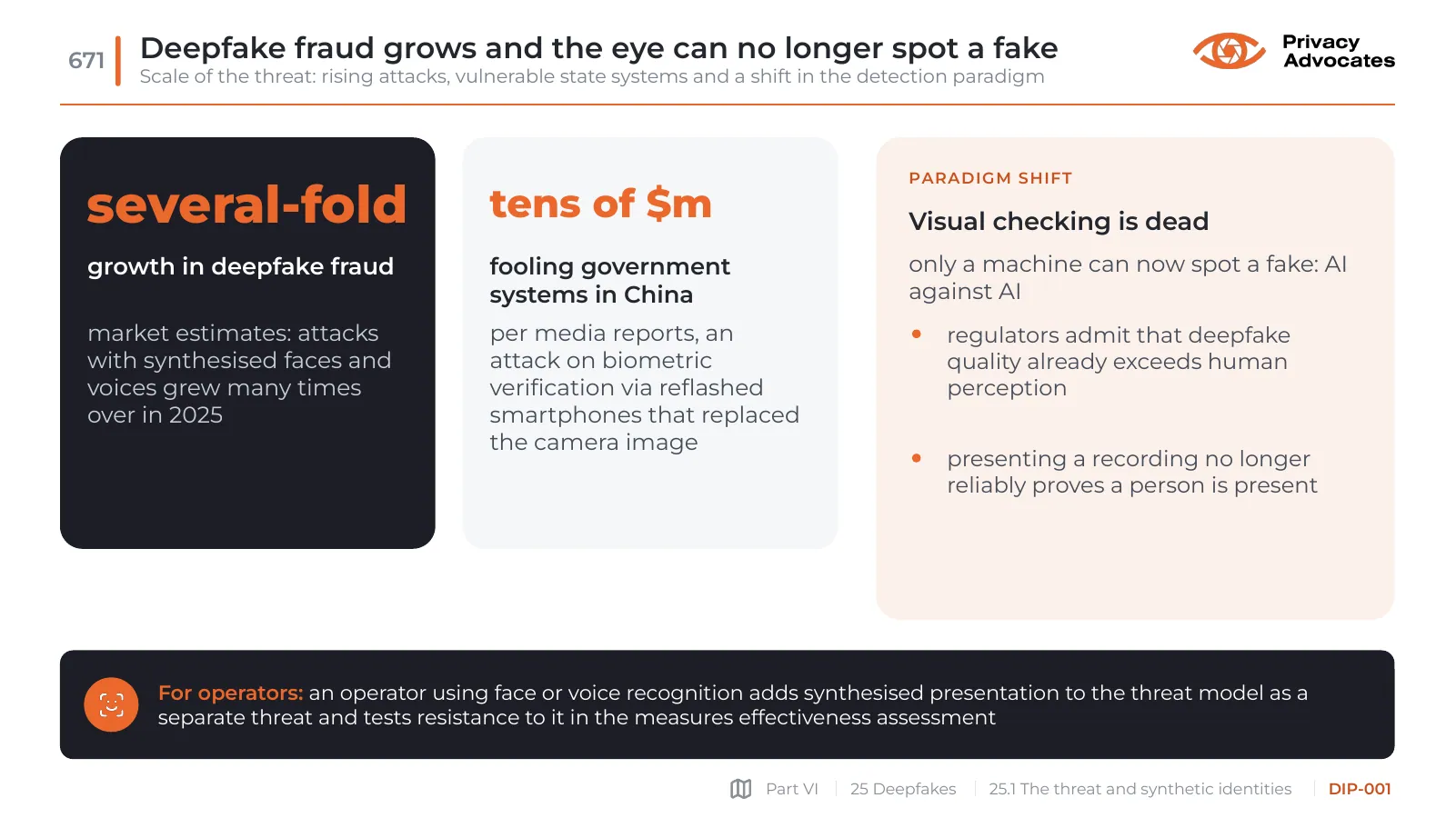
Slide DIP-001: Deepfake fraud grows and the eye can no longer spot a fake
Slide text

several-fold

growth in deepfake fraud

market estimates: attacks with synthesised faces and voices grew many times over in 2025

tens of $m

fooling government systems in China

per media reports, an attack on biometric verification via reflashed smartphones that replaced the camera image

Paradigm shift

Visual checking is dead

only a machine can now spot a fake: AI against AI

regulators admit that deepfake quality already exceeds human perception

presenting a recording no longer reliably proves a person is present

For operators: an operator using face or voice recognition adds synthesised presentation to the threat model as a separate threat and tests resistance to it in the measures effectiveness assessment
DIP-002

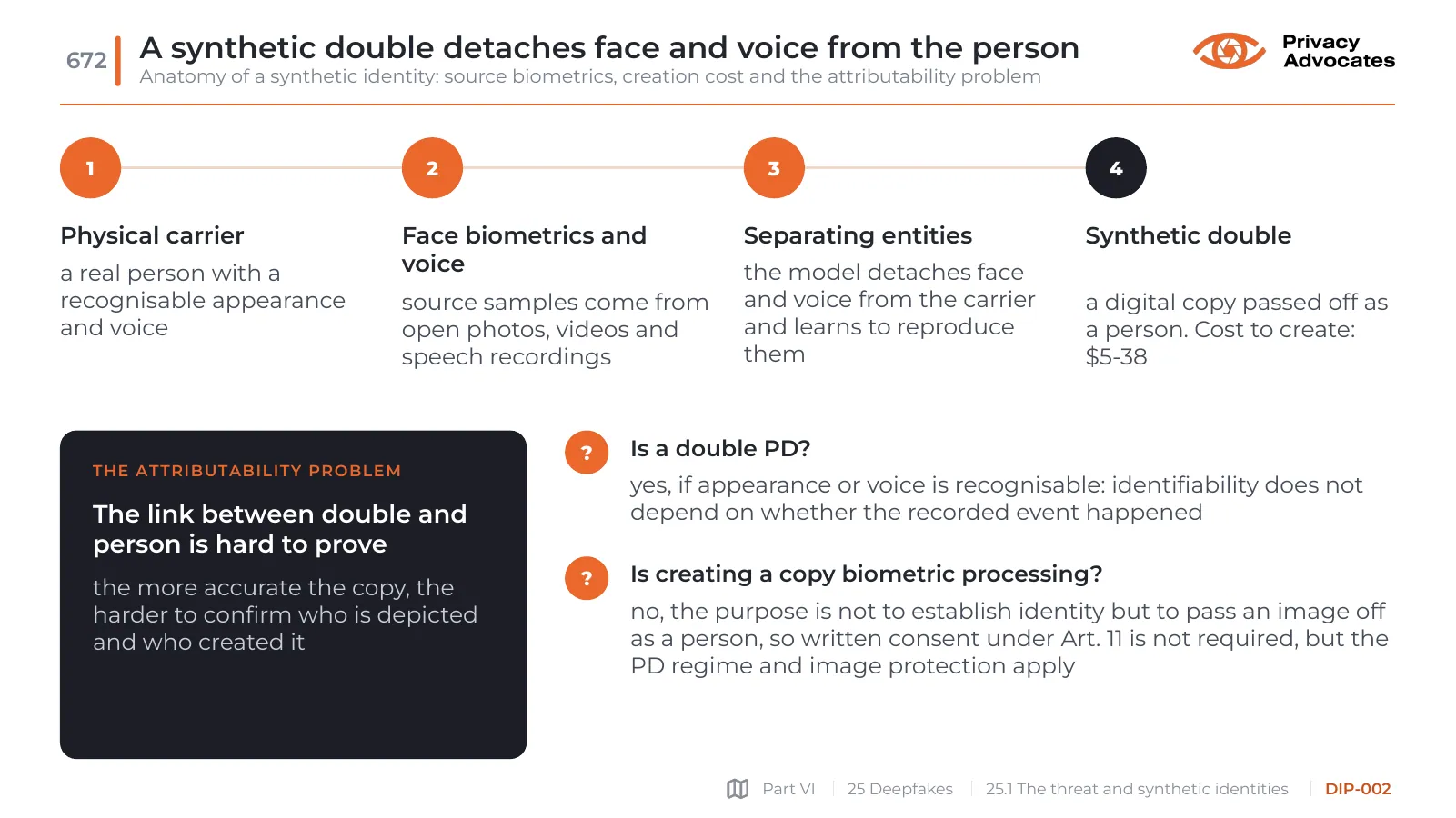
A synthetic double detaches face and voice from the person

Anatomy of a synthetic identity: source biometrics, creation cost and the attributability problem

Slide DIP-002: A synthetic double detaches face and voice from the person
Slide text

1

Physical carrier

a real person with a recognisable appearance and voice

2

Face biometrics and voice

source samples come from open photos, videos and speech recordings

3

Separating entities

the model detaches face and voice from the carrier and learns to reproduce them

4

Synthetic double

a digital copy passed off as a person. Cost to create: $5-38

The attributability problem

The link between double and person is hard to prove

the more accurate the copy, the harder to confirm who is depicted and who created it

  • ?
  • Is a double PD?

yes, if appearance or voice is recognisable: identifiability does not depend on whether the recorded event happened

  • ?
  • Is creating a copy biometric processing?

no, the purpose is not to establish identity but to pass an image off as a person, so written consent under Art. 11 is not required, but the PD regime and image protection apply

25.2

Regulation of deepfakes

DIP-003

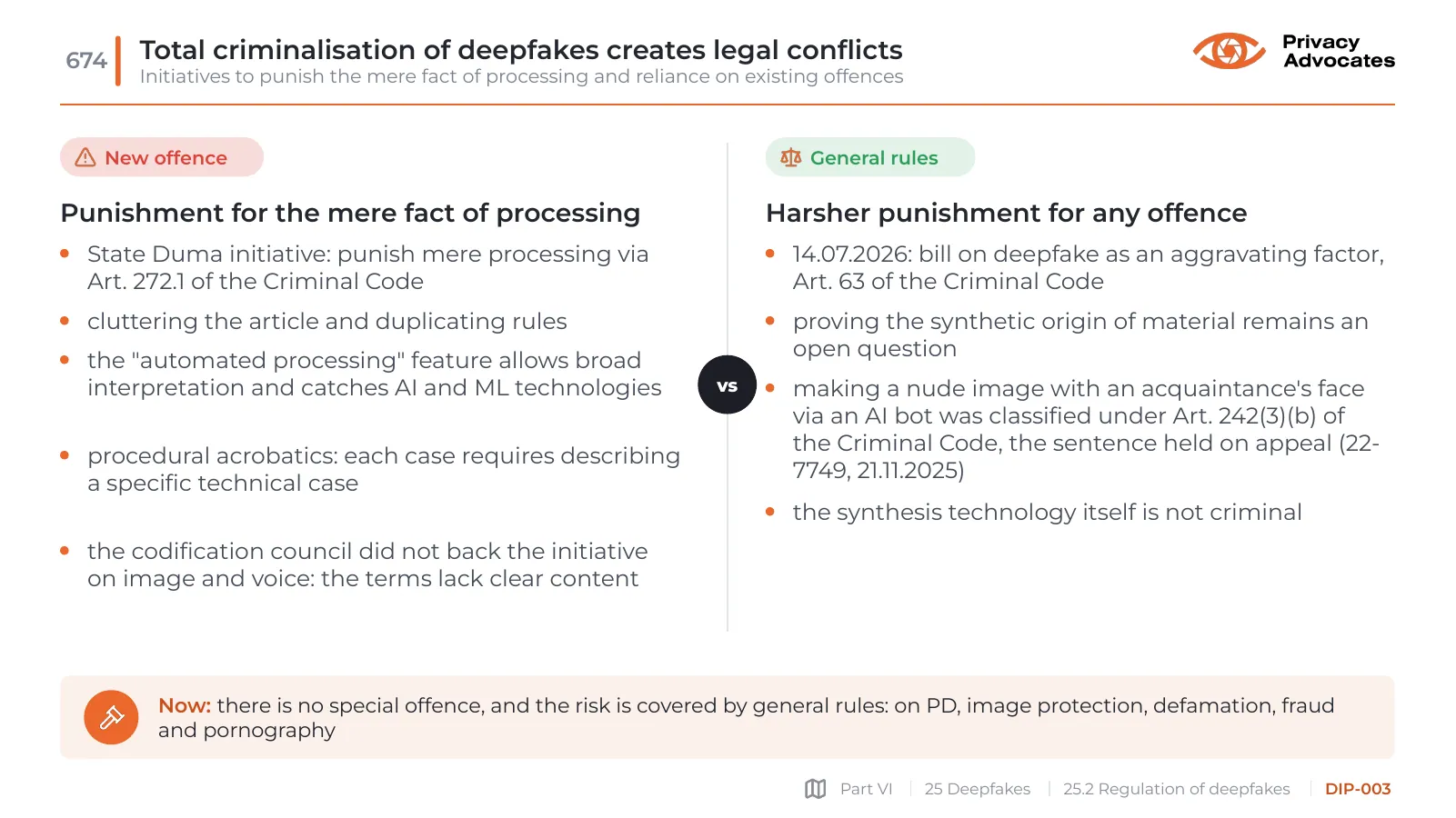
Total criminalisation of deepfakes creates legal conflicts

Initiatives to punish the mere fact of processing and reliance on existing offences

Slide DIP-003: Total criminalisation of deepfakes creates legal conflicts
Slide text

vs

New offence

Punishment for the mere fact of processing

State Duma initiative: punish mere processing via Art. 272.1 of the Criminal Code

cluttering the article and duplicating rules

the "automated processing" feature allows broad interpretation and catches AI and ML technologies

procedural acrobatics: each case requires describing a specific technical case

the codification council did not back the initiative on image and voice: the terms lack clear content

General rules

Harsher punishment for any offence

14.07.2026: bill on deepfake as an aggravating factor, Art. 63 of the Criminal Code

proving the synthetic origin of material remains an open question

making a nude image with an acquaintance's face via an AI bot was classified under Art. 242(3)(b) of the Criminal Code, the sentence held on appeal (22-7749, 21.11.2025)

the synthesis technology itself is not criminal

Now: there is no special offence, and the risk is covered by general rules: on PD, image protection, defamation, fraud and pornography

DIP-004

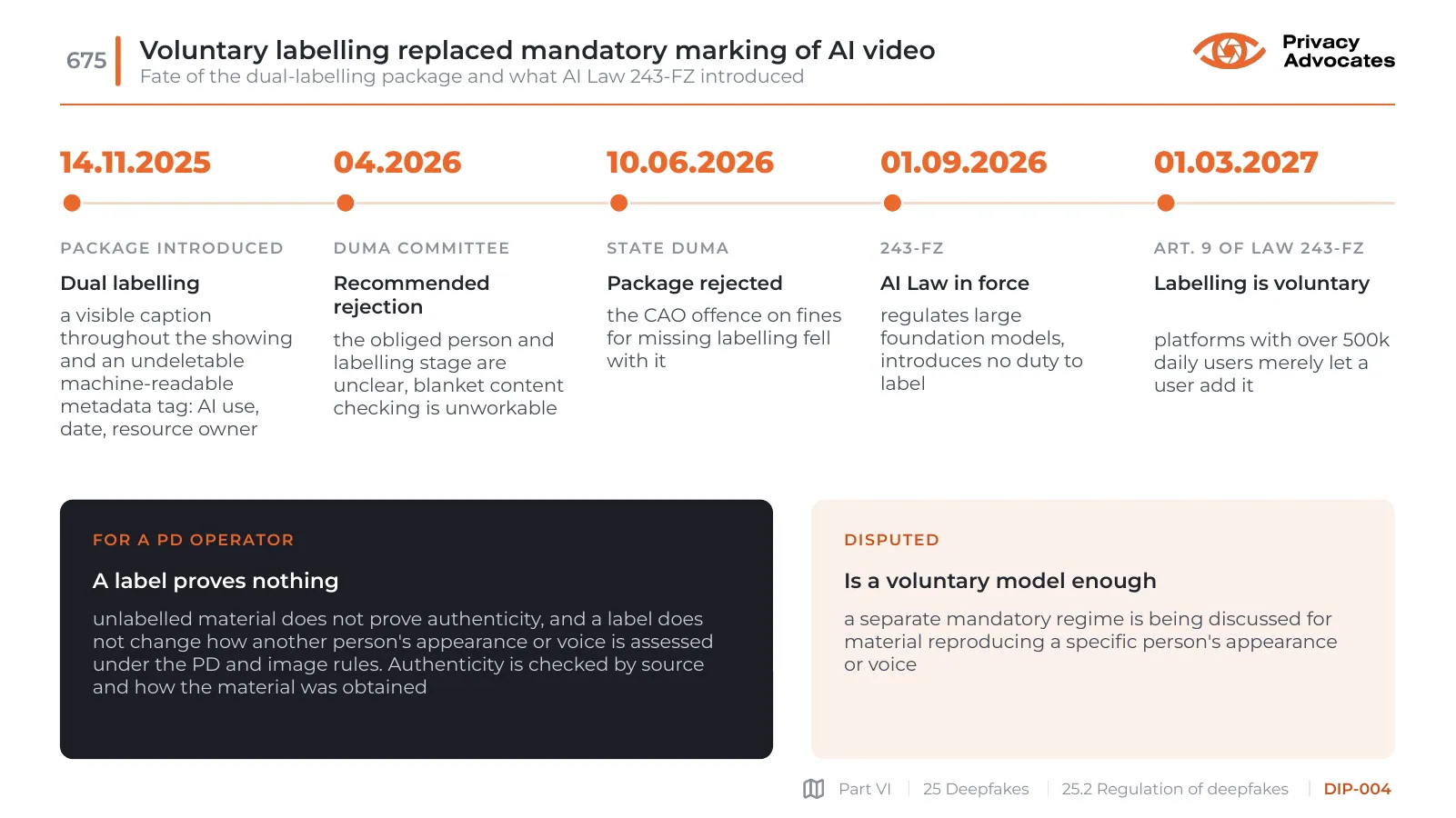
Voluntary labelling replaced mandatory marking of AI video

Fate of the dual-labelling package and what AI Law 243-FZ introduced

Slide DIP-004: Voluntary labelling replaced mandatory marking of AI video
Slide text

14.11.2025

package introduced

Dual labelling

a visible caption throughout the showing and an undeletable machine-readable metadata tag: AI use, date, resource owner

04.2026

Duma committee

Recommended rejection

the obliged person and labelling stage are unclear, blanket content checking is unworkable

10.06.2026

State Duma

Package rejected

the CAO offence on fines for missing labelling fell with it

01.09.2026

243-FZ

AI Law in force

regulates large foundation models, introduces no duty to label

01.03.2027

Art. 9 of Law 243-FZ

Labelling is voluntary

platforms with over 500k daily users merely let a user add it

For a PD operator

A label proves nothing

unlabelled material does not prove authenticity, and a label does not change how another person's appearance or voice is assessed under the PD and image rules. Authenticity is checked by source and how the material was obtained

Disputed

Is a voluntary model enough

a separate mandatory regime is being discussed for material reproducing a specific person's appearance or voice

DIP-005

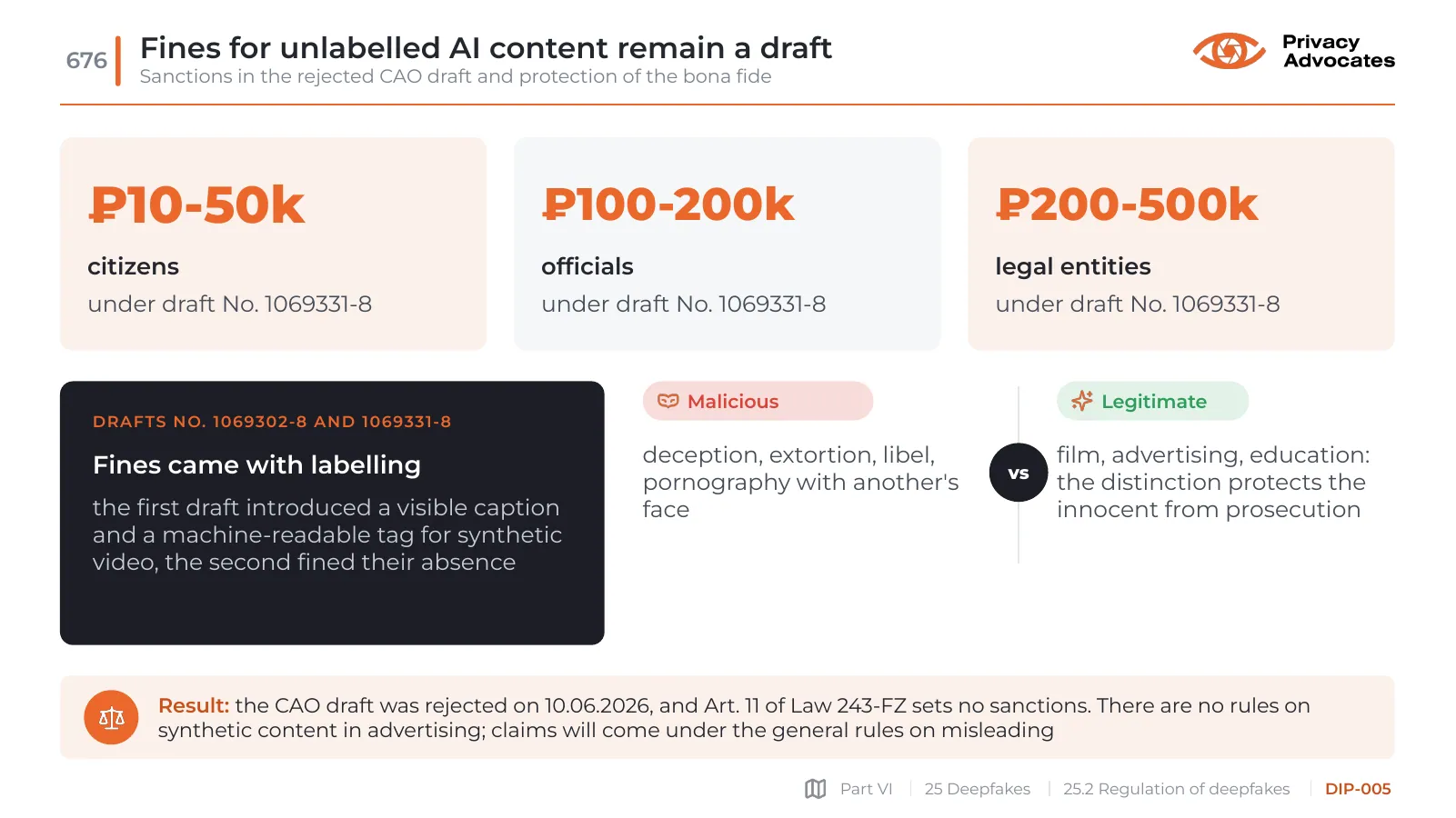
Fines for unlabelled AI content remain a draft

Sanctions in the rejected CAO draft and protection of the bona fide

Slide DIP-005: Fines for unlabelled AI content remain a draft
Slide text

₽10-50k

citizens

under draft No. 1069331-8

₽100-200k

officials

under draft No. 1069331-8

₽200-500k

legal entities

under draft No. 1069331-8

Drafts No. 1069302-8 and 1069331-8

Fines came with labelling

the first draft introduced a visible caption and a machine-readable tag for synthetic video, the second fined their absence

vs

Malicious

deception, extortion, libel, pornography with another's face

Legitimate

film, advertising, education: the distinction protects the innocent from prosecution

Result: the CAO draft was rejected on 10.06.2026, and Art. 11 of Law 243-FZ sets no sanctions. There are no rules on synthetic content in advertising; claims will come under the general rules on misleading

DIP-006

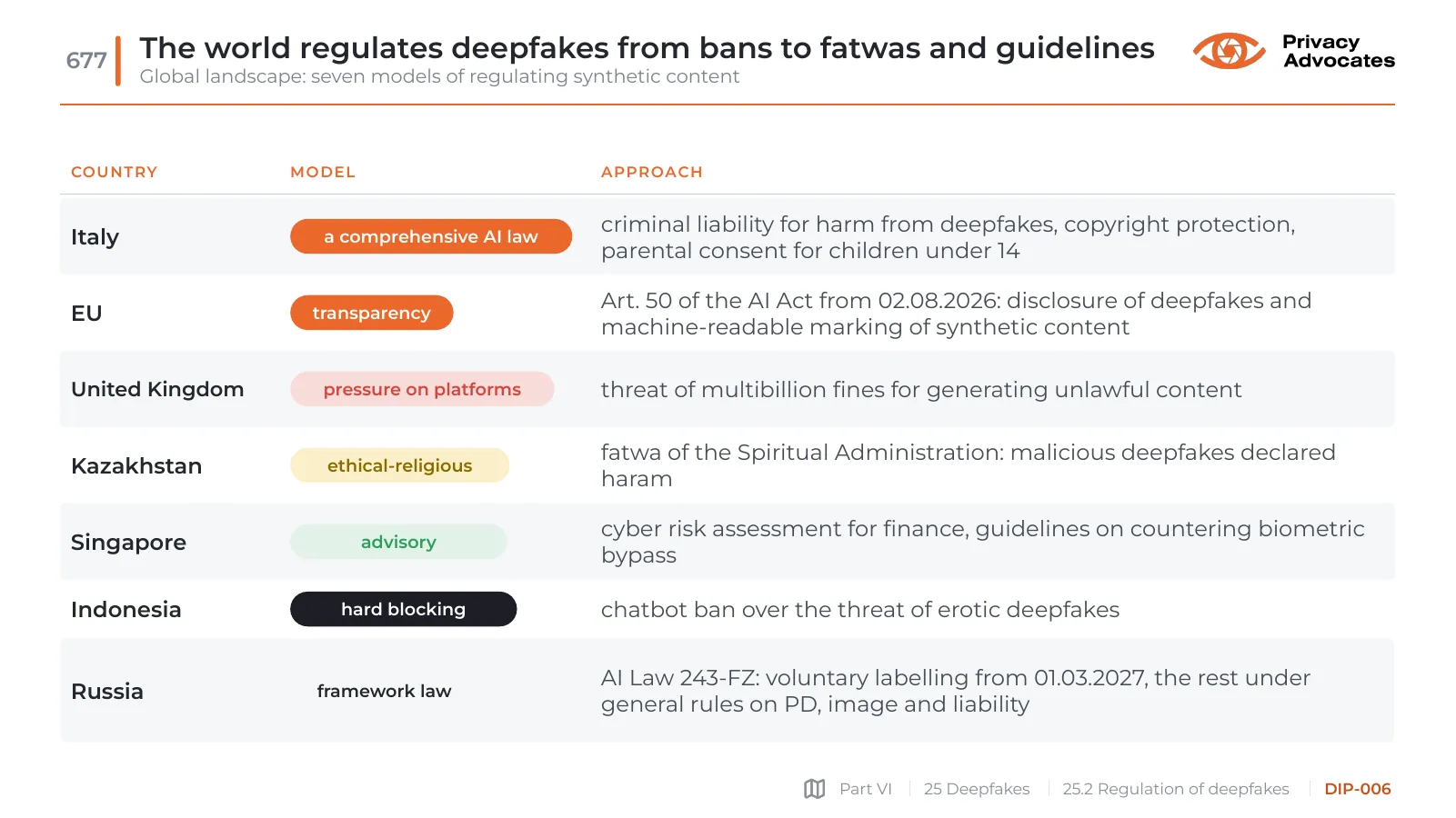
The world regulates deepfakes from bans to fatwas and guidelines

Global landscape: seven models of regulating synthetic content

Slide DIP-006: The world regulates deepfakes from bans to fatwas and guidelines
Slide text
  • Country
  • Model
  • Approach
  • Italy
  • a comprehensive AI law
  • criminal liability for harm from deepfakes, copyright protection, parental consent for children under 14
  • EU
  • transparency
  • Art. 50 of the AI Act from 02.08.2026: disclosure of deepfakes and machine-readable marking of synthetic content
  • United Kingdom
  • pressure on platforms
  • threat of multibillion fines for generating unlawful content
  • Kazakhstan
  • ethical-religious
  • fatwa of the Spiritual Administration: malicious deepfakes declared haram
  • Singapore
  • advisory
  • cyber risk assessment for finance, guidelines on countering biometric bypass
  • Indonesia
  • hard blocking
  • chatbot ban over the threat of erotic deepfakes
  • Russia
  • framework law
  • AI Law 243-FZ: voluntary labelling from 01.03.2027, the rest under general rules on PD, image and liability
DIP-007

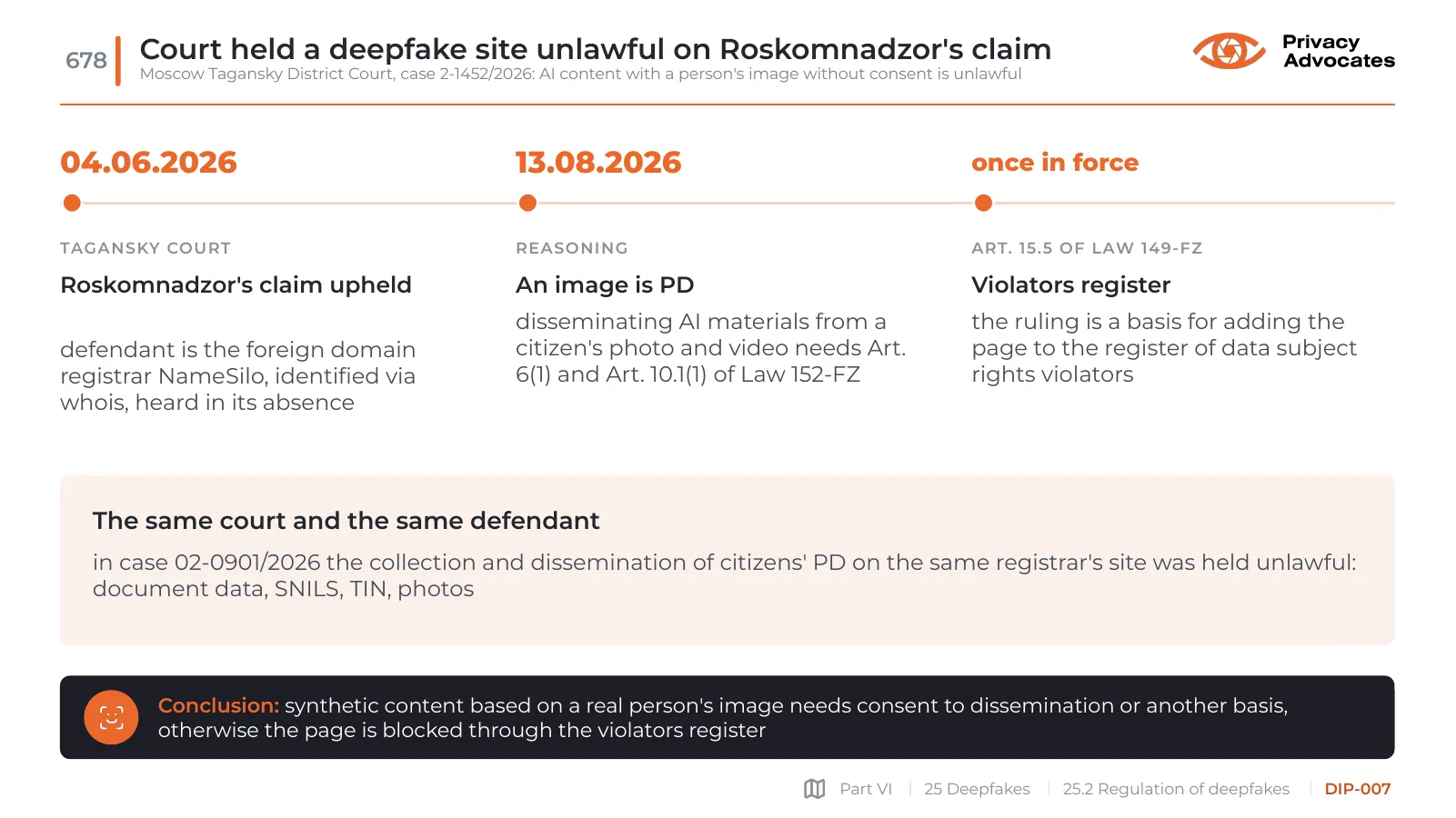
Court held a deepfake site unlawful on Roskomnadzor's claim

Moscow Tagansky District Court, case 2-1452/2026: AI content with a person's image without consent is unlawful

Slide DIP-007: Court held a deepfake site unlawful on Roskomnadzor's claim
Slide text

04.06.2026

Tagansky Court

Roskomnadzor's claim upheld

defendant is the foreign domain registrar NameSilo, identified via whois, heard in its absence

13.08.2026

reasoning

An image is PD

disseminating AI materials from a citizen's photo and video needs Art. 6(1) and Art. 10.1(1) of Law 152-FZ

once in force

Art. 15.5 of Law 149-FZ

Violators register

the ruling is a basis for adding the page to the register of data subject rights violators

The same court and the same defendant

in case 02-0901/2026 the collection and dissemination of citizens' PD on the same registrar's site was held unlawful: document data, SNILS, TIN, photos

Conclusion: synthetic content based on a real person's image needs consent to dissemination or another basis, otherwise the page is blocked through the violators register

DIP-008

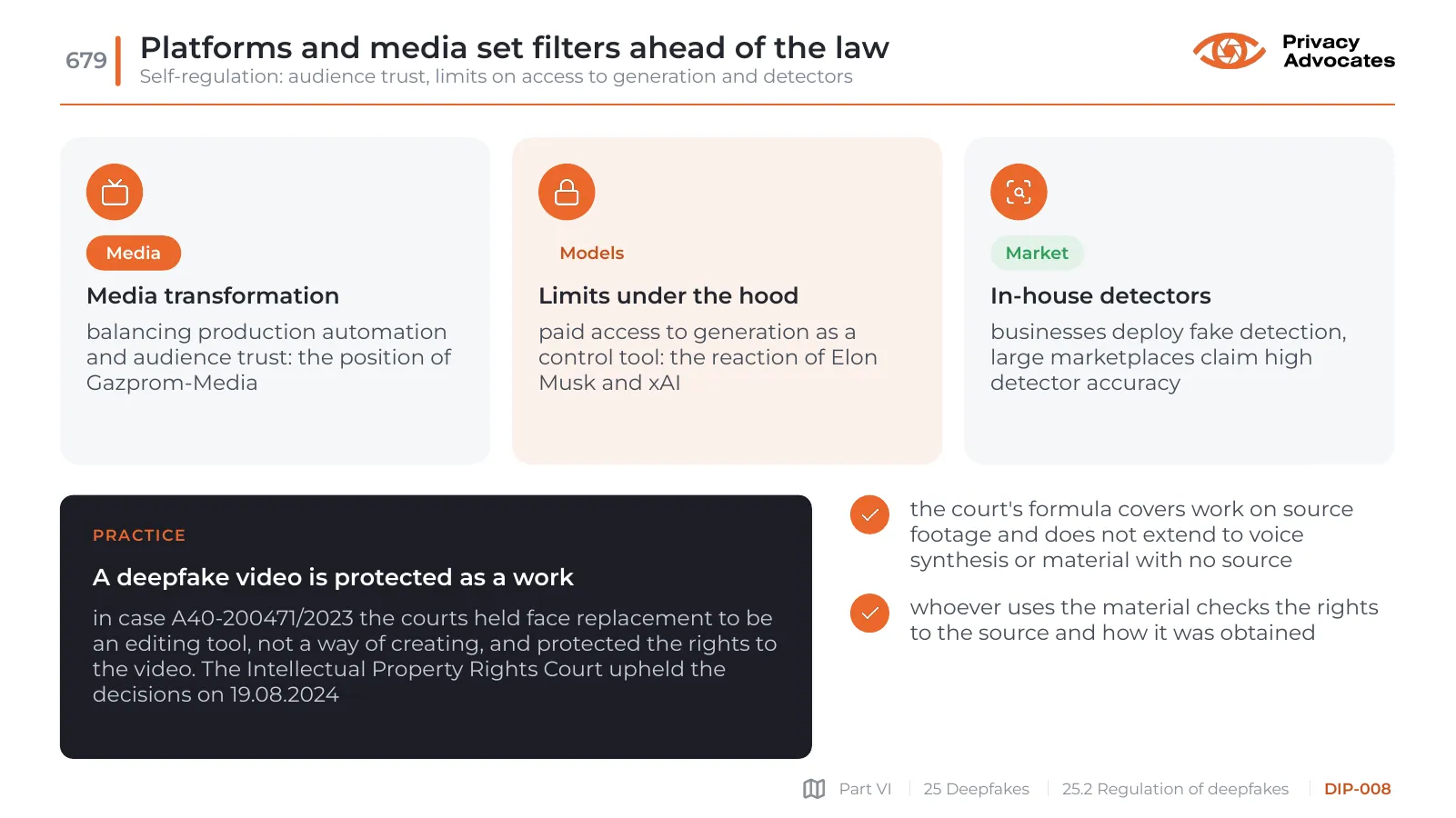
Platforms and media set filters ahead of the law

Self-regulation: audience trust, limits on access to generation and detectors

Slide DIP-008: Platforms and media set filters ahead of the law
Slide text

Media

Media transformation

balancing production automation and audience trust: the position of Gazprom-Media

Models

Limits under the hood

paid access to generation as a control tool: the reaction of Elon Musk and xAI

Market

In-house detectors

businesses deploy fake detection, large marketplaces claim high detector accuracy

Practice

A deepfake video is protected as a work

in case A40-200471/2023 the courts held face replacement to be an editing tool, not a way of creating, and protected the rights to the video. The Intellectual Property Rights Court upheld the decisions on 19.08.2024

the court's formula covers work on source footage and does not extend to voice synthesis or material with no source

whoever uses the material checks the rights to the source and how it was obtained

DIP-009

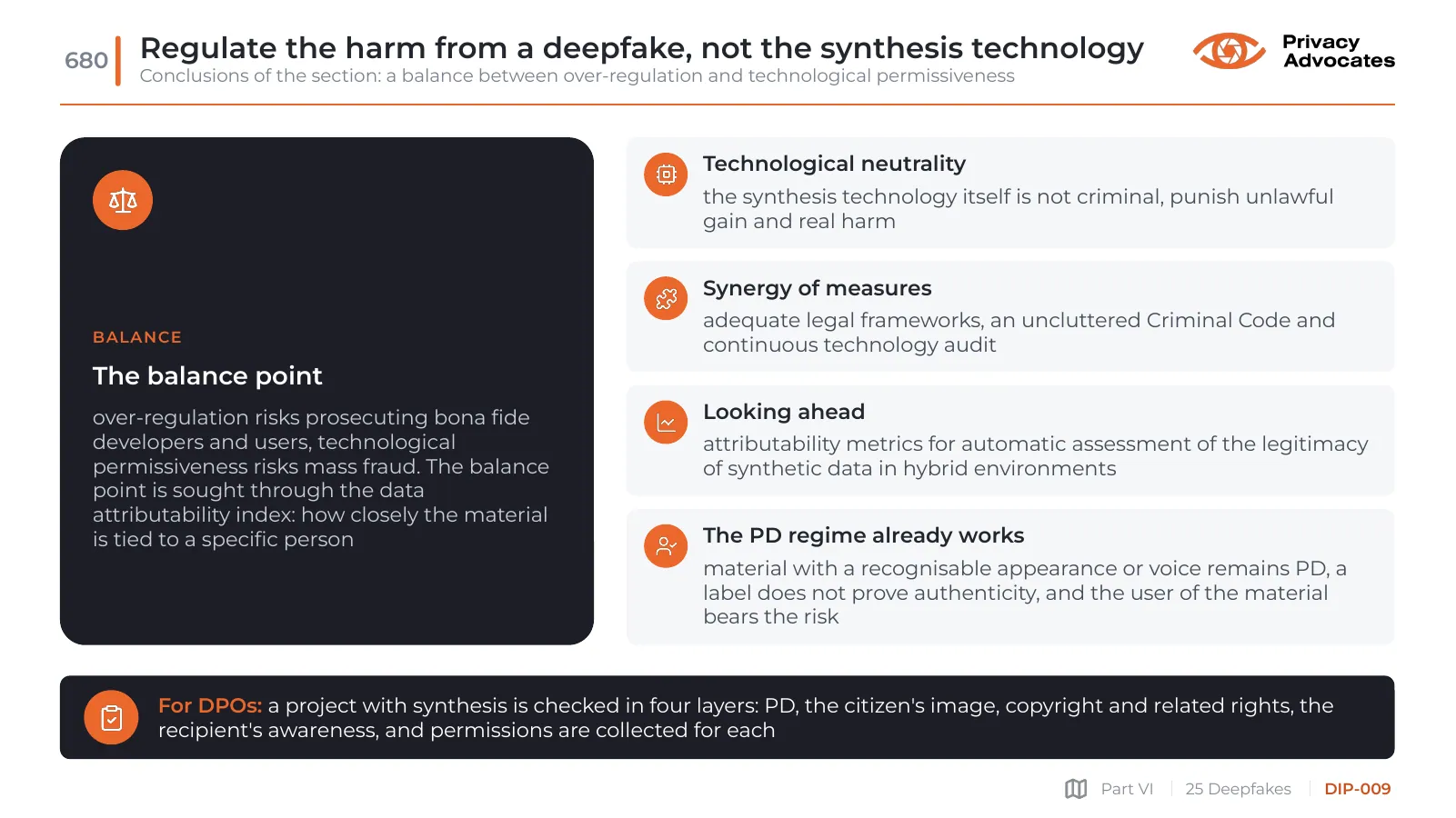
Regulate the harm from a deepfake, not the synthesis technology

Conclusions of the section: a balance between over-regulation and technological permissiveness

Slide DIP-009: Regulate the harm from a deepfake, not the synthesis technology
Slide text

Balance

The balance point

over-regulation risks prosecuting bona fide developers and users, technological permissiveness risks mass fraud. The balance point is sought through the data attributability index: how closely the material is tied to a specific person

Technological neutrality

the synthesis technology itself is not criminal, punish unlawful gain and real harm

Synergy of measures

adequate legal frameworks, an uncluttered Criminal Code and continuous technology audit

Looking ahead

attributability metrics for automatic assessment of the legitimacy of synthetic data in hybrid environments

The PD regime already works

material with a recognisable appearance or voice remains PD, a label does not prove authenticity, and the user of the material bears the risk

For DPOs: a project with synthesis is checked in four layers: PD, the citizen's image, copyright and related rights, the recipient's awareness, and permissions are collected for each