Part VII, section 26

Privacy risk management

How to assess PD processing risk and make a decision you can prove

  • 18 slides
  • 4 subsections
  • Edition of 25 October 2026

26.1

Risk thinking

RSK-001

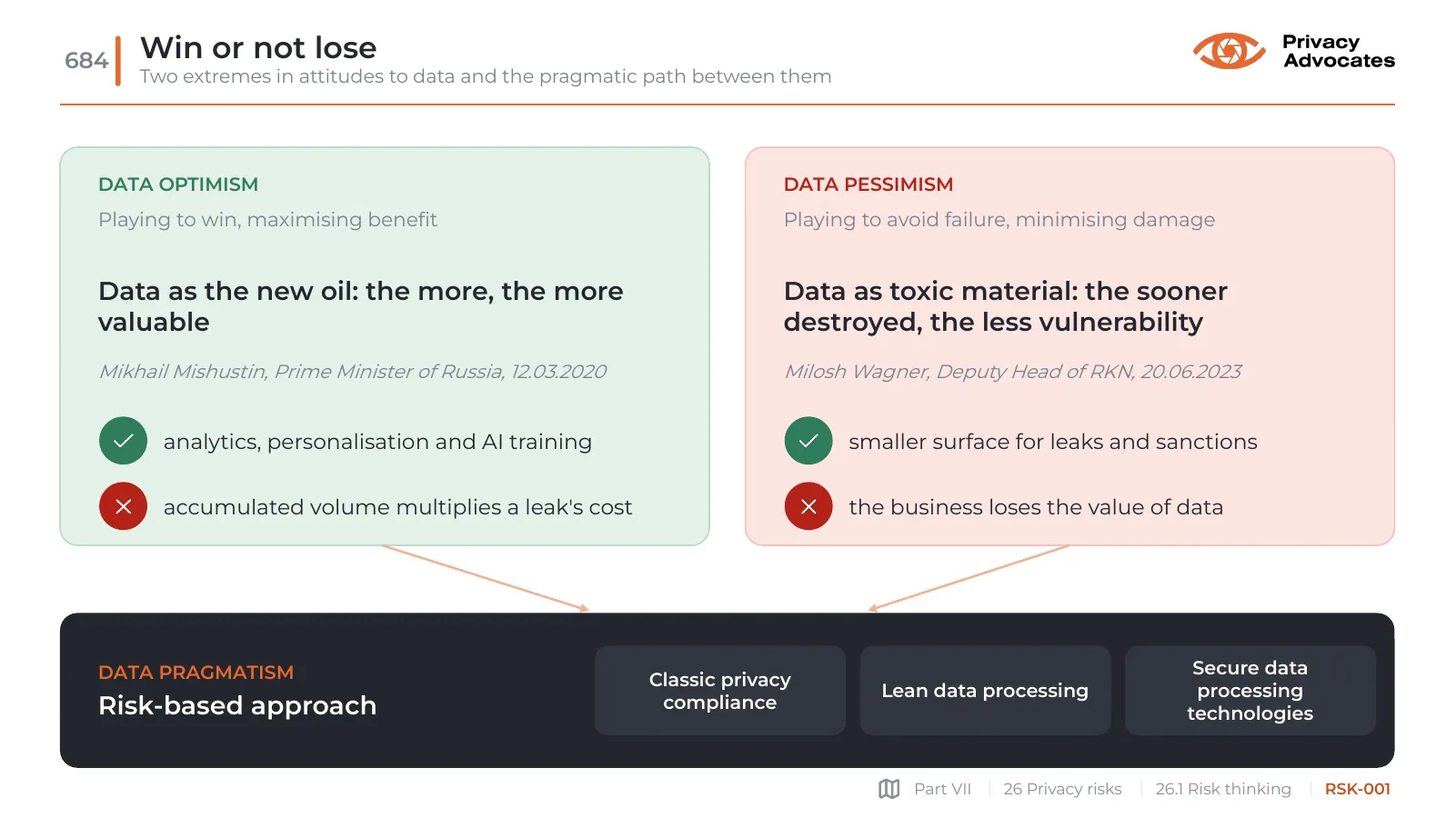
Win or not lose

Two extremes in attitudes to data and the pragmatic path between them
Slide RSK-001: Win or not lose
Slide text

DATA OPTIMISM

Playing to win, maximising benefit

Data as the new oil: the more, the more valuable

analytics, personalisation and AI training

accumulated volume multiplies a leak's cost

DATA PESSIMISM

Playing to avoid failure, minimising damage

Data as toxic material: the sooner destroyed, the less vulnerability

smaller surface for leaks and sanctions

the business loses the value of data

DATA PRAGMATISM

Risk-based approach

  • Classic privacy compliance
  • Lean data processing
  • Secure data processing technologies
  • Mikhail Mishustin, Prime Minister of Russia, 12.03.2020
  • Milosh Wagner, Deputy Head of RKN, 20.06.2023
RSK-002

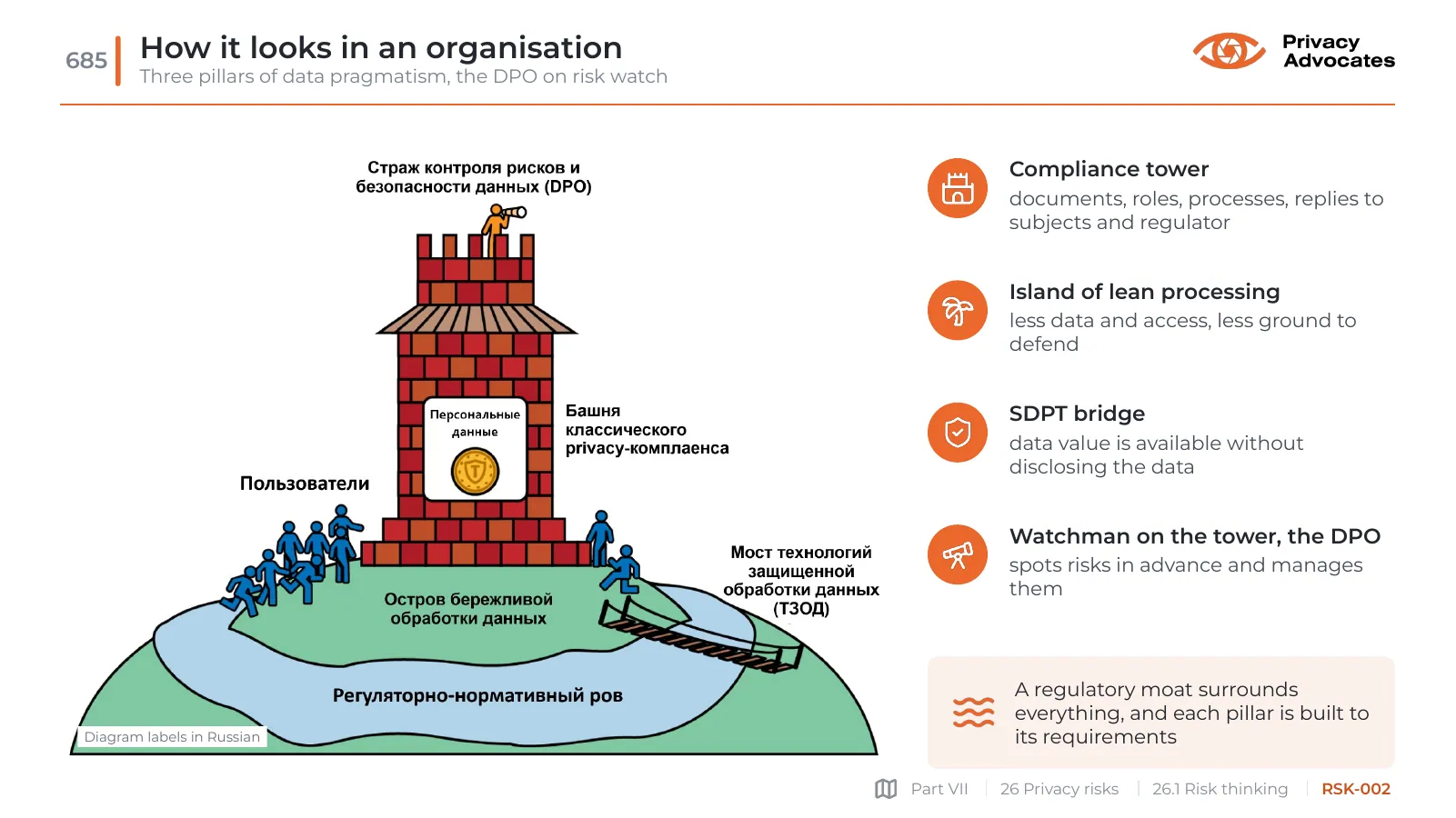
How it looks in an organisation

Three pillars of data pragmatism, the DPO on risk watch

Slide RSK-002: How it looks in an organisation
Slide text

Compliance tower

documents, roles, processes, replies to subjects and regulator

Island of lean processing

less data and access, less ground to defend

SDPT bridge

data value is available without disclosing the data

Watchman on the tower, the DPO

spots risks in advance and manages them

  • Diagram labels in Russian
  • A regulatory moat surrounds everything, and each pillar is built to its requirements
RSK-003

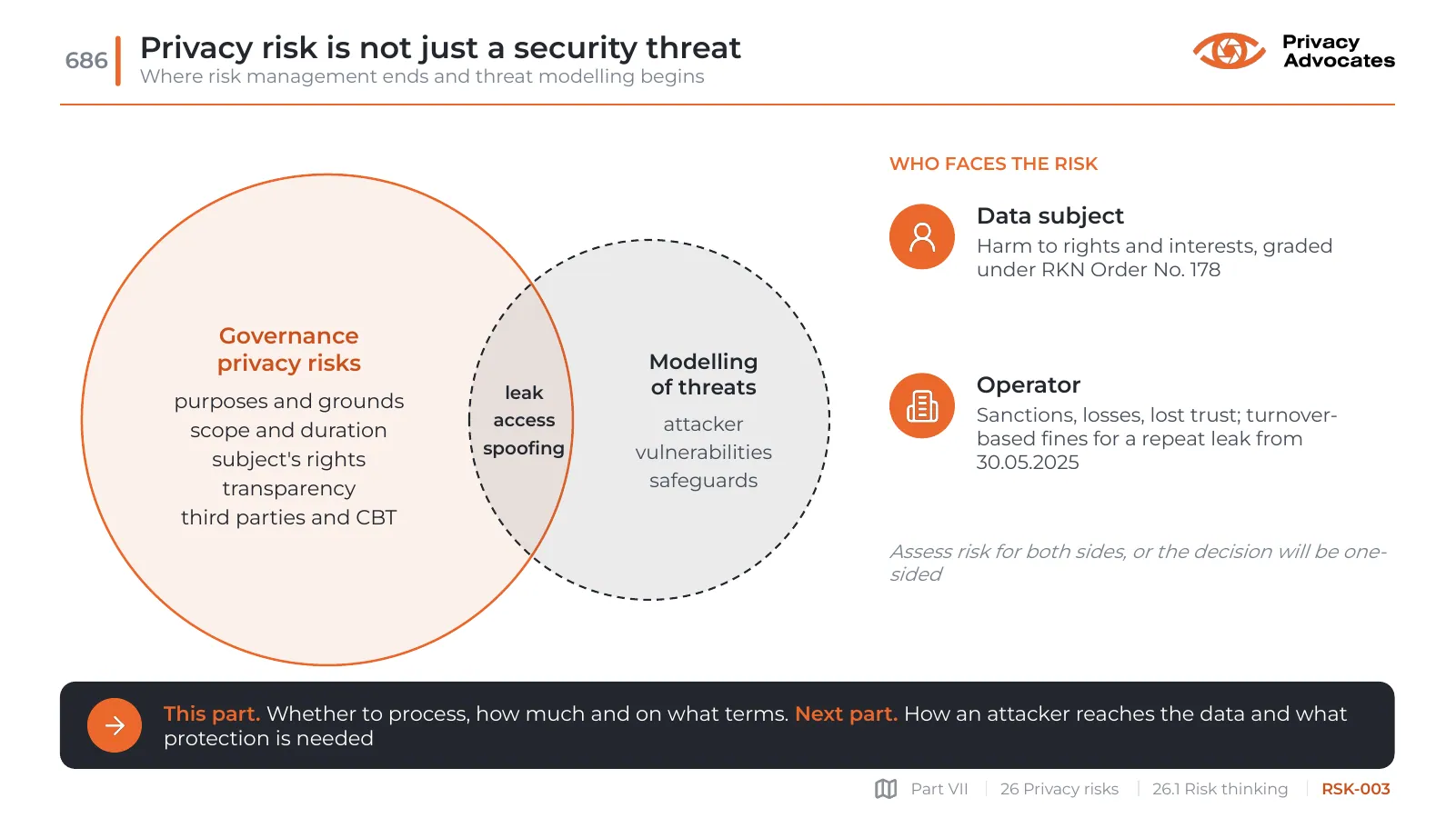
Privacy risk is not just a security threat

Where risk management ends and threat modelling begins

Slide RSK-003: Privacy risk is not just a security threat
Slide text

Governance

privacy risks

purposes and grounds

scope and duration

subject's rights

transparency

third parties and CBT

leak

access

spoofing

Modelling

of threats

attacker

vulnerabilities

safeguards

WHO FACES THE RISK

Data subject

Harm to rights and interests, graded under RKN Order No. 178

Operator

Sanctions, losses, lost trust; turnover-based fines for a repeat leak from 30.05.2025

Assess risk for both sides, or the decision will be one-sided

This part. Whether to process, how much and on what terms. Next part. How an attacker reaches the data and what protection is needed

RSK-004

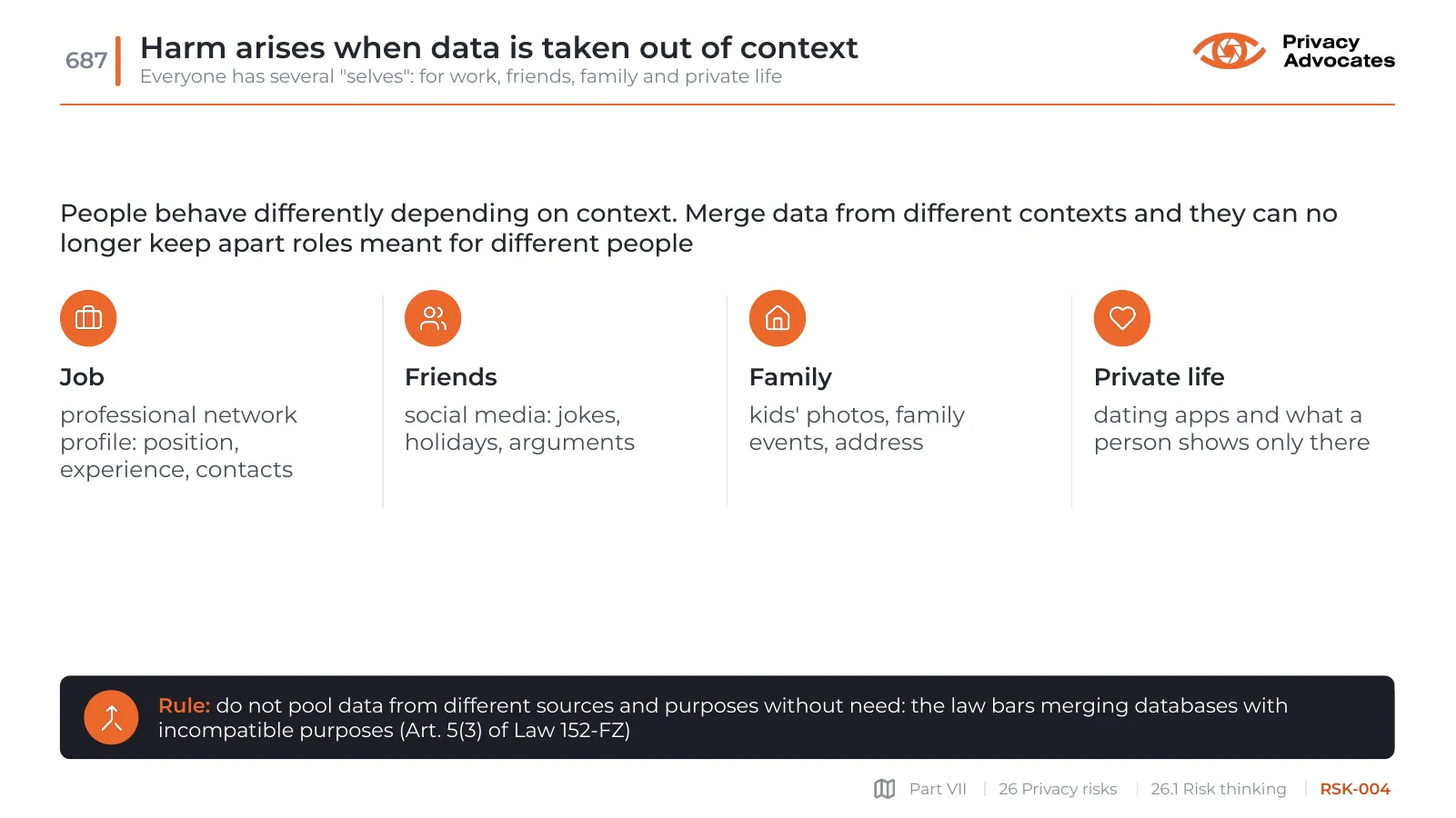
Harm arises when data is taken out of context

Everyone has several "selves": for work, friends, family and private life

Slide RSK-004: Harm arises when data is taken out of context
Slide text

People behave differently depending on context. Merge data from different contexts and they can no longer keep apart roles meant for different people

Job

professional network profile: position, experience, contacts

Friends

social media: jokes, holidays, arguments

Family

kids' photos, family events, address

Private life

dating apps and what a person shows only there

Rule: do not pool data from different sources and purposes without need: the law bars merging databases with incompatible purposes (Art. 5(3) of Law 152-FZ)

RSK-005

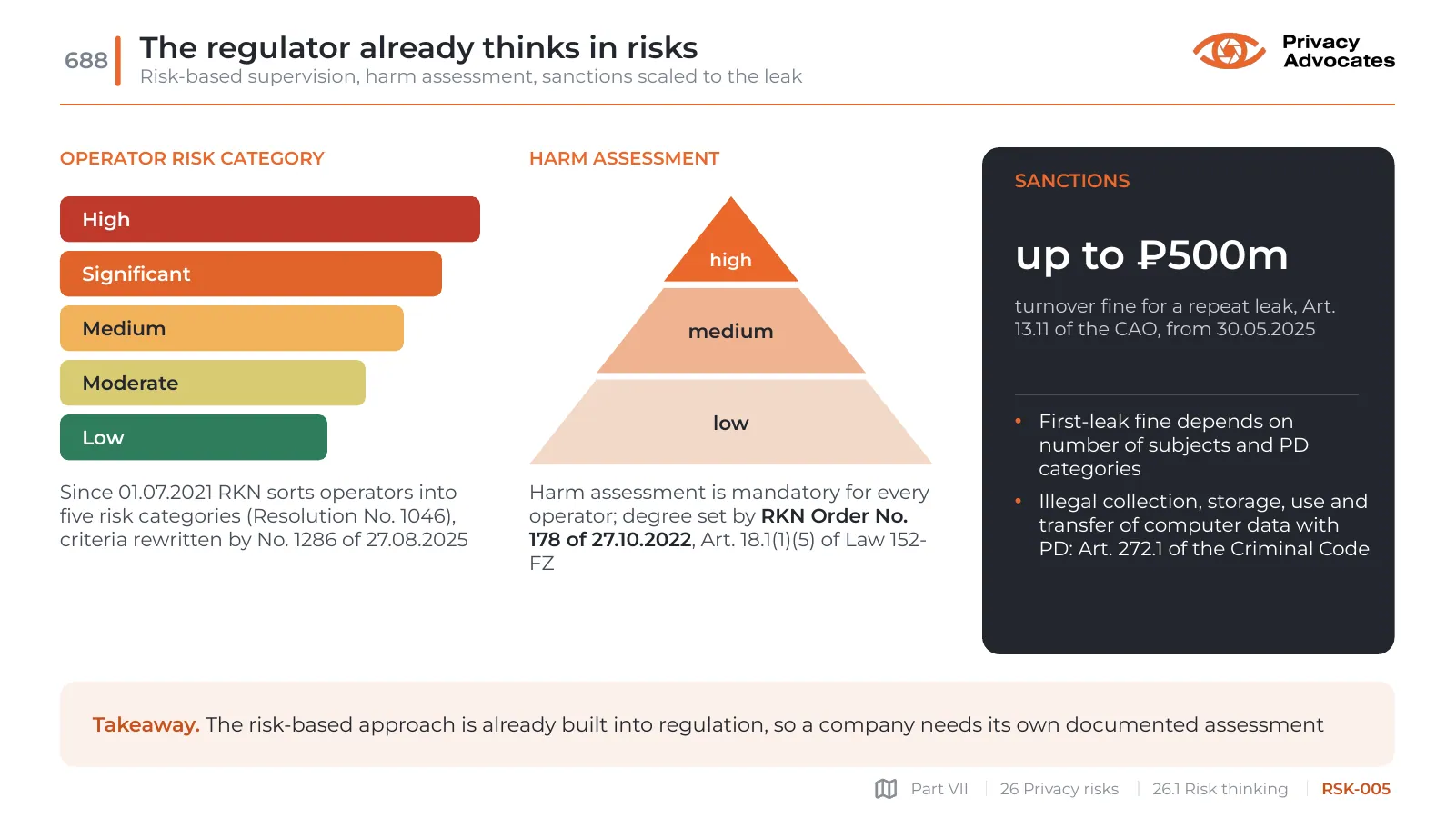
The regulator already thinks in risks

Risk-based supervision, harm assessment, sanctions scaled to the leak

Slide RSK-005: The regulator already thinks in risks
Slide text

OPERATOR RISK CATEGORY

High

Significant

Medium

Moderate

Low

Since 01.07.2021 RKN sorts operators into five risk categories (Resolution No. 1046), criteria rewritten by No. 1286 of 27.08.2025

HARM ASSESSMENT

high

medium

low

Harm assessment is mandatory for every operator; degree set by RKN Order No. 178 of 27.10.2022, Art. 18.1(1)(5) of Law 152-FZ

SANCTIONS

up to ₽500m

turnover fine for a repeat leak, Art. 13.11 of the CAO, from 30.05.2025

First-leak fine depends on number of subjects and PD categories

Illegal collection, storage, use and transfer of computer data with PD: Art. 272.1 of the Criminal Code

Takeaway. The risk-based approach is already built into regulation, so a company needs its own documented assessment

26.2

Harm assessment and principles

RSK-006

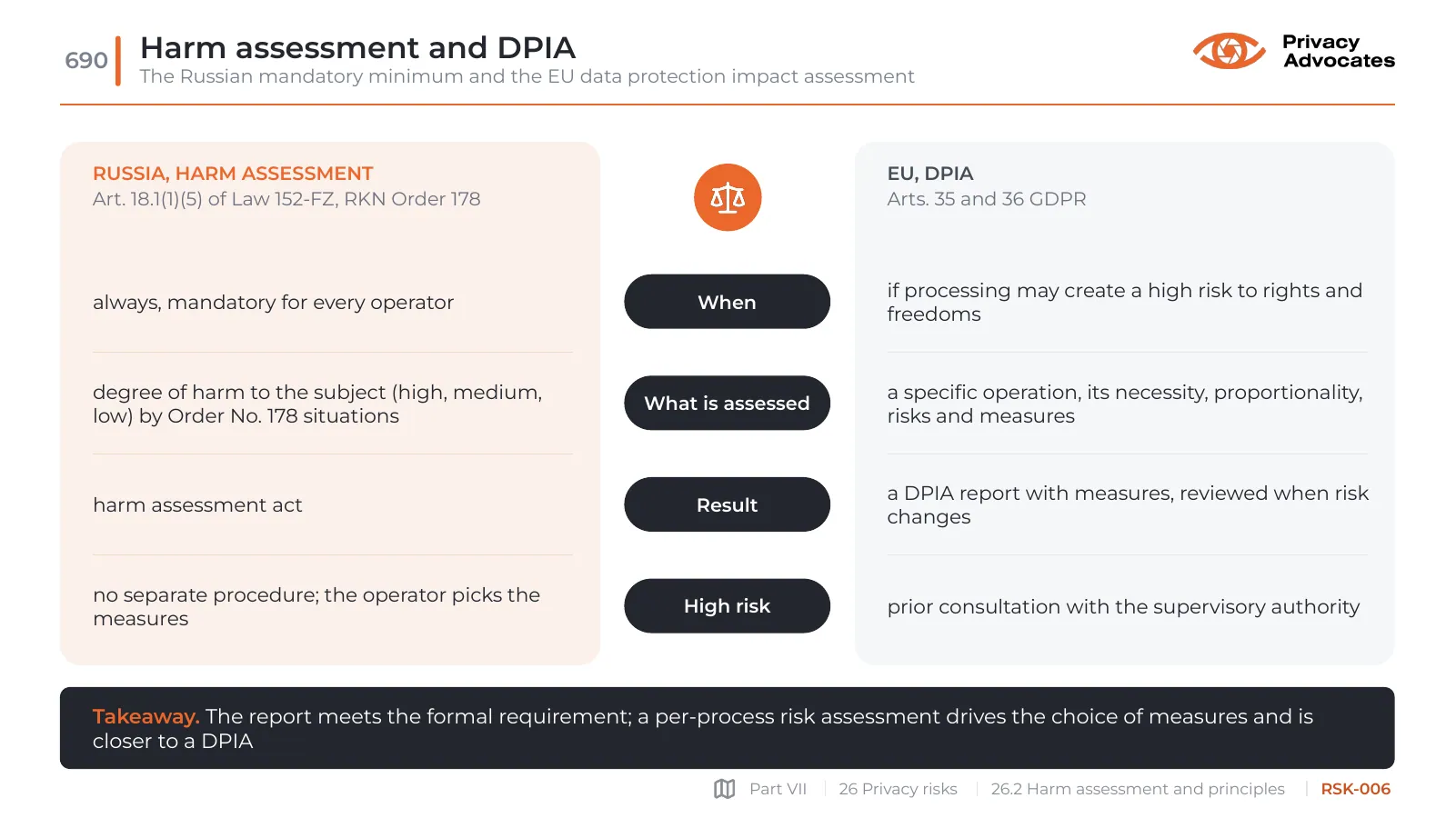
Harm assessment and DPIA

The Russian mandatory minimum and the EU data protection impact assessment

Slide RSK-006: Harm assessment and DPIA
Slide text

RUSSIA, HARM ASSESSMENT

Art. 18.1(1)(5) of Law 152-FZ, RKN Order 178

EU, DPIA

Arts. 35 and 36 GDPR

  • always, mandatory for every operator
  • When
  • if processing may create a high risk to rights and freedoms
  • degree of harm to the subject (high, medium, low) by Order No. 178 situations
  • What is assessed
  • a specific operation, its necessity, proportionality, risks and measures
  • harm assessment act
  • Result
  • a DPIA report with measures, reviewed when risk changes
  • no separate procedure; the operator picks the measures
  • High risk
  • prior consultation with the supervisory authority

Takeaway. The report meets the formal requirement; a per-process risk assessment drives the choice of measures and is closer to a DPIA

RSK-007

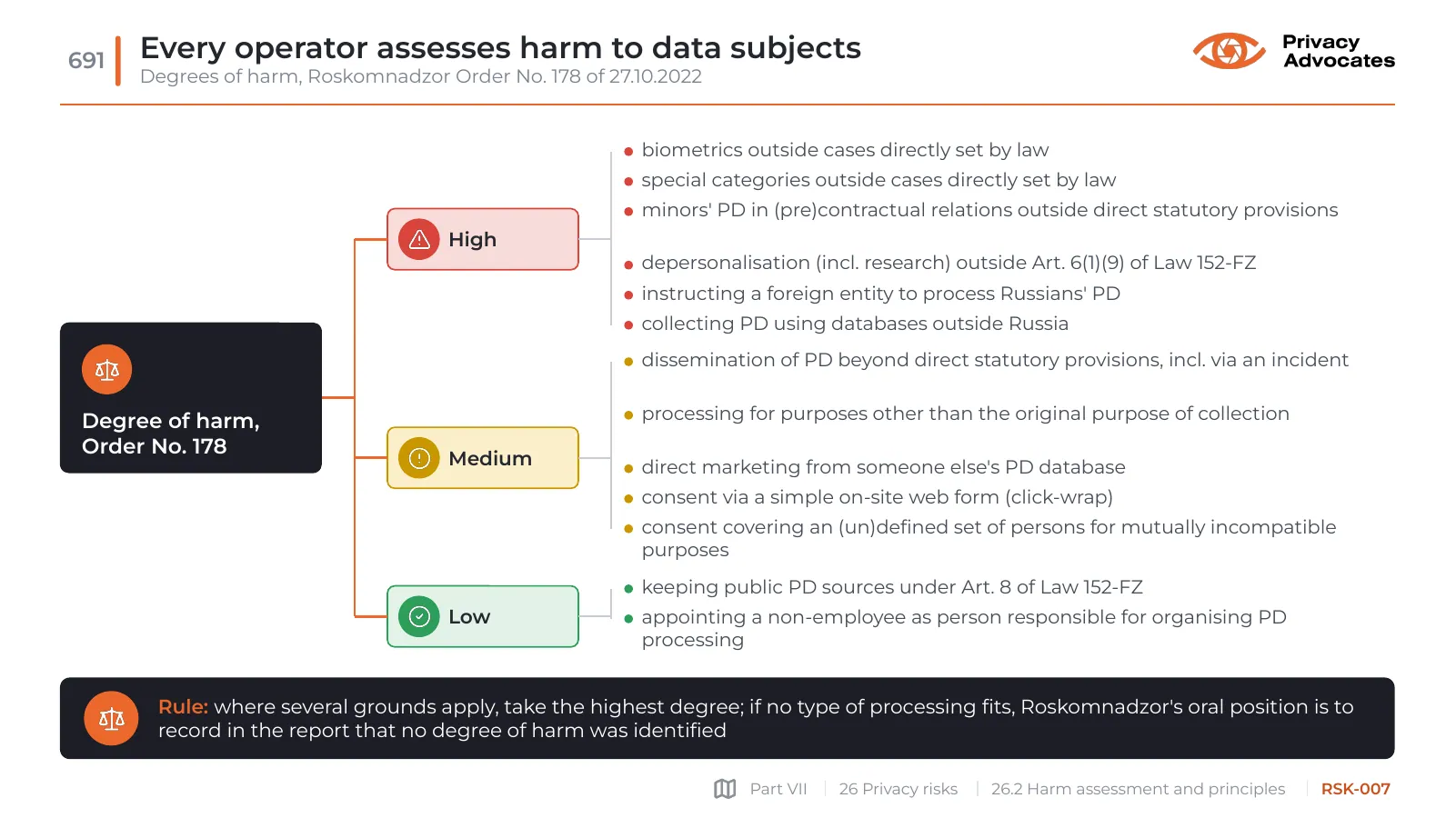
Every operator assesses harm to data subjects

Degrees of harm, Roskomnadzor Order No. 178 of 27.10.2022

Slide RSK-007: Every operator assesses harm to data subjects
Slide text

Degree of harm, Order No. 178

High

biometrics outside cases directly set by law

special categories outside cases directly set by law

minors' PD in (pre)contractual relations outside direct statutory provisions

depersonalisation (incl. research) outside Art. 6(1)(9) of Law 152-FZ

instructing a foreign entity to process Russians' PD

collecting PD using databases outside Russia

Medium

dissemination of PD beyond direct statutory provisions, incl. via an incident

processing for purposes other than the original purpose of collection

direct marketing from someone else's PD database

consent via a simple on-site web form (click-wrap)

consent covering an (un)defined set of persons for mutually incompatible purposes

  • Low
  • keeping public PD sources under Art. 8 of Law 152-FZ

appointing a non-employee as person responsible for organising PD processing

Rule: where several grounds apply, take the highest degree; if no type of processing fits, Roskomnadzor's oral position is to record in the report that no degree of harm was identified

RSK-008

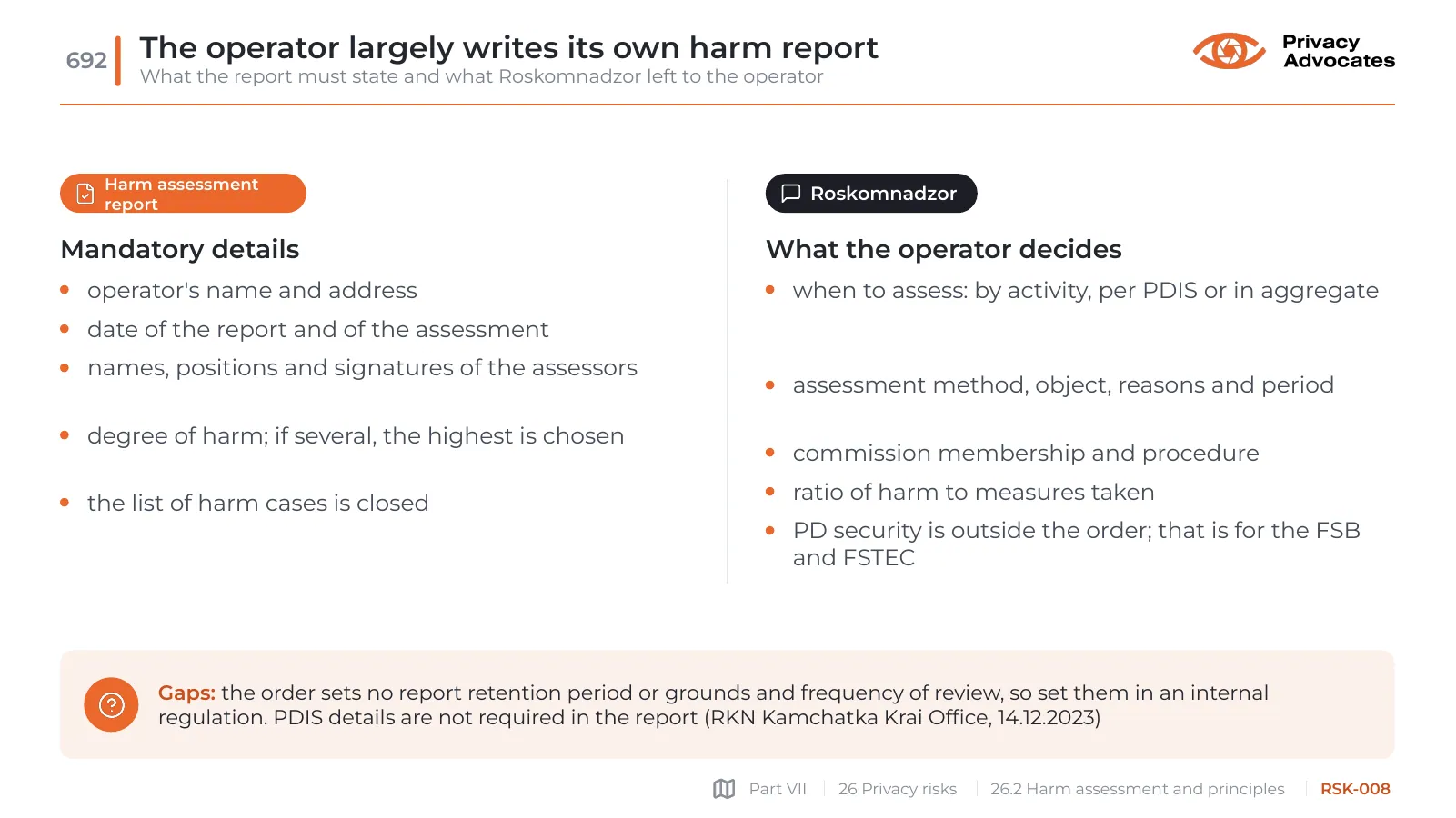
The operator largely writes its own harm report

What the report must state and what Roskomnadzor left to the operator

Slide RSK-008: The operator largely writes its own harm report
Slide text

Harm assessment report

Mandatory details

operator's name and address

date of the report and of the assessment

names, positions and signatures of the assessors

degree of harm; if several, the highest is chosen

the list of harm cases is closed

Roskomnadzor

What the operator decides

when to assess: by activity, per PDIS or in aggregate

assessment method, object, reasons and period

commission membership and procedure

ratio of harm to measures taken

PD security is outside the order; that is for the FSB and FSTEC

Gaps: the order sets no report retention period or grounds and frequency of review, so set them in an internal regulation. PDIS details are not required in the report (RKN Kamchatka Krai Office, 14.12.2023)

RSK-009

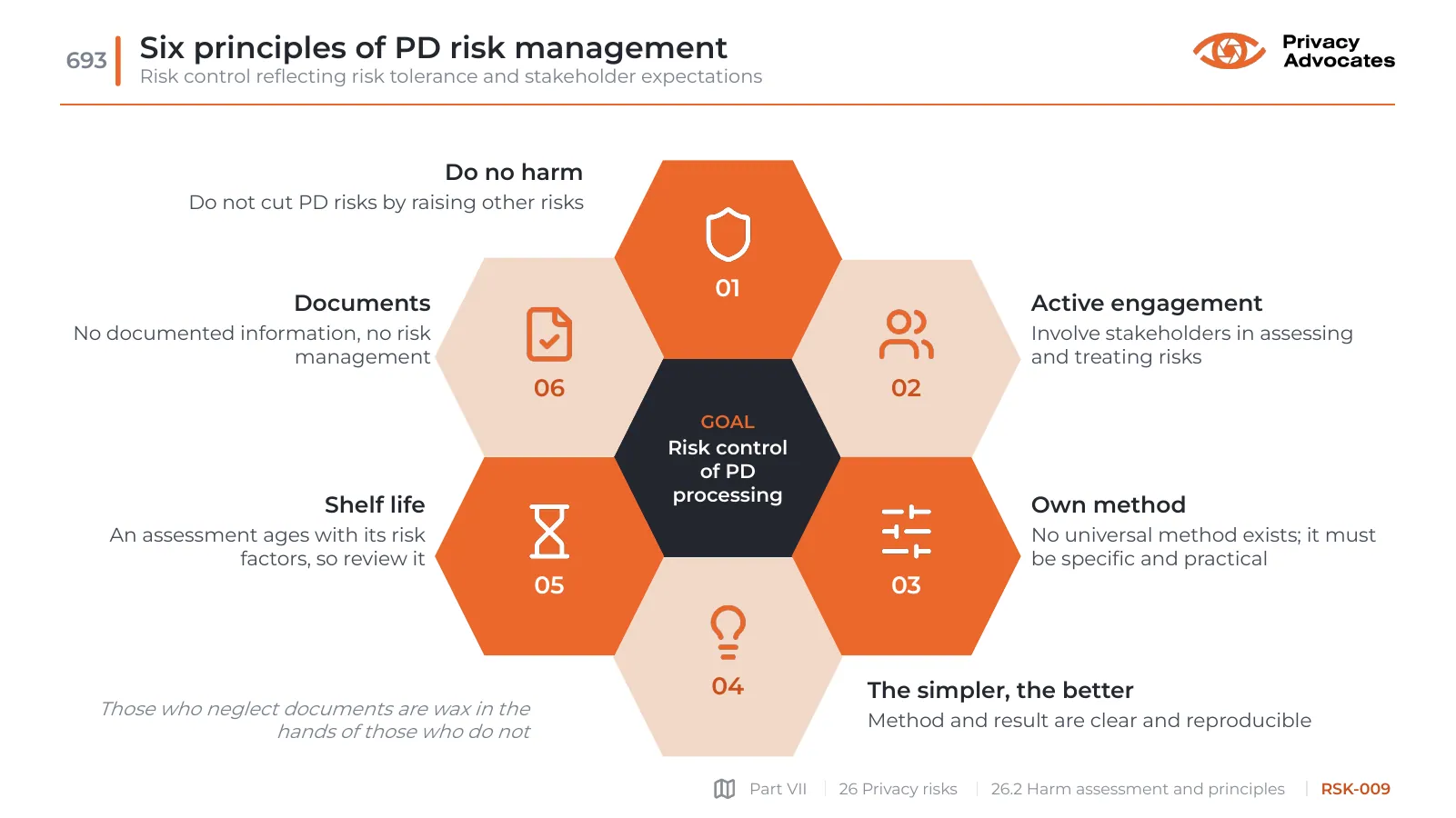
Six principles of PD risk management

Risk control reflecting risk tolerance and stakeholder expectations

Slide RSK-009: Six principles of PD risk management
Slide text

GOAL

Risk control

of PD processing

01

Do no harm

Do not cut PD risks by raising other risks

02

Active engagement

Involve stakeholders in assessing and treating risks

03

Own method

No universal method exists; it must be specific and practical

04

The simpler, the better

Method and result are clear and reproducible

05

Shelf life

An assessment ages with its risk factors, so review it

06

Documents

No documented information, no risk management

Those who neglect documents are wax in the hands of those who do not

26.3

A three-step algorithm

RSK-010

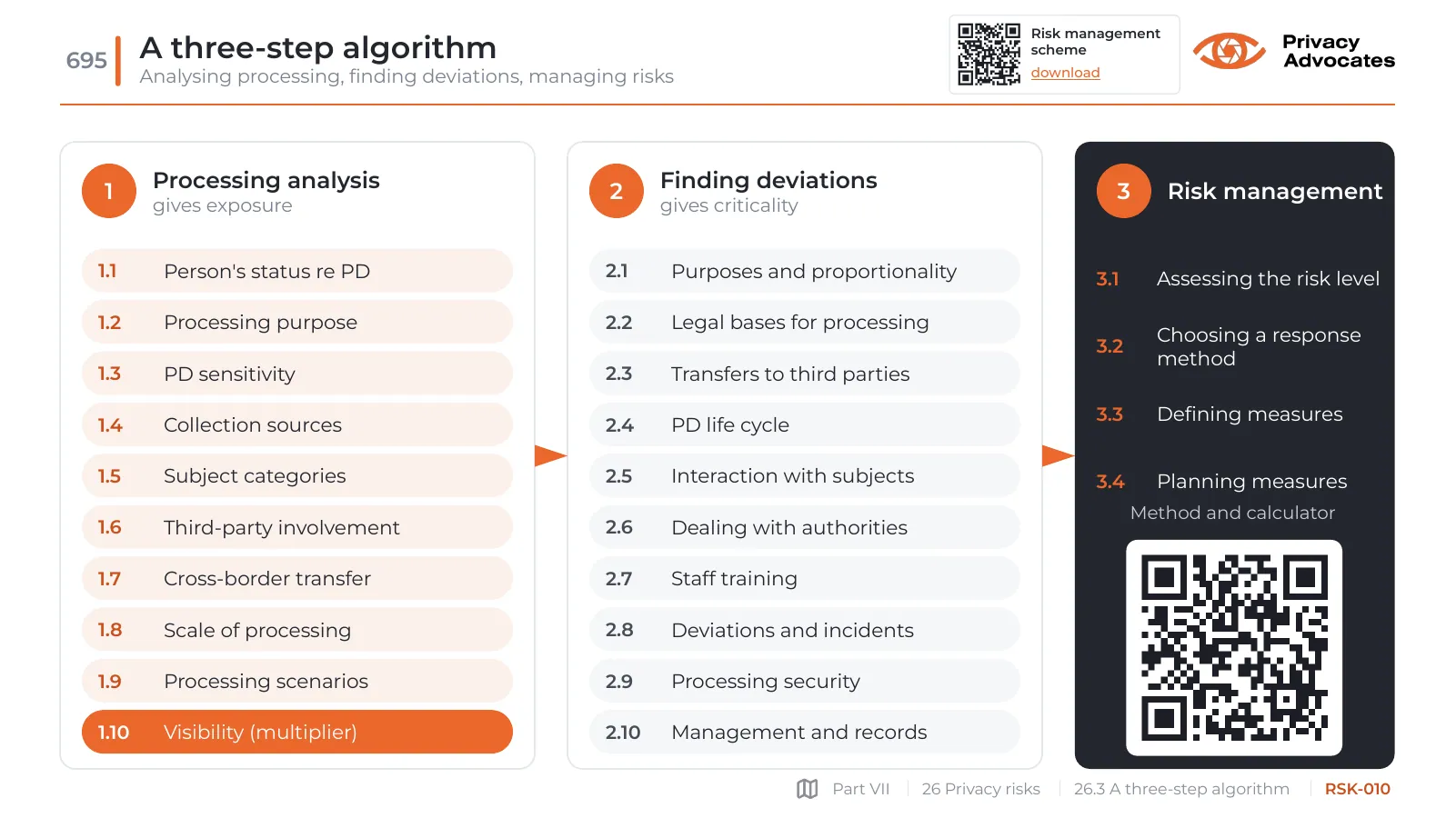
A three-step algorithm

Analysing processing, finding deviations, managing risks

Slide RSK-010: A three-step algorithm
Slide text

1

Processing analysis

gives exposure

  • 1.1
  • Person's status re PD
  • 1.2
  • Processing purpose
  • 1.3
  • PD sensitivity
  • 1.4
  • Collection sources
  • 1.5
  • Subject categories
  • 1.6
  • Third-party involvement
  • 1.7
  • Cross-border transfer
  • 1.8
  • Scale of processing
  • 1.9
  • Processing scenarios
  • 1.10
  • Visibility (multiplier)

2

Finding deviations

gives criticality

  • 2.1
  • Purposes and proportionality
  • 2.2
  • Legal bases for processing
  • 2.3
  • Transfers to third parties
  • 2.4
  • PD life cycle
  • 2.5
  • Interaction with subjects
  • 2.6
  • Dealing with authorities
  • 2.7
  • Staff training
  • 2.8
  • Deviations and incidents
  • 2.9
  • Processing security
  • 2.10
  • Management and records
  • 3
  • Risk management
  • 3.1
  • Assessing the risk level
  • 3.2
  • Choosing a response method
  • 3.3
  • Defining measures
  • 3.4
  • Planning measures

Method and calculator

RSK-011

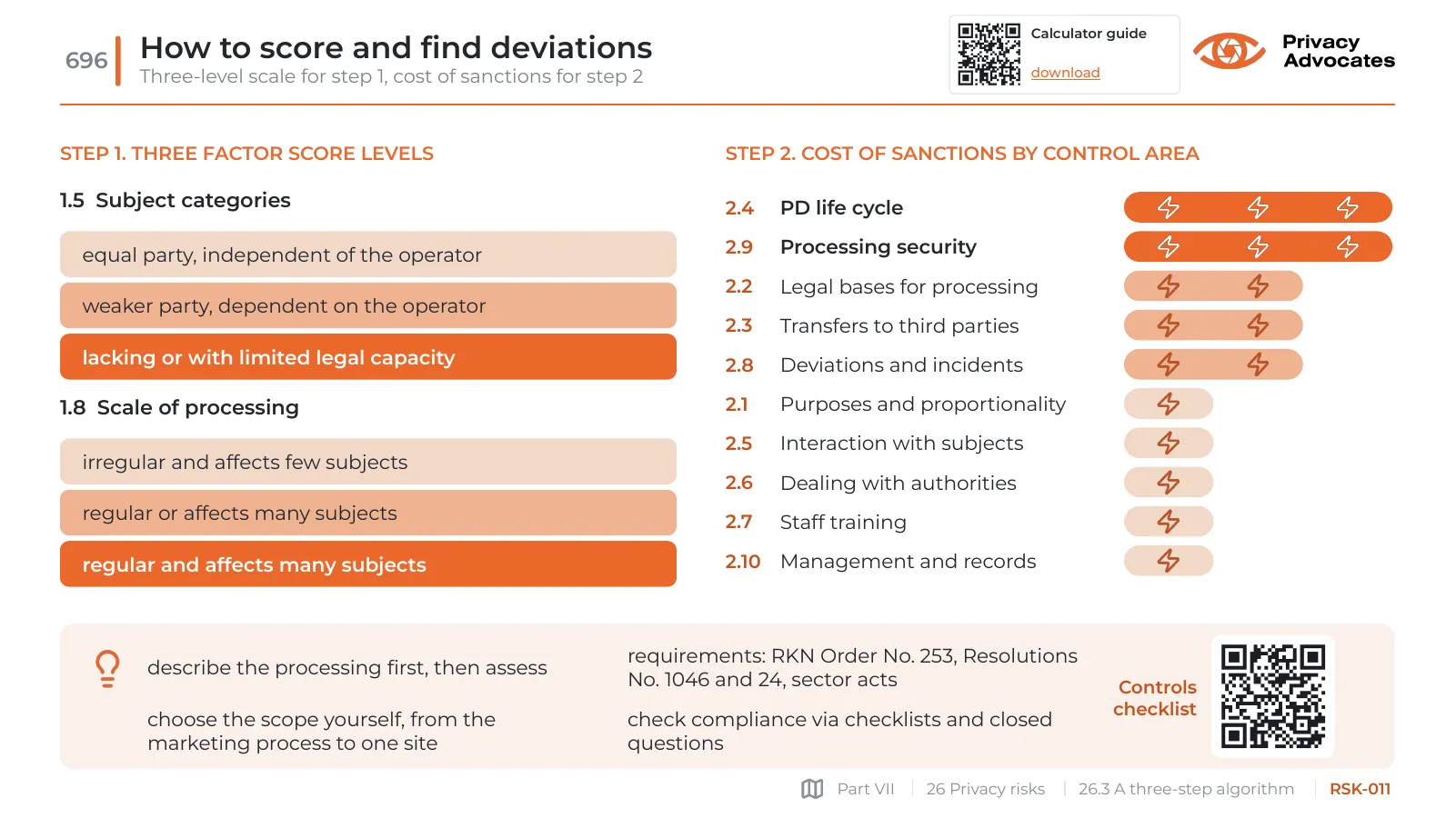
How to score and find deviations

Three-level scale for step 1, cost of sanctions for step 2

Slide RSK-011: How to score and find deviations
Slide text

STEP 1. THREE FACTOR SCORE LEVELS

1.5 Subject categories

equal party, independent of the operator

weaker party, dependent on the operator

lacking or with limited legal capacity

1.8 Scale of processing

irregular and affects few subjects

regular or affects many subjects

regular and affects many subjects

STEP 2. COST OF SANCTIONS BY CONTROL AREA

  • 2.4
  • PD life cycle
  • 2.9
  • Processing security
  • 2.2
  • Legal bases for processing
  • 2.3
  • Transfers to third parties
  • 2.8
  • Deviations and incidents
  • 2.1
  • Purposes and proportionality
  • 2.5
  • Interaction with subjects
  • 2.6
  • Dealing with authorities
  • 2.7
  • Staff training
  • 2.10
  • Management and records

describe the processing first, then assess

choose the scope yourself, from the marketing process to one site

requirements: RKN Order No. 253, Resolutions No. 1046 and 24, sector acts

  • check compliance via checklists and closed questions
  • Controls checklist
RSK-012

Risk level as a process coordinate

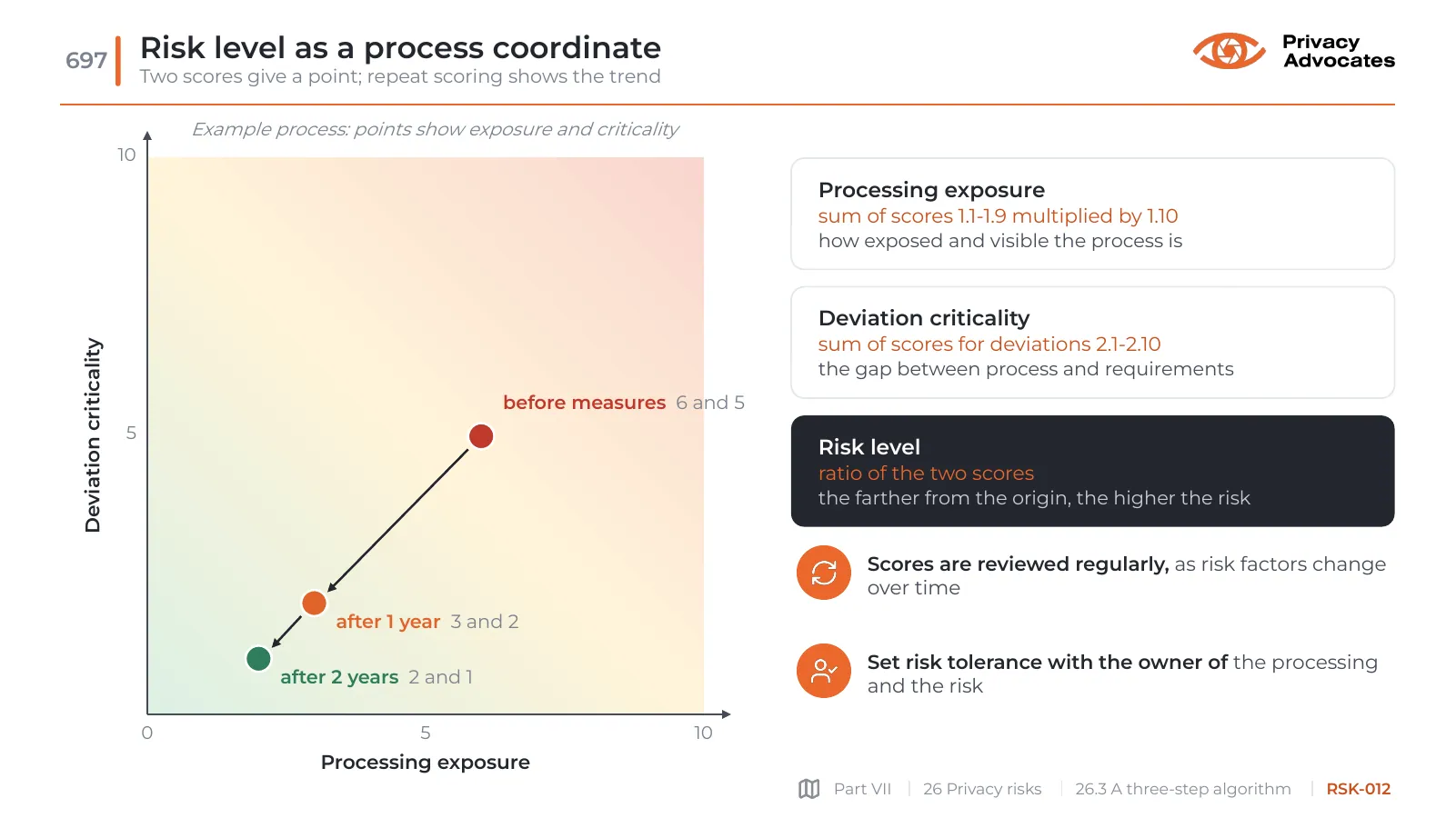
Two scores give a point; repeat scoring shows the trend

Slide RSK-012: Risk level as a process coordinate
Slide text
  • 0
  • 5

5

10

10

Processing exposure

Deviation criticality

before measures 6 and 5

after 1 year 3 and 2

after 2 years 2 and 1

Example process: points show exposure and criticality

Processing exposure

sum of scores 1.1-1.9 multiplied by 1.10

how exposed and visible the process is

Deviation criticality

sum of scores for deviations 2.1-2.10

the gap between process and requirements

Risk level

ratio of the two scores

the farther from the origin, the higher the risk

Scores are reviewed regularly, as risk factors change over time

Set risk tolerance with the owner of the processing and the risk

RSK-013

From assessment to response plan

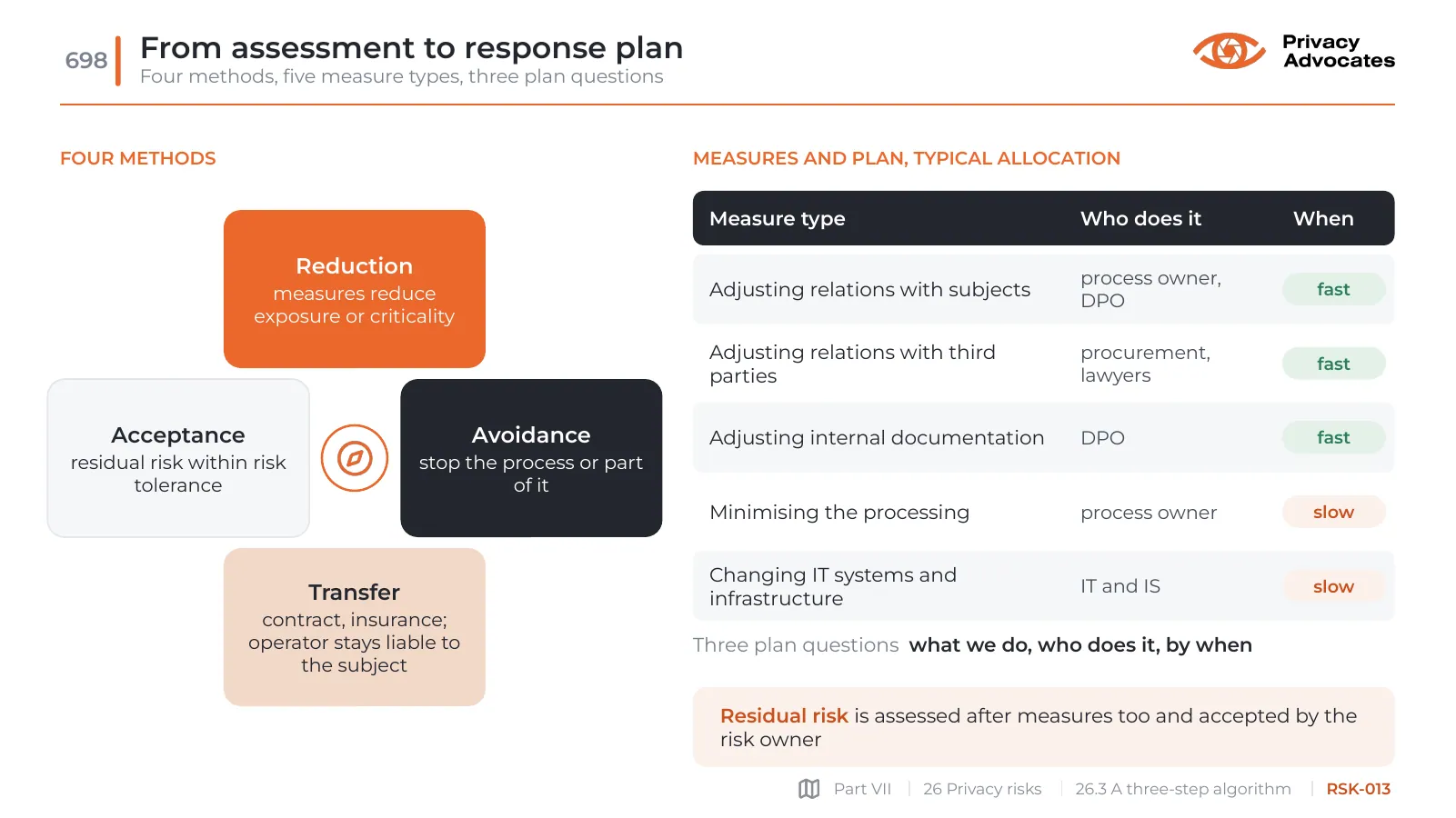
Four methods, five measure types, three plan questions

Slide RSK-013: From assessment to response plan
Slide text

Reduction

measures reduce exposure or criticality

Avoidance

stop the process or part of it

Transfer

contract, insurance; operator stays liable to the subject

Acceptance

residual risk within risk tolerance

  • FOUR METHODS
  • MEASURES AND PLAN, TYPICAL ALLOCATION
  • Measure type
  • Who does it
  • When
  • Adjusting relations with subjects
  • process owner, DPO
  • fast
  • Adjusting relations with third parties
  • procurement, lawyers
  • fast
  • Adjusting internal documentation
  • DPO
  • fast
  • Minimising the processing
  • process owner
  • slow
  • Changing IT systems and infrastructure
  • IT and IS
  • slow

Three plan questions what we do, who does it, by when

Residual risk is assessed after measures too and accepted by the risk owner

26.4

Measures and demonstrability

RSK-014

Lean data processing

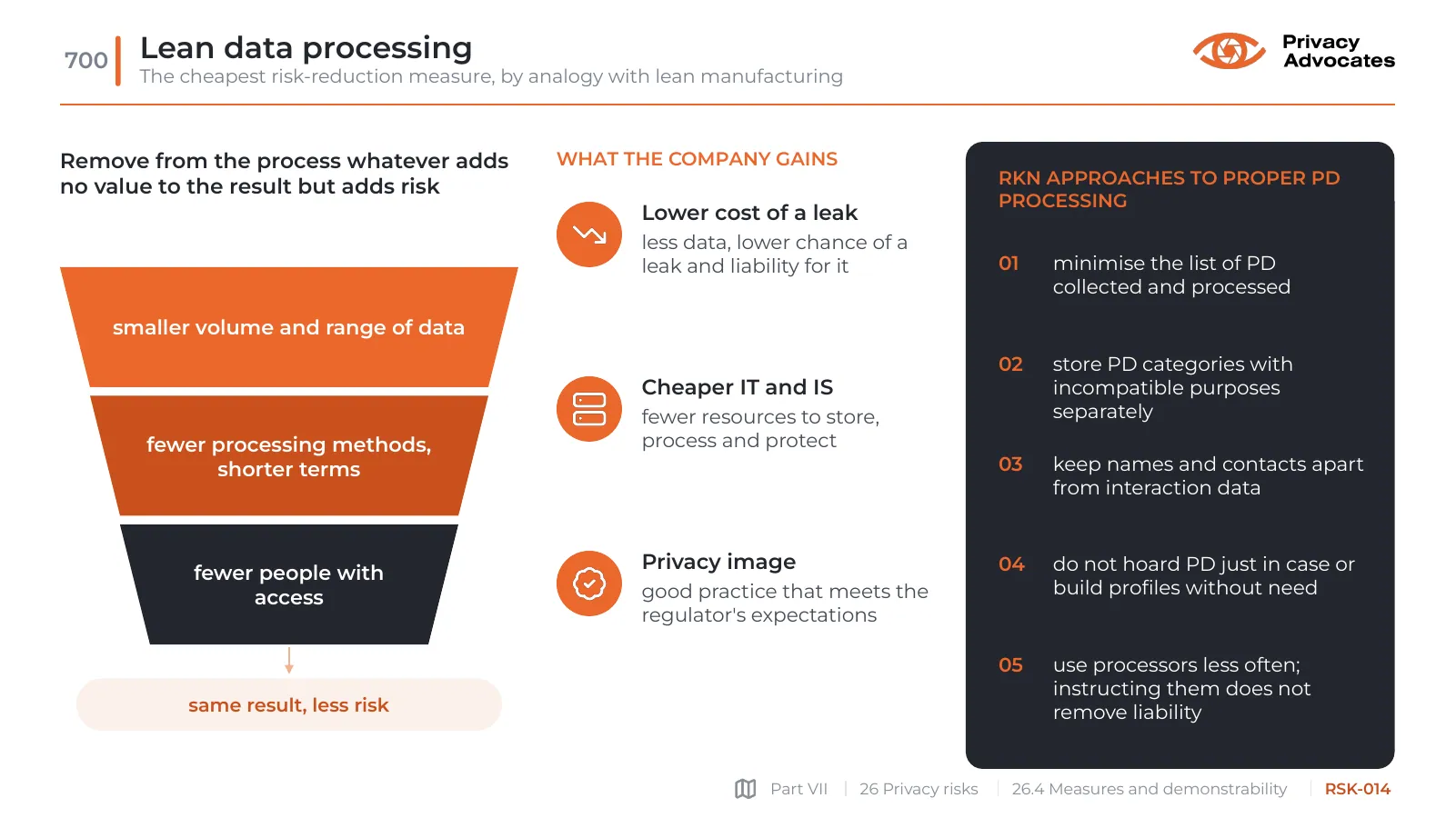
The cheapest risk-reduction measure, by analogy with lean manufacturing

Slide RSK-014: Lean data processing
Slide text

Remove from the process whatever adds no value to the result but adds risk

smaller volume and range of data

fewer processing methods, shorter terms

fewer people with access

same result, less risk

WHAT THE COMPANY GAINS

Lower cost of a leak

less data, lower chance of a leak and liability for it

Cheaper IT and IS

fewer resources to store, process and protect

Privacy image

good practice that meets the regulator's expectations

RKN APPROACHES TO PROPER PD PROCESSING

  • 01
  • minimise the list of PD collected and processed
  • 02
  • store PD categories with incompatible purposes separately
  • 03
  • keep names and contacts apart from interaction data
  • 04
  • do not hoard PD just in case or build profiles without need
  • 05
  • use processors less often; instructing them does not remove liability
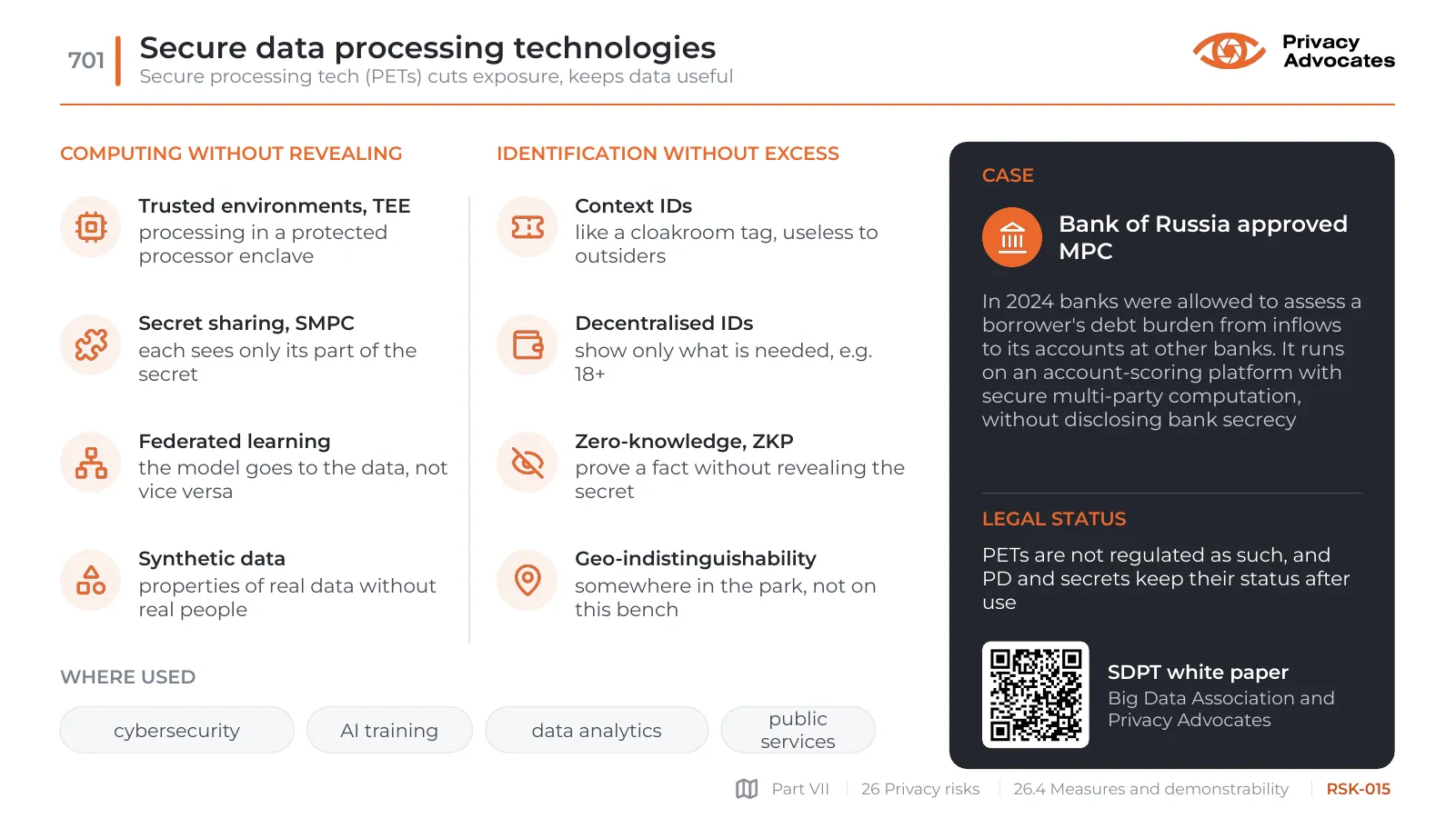
RSK-015

Secure data processing technologies

Secure processing tech (PETs) cuts exposure, keeps data useful

Slide RSK-015: Secure data processing technologies
Slide text

COMPUTING WITHOUT REVEALING

Trusted environments, TEE

processing in a protected processor enclave

Secret sharing, SMPC

each sees only its part of the secret

Federated learning

the model goes to the data, not vice versa

Synthetic data

properties of real data without real people

IDENTIFICATION WITHOUT EXCESS

Context IDs

like a cloakroom tag, useless to outsiders

Decentralised IDs

show only what is needed, e.g. 18+

Zero-knowledge, ZKP

prove a fact without revealing the secret

Geo-indistinguishability

somewhere in the park, not on this bench

WHERE USED

  • cybersecurity
  • AI training
  • data analytics
  • public services

CASE

Bank of Russia approved MPC

In 2024 banks were allowed to assess a borrower's debt burden from inflows to its accounts at other banks. It runs on an account-scoring platform with secure multi-party computation, without disclosing bank secrecy

LEGAL STATUS

PETs are not regulated as such, and PD and secrets keep their status after use

SDPT white paper

Big Data Association and Privacy Advocates

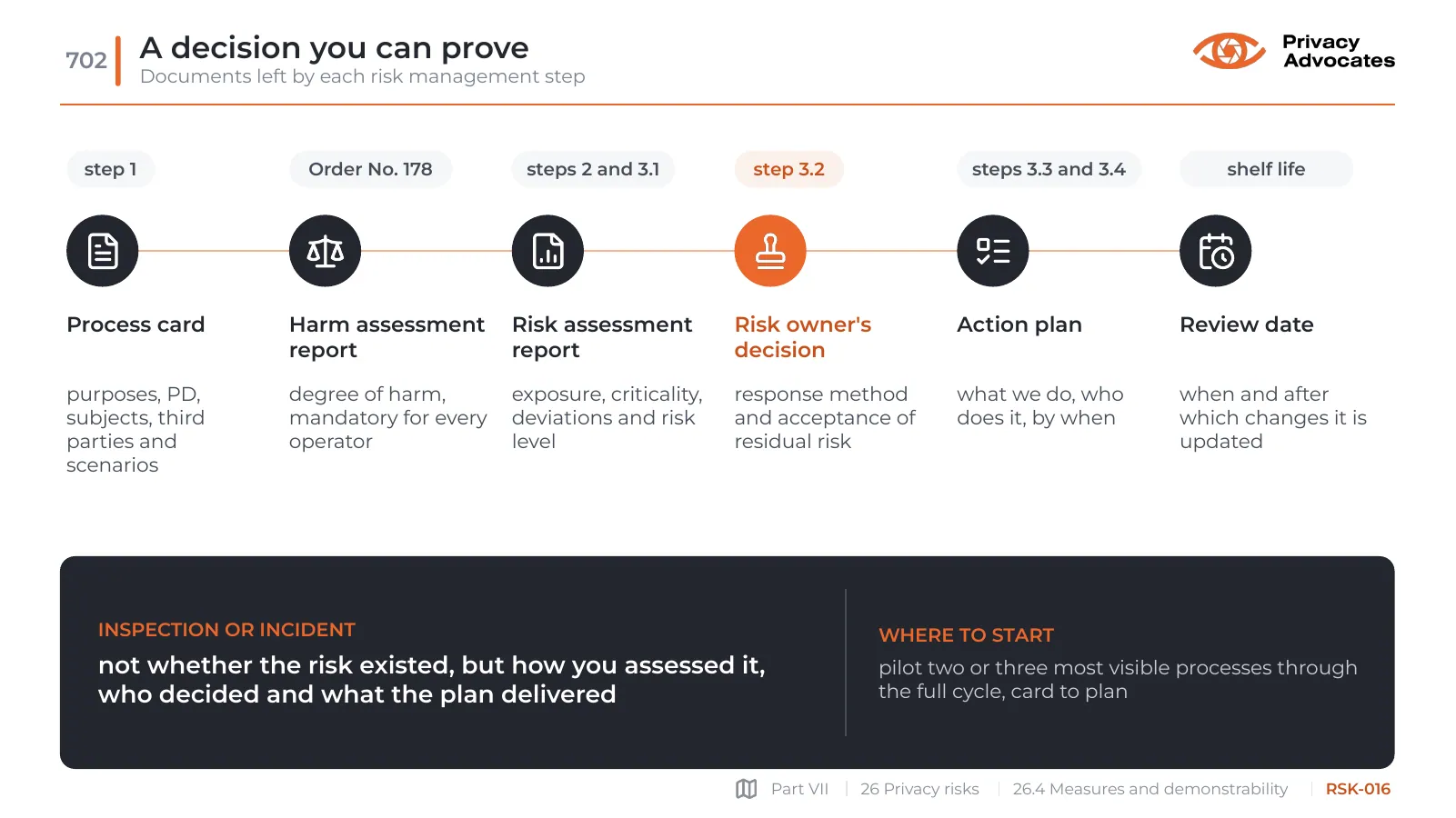
RSK-016

A decision you can prove

Documents left by each risk management step

Slide RSK-016: A decision you can prove
Slide text

step 1

Process card

purposes, PD, subjects, third parties and scenarios

Order No. 178

Harm assessment report

degree of harm, mandatory for every operator

steps 2 and 3.1

Risk assessment report

exposure, criticality, deviations and risk level

step 3.2

Risk owner's decision

response method and acceptance of residual risk

steps 3.3 and 3.4

Action plan

what we do, who does it, by when

shelf life

Review date

when and after which changes it is updated

INSPECTION OR INCIDENT

not whether the risk existed, but how you assessed it, who decided and what the plan delivered

WHERE TO START

pilot two or three most visible processes through the full cycle, card to plan

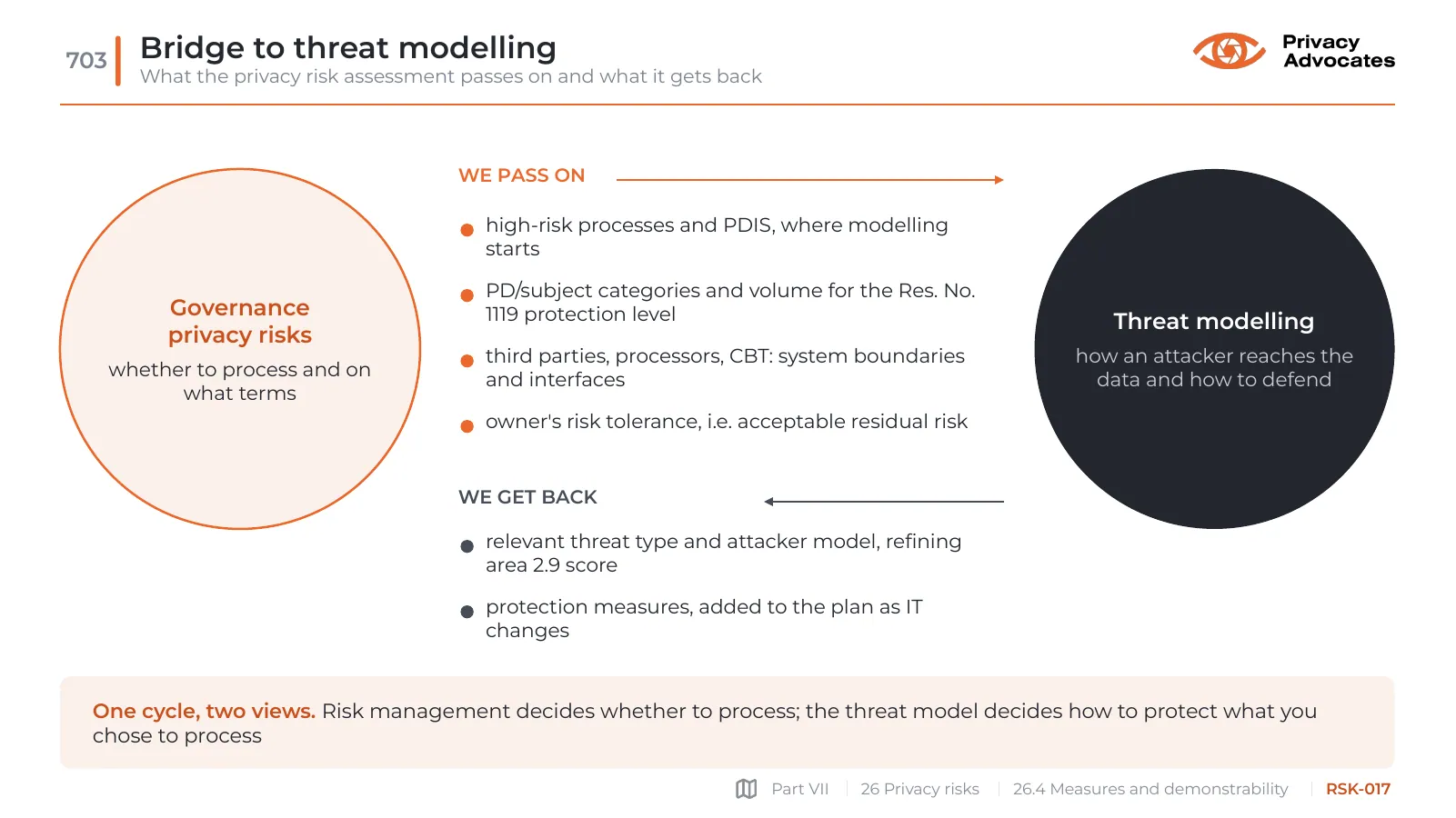
RSK-017

Bridge to threat modelling

What the privacy risk assessment passes on and what it gets back

Slide RSK-017: Bridge to threat modelling
Slide text

Governance

privacy risks

whether to process and on what terms

Threat modelling

how an attacker reaches the data and how to defend

WE PASS ON

high-risk processes and PDIS, where modelling starts

PD/subject categories and volume for the Res. No. 1119 protection level

third parties, processors, CBT: system boundaries and interfaces

owner's risk tolerance, i.e. acceptable residual risk

WE GET BACK

relevant threat type and attacker model, refining area 2.9 score

protection measures, added to the plan as IT changes

One cycle, two views. Risk management decides whether to process; the threat model decides how to protect what you chose to process

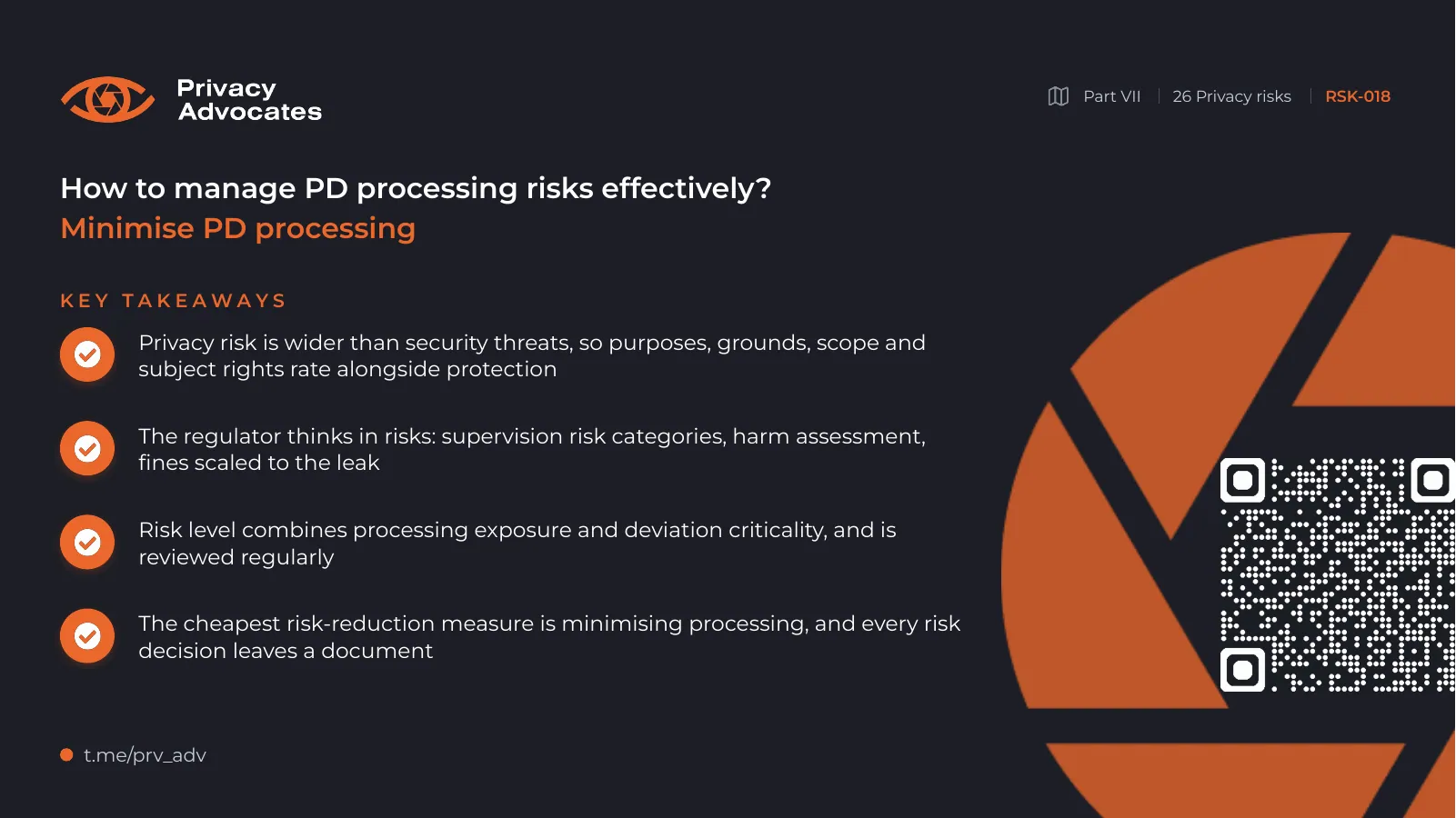
RSK-018

Key takeaways

Slide RSK-018: Key takeaways
Slide text

Privacy risk is wider than security threats, so purposes, grounds, scope and subject rights rate alongside protection

The regulator thinks in risks: supervision risk categories, harm assessment, fines scaled to the leak

Risk level combines processing exposure and deviation criticality, and is reviewed regularly

The cheapest risk-reduction measure is minimising processing, and every risk decision leaves a document

t.me/prv_adv

How to manage PD processing risks effectively?

Minimise PD processing