Part IV, section 16

Genetic data

Concept, regime, cross-border transfer and liability

  • 10 slides
  • 3 subsections
  • Edition of 25 October 2026

16.1

Concept and regime

GEN-001

Genetic data

What it is and which regulation applies
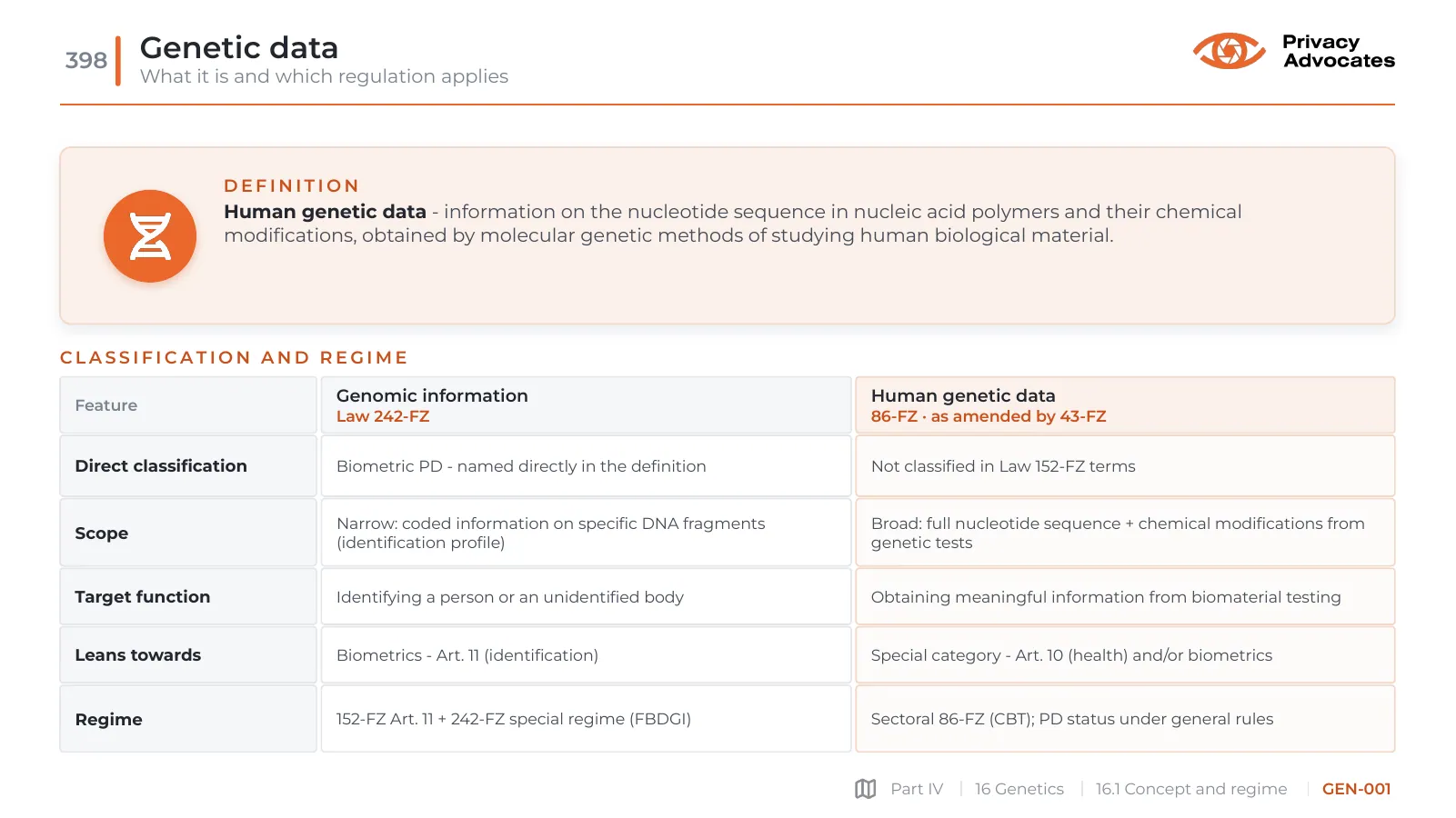
Slide GEN-001: Genetic data
Slide text

DEFINITION

Human genetic data - information on the nucleotide sequence in nucleic acid polymers and their chemical modifications, obtained by molecular genetic methods of studying human biological material.

CLASSIFICATION AND REGIME

Feature

Genomic information

Law 242-FZ

Human genetic data

86-FZ, as amended by 43-FZ

  • Direct classification
  • Biometric PD - named directly in the definition
  • Not classified in Law 152-FZ terms
  • Scope
  • Narrow: coded information on specific DNA fragments (identification profile)
  • Broad: full nucleotide sequence + chemical modifications from genetic tests
  • Target function
  • Identifying a person or an unidentified body
  • Obtaining meaningful information from biomaterial testing
  • Leans towards
  • Biometrics - Art. 11 (identification)
  • Special category - Art. 10 (health) and/or biometrics
  • Regime
  • 152-FZ Art. 11 + 242-FZ special regime (FBDGI)
  • Sectoral 86-FZ (CBT); PD status under general rules
16.2

CBT of genetic data

GEN-002

Cross-border transfer

Resolution No. 750

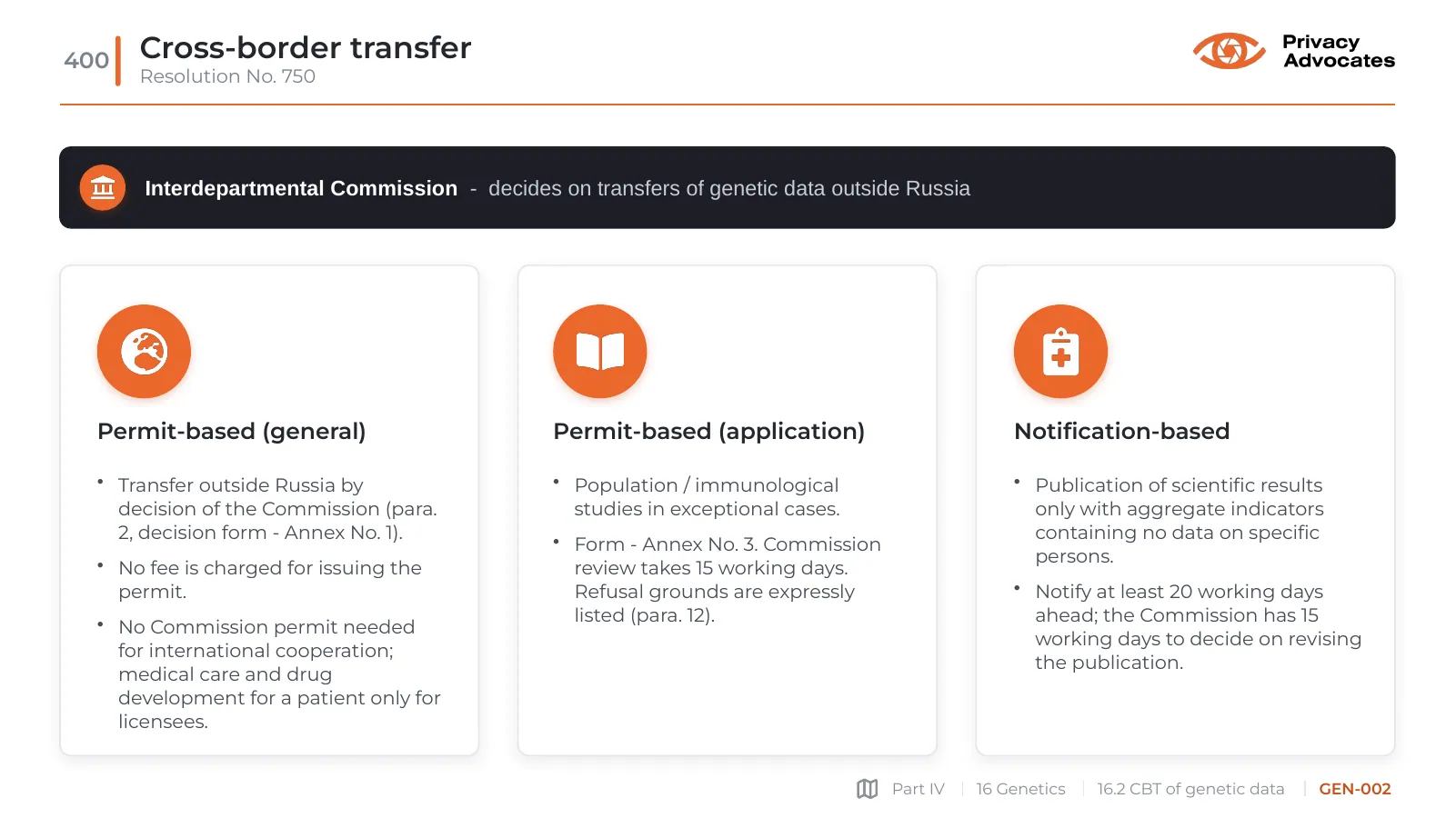
Slide GEN-002: Cross-border transfer
Slide text

Permit-based (general)

Transfer outside Russia by decision of the Commission (para. 2, decision form - Annex No. 1).

No fee is charged for issuing the permit.

No Commission permit needed for international cooperation; medical care and drug development for a patient only for licensees.

Permit-based (application)

Population / immunological studies in exceptional cases.

Form - Annex No. 3. Commission review takes 15 working days. Refusal grounds are expressly listed (para. 12).

Notification-based

Publication of scientific results only with aggregate indicators containing no data on specific persons.

Notify at least 20 working days ahead; the Commission has 15 working days to decide on revising the publication.

Interdepartmental Commission - decides on transfers of genetic data outside Russia

GEN-003

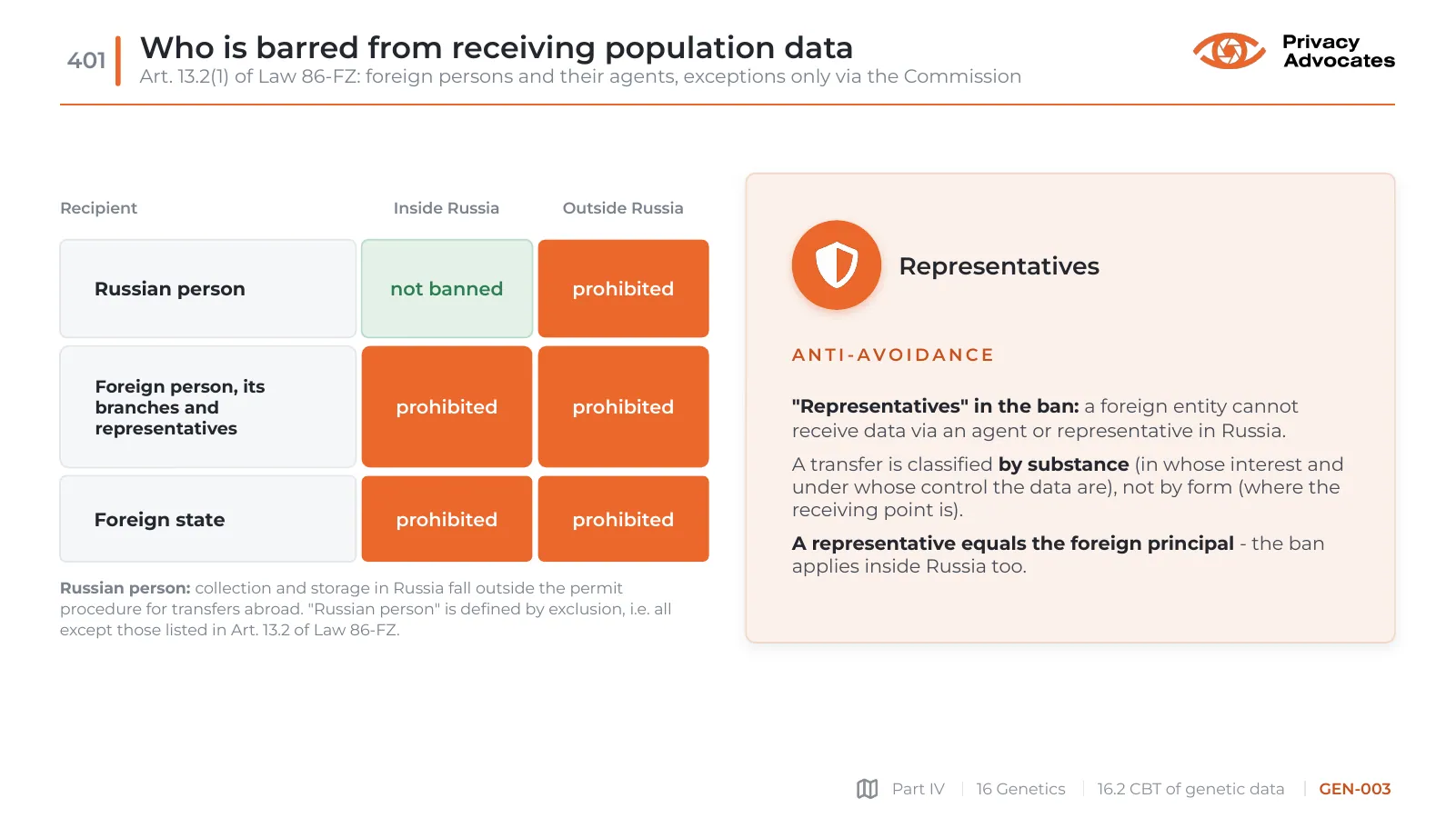
Who is barred from receiving population data

Art. 13.2(1) of Law 86-FZ: foreign persons and their agents, exceptions only via the Commission

Slide GEN-003: Who is barred from receiving population data
Slide text
  • Recipient
  • Inside Russia
  • Outside Russia
  • Russian person
  • not banned
  • prohibited
  • Foreign person, its branches and representatives
  • prohibited
  • prohibited
  • Foreign state
  • prohibited
  • prohibited

Russian person: collection and storage in Russia fall outside the permit procedure for transfers abroad. "Russian person" is defined by exclusion, i.e. all except those listed in Art. 13.2 of Law 86-FZ.

Representatives

ANTI-AVOIDANCE

"Representatives" in the ban: a foreign entity cannot receive data via an agent or representative in Russia.

A transfer is classified by substance (in whose interest and under whose control the data are), not by form (where the receiving point is).

A representative equals the foreign principal - the ban applies inside Russia too.

GEN-004

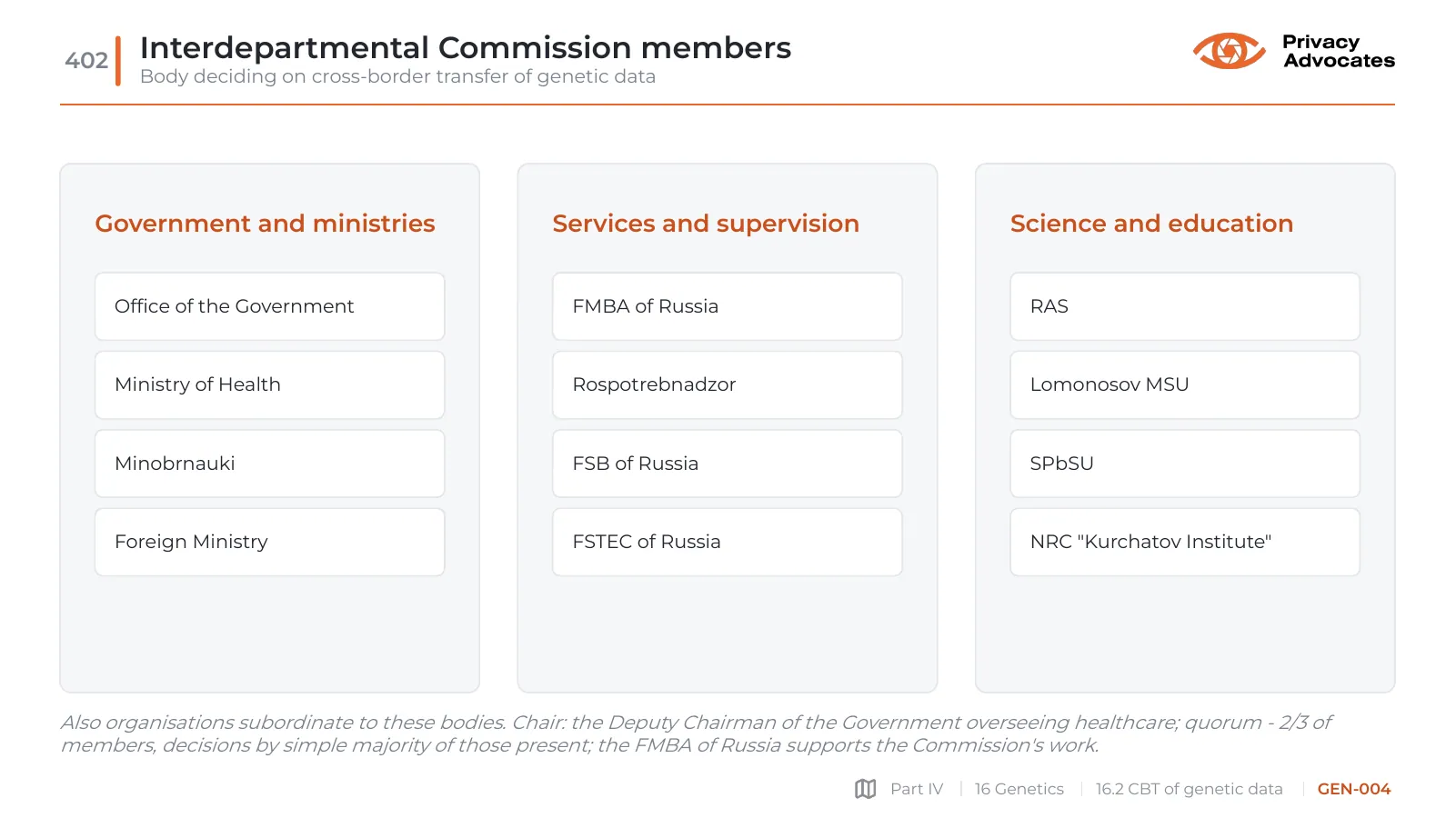
Interdepartmental Commission members

Body deciding on cross-border transfer of genetic data

Slide GEN-004: Interdepartmental Commission members
Slide text

Government and ministries

Office of the Government

Ministry of Health

Minobrnauki

Foreign Ministry

Services and supervision

FMBA of Russia

Rospotrebnadzor

FSB of Russia

FSTEC of Russia

Science and education

RAS

Lomonosov MSU

SPbSU

NRC "Kurchatov Institute"

Also organisations subordinate to these bodies. Chair: the Deputy Chairman of the Government overseeing healthcare; quorum - 2/3 of members, decisions by simple majority of those present; the FMBA of Russia supports the Commission's work.

GEN-005

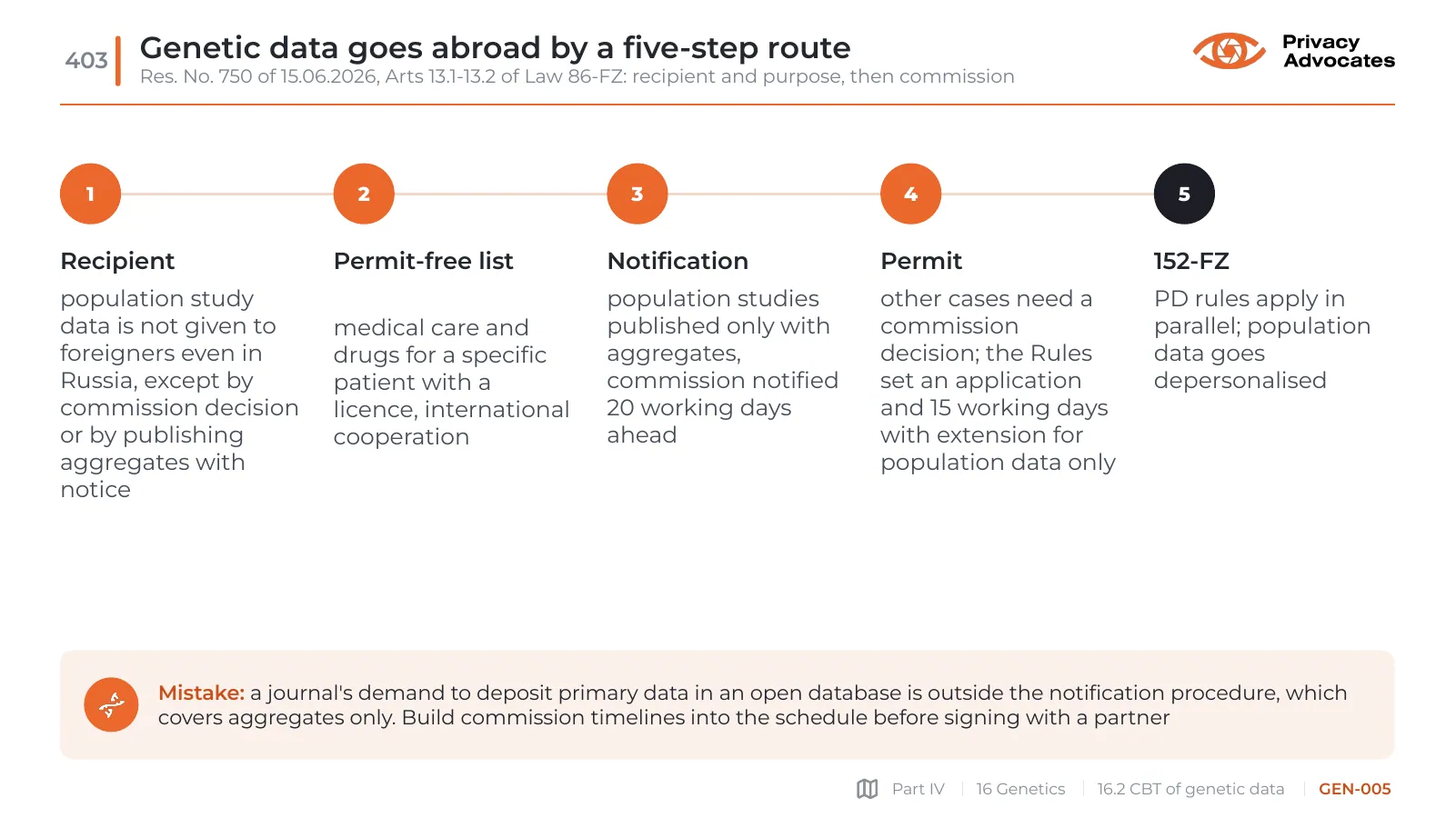
Genetic data goes abroad by a five-step route

Res. No. 750 of 15.06.2026, Arts 13.1-13.2 of Law 86-FZ: recipient and purpose, then commission

Slide GEN-005: Genetic data goes abroad by a five-step route
Slide text

1

Recipient

population study data is not given to foreigners even in Russia, except by commission decision or by publishing aggregates with notice

2

Permit-free list

medical care and drugs for a specific patient with a licence, international cooperation

3

Notification

population studies published only with aggregates, commission notified 20 working days ahead

4

Permit

other cases need a commission decision; the Rules set an application and 15 working days with extension for population data only

5

152-FZ

PD rules apply in parallel; population data goes depersonalised

Mistake: a journal's demand to deposit primary data in an open database is outside the notification procedure, which covers aggregates only. Build commission timelines into the schedule before signing with a partner

16.3

Risks and liability

GEN-006

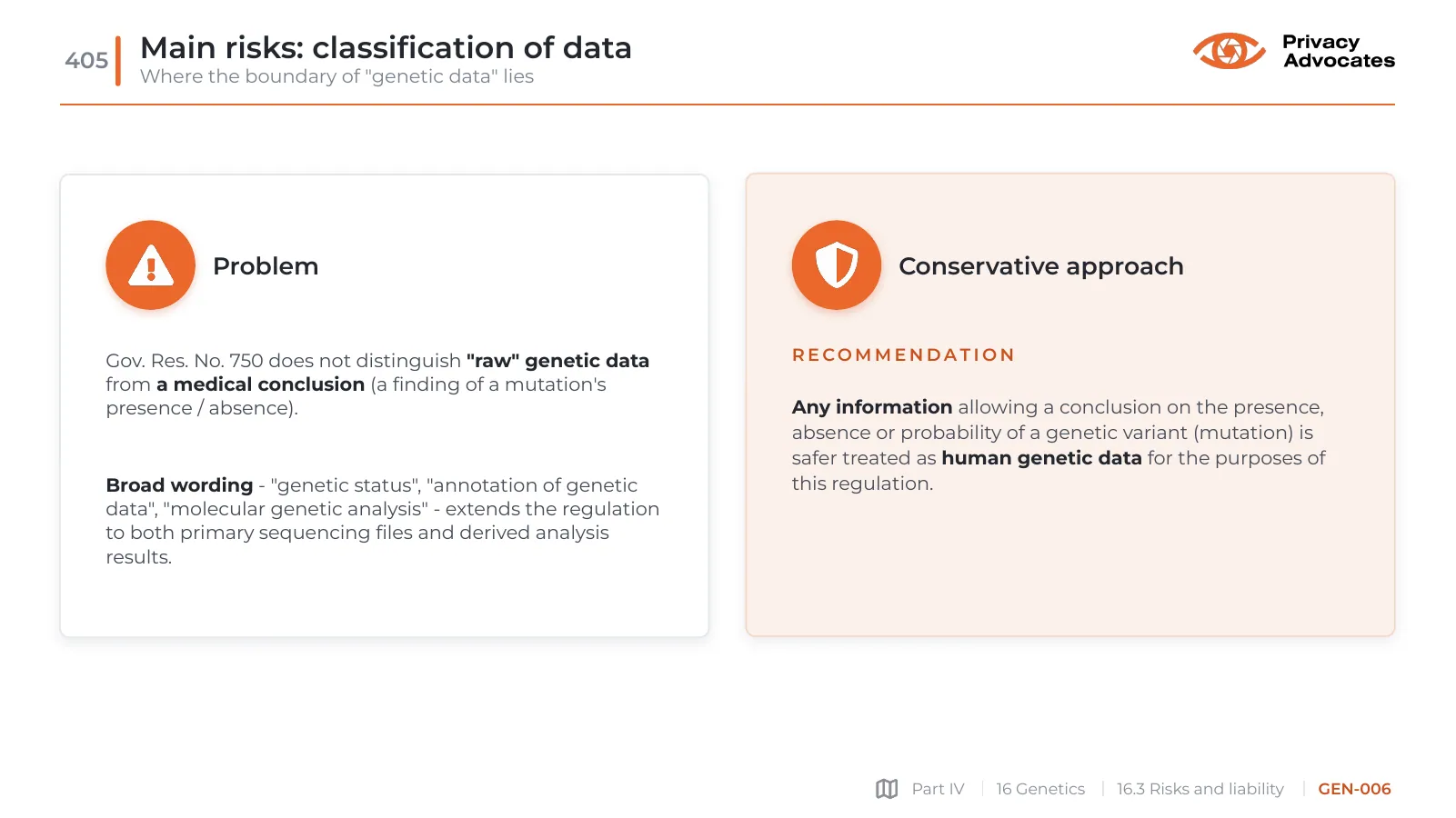
Main risks: classification of data

Where the boundary of "genetic data" lies

Slide GEN-006: Main risks: classification of data
Slide text

Problem

Gov. Res. No. 750 does not distinguish "raw" genetic data from a medical conclusion (a finding of a mutation's presence / absence).

Broad wording - "genetic status", "annotation of genetic data", "molecular genetic analysis" - extends the regulation to both primary sequencing files and derived analysis results.

Conservative approach

RECOMMENDATION

Any information allowing a conclusion on the presence, absence or probability of a genetic variant (mutation) is safer treated as human genetic data for the purposes of this regulation.

GEN-007

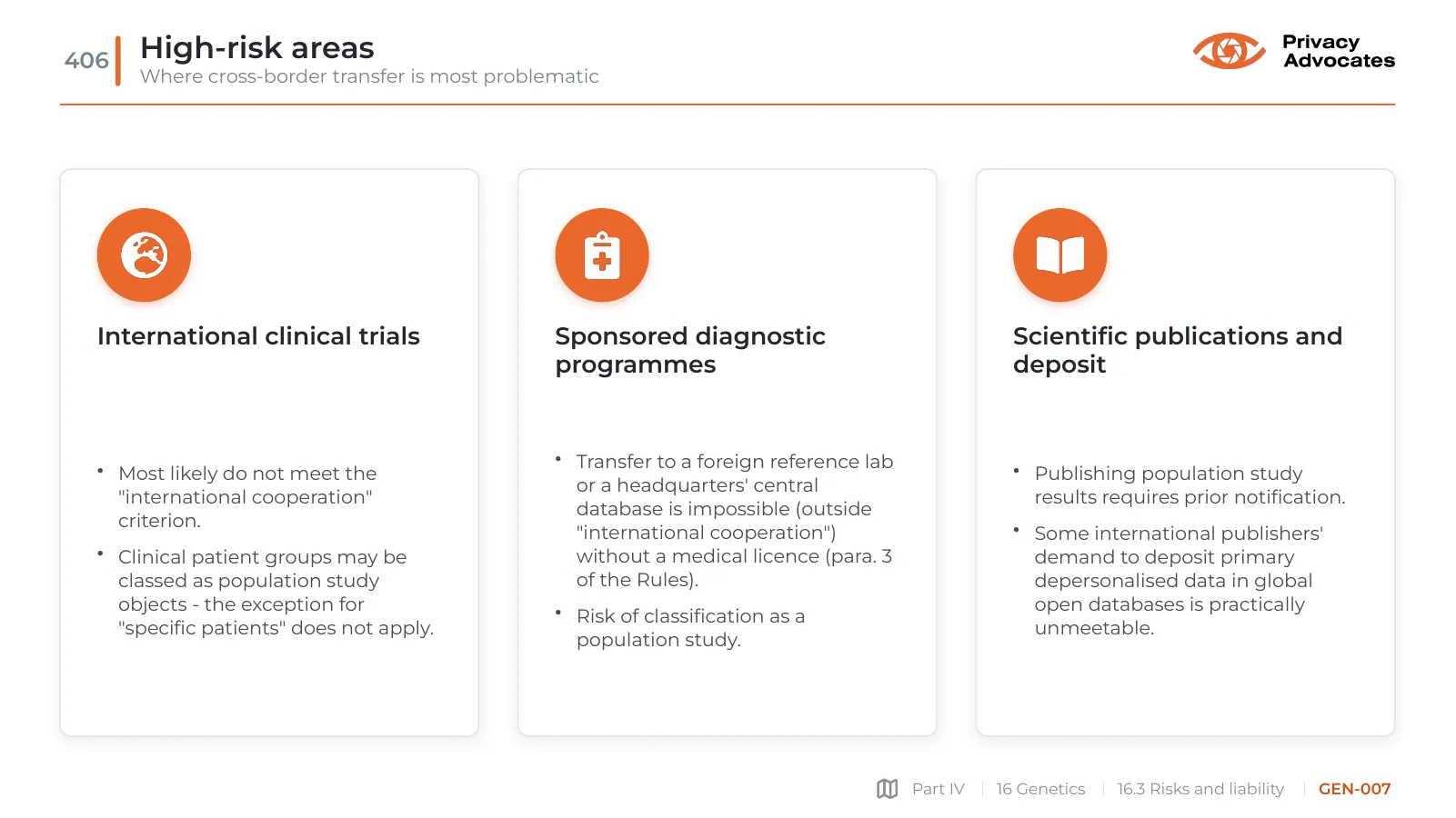
High-risk areas

Where cross-border transfer is most problematic

Slide GEN-007: High-risk areas
Slide text

International clinical trials

Most likely do not meet the "international cooperation" criterion.

Clinical patient groups may be classed as population study objects - the exception for "specific patients" does not apply.

Sponsored diagnostic programmes

Transfer to a foreign reference lab or a headquarters' central database is impossible (outside "international cooperation") without a medical licence (para. 3 of the Rules).

Risk of classification as a population study.

Scientific publications and deposit

Publishing population study results requires prior notification.

Some international publishers' demand to deposit primary depersonalised data in global open databases is practically unmeetable.

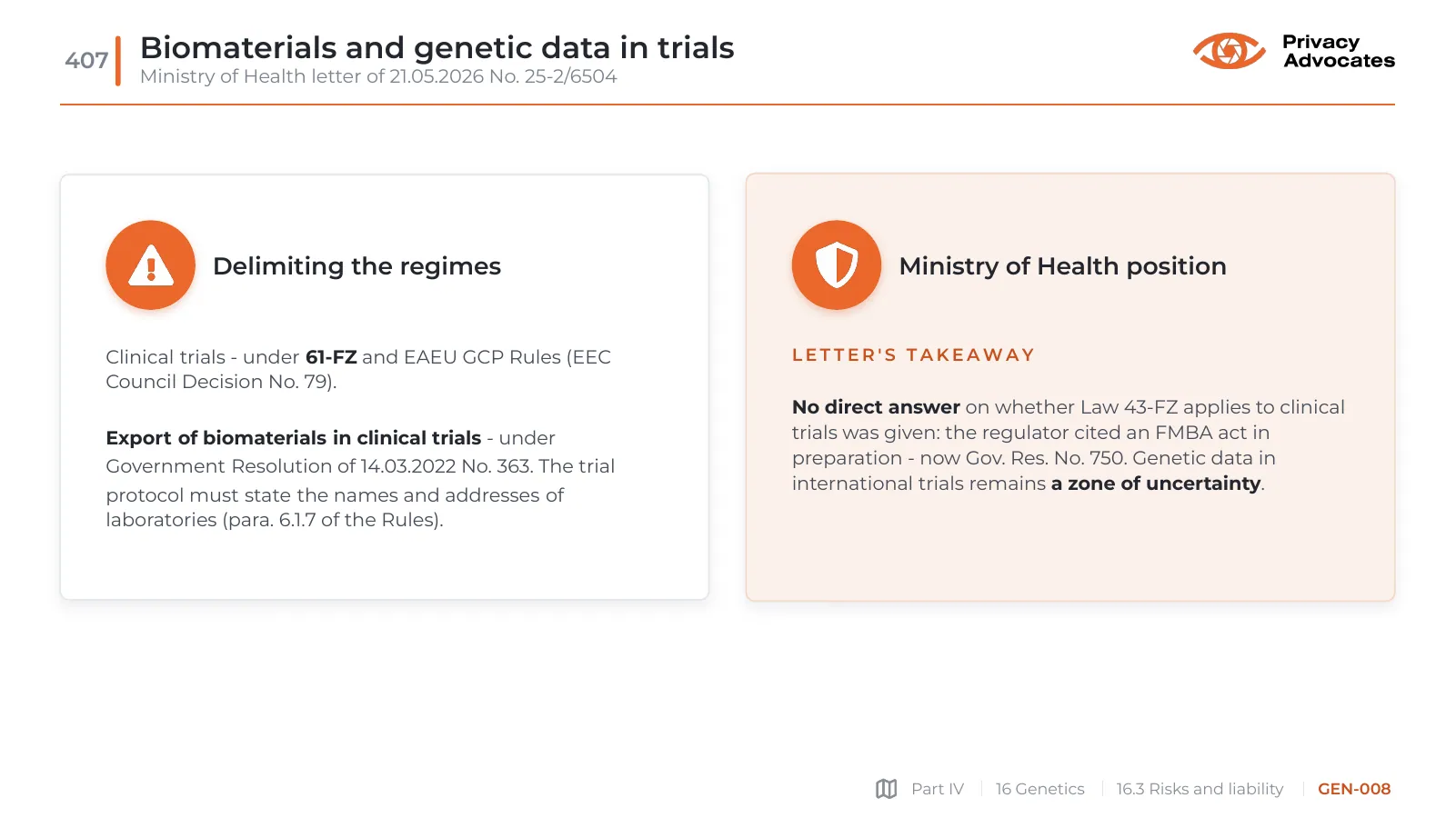
GEN-008

Biomaterials and genetic data in trials

Ministry of Health letter of 21.05.2026 No. 25-2/6504

Slide GEN-008: Biomaterials and genetic data in trials
Slide text

Delimiting the regimes

Clinical trials - under 61-FZ and EAEU GCP Rules (EEC Council Decision No. 79).

Export of biomaterials in clinical trials - under Government Resolution of 14.03.2022 No. 363. The trial protocol must state the names and addresses of laboratories (para. 6.1.7 of the Rules).

Ministry of Health position

LETTER'S TAKEAWAY

No direct answer on whether Law 43-FZ applies to clinical trials was given: the regulator cited an FMBA act in preparation - now Gov. Res. No. 750. Genetic data in international trials remains a zone of uncertainty.

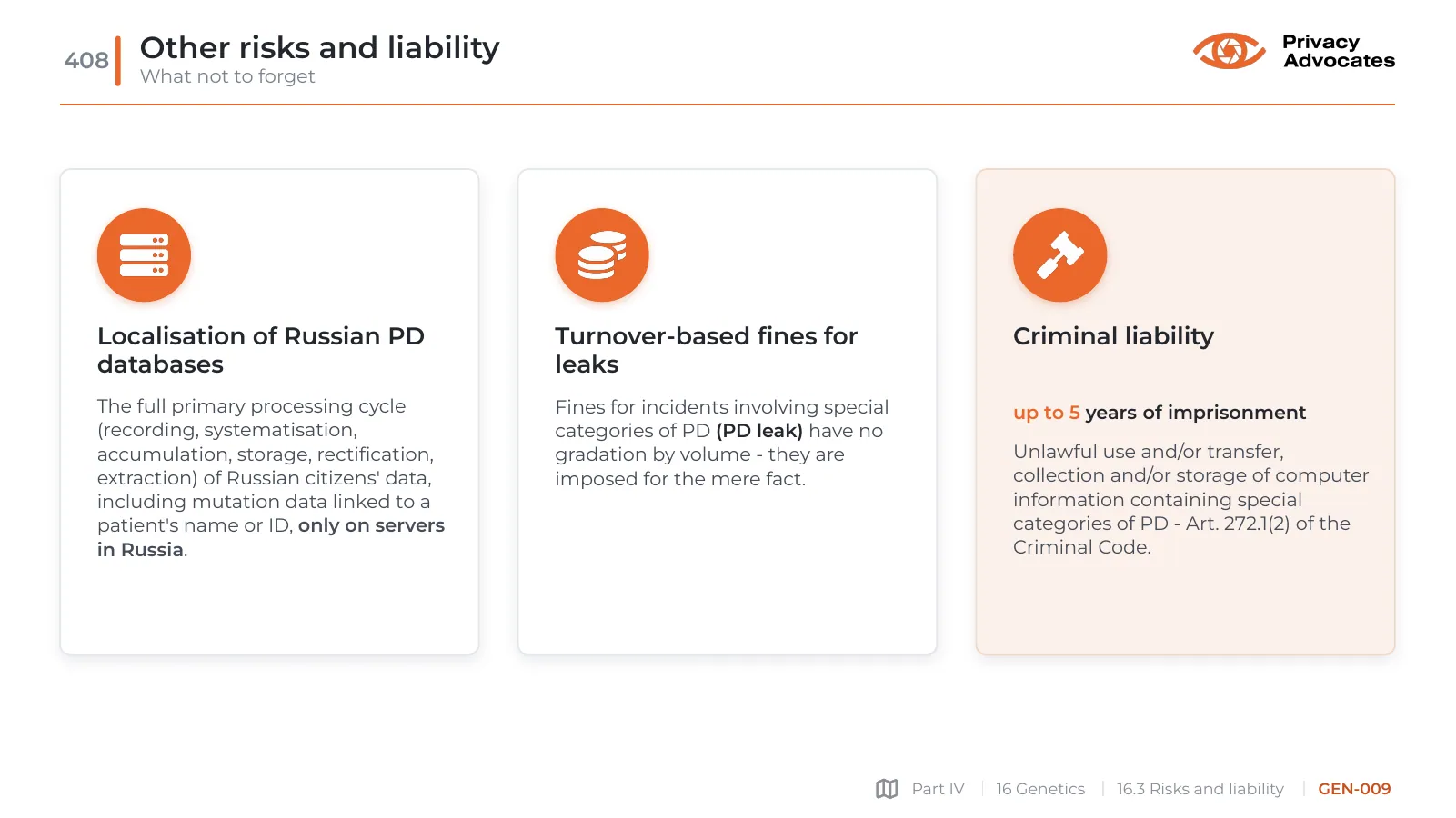
GEN-009

Other risks and liability

What not to forget

Slide GEN-009: Other risks and liability
Slide text

Localisation of Russian PD databases

The full primary processing cycle (recording, systematisation, accumulation, storage, rectification, extraction) of Russian citizens' data, including mutation data linked to a patient's name or ID, only on servers in Russia.

Turnover-based fines for leaks

Fines for incidents involving special categories of PD (PD leak) have no gradation by volume - they are imposed for the mere fact.

Criminal liability

up to 5 years of imprisonment

Unlawful use and/or transfer, collection and/or storage of computer information containing special categories of PD - Art. 272.1(2) of the Criminal Code.

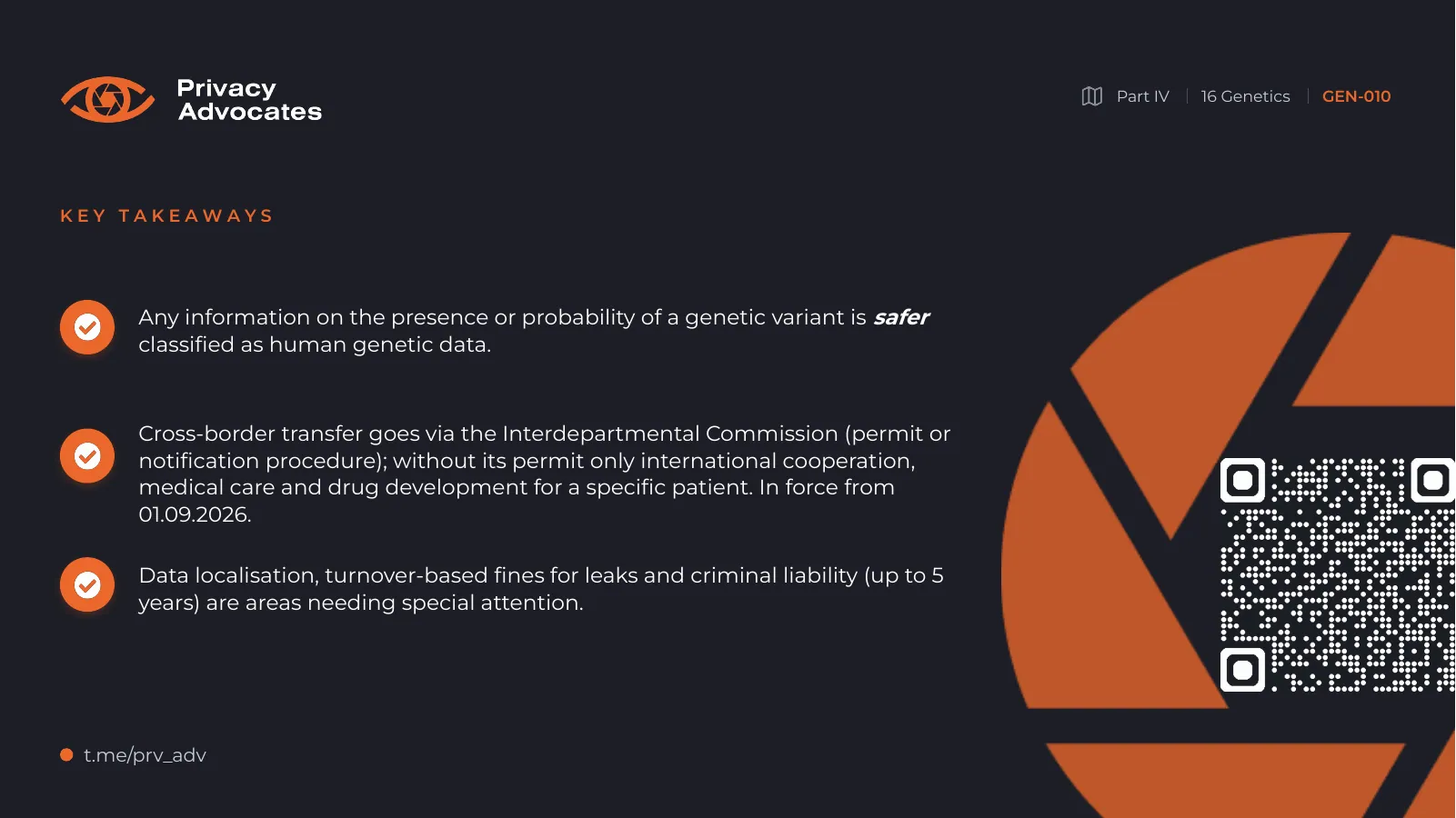
GEN-010

Key takeaways

Slide GEN-010: Key takeaways
Slide text

t.me/prv_adv

Any information on the presence or probability of a genetic variant is safer classified as human genetic data.

Cross-border transfer goes via the Interdepartmental Commission (permit or notification procedure); without its permit only international cooperation, medical care and drug development for a specific patient. In force from 01.09.2026.

Data localisation, turnover-based fines for leaks and criminal liability (up to 5 years) are areas needing special attention.