Part II, section 03

PD compliance overview

The PD processing lifecycle in one pass, from definitions to liability

  • 31 slides
  • 6 subsections
  • Edition of 25 October 2026

03.1

What is regulated and by whom

BAZ-001

Overview follows PD from collection to liability

Six life-cycle steps: the number opens a subsection, the tag leads to the relevant section
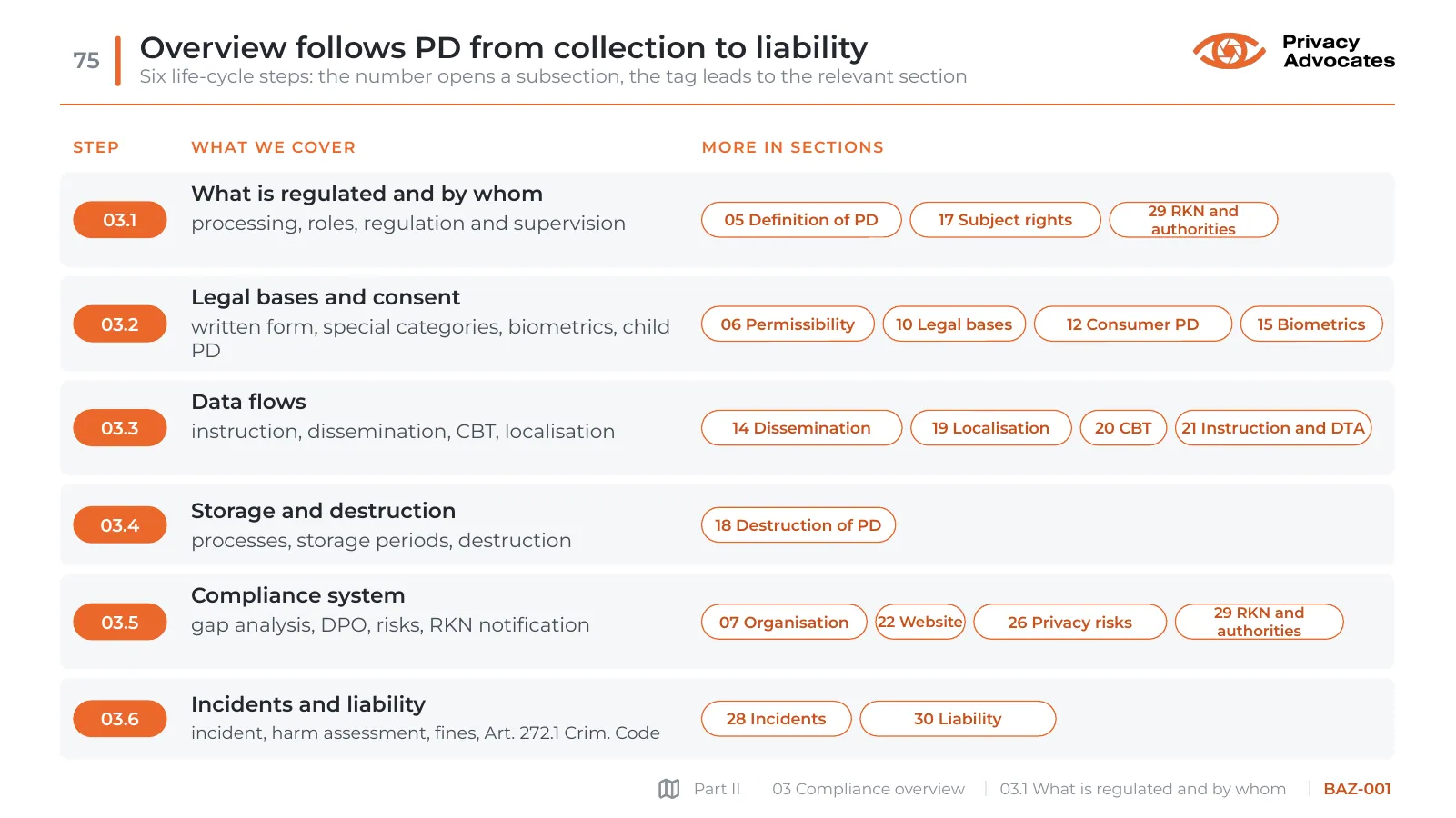
Slide BAZ-001: Overview follows PD from collection to liability
Slide text
  • Step
  • What we cover
  • More in sections

03.1

What is regulated and by whom

03.2

Legal bases and consent

03.3

Data flows

  • 03.4
  • Storage and destruction

processes, storage periods, destruction

18 Destruction of PD

03.5

Compliance system

  • 03.6
  • Incidents and liability

incident, harm assessment, fines, Art. 272.1 Crim. Code
BAZ-002

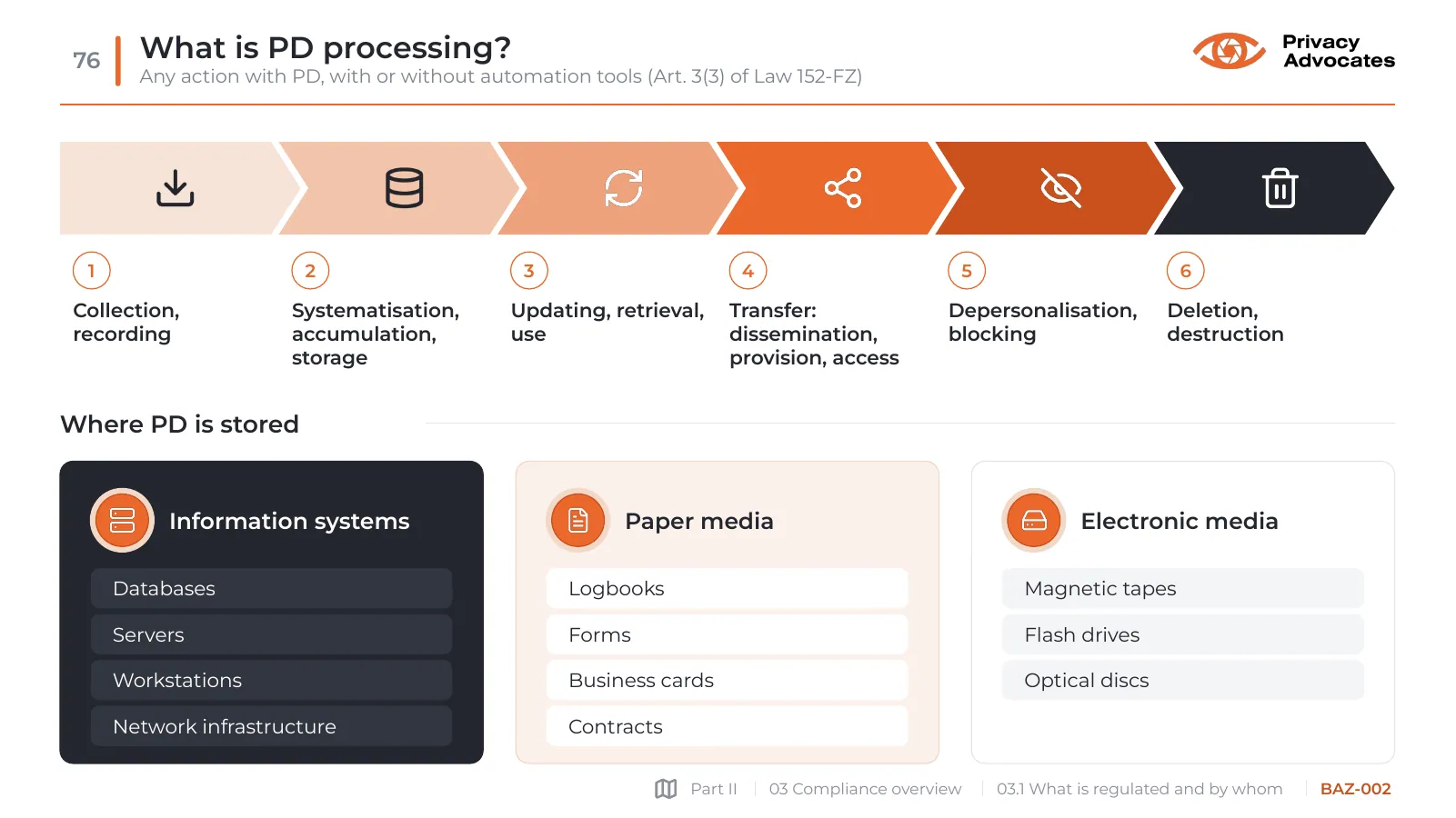
What is PD processing?

Any action with PD, with or without automation tools (Art. 3(3) of Law 152-FZ)

Slide BAZ-002: What is PD processing?
Slide text

1

Collection, recording

2

Systematisation, accumulation, storage

3

Updating, retrieval, use

4

Transfer: dissemination, provision, access

5

Depersonalisation, blocking

6

Deletion, destruction

Where PD is stored

Information systems

Databases

Servers

Workstations

Network infrastructure

Paper media

Logbooks

Forms

Business cards

Contracts

Electronic media

Magnetic tapes

Flash drives

Optical discs

BAZ-003

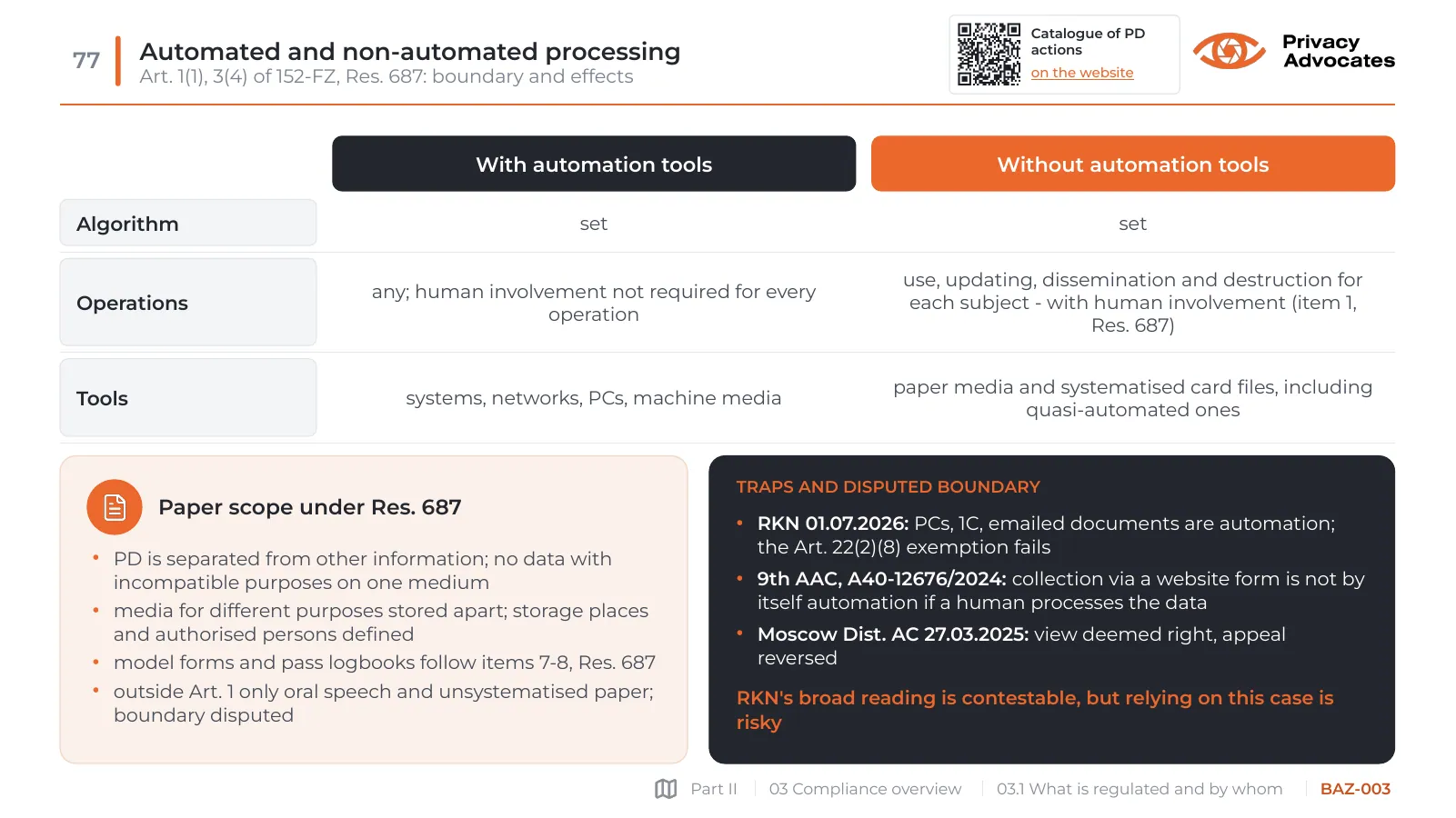
Automated and non-automated processing

Art. 1(1), 3(4) of 152-FZ, Res. 687: boundary and effects

Slide BAZ-003: Automated and non-automated processing
Slide text
  • With automation tools
  • Without automation tools
  • Algorithm
  • set
  • set
  • Operations
  • any; human involvement not required for every operation
  • use, updating, dissemination and destruction for each subject - with human involvement (item 1, Res. 687)
  • Tools
  • systems, networks, PCs, machine media
  • paper media and systematised card files, including quasi-automated ones

Paper scope under Res. 687

PD is separated from other information; no data with incompatible purposes on one medium

media for different purposes stored apart; storage places and authorised persons defined

model forms and pass logbooks follow items 7-8, Res. 687

outside Art. 1 only oral speech and unsystematised paper; boundary disputed

TRAPS AND DISPUTED BOUNDARY

RKN 01.07.2026: PCs, 1C, emailed documents are automation; the Art. 22(2)(8) exemption fails

9th AAC, A40-12676/2024: collection via a website form is not by itself automation if a human processes the data

Moscow Dist. AC 27.03.2025: view deemed right, appeal reversed

RKN's broad reading is contestable, but relying on this case is risky

BAZ-004

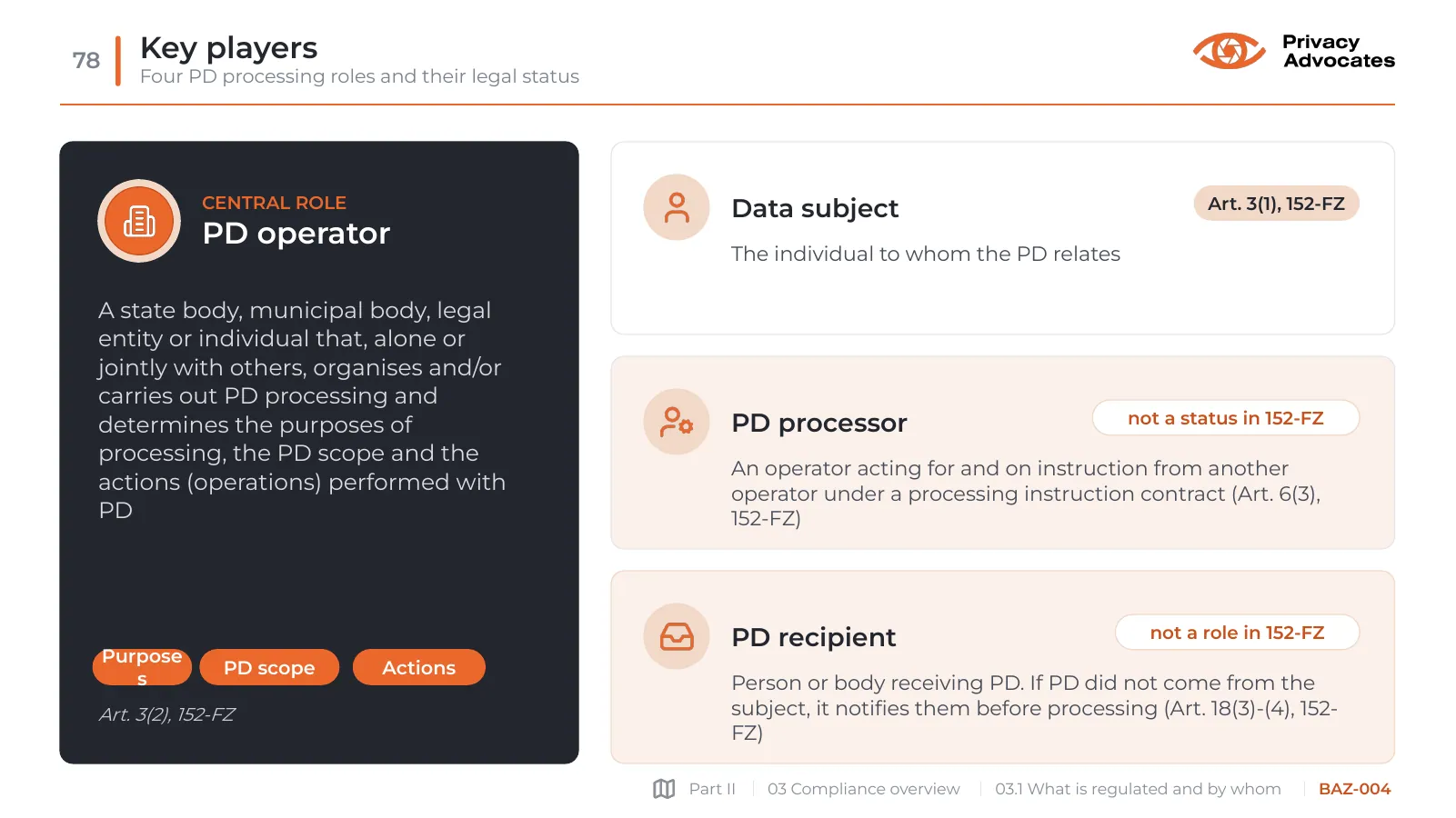
Key players

Four PD processing roles and their legal status

Slide BAZ-004: Key players
Slide text

CENTRAL ROLE

PD operator

A state body, municipal body, legal entity or individual that, alone or jointly with others, organises and/or carries out PD processing and determines the purposes of processing, the PD scope and the actions (operations) performed with PD

  • Purposes
  • PD scope
  • Actions

Art. 3(2), 152-FZ

  • Data subject
  • Art. 3(1), 152-FZ

The individual to whom the PD relates

  • PD processor
  • not a status in 152-FZ

An operator acting for and on instruction from another operator under a processing instruction contract (Art. 6(3), 152-FZ)

  • PD recipient
  • not a role in 152-FZ

Person or body receiving PD. If PD did not come from the subject, it notifies them before processing (Art. 18(3)-(4), 152-FZ)

BAZ-005

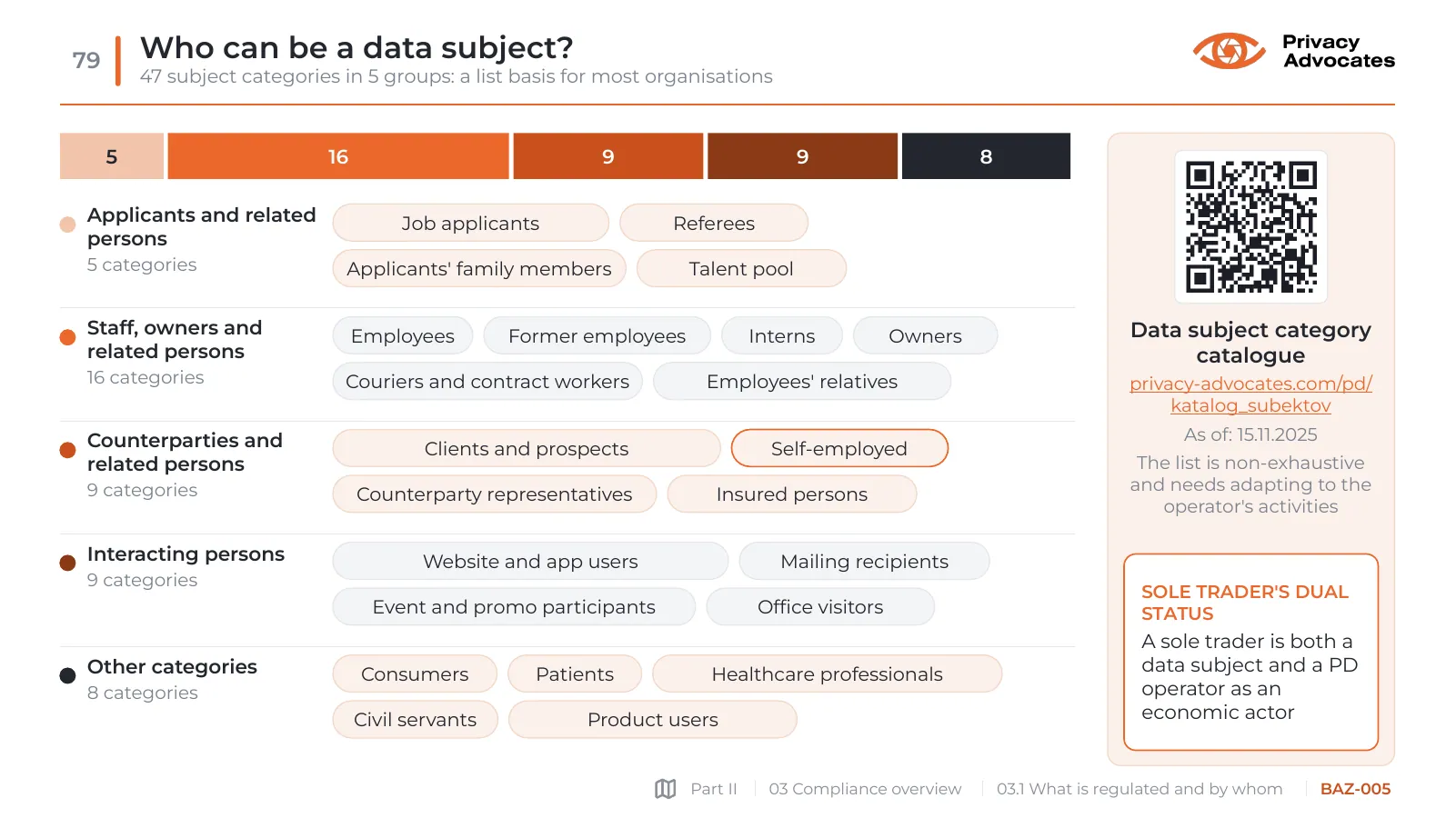
Who can be a data subject?

47 subject categories in 5 groups: a list basis for most organisations

Slide BAZ-005: Who can be a data subject?
Slide text
  • 5
  • 16
  • 9
  • 9
  • 8

Applicants and related persons

5 categories

  • Job applicants
  • Referees
  • Applicants' family members
  • Talent pool

Staff, owners and related persons

16 categories

  • Employees
  • Former employees
  • Interns
  • Owners
  • Couriers and contract workers
  • Employees' relatives

Counterparties and related persons

9 categories

  • Clients and prospects
  • Self-employed
  • Counterparty representatives
  • Insured persons

Interacting persons

9 categories

  • Website and app users
  • Mailing recipients
  • Event and promo participants
  • Office visitors

Other categories

8 categories

  • Consumers
  • Patients
  • Healthcare professionals
  • Civil servants
  • Product users

Data subject category catalogue

privacy-advocates.com/pd/

katalog_subektov

As of: 15.11.2025

The list is non-exhaustive and needs adapting to the operator's activities

SOLE TRADER'S DUAL STATUS

A sole trader is both a data subject and a PD operator as an economic actor

BAZ-006

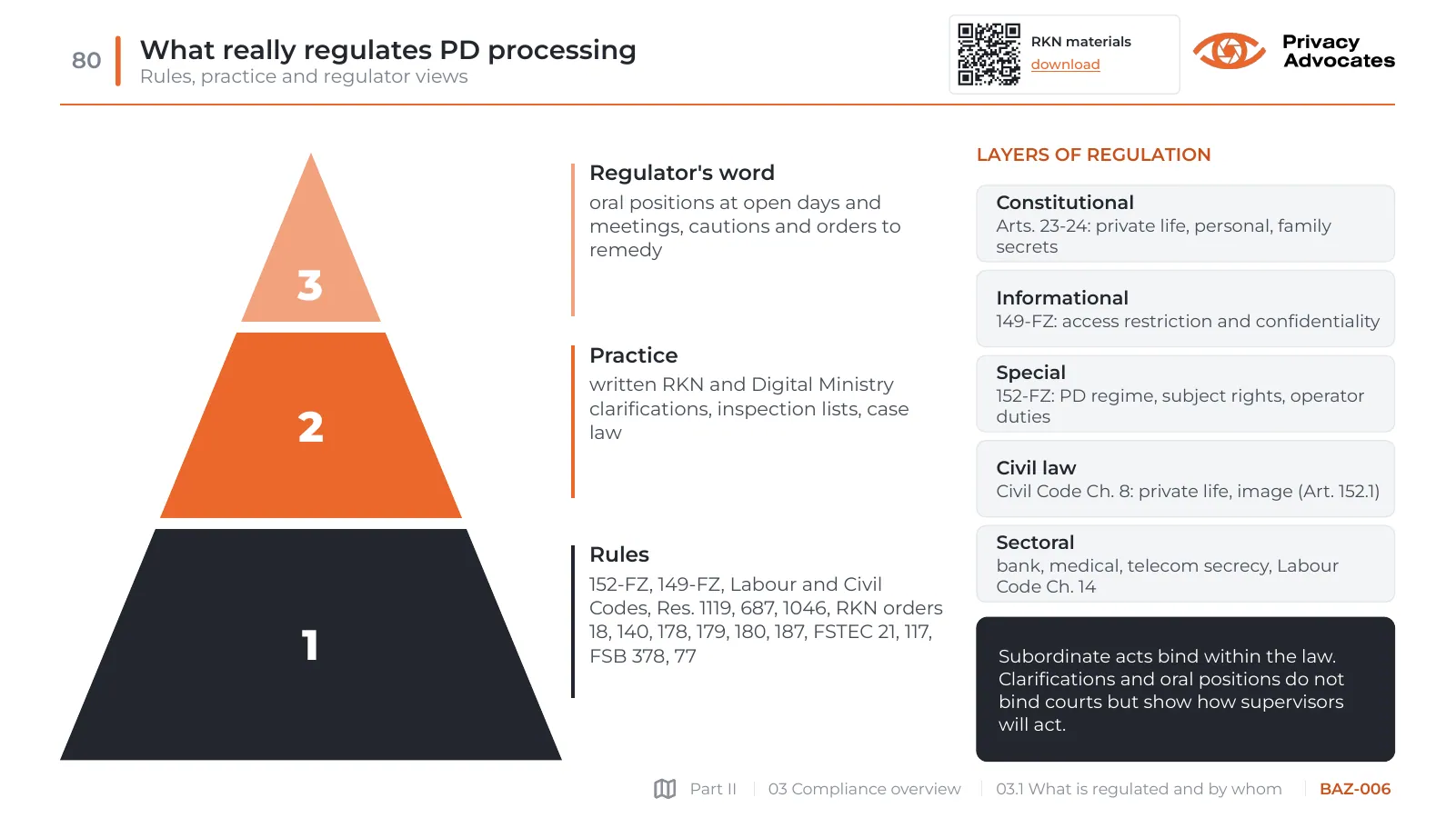
What really regulates PD processing

Rules, practice and regulator views

Slide BAZ-006: What really regulates PD processing
Slide text

3

2

1

Regulator's word

oral positions at open days and meetings, cautions and orders to remedy

Practice

written RKN and Digital Ministry clarifications, inspection lists, case law

Rules

152-FZ, 149-FZ, Labour and Civil Codes, Res. 1119, 687, 1046, RKN orders 18, 140, 178, 179, 180, 187, FSTEC 21, 117, FSB 378, 77

LAYERS OF REGULATION

Constitutional

Arts. 23-24: private life, personal, family secrets

Informational

149-FZ: access restriction and confidentiality

Special

152-FZ: PD regime, subject rights, operator duties

Civil law

Civil Code Ch. 8: private life, image (Art. 152.1)

Sectoral

bank, medical, telecom secrecy, Labour Code Ch. 14

Subordinate acts bind within the law. Clarifications and oral positions do not bind courts but show how supervisors will act.

BAZ-007

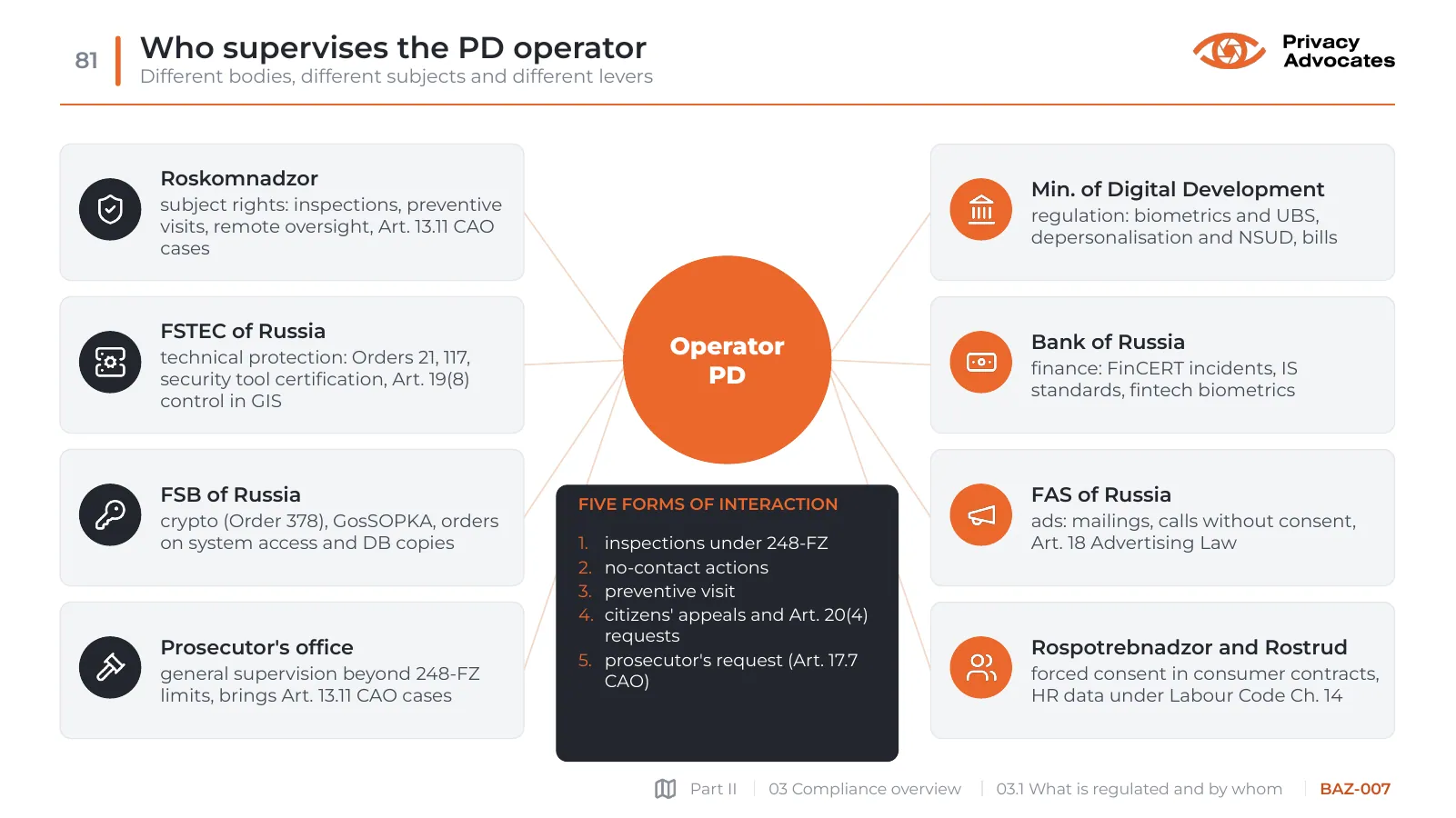
Who supervises the PD operator

Different bodies, different subjects and different levers

Slide BAZ-007: Who supervises the PD operator
Slide text

Roskomnadzor

subject rights: inspections, preventive visits, remote oversight, Art. 13.11 CAO cases

FSTEC of Russia

technical protection: Orders 21, 117, security tool certification, Art. 19(8) control in GIS

FSB of Russia

crypto (Order 378), GosSOPKA, orders on system access and DB copies

Prosecutor's office

general supervision beyond 248-FZ limits, brings Art. 13.11 CAO cases

Min. of Digital Development

regulation: biometrics and UBS, depersonalisation and NSUD, bills

Bank of Russia

finance: FinCERT incidents, IS standards, fintech biometrics

FAS of Russia

ads: mailings, calls without consent, Art. 18 Advertising Law

Rospotrebnadzor and Rostrud

forced consent in consumer contracts, HR data under Labour Code Ch. 14

Operator

PD

FIVE FORMS OF INTERACTION

inspections under 248-FZ

no-contact actions

preventive visit

citizens' appeals and Art. 20(4) requests

prosecutor's request (Art. 17.7 CAO)

03.2

Legal bases and consent

BAZ-008

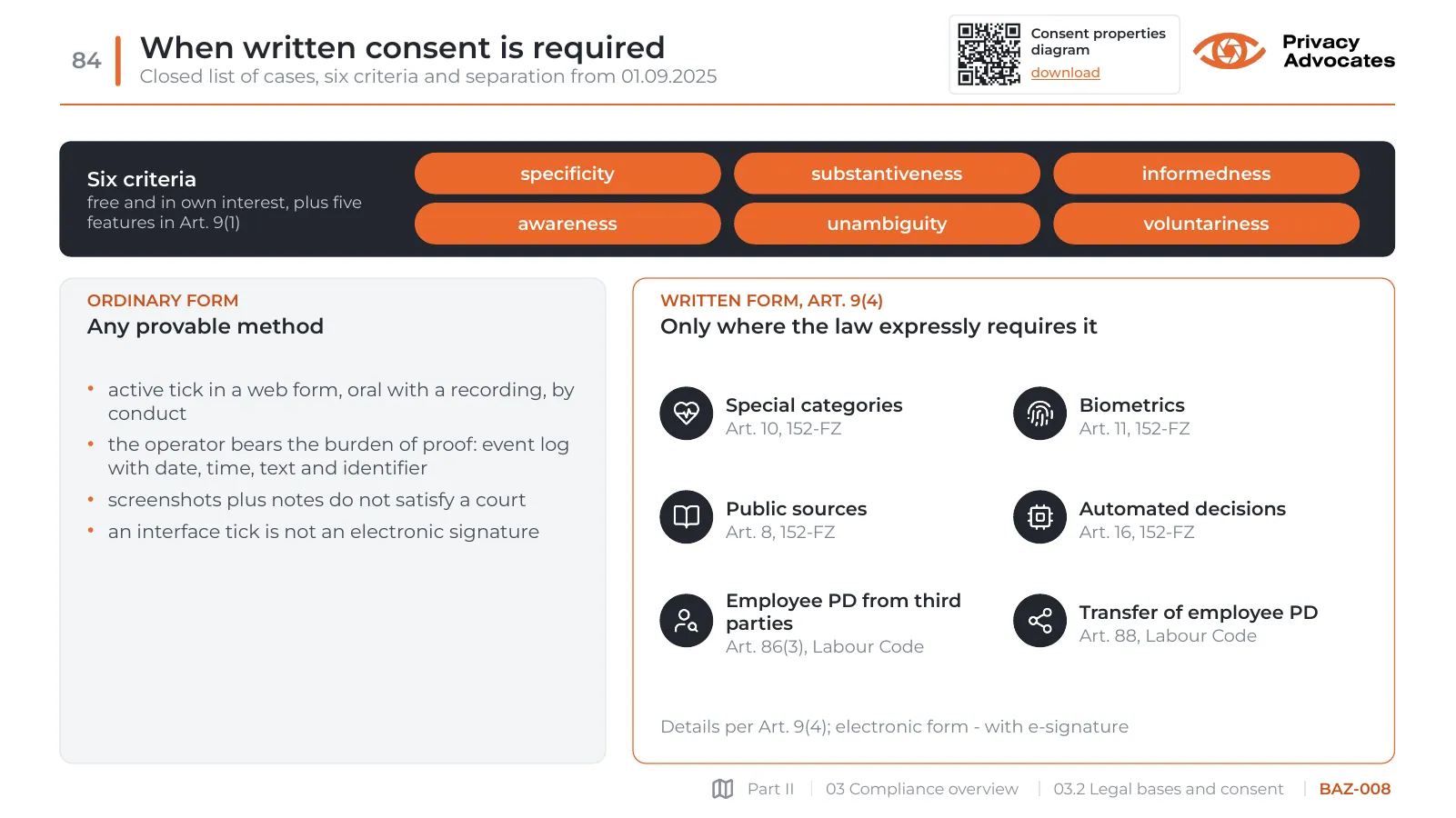
When written consent is required

Closed list of cases, six criteria and separation from 01.09.2025

Slide BAZ-008: When written consent is required
Slide text

Six criteria

free and in own interest, plus five features in Art. 9(1)

  • specificity
  • substantiveness
  • informedness
  • awareness
  • unambiguity
  • voluntariness

ORDINARY FORM

Any provable method

active tick in a web form, oral with a recording, by conduct

the operator bears the burden of proof: event log with date, time, text and identifier

screenshots plus notes do not satisfy a court

an interface tick is not an electronic signature

WRITTEN FORM, ART. 9(4)

Only where the law expressly requires it

Special categories

Art. 10, 152-FZ

Biometrics

Art. 11, 152-FZ

Public sources

Art. 8, 152-FZ

Automated decisions

Art. 16, 152-FZ

Employee PD from third parties

Art. 86(3), Labour Code

Transfer of employee PD

Art. 88, Labour Code

Details per Art. 9(4); electronic form - with e-signature

BAZ-009

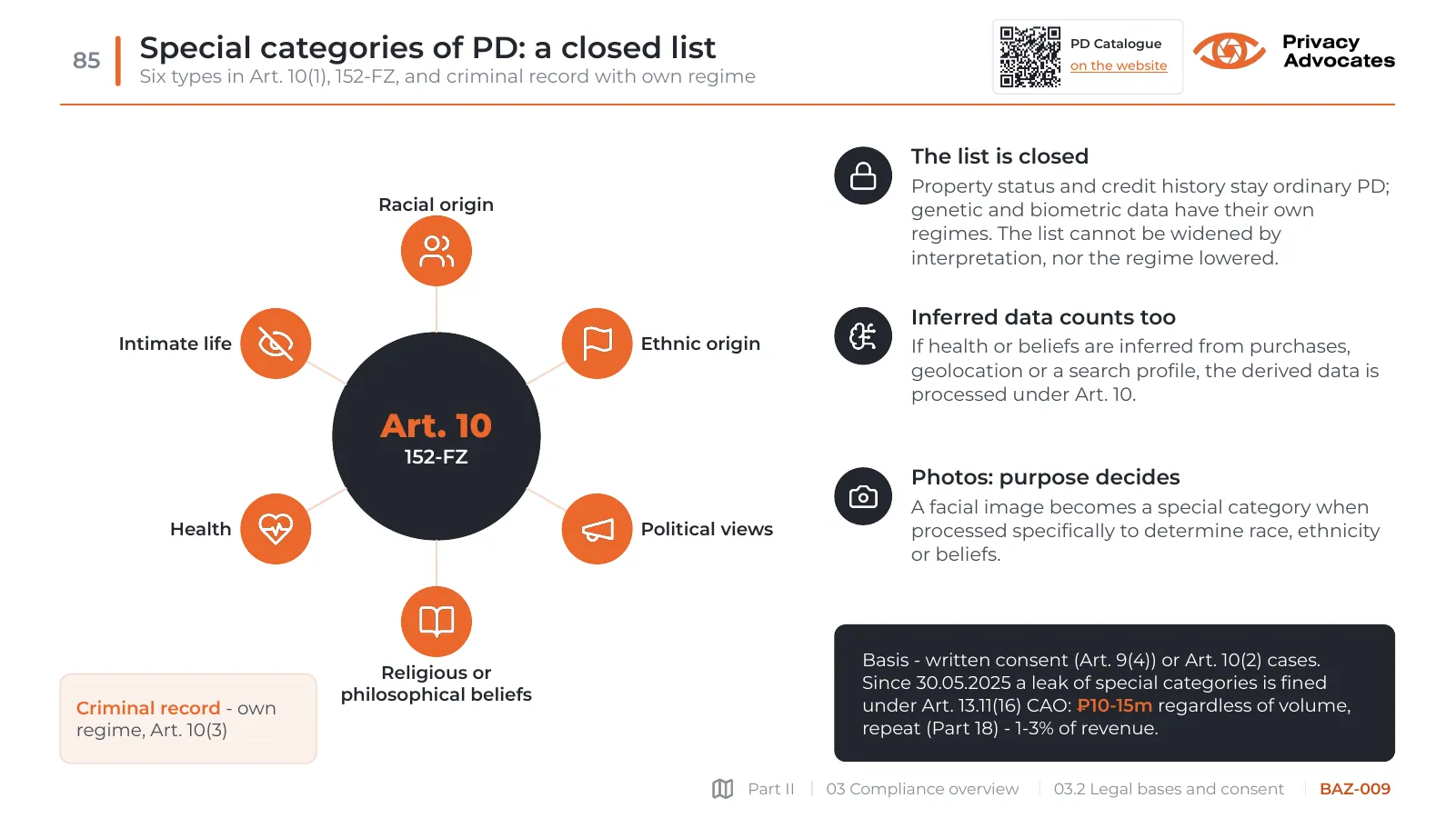
Special categories of PD: a closed list

Six types in Art. 10(1), 152-FZ, and criminal record with own regime

Slide BAZ-009: Special categories of PD: a closed list
Slide text

Art. 10

152-FZ

Racial origin

Ethnic origin

Political views

Religious or philosophical beliefs

Health

Intimate life

Criminal record - own regime, Art. 10(3)

The list is closed

Property status and credit history stay ordinary PD; genetic and biometric data have their own regimes. The list cannot be widened by interpretation, nor the regime lowered.

Inferred data counts too

If health or beliefs are inferred from purchases, geolocation or a search profile, the derived data is processed under Art. 10.

Photos: purpose decides

A facial image becomes a special category when processed specifically to determine race, ethnicity or beliefs.

Basis - written consent (Art. 9(4)) or Art. 10(2) cases. Since 30.05.2025 a leak of special categories is fined under Art. 13.11(16) CAO: ₽10-15m regardless of volume, repeat (Part 18) - 1-3% of revenue.

BAZ-010

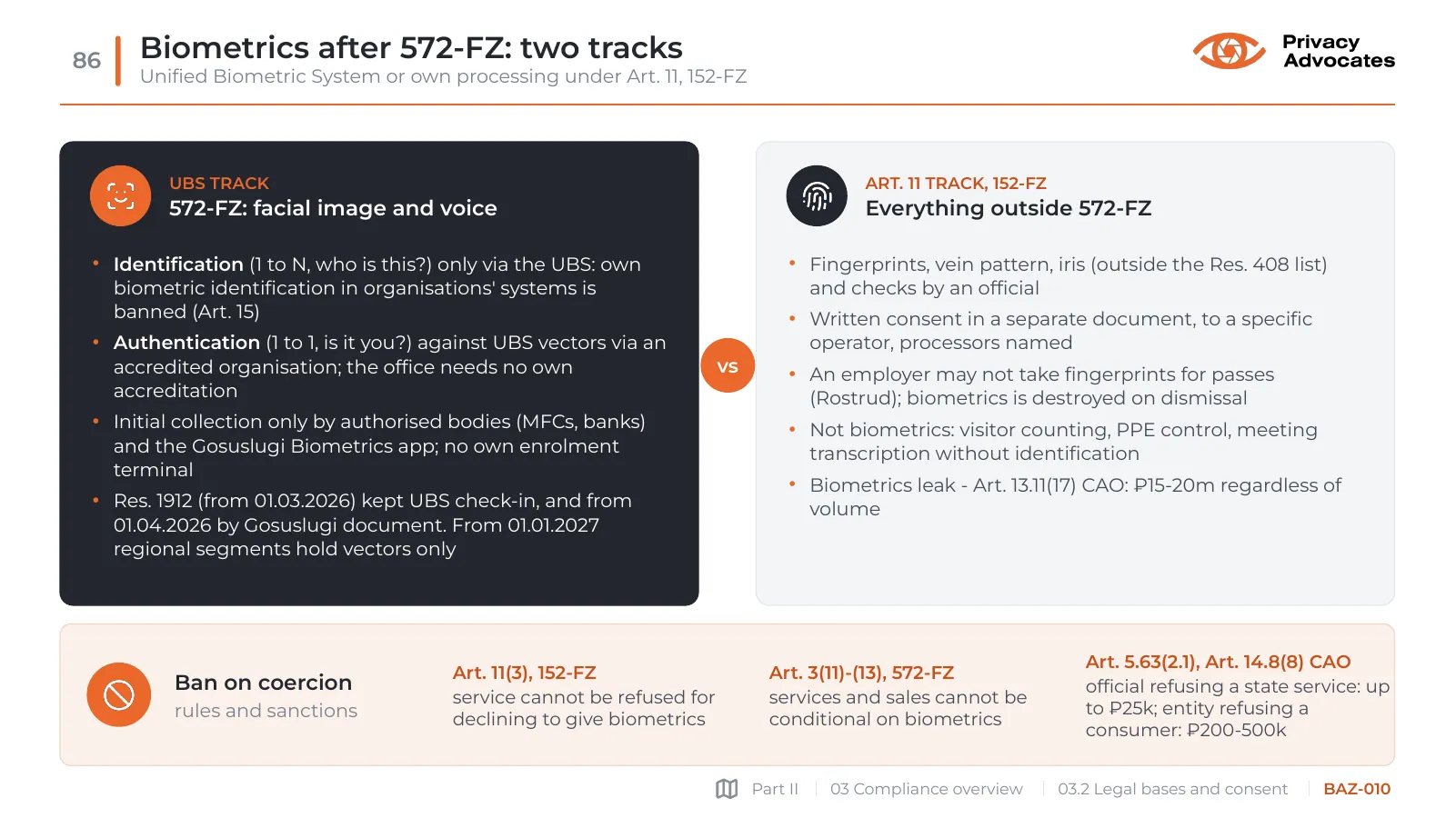
Biometrics after 572-FZ: two tracks

Unified Biometric System or own processing under Art. 11, 152-FZ

Slide BAZ-010: Biometrics after 572-FZ: two tracks
Slide text

UBS TRACK

572-FZ: facial image and voice

Identification (1 to N, who is this?) only via the UBS: own biometric identification in organisations' systems is banned (Art. 15)

Authentication (1 to 1, is it you?) against UBS vectors via an accredited organisation; the office needs no own accreditation

Initial collection only by authorised bodies (MFCs, banks) and the Gosuslugi Biometrics app; no own enrolment terminal

Res. 1912 (from 01.03.2026) kept UBS check-in, and from 01.04.2026 by Gosuslugi document. From 01.01.2027 regional segments hold vectors only

ART. 11 TRACK, 152-FZ

Everything outside 572-FZ

Fingerprints, vein pattern, iris (outside the Res. 408 list) and checks by an official

Written consent in a separate document, to a specific operator, processors named

An employer may not take fingerprints for passes (Rostrud); biometrics is destroyed on dismissal

Not biometrics: visitor counting, PPE control, meeting transcription without identification

Biometrics leak - Art. 13.11(17) CAO: ₽15-20m regardless of volume

vs

Ban on coercion

rules and sanctions

Art. 11(3), 152-FZ

service cannot be refused for declining to give biometrics

Art. 3(11)-(13), 572-FZ

services and sales cannot be conditional on biometrics

Art. 5.63(2.1), Art. 14.8(8) CAO

official refusing a state service: up to ₽25k; entity refusing a consumer: ₽200-500k

BAZ-011

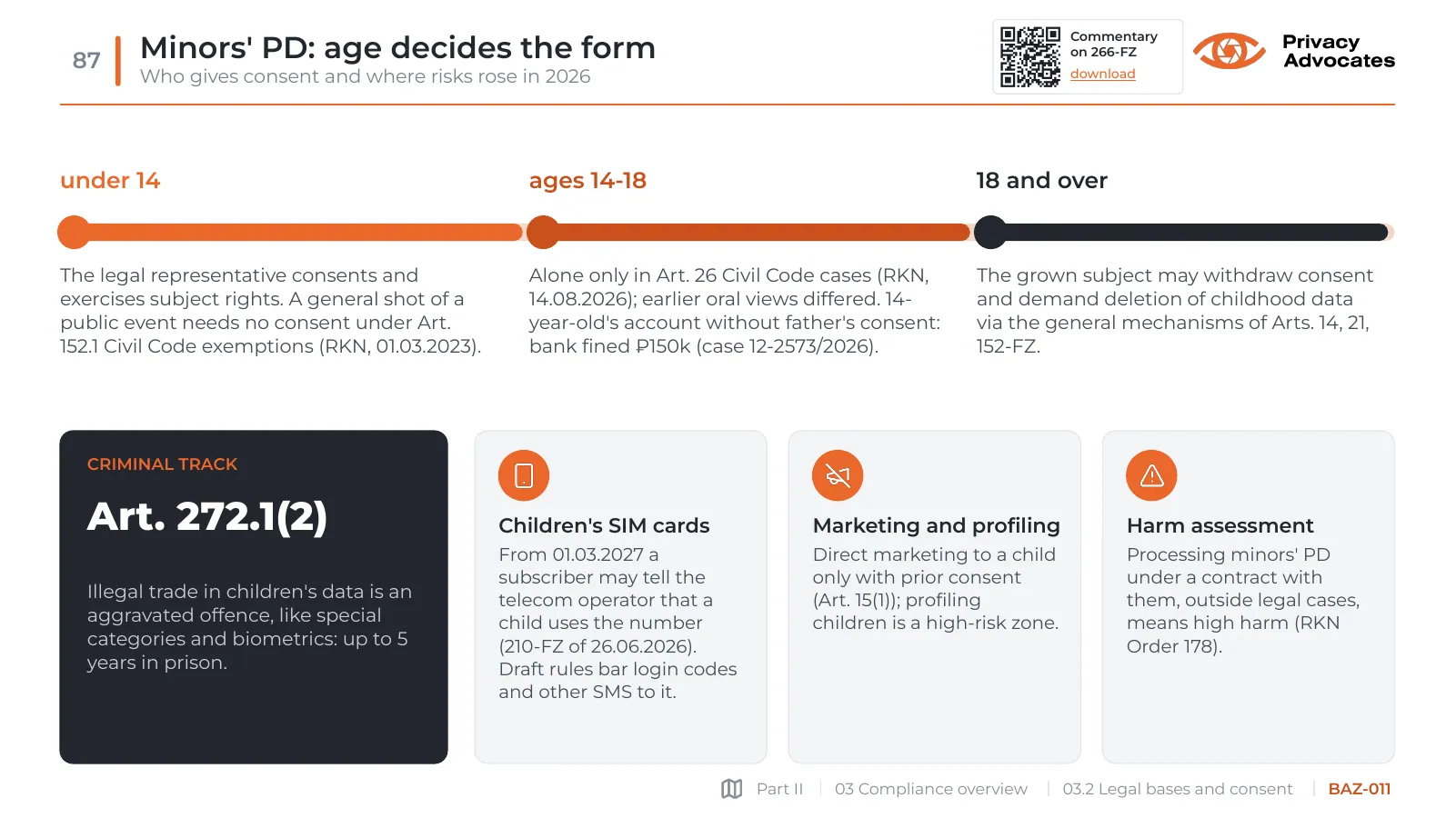
Minors' PD: age decides the form

Who gives consent and where risks rose in 2026

Slide BAZ-011: Minors' PD: age decides the form
Slide text
  • under 14
  • ages 14-18
  • 18 and over
  • The legal representative consents and exercises subject rights. A general shot of a public event needs no consent under Art. 152.1 Civil Code exemptions (RKN, 01.03.2023).
  • Alone only in Art. 26 Civil Code cases (RKN, 14.08.2026); earlier oral views differed. 14-year-old's account without father's consent: bank fined ₽150k (case 12-2573/2026).
  • The grown subject may withdraw consent and demand deletion of childhood data via the general mechanisms of Arts. 14, 21, 152-FZ.

CRIMINAL TRACK

Art. 272.1(2)

Illegal trade in children's data is an aggravated offence, like special categories and biometrics: up to 5 years in prison.

Children's SIM cards

From 01.03.2027 a subscriber may tell the telecom operator that a child uses the number (210-FZ of 26.06.2026). Draft rules bar login codes and other SMS to it.

Marketing and profiling

Direct marketing to a child only with prior consent (Art. 15(1)); profiling children is a high-risk zone.

Harm assessment

Processing minors' PD under a contract with them, outside legal cases, means high harm (RKN Order 178).

03.3

Data flows

BAZ-012

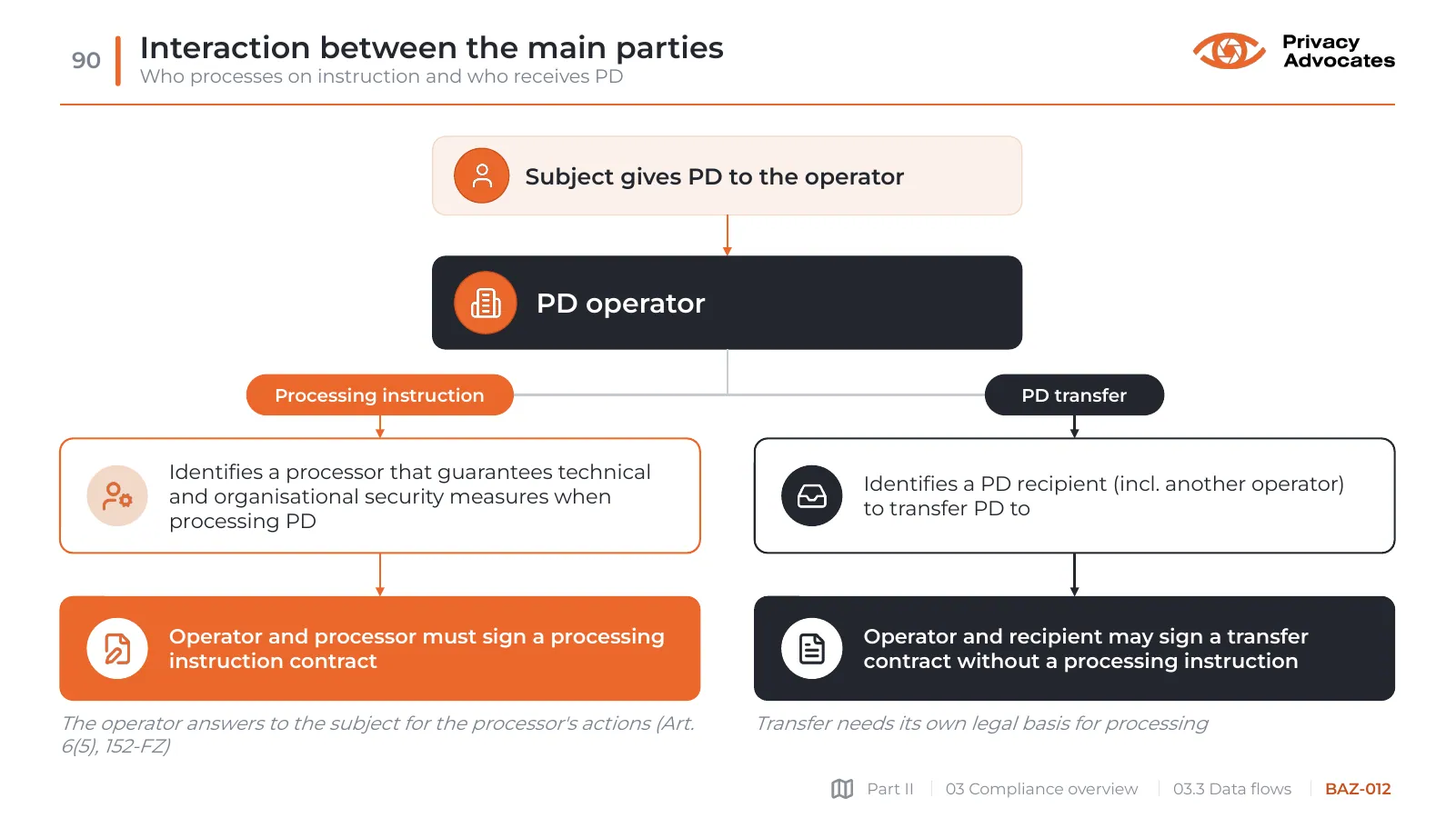
Interaction between the main parties

Who processes on instruction and who receives PD

Slide BAZ-012: Interaction between the main parties
Slide text

Subject gives PD to the operator

PD operator

  • Processing instruction
  • PD transfer

Identifies a processor that guarantees technical and organisational security measures when processing PD

Operator and processor must sign a processing instruction contract

The operator answers to the subject for the processor's actions (Art. 6(5), 152-FZ)

Identifies a PD recipient (incl. another operator) to transfer PD to

Operator and recipient may sign a transfer contract without a processing instruction

Transfer needs its own legal basis for processing

BAZ-013

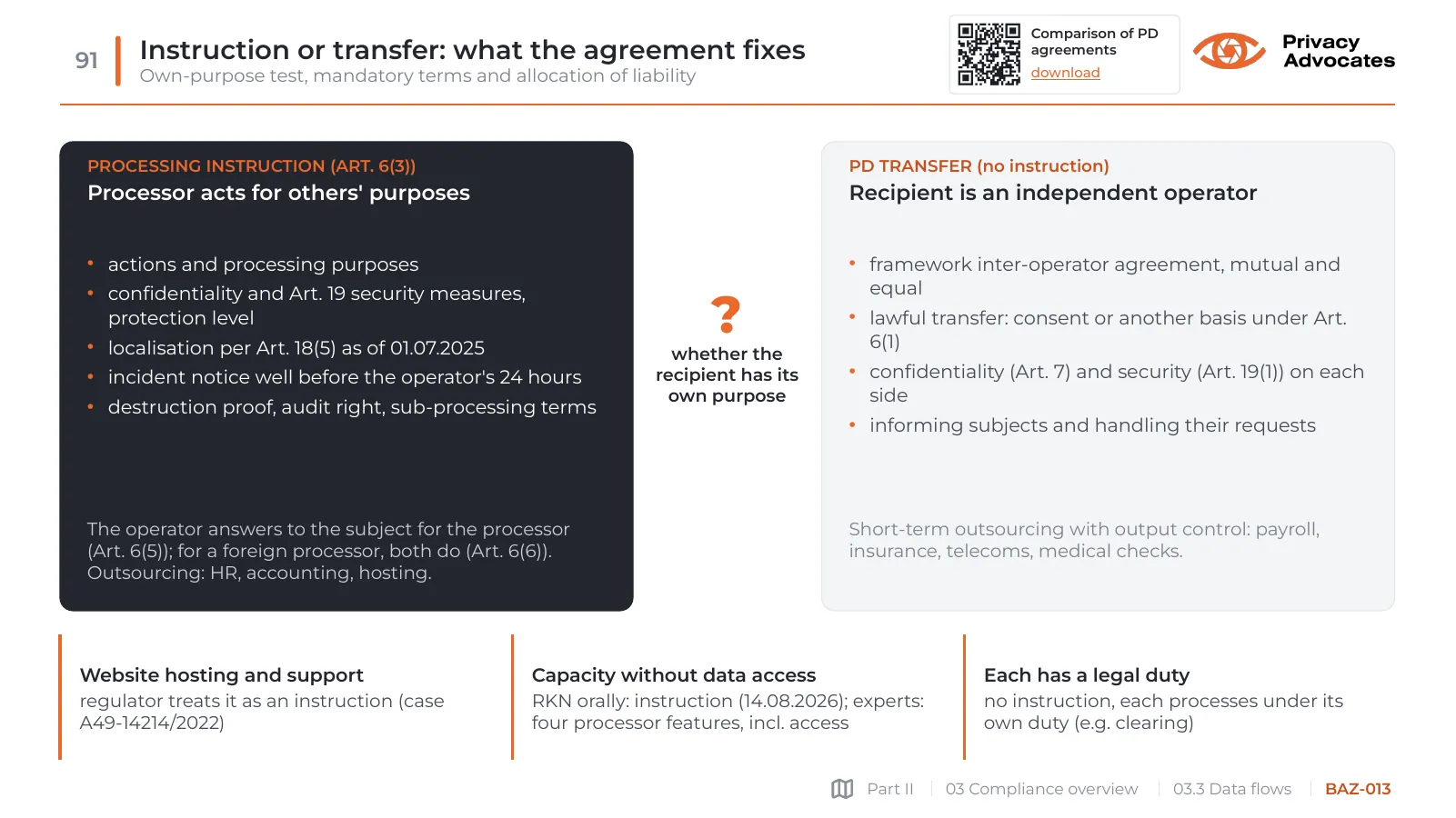
Instruction or transfer: what the agreement fixes

Own-purpose test, mandatory terms and allocation of liability

Slide BAZ-013: Instruction or transfer: what the agreement fixes
Slide text

PROCESSING INSTRUCTION (ART. 6(3))

Processor acts for others' purposes

actions and processing purposes

confidentiality and Art. 19 security measures, protection level

localisation per Art. 18(5) as of 01.07.2025

incident notice well before the operator's 24 hours

destruction proof, audit right, sub-processing terms

The operator answers to the subject for the processor (Art. 6(5)); for a foreign processor, both do (Art. 6(6)). Outsourcing: HR, accounting, hosting.

PD TRANSFER (no instruction)

Recipient is an independent operator

framework inter-operator agreement, mutual and equal

lawful transfer: consent or another basis under Art. 6(1)

confidentiality (Art. 7) and security (Art. 19(1)) on each side

informing subjects and handling their requests

Short-term outsourcing with output control: payroll, insurance, telecoms, medical checks.

?

whether the recipient has its own purpose

Website hosting and support

regulator treats it as an instruction (case A49-14214/2022)

Capacity without data access

RKN orally: instruction (14.08.2026); experts: four processor features, incl. access

Each has a legal duty

no instruction, each processes under its own duty (e.g. clearing)

BAZ-014

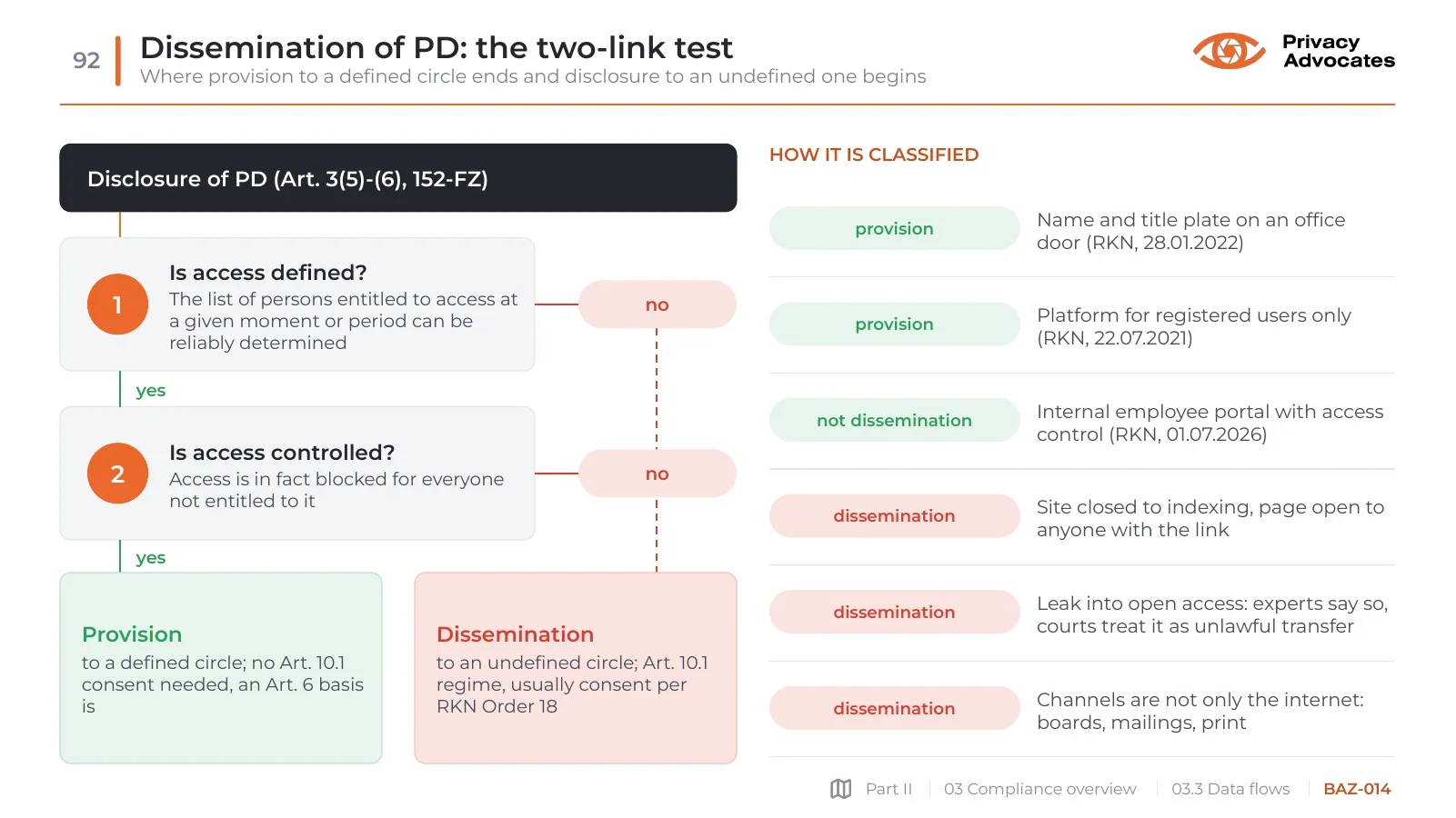
Dissemination of PD: the two-link test

Where provision to a defined circle ends and disclosure to an undefined one begins

Slide BAZ-014: Dissemination of PD: the two-link test
Slide text

Disclosure of PD (Art. 3(5)-(6), 152-FZ)

1

Is access defined?

The list of persons entitled to access at a given moment or period can be reliably determined

no

2

Is access controlled?

Access is in fact blocked for everyone not entitled to it

no

yes

yes

Provision

to a defined circle; no Art. 10.1 consent needed, an Art. 6 basis is

Dissemination

to an undefined circle; Art. 10.1 regime, usually consent per RKN Order 18

HOW IT IS CLASSIFIED

  • provision
  • Name and title plate on an office door (RKN, 28.01.2022)
  • provision
  • Platform for registered users only (RKN, 22.07.2021)
  • not dissemination
  • Internal employee portal with access control (RKN, 01.07.2026)
  • dissemination
  • Site closed to indexing, page open to anyone with the link
  • dissemination
  • Leak into open access: experts say so, courts treat it as unlawful transfer
  • dissemination
  • Channels are not only the internet: boards, mailings, print
BAZ-015

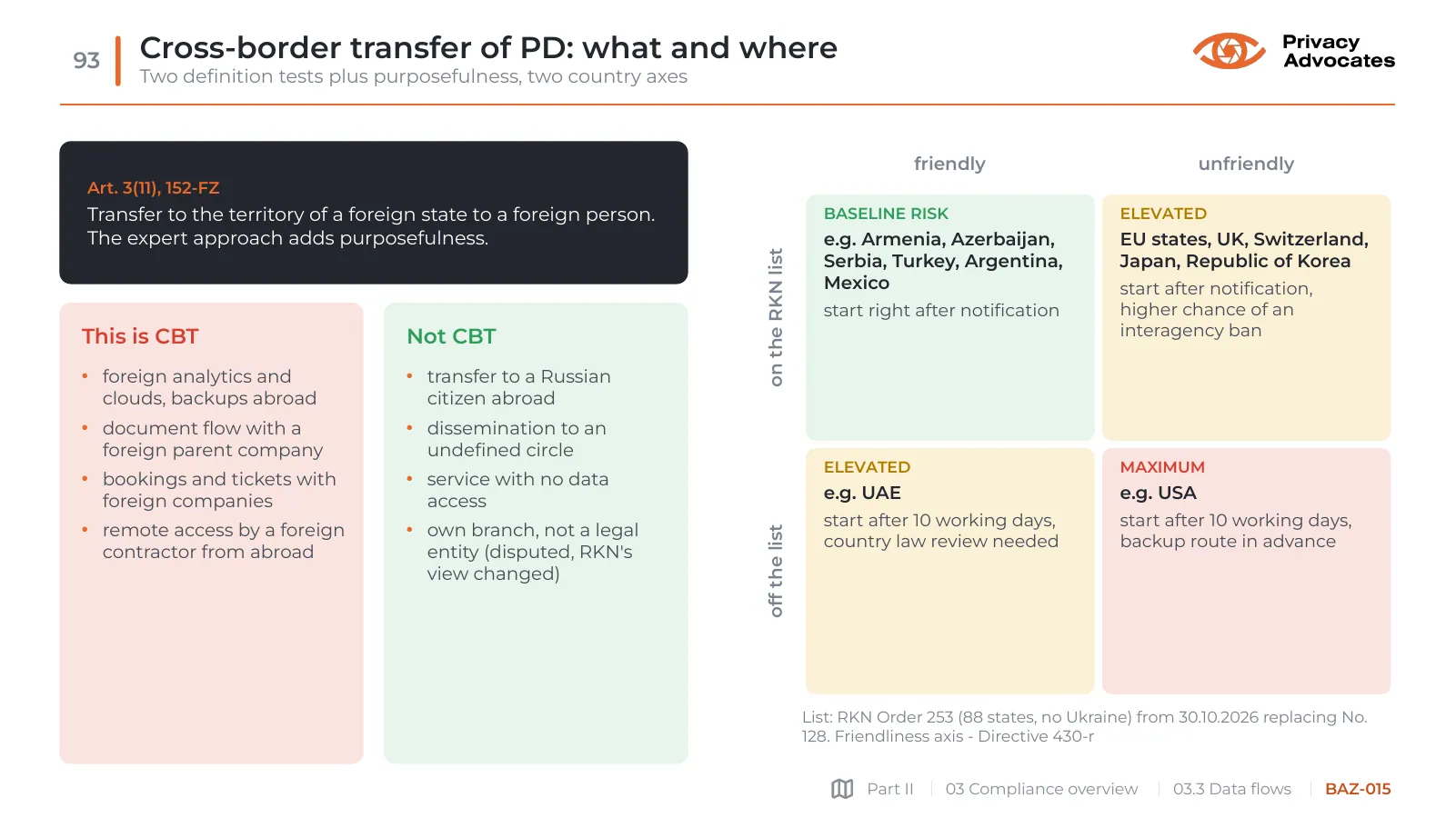
Cross-border transfer of PD: what and where

Two definition tests plus purposefulness, two country axes

Slide BAZ-015: Cross-border transfer of PD: what and where
Slide text

Art. 3(11), 152-FZ

Transfer to the territory of a foreign state to a foreign person. The expert approach adds purposefulness.

This is CBT

foreign analytics and clouds, backups abroad

document flow with a foreign parent company

bookings and tickets with foreign companies

remote access by a foreign contractor from abroad

Not CBT

transfer to a Russian citizen abroad

dissemination to an undefined circle

service with no data access

own branch, not a legal entity (disputed, RKN's view changed)

  • friendly
  • unfriendly

on the RKN list

off the list

BASELINE RISK

e.g. Armenia, Azerbaijan, Serbia, Turkey, Argentina, Mexico

start right after notification

ELEVATED

EU states, UK, Switzerland, Japan, Republic of Korea

start after notification, higher chance of an interagency ban

ELEVATED

e.g. UAE

start after 10 working days, country law review needed

MAXIMUM

e.g. USA

start after 10 working days, backup route in advance

List: RKN Order 253 (88 states, no Ukraine) from 30.10.2026 replacing No. 128. Friendliness axis - Directive 430-r

BAZ-016

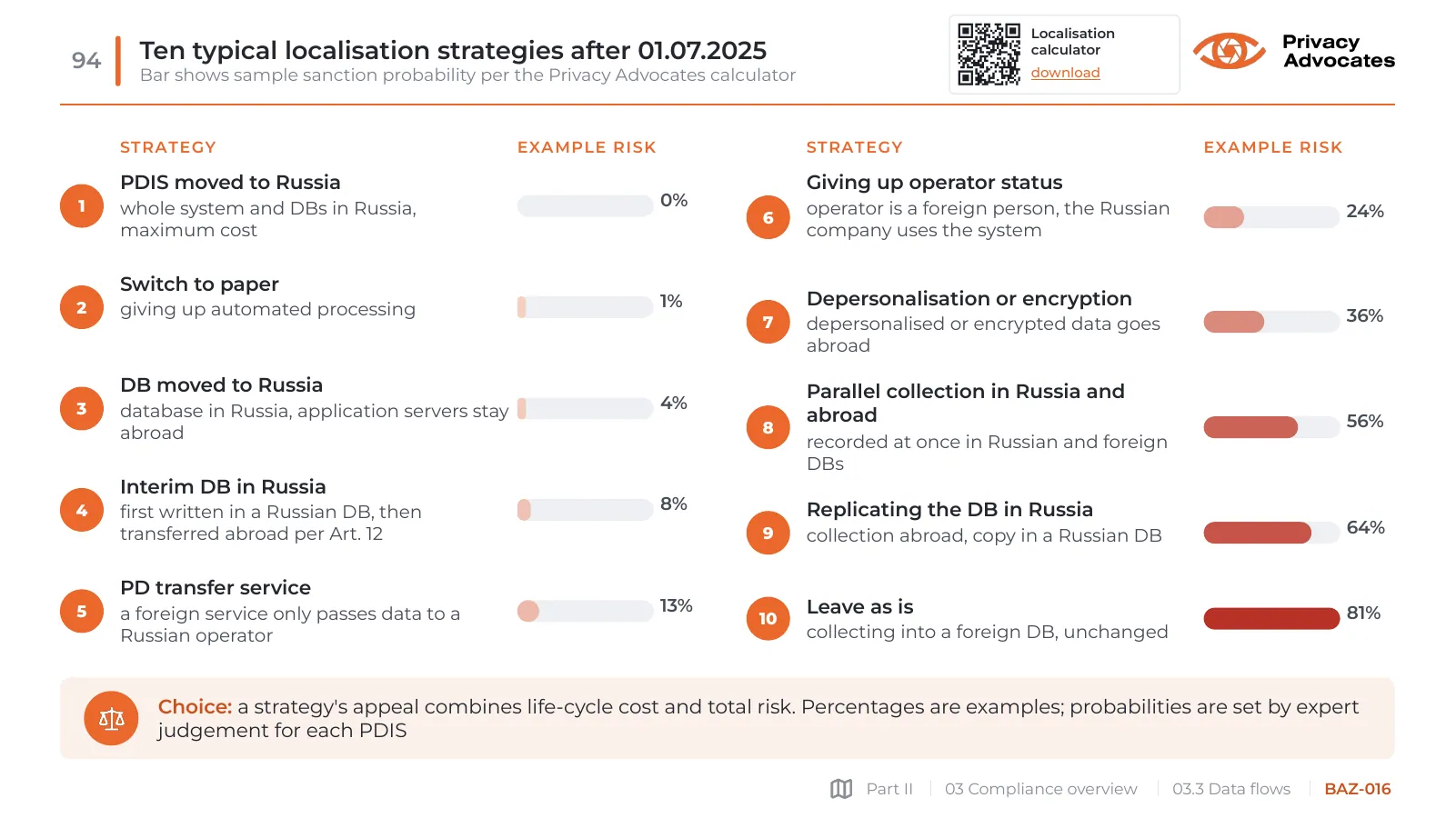
Ten typical localisation strategies after 01.07.2025

Bar shows sample sanction probability per the Privacy Advocates calculator

Slide BAZ-016: Ten typical localisation strategies after 01.07.2025
Slide text
  • Strategy
  • Example risk
  • 1
  • PDIS moved to Russia
  • whole system and DBs in Russia, maximum cost
  • 0%
  • 2
  • Switch to paper
  • giving up automated processing
  • 1%
  • 3
  • DB moved to Russia
  • database in Russia, application servers stay abroad
  • 4%
  • 4
  • Interim DB in Russia
  • first written in a Russian DB, then transferred abroad per Art. 12
  • 8%
  • 5
  • PD transfer service
  • a foreign service only passes data to a Russian operator
  • 13%
  • Strategy
  • Example risk

6

Giving up operator status

  • operator is a foreign person, the Russian company uses the system
  • 24%
  • 7
  • Depersonalisation or encryption
  • depersonalised or encrypted data goes abroad
  • 36%
  • 8
  • Parallel collection in Russia and abroad

recorded at once in Russian and foreign DBs

56%

  • 9
  • Replicating the DB in Russia
  • collection abroad, copy in a Russian DB
  • 64%
  • 10
  • Leave as is

collecting into a foreign DB, unchanged

81%

Choice: a strategy's appeal combines life-cycle cost and total risk. Percentages are examples; probabilities are set by expert judgement for each PDIS

03.4

Storage and destruction

BAZ-017

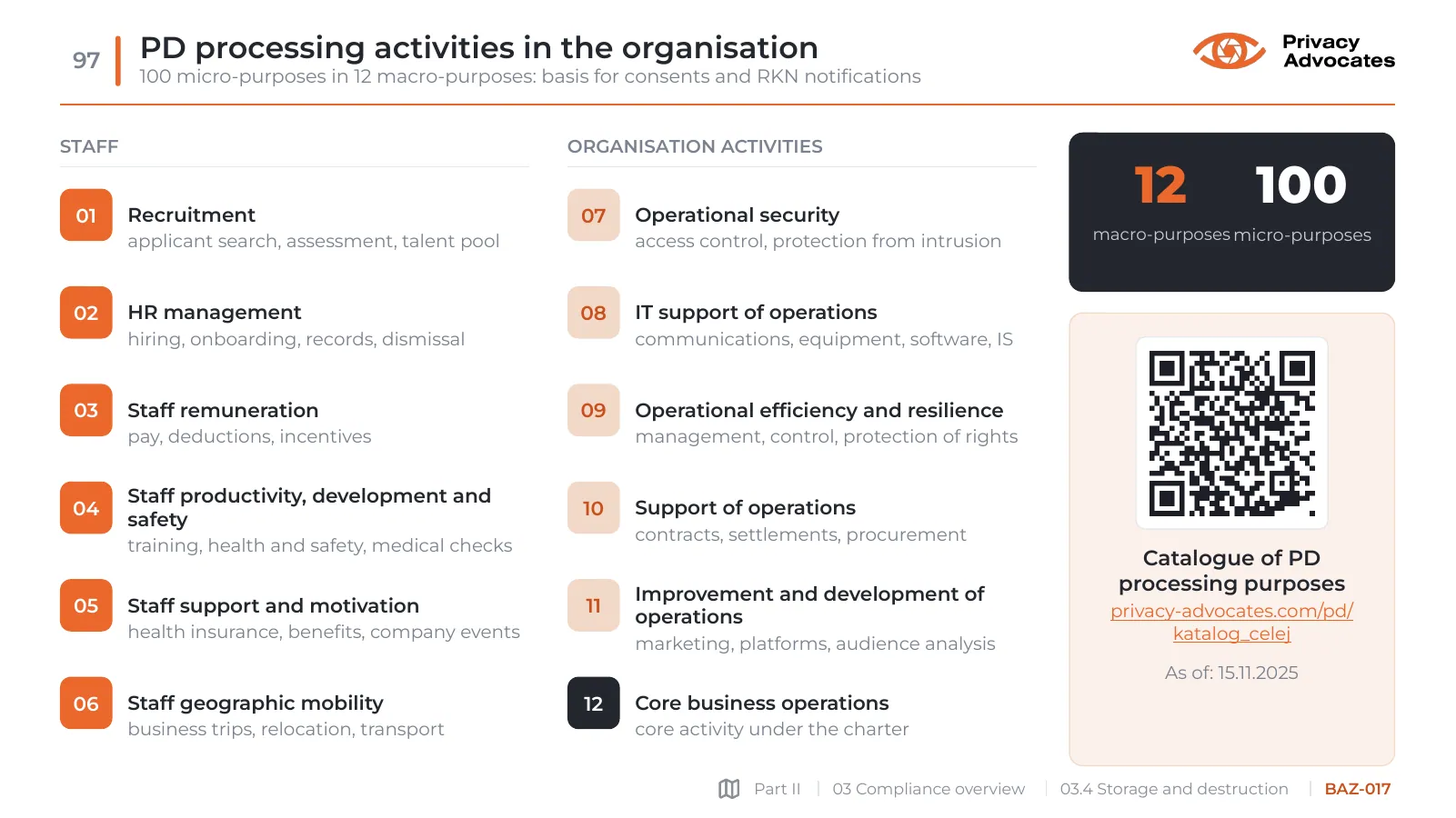
PD processing activities in the organisation

100 micro-purposes in 12 macro-purposes: basis for consents and RKN notifications

Slide BAZ-017: PD processing activities in the organisation
Slide text

STAFF

01

Recruitment

applicant search, assessment, talent pool

02

HR management

hiring, onboarding, records, dismissal

03

Staff remuneration

pay, deductions, incentives

04

Staff productivity, development and safety

training, health and safety, medical checks

05

Staff support and motivation

health insurance, benefits, company events

06

Staff geographic mobility

business trips, relocation, transport

ORGANISATION ACTIVITIES

07

Operational security

access control, protection from intrusion

08

IT support of operations

communications, equipment, software, IS

09

Operational efficiency and resilience

management, control, protection of rights

10

Support of operations

contracts, settlements, procurement

11

Improvement and development of operations

marketing, platforms, audience analysis

12

Core business operations

core activity under the charter

  • 12
  • 100
  • macro-purposes
  • micro-purposes

Catalogue of PD processing purposes

privacy-advocates.com/pd/

katalog_celej

As of: 15.11.2025

BAZ-018

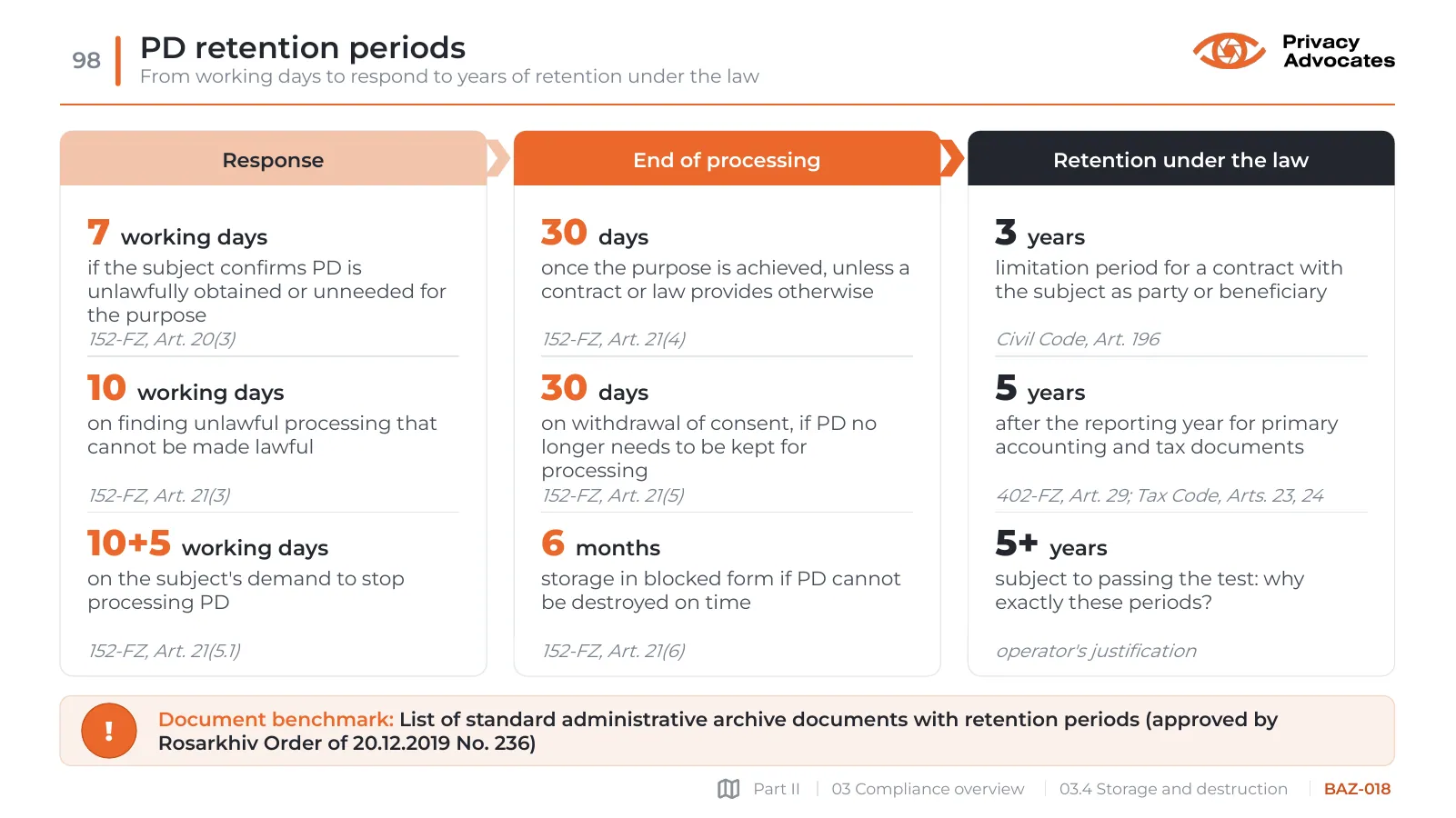
PD retention periods

From working days to respond to years of retention under the law

Slide BAZ-018: PD retention periods
Slide text

Response

7 working days

if the subject confirms PD is unlawfully obtained or unneeded for the purpose

152-FZ, Art. 20(3)

10 working days

on finding unlawful processing that cannot be made lawful

152-FZ, Art. 21(3)

10+5 working days

on the subject's demand to stop processing PD

152-FZ, Art. 21(5.1)

End of processing

30 days

once the purpose is achieved, unless a contract or law provides otherwise

152-FZ, Art. 21(4)

30 days

on withdrawal of consent, if PD no longer needs to be kept for processing

152-FZ, Art. 21(5)

6 months

storage in blocked form if PD cannot be destroyed on time

152-FZ, Art. 21(6)

Retention under the law

3 years

limitation period for a contract with the subject as party or beneficiary

Civil Code, Art. 196

5 years

after the reporting year for primary accounting and tax documents

402-FZ, Art. 29; Tax Code, Arts. 23, 24

5+ years

subject to passing the test: why exactly these periods?

operator's justification

  • !
  • Document benchmark: List of standard administrative archive documents with retention periods (approved by Rosarkhiv Order of 20.12.2019 No. 236)
BAZ-019

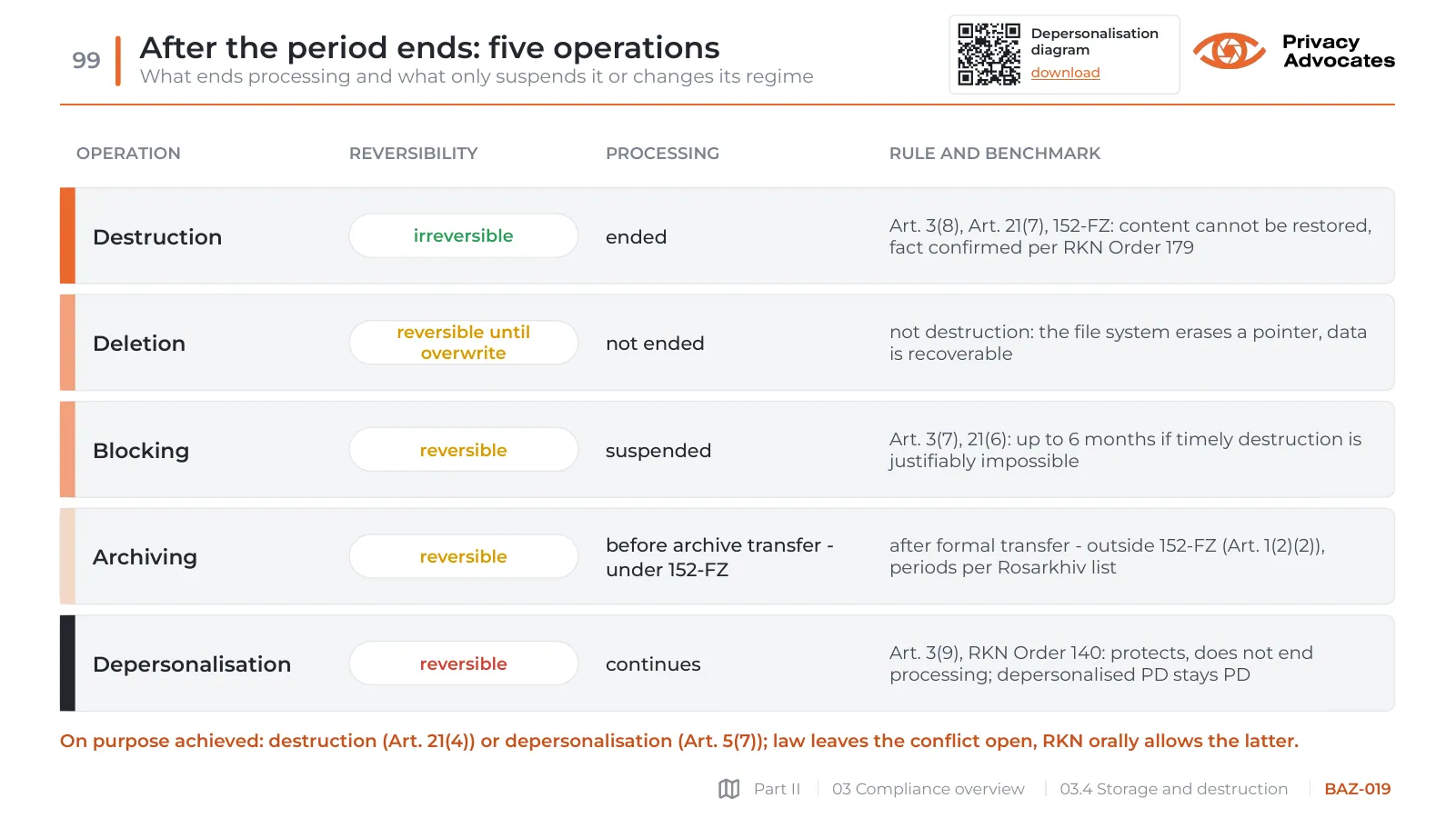
After the period ends: five operations

What ends processing and what only suspends it or changes its regime

Slide BAZ-019: After the period ends: five operations
Slide text
  • OPERATION
  • REVERSIBILITY
  • PROCESSING
  • RULE AND BENCHMARK
  • Destruction
  • irreversible
  • ended
  • Art. 3(8), Art. 21(7), 152-FZ: content cannot be restored, fact confirmed per RKN Order 179
  • Deletion
  • reversible until overwrite
  • not ended
  • not destruction: the file system erases a pointer, data is recoverable
  • Blocking
  • reversible
  • suspended
  • Art. 3(7), 21(6): up to 6 months if timely destruction is justifiably impossible
  • Archiving
  • reversible
  • before archive transfer - under 152-FZ
  • after formal transfer - outside 152-FZ (Art. 1(2)(2)), periods per Rosarkhiv list
  • Depersonalisation
  • reversible
  • continues
  • Art. 3(9), RKN Order 140: protects, does not end processing; depersonalised PD stays PD

On purpose achieved: destruction (Art. 21(4)) or depersonalisation (Art. 5(7)); law leaves the conflict open, RKN orally allows the latter.

BAZ-020

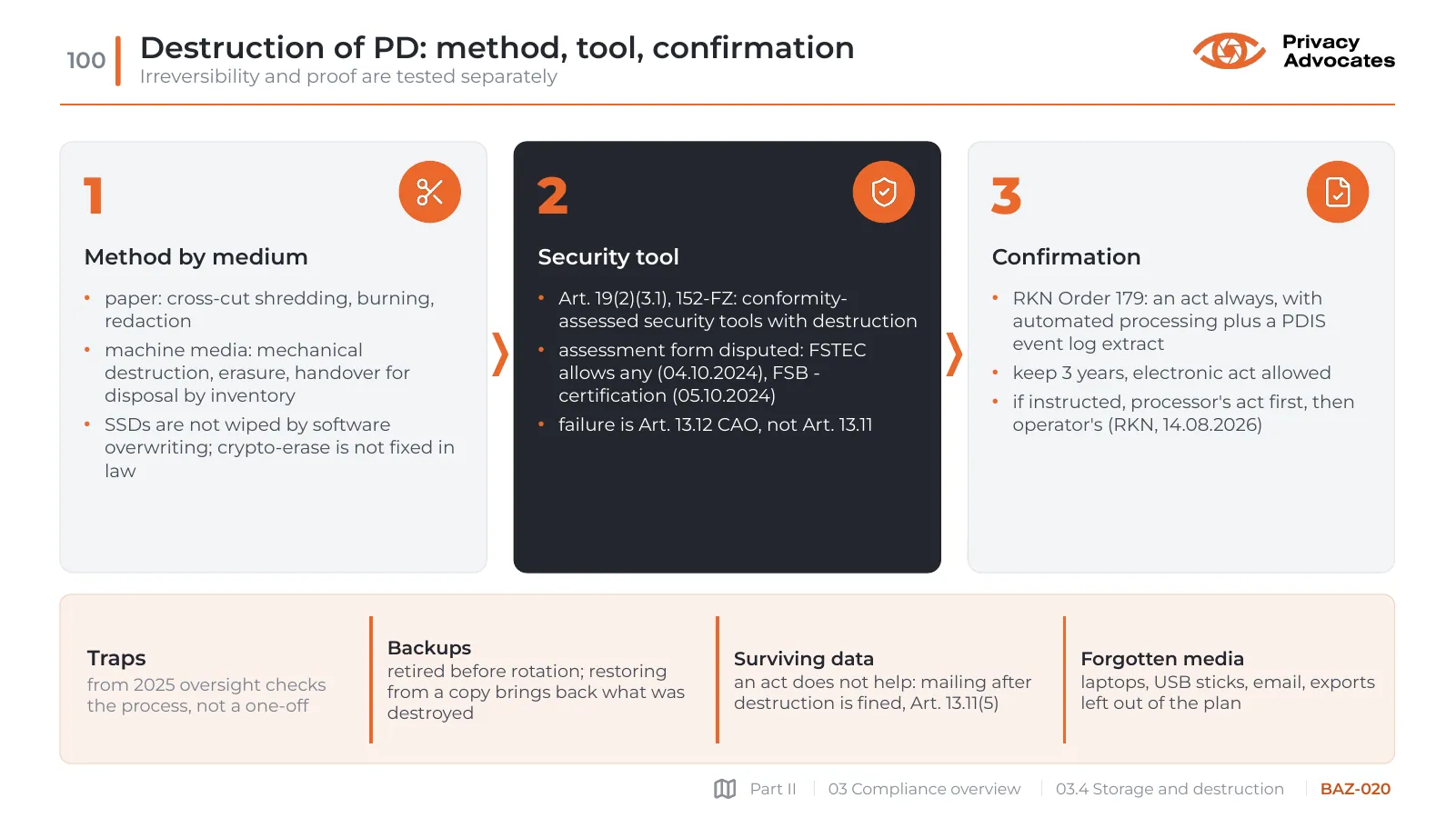
Destruction of PD: method, tool, confirmation

Irreversibility and proof are tested separately

Slide BAZ-020: Destruction of PD: method, tool, confirmation
Slide text

1

Method by medium

paper: cross-cut shredding, burning, redaction

machine media: mechanical destruction, erasure, handover for disposal by inventory

SSDs are not wiped by software overwriting; crypto-erase is not fixed in law

2

Security tool

Art. 19(2)(3.1), 152-FZ: conformity-assessed security tools with destruction

assessment form disputed: FSTEC allows any (04.10.2024), FSB - certification (05.10.2024)

failure is Art. 13.12 CAO, not Art. 13.11

3

Confirmation

RKN Order 179: an act always, with automated processing plus a PDIS event log extract

keep 3 years, electronic act allowed

if instructed, processor's act first, then operator's (RKN, 14.08.2026)

Traps

from 2025 oversight checks the process, not a one-off

Backups

retired before rotation; restoring from a copy brings back what was destroyed

Surviving data

an act does not help: mailing after destruction is fined, Art. 13.11(5)

Forgotten media

laptops, USB sticks, email, exports left out of the plan

03.5

Compliance system

BAZ-021

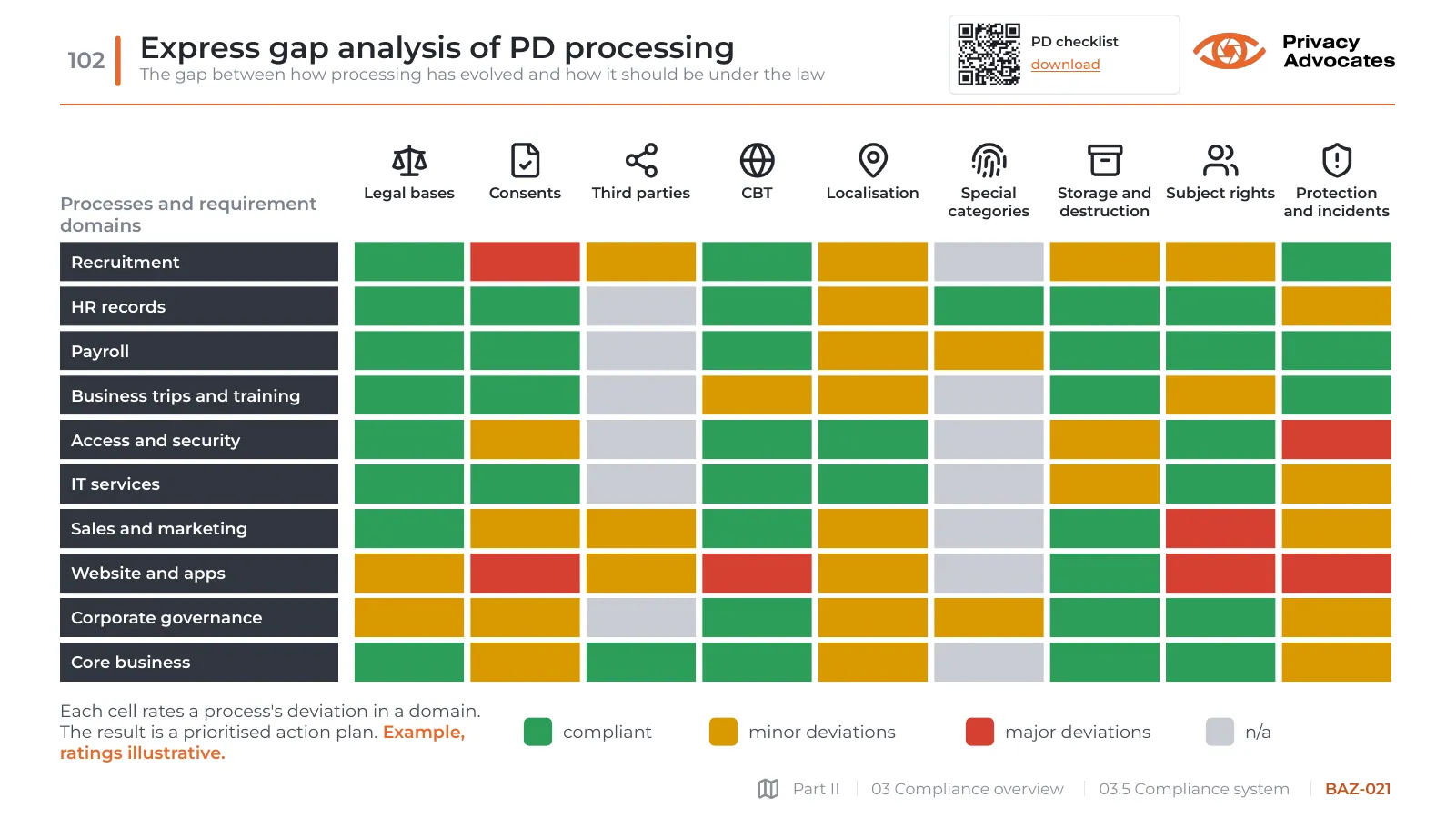
Express gap analysis of PD processing

The gap between how processing has evolved and how it should be under the law

Slide BAZ-021: Express gap analysis of PD processing
Slide text
  • Processes and requirement domains
  • Legal bases
  • Consents
  • Third parties
  • CBT
  • Localisation
  • Special categories
  • Storage and destruction
  • Subject rights
  • Protection and incidents

Recruitment

HR records

Payroll

Business trips and training

Access and security

IT services

Sales and marketing

Website and apps

Corporate governance

Core business

  • Each cell rates a process's deviation in a domain. The result is a prioritised action plan. Example, ratings illustrative.
  • compliant
  • minor deviations
  • major deviations
  • n/a
BAZ-022

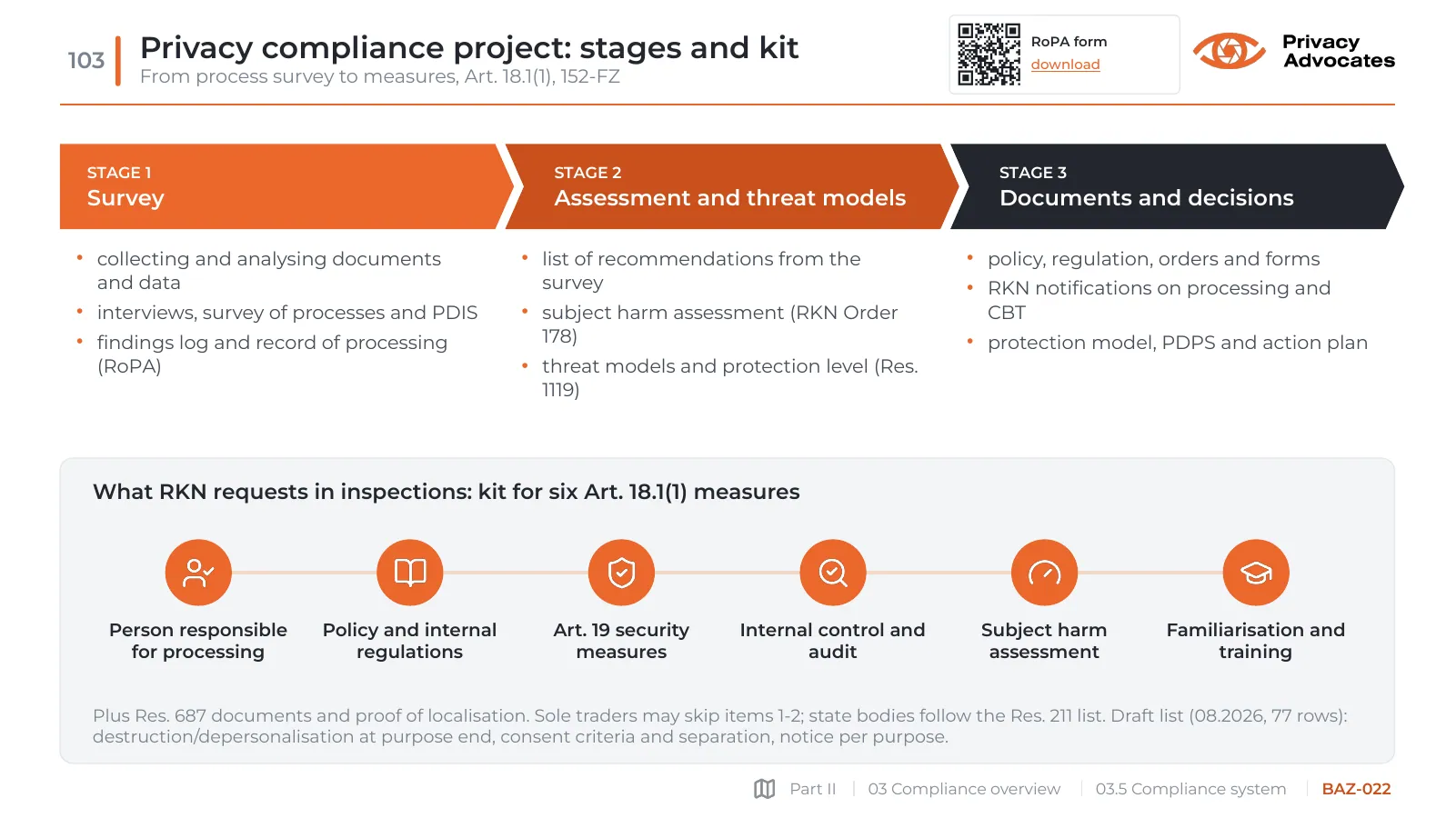
Privacy compliance project: stages and kit

From process survey to measures, Art. 18.1(1), 152-FZ

Slide BAZ-022: Privacy compliance project: stages and kit
Slide text

STAGE 1

Survey

collecting and analysing documents and data

interviews, survey of processes and PDIS

findings log and record of processing (RoPA)

STAGE 2

Assessment and threat models

list of recommendations from the survey

subject harm assessment (RKN Order 178)

threat models and protection level (Res. 1119)

STAGE 3

Documents and decisions

policy, regulation, orders and forms

RKN notifications on processing and CBT

protection model, PDPS and action plan

What RKN requests in inspections: kit for six Art. 18.1(1) measures

  • Person responsible for processing
  • Policy and internal regulations
  • Art. 19 security measures
  • Internal control and audit
  • Subject harm assessment
  • Familiarisation and training

Plus Res. 687 documents and proof of localisation. Sole traders may skip items 1-2; state bodies follow the Res. 211 list. Draft list (08.2026, 77 rows): destruction/depersonalisation at purpose end, consent criteria and separation, notice per purpose.

BAZ-023

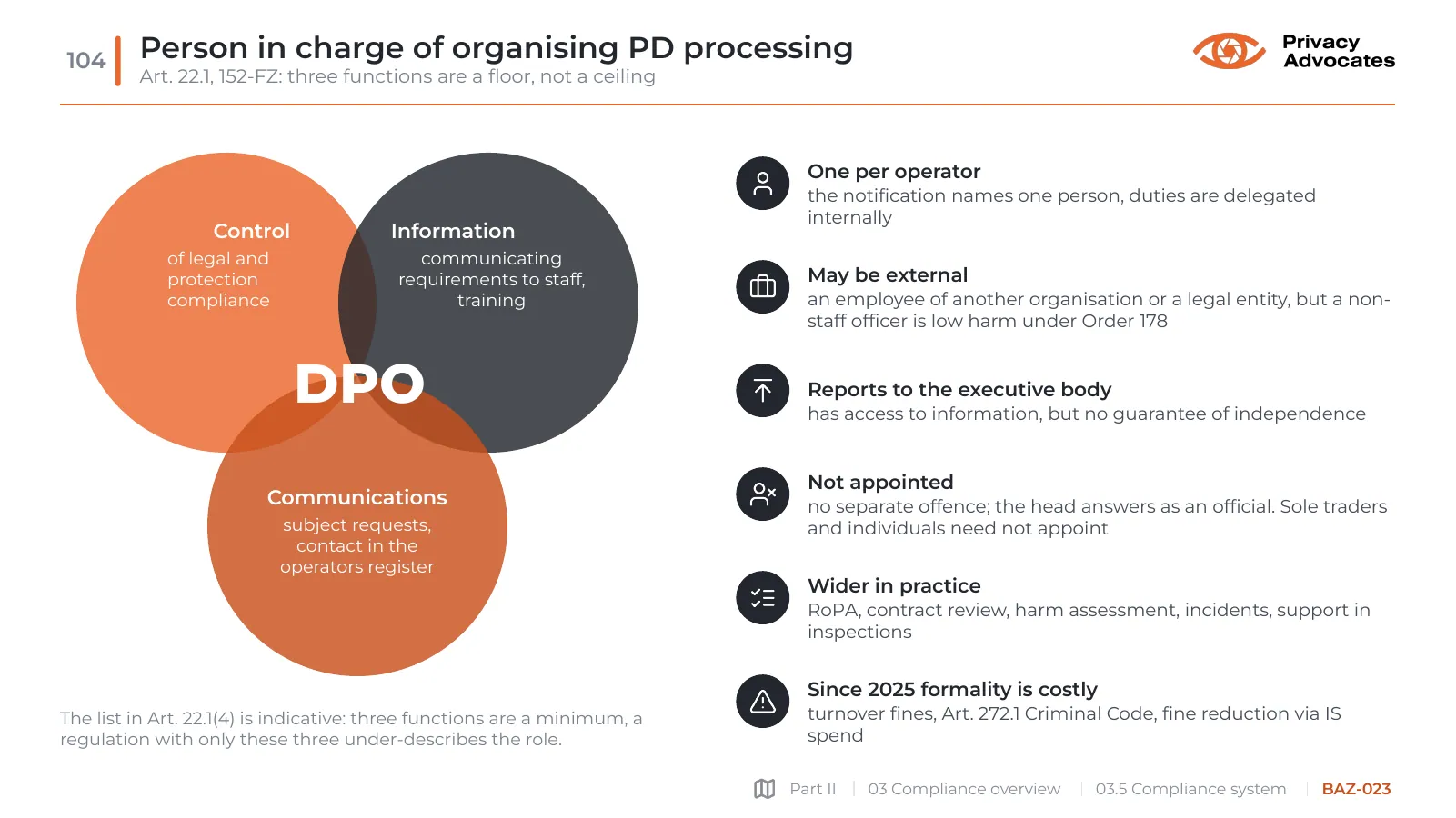
Person in charge of organising PD processing

Art. 22.1, 152-FZ: three functions are a floor, not a ceiling

Slide BAZ-023: Person in charge of organising PD processing
Slide text

Control

of legal and protection compliance

Information

communicating requirements to staff, training

Communications

subject requests, contact in the operators register

DPO

The list in Art. 22.1(4) is indicative: three functions are a minimum, a regulation with only these three under-describes the role.

One per operator

the notification names one person, duties are delegated internally

May be external

an employee of another organisation or a legal entity, but a non-staff officer is low harm under Order 178

Reports to the executive body

has access to information, but no guarantee of independence

Not appointed

no separate offence; the head answers as an official. Sole traders and individuals need not appoint

Wider in practice

RoPA, contract review, harm assessment, incidents, support in inspections

Since 2025 formality is costly

turnover fines, Art. 272.1 Criminal Code, fine reduction via IS spend

BAZ-024

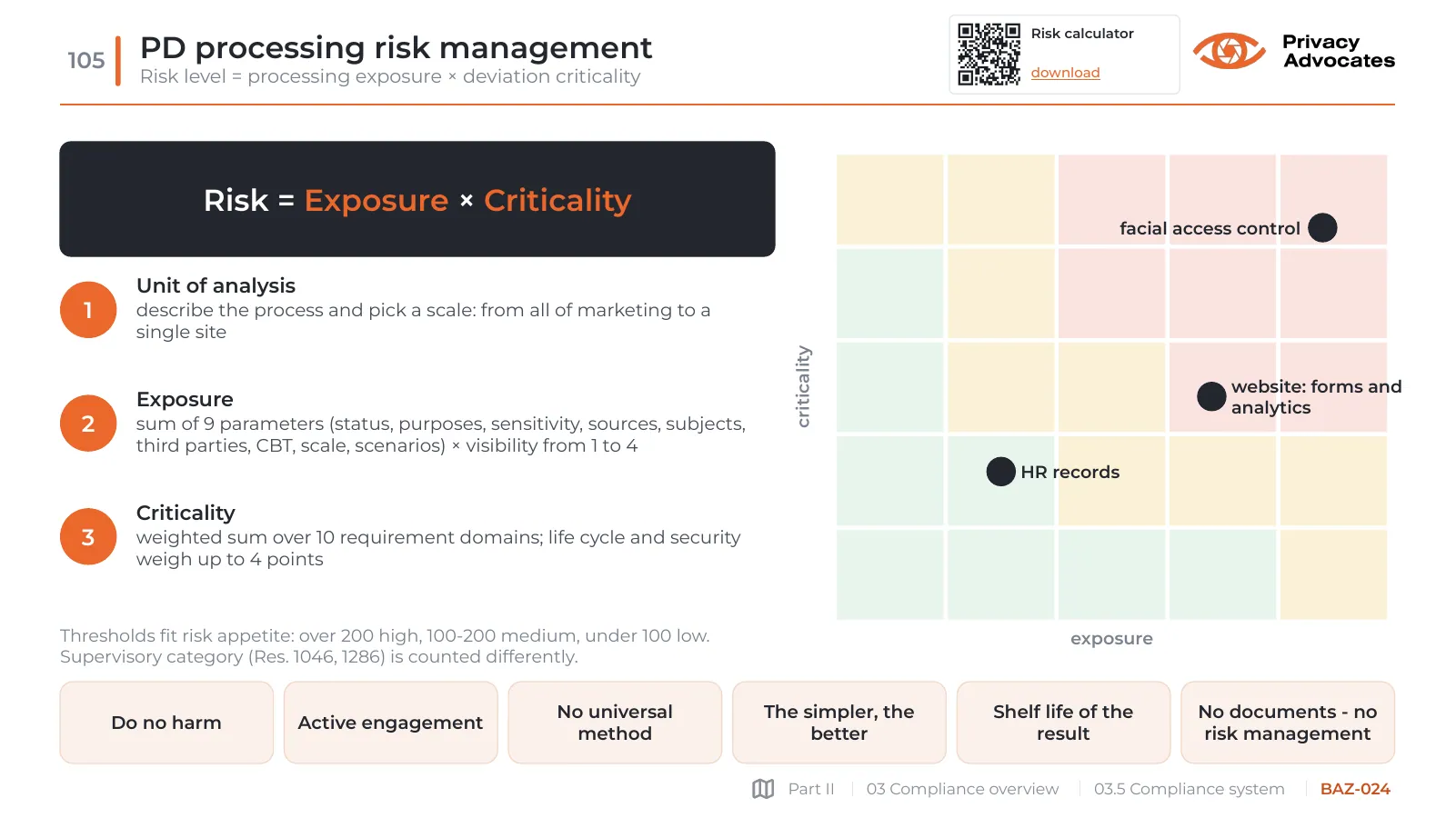
PD processing risk management

Risk level = processing exposure × deviation criticality

Slide BAZ-024: PD processing risk management
Slide text

Risk = Exposure × Criticality

1

Unit of analysis

describe the process and pick a scale: from all of marketing to a single site

2

Exposure

sum of 9 parameters (status, purposes, sensitivity, sources, subjects, third parties, CBT, scale, scenarios) × visibility from 1 to 4

3

Criticality

weighted sum over 10 requirement domains; life cycle and security weigh up to 4 points

  • Thresholds fit risk appetite: over 200 high, 100-200 medium, under 100 low. Supervisory category (Res. 1046, 1286) is counted differently.
  • exposure

criticality

HR records

website: forms and analytics

facial access control

  • Do no harm
  • Active engagement
  • No universal method
  • The simpler, the better
  • Shelf life of the result
  • No documents - no risk management
BAZ-025

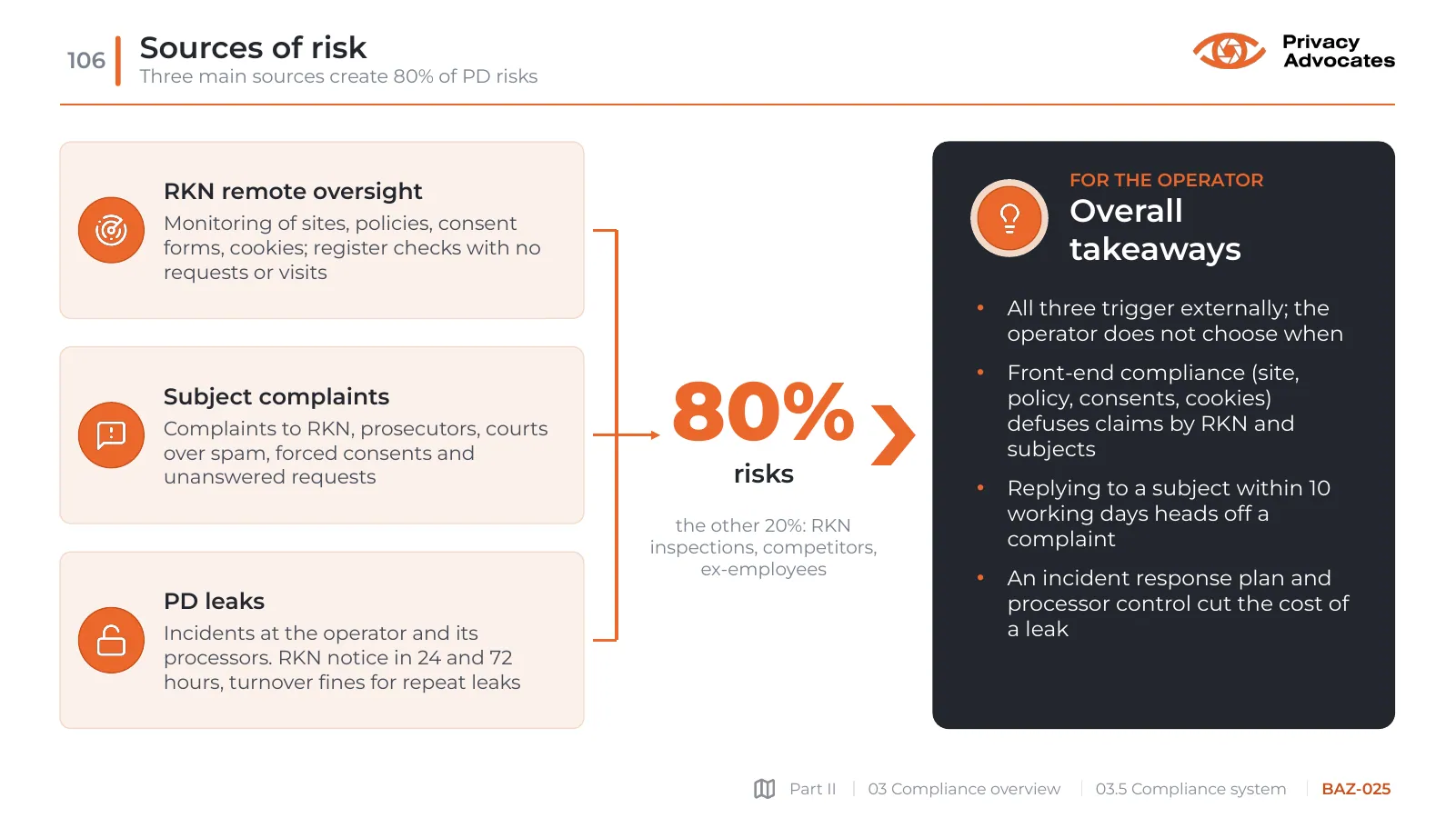
Sources of risk

Three main sources create 80% of PD risks

Slide BAZ-025: Sources of risk
Slide text

RKN remote oversight

Monitoring of sites, policies, consent forms, cookies; register checks with no requests or visits

Subject complaints

Complaints to RKN, prosecutors, courts over spam, forced consents and unanswered requests

PD leaks

Incidents at the operator and its processors. RKN notice in 24 and 72 hours, turnover fines for repeat leaks

80%

risks

FOR THE OPERATOR

Overall takeaways

All three trigger externally; the operator does not choose when

Front-end compliance (site, policy, consents, cookies) defuses claims by RKN and subjects

Replying to a subject within 10 working days heads off a complaint

An incident response plan and processor control cut the cost of a leak

the other 20%: RKN inspections, competitors, ex-employees

BAZ-026

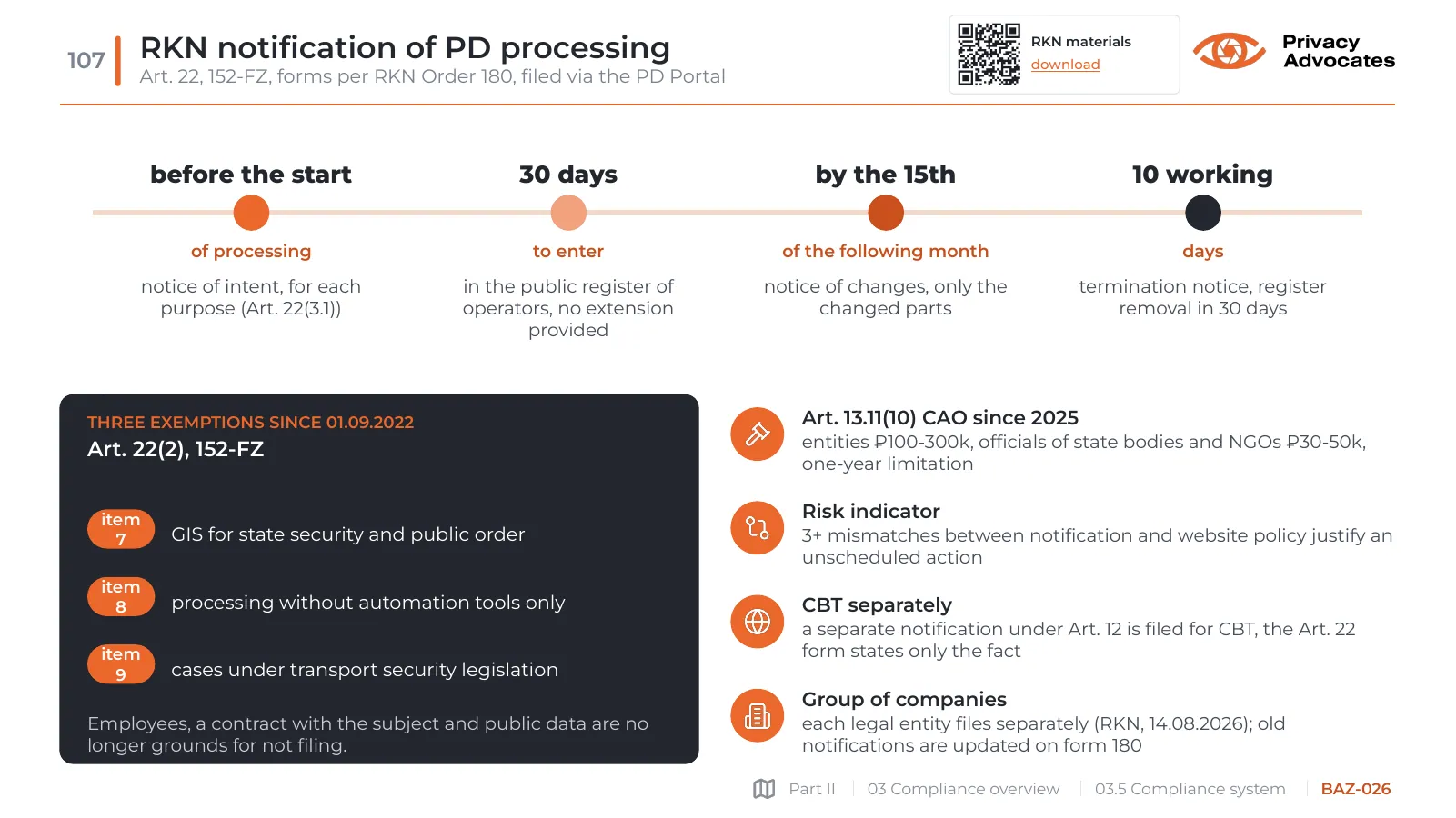
RKN notification of PD processing

Art. 22, 152-FZ, forms per RKN Order 180, filed via the PD Portal

Slide BAZ-026: RKN notification of PD processing
Slide text

before the start

of processing

notice of intent, for each purpose (Art. 22(3.1))

30 days

to enter

in the public register of operators, no extension provided

by the 15th

of the following month

notice of changes, only the changed parts

10 working

days

termination notice, register removal in 30 days

THREE EXEMPTIONS SINCE 01.09.2022

Art. 22(2), 152-FZ

  • item 7
  • GIS for state security and public order
  • item 8
  • processing without automation tools only
  • item 9
  • cases under transport security legislation

Employees, a contract with the subject and public data are no longer grounds for not filing.

Art. 13.11(10) CAO since 2025

entities ₽100-300k, officials of state bodies and NGOs ₽30-50k, one-year limitation

Risk indicator

3+ mismatches between notification and website policy justify an unscheduled action

CBT separately

a separate notification under Art. 12 is filed for CBT, the Art. 22 form states only the fact

Group of companies

each legal entity files separately (RKN, 14.08.2026); old notifications are updated on form 180

03.6

Incidents and liability

BAZ-027

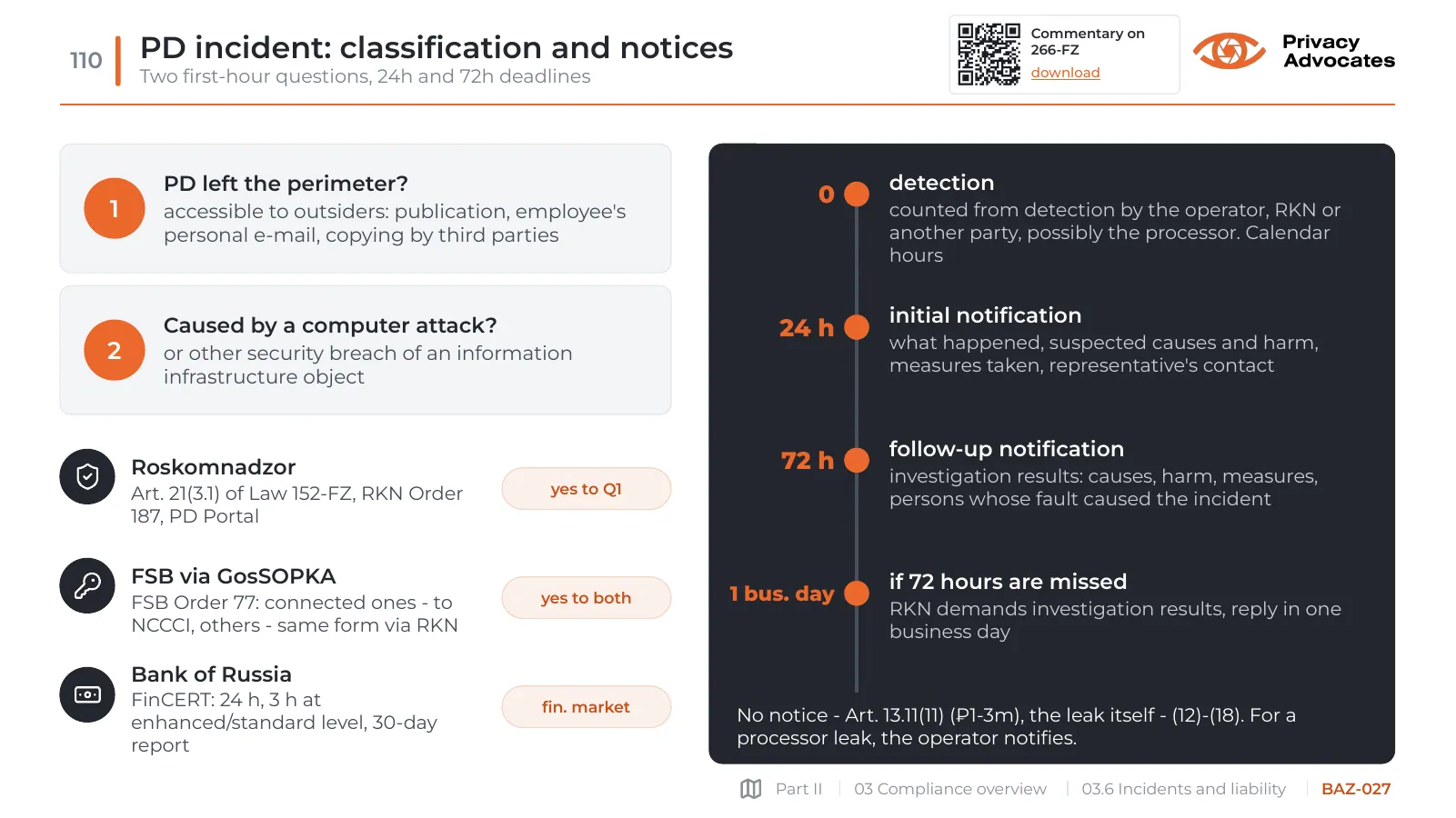
PD incident: classification and notices

Two first-hour questions, 24h and 72h deadlines

Slide BAZ-027: PD incident: classification and notices
Slide text

1

PD left the perimeter?

accessible to outsiders: publication, employee's personal e-mail, copying by third parties

2

Caused by a computer attack?

or other security breach of an information infrastructure object

Roskomnadzor

Art. 21(3.1) of Law 152-FZ, RKN Order 187, PD Portal

yes to Q1

FSB via GosSOPKA

FSB Order 77: connected ones - to NCCCI, others - same form via RKN

yes to both

Bank of Russia

FinCERT: 24 h, 3 h at enhanced/standard level, 30-day report

fin. market

0

detection

counted from detection by the operator, RKN or another party, possibly the processor. Calendar hours

24 h

initial notification

what happened, suspected causes and harm, measures taken, representative's contact

72 h

follow-up notification

investigation results: causes, harm, measures, persons whose fault caused the incident

1 bus. day

if 72 hours are missed

RKN demands investigation results, reply in one business day

No notice - Art. 13.11(11) (₽1-3m), the leak itself - (12)-(18). For a processor leak, the operator notifies.

BAZ-028

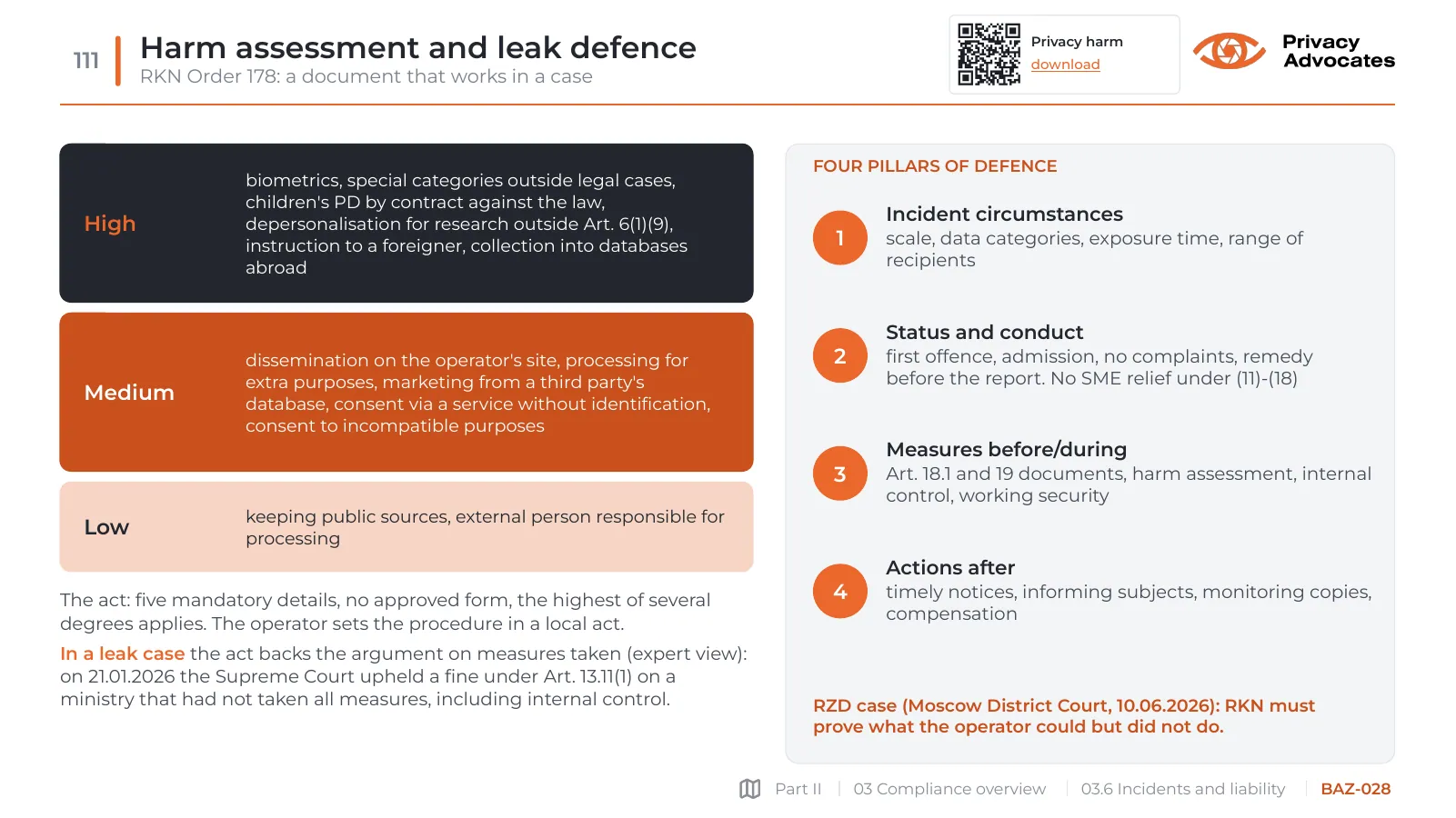
Harm assessment and leak defence

RKN Order 178: a document that works in a case

Slide BAZ-028: Harm assessment and leak defence
Slide text

High

biometrics, special categories outside legal cases, children's PD by contract against the law, depersonalisation for research outside Art. 6(1)(9), instruction to a foreigner, collection into databases abroad

Medium

dissemination on the operator's site, processing for extra purposes, marketing from a third party's database, consent via a service without identification, consent to incompatible purposes

  • Low
  • keeping public sources, external person responsible for processing

The act: five mandatory details, no approved form, the highest of several degrees applies. The operator sets the procedure in a local act.

In a leak case the act backs the argument on measures taken (expert view): on 21.01.2026 the Supreme Court upheld a fine under Art. 13.11(1) on a ministry that had not taken all measures, including internal control.

FOUR PILLARS OF DEFENCE

1

Incident circumstances

scale, data categories, exposure time, range of recipients

2

Status and conduct

first offence, admission, no complaints, remedy before the report. No SME relief under (11)-(18)

3

Measures before/during

Art. 18.1 and 19 documents, harm assessment, internal control, working security

4

Actions after

timely notices, informing subjects, monitoring copies, compensation

RZD case (Moscow District Court, 10.06.2026): RKN must prove what the operator could but did not do.

BAZ-029

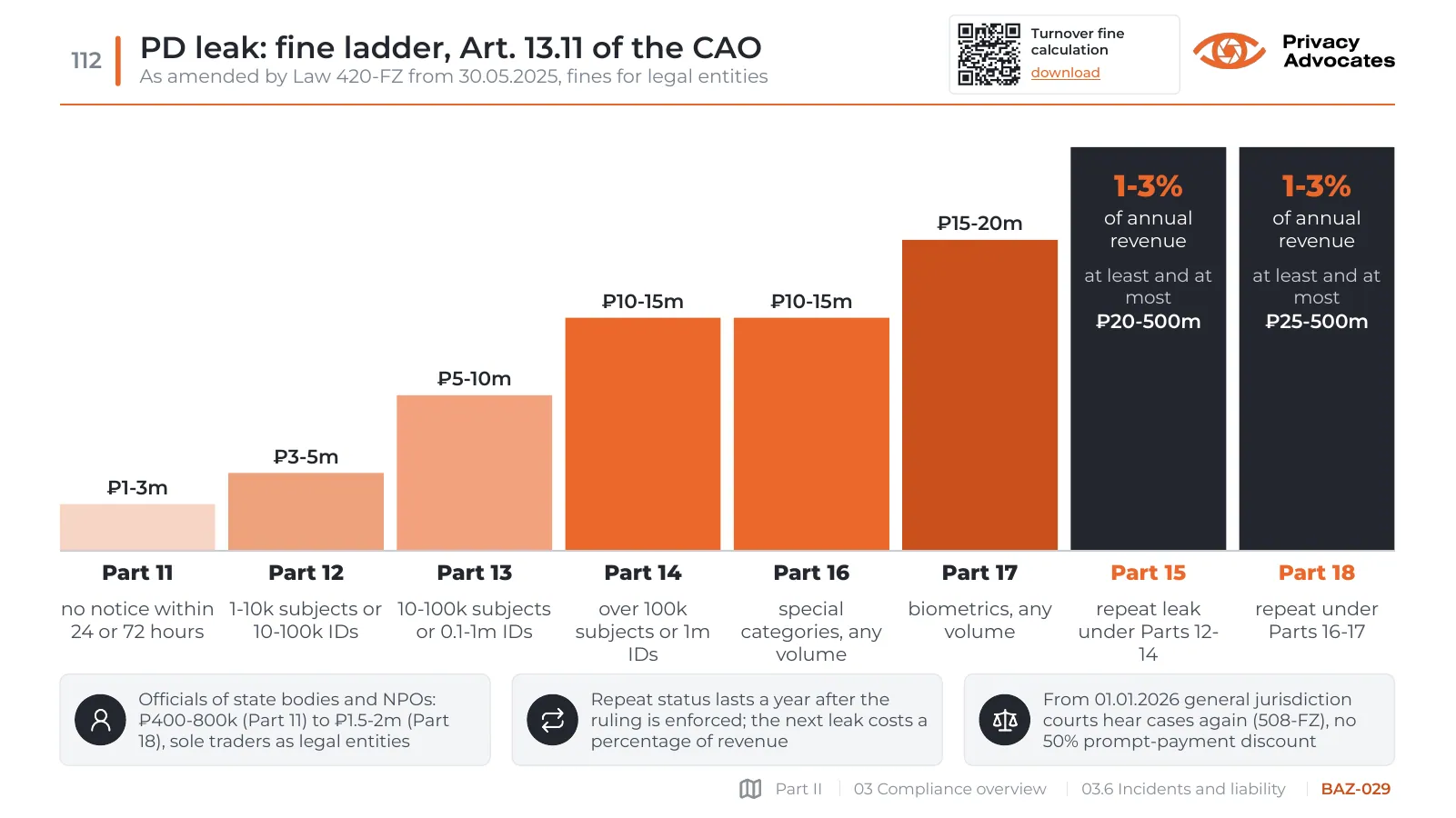
PD leak: fine ladder, Art. 13.11 of the CAO

As amended by Law 420-FZ from 30.05.2025, fines for legal entities

Slide BAZ-029: PD leak: fine ladder, Art. 13.11 of the CAO
Slide text

₽1-3m

Part 11

no notice within 24 or 72 hours

₽3-5m

Part 12

1-10k subjects or 10-100k IDs

₽5-10m

Part 13

10-100k subjects or 0.1-1m IDs

₽10-15m

Part 14

over 100k subjects or 1m IDs

₽10-15m

Part 16

special categories, any volume

₽15-20m

Part 17

biometrics, any volume

1-3%

of annual revenue

at least and at most

₽20-500m

Part 15

repeat leak under Parts 12-14

1-3%

of annual revenue

at least and at most

₽25-500m

Part 18

repeat under Parts 16-17

  • Officials of state bodies and NPOs: ₽400-800k (Part 11) to ₽1.5-2m (Part 18), sole traders as legal entities
  • Repeat status lasts a year after the ruling is enforced; the next leak costs a percentage of revenue
  • From 01.01.2026 general jurisdiction courts hear cases again (508-FZ), no 50% prompt-payment discount
BAZ-030

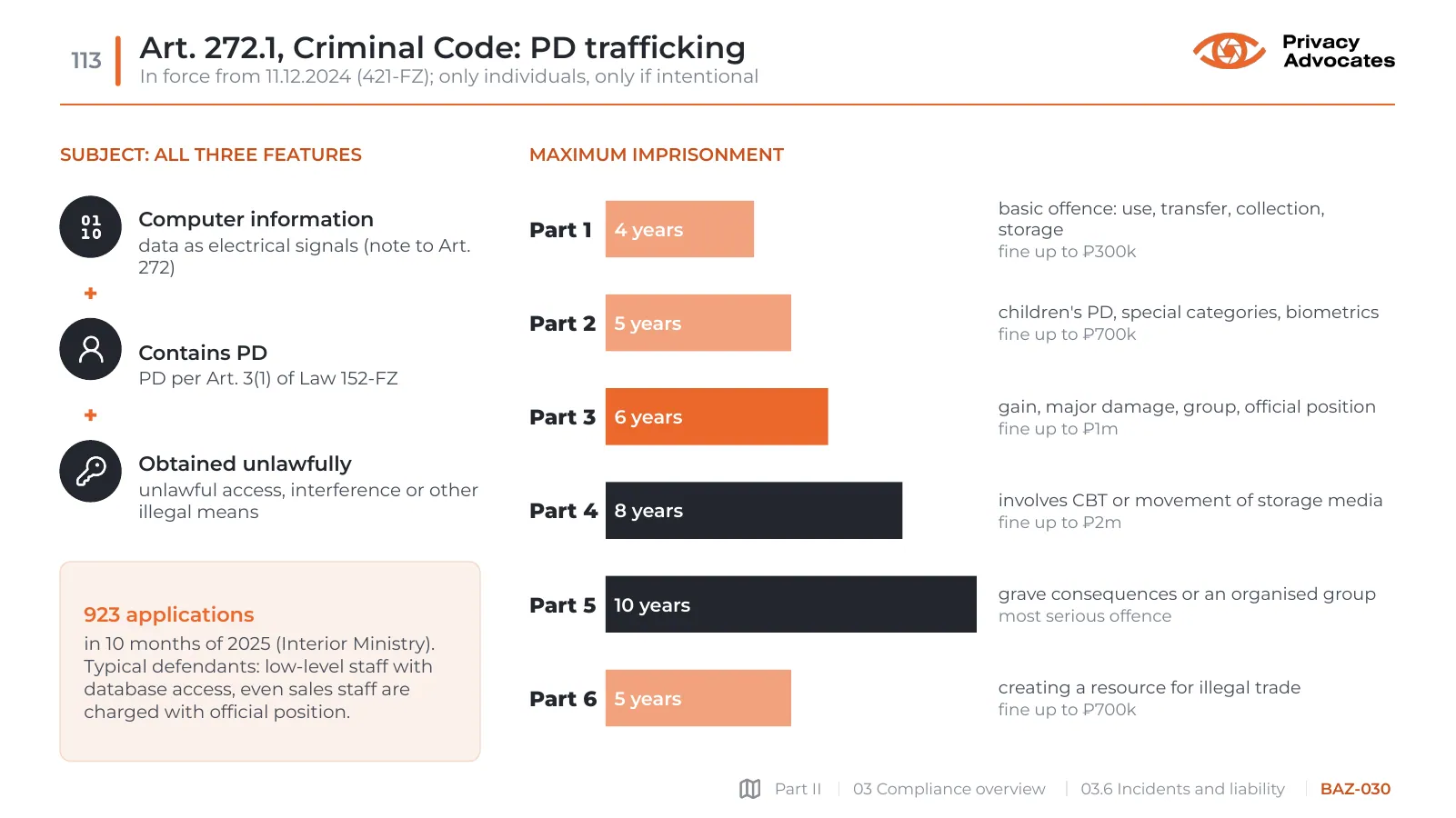
Art. 272.1, Criminal Code: PD trafficking

In force from 11.12.2024 (421-FZ); only individuals, only if intentional

Slide BAZ-030: Art. 272.1, Criminal Code: PD trafficking
Slide text

SUBJECT: ALL THREE FEATURES

Computer information

data as electrical signals (note to Art. 272)

+

Contains PD

PD per Art. 3(1) of Law 152-FZ

+

Obtained unlawfully

unlawful access, interference or other illegal means

923 applications

in 10 months of 2025 (Interior Ministry). Typical defendants: low-level staff with database access, even sales staff are charged with official position.

MAXIMUM IMPRISONMENT

  • Part 1
  • 4 years

basic offence: use, transfer, collection, storage

fine up to ₽300k

  • Part 2
  • 5 years

children's PD, special categories, biometrics

fine up to ₽700k

  • Part 3
  • 6 years

gain, major damage, group, official position

fine up to ₽1m

  • Part 4
  • 8 years

involves CBT or movement of storage media

fine up to ₽2m

  • Part 5
  • 10 years

grave consequences or an organised group

most serious offence

  • Part 6
  • 5 years

creating a resource for illegal trade

fine up to ₽700k

BAZ-031

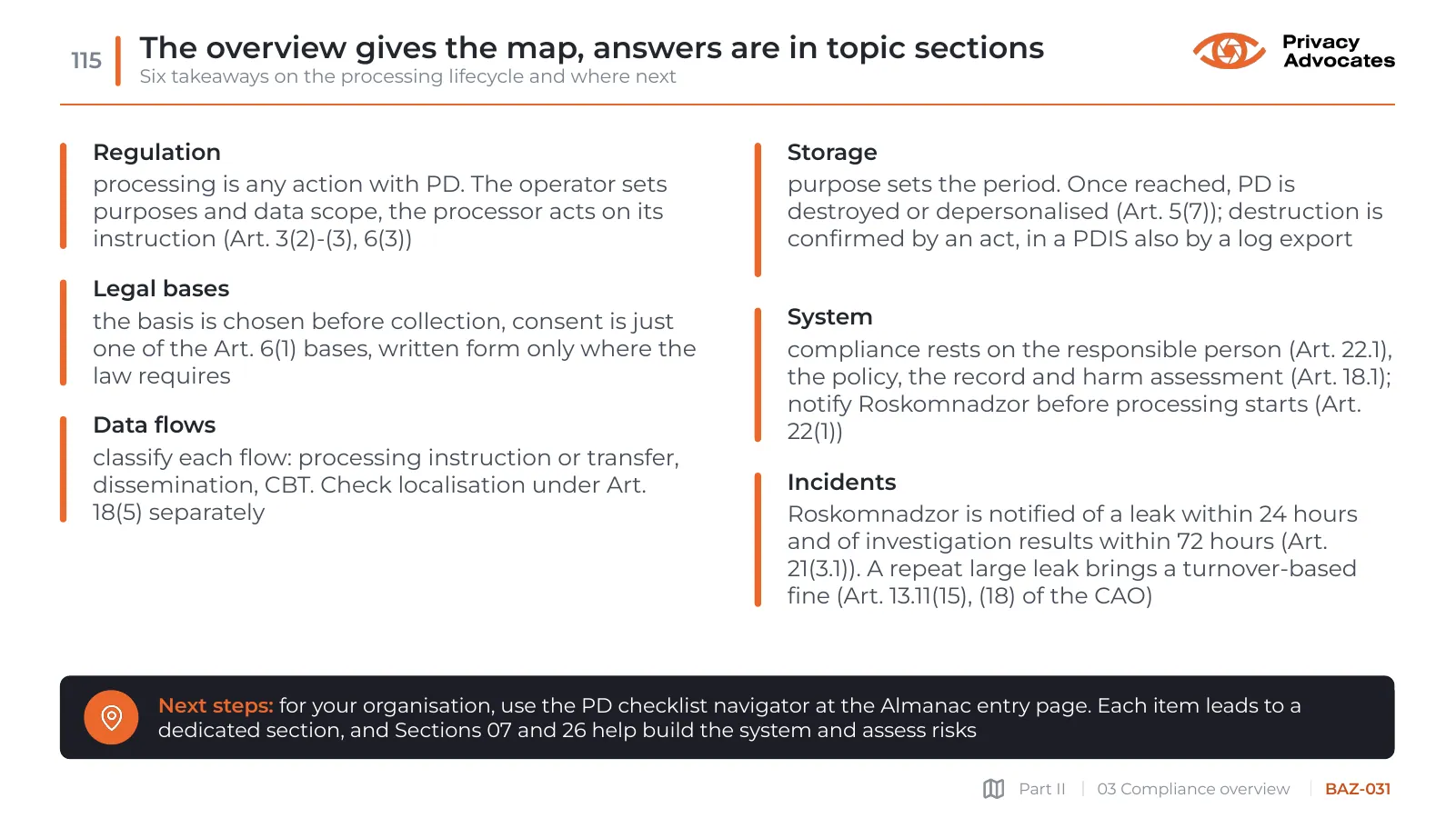
The overview gives the map, answers are in topic sections

Six takeaways on the processing lifecycle and where next

Slide BAZ-031: The overview gives the map, answers are in topic sections
Slide text

Regulation

processing is any action with PD. The operator sets purposes and data scope, the processor acts on its instruction (Art. 3(2)-(3), 6(3))

Legal bases

the basis is chosen before collection, consent is just one of the Art. 6(1) bases, written form only where the law requires

Data flows

classify each flow: processing instruction or transfer, dissemination, CBT. Check localisation under Art. 18(5) separately

Storage

purpose sets the period. Once reached, PD is destroyed or depersonalised (Art. 5(7)); destruction is confirmed by an act, in a PDIS also by a log export

System

compliance rests on the responsible person (Art. 22.1), the policy, the record and harm assessment (Art. 18.1); notify Roskomnadzor before processing starts (Art. 22(1))

Incidents

Roskomnadzor is notified of a leak within 24 hours and of investigation results within 72 hours (Art. 21(3.1)). A repeat large leak brings a turnover-based fine (Art. 13.11(15), (18) of the CAO)

Next steps: for your organisation, use the PD checklist navigator at the Almanac entry page. Each item leads to a dedicated section, and Sections 07 and 26 help build the system and assess risks